iROCKER Paddle Board Review: Blackfin Model X, Cruiser, and All Around Compared
An honest, deep-dive look at three of iROCKER’s most popular inflatable stand up paddle boards — who each one is built for, how they perform on the water, and which model actually deserves a spot in your garage.
Why iROCKER Boards Stand Out in a Crowded Market
Inflatable paddle boards have exploded in popularity over the last several years, and with that growth has come a flood of forgettable, thin-walled boards that flex underfoot and lose air pressure within a season. iROCKER built its reputation by refusing to cut corners on core construction, and that reputation is the reason so many paddlers researching their first — or fifth — board keep landing on this brand.
In this review, we’re breaking down three distinct boards in the iROCKER lineup: the performance-oriented Blackfin Model X 7.0, the family-friendly Cruiser 8.0, and the do-everything All Around 11 8.0. Each one targets a different kind of paddler, and by the end of this guide you should have a clear sense of which board actually matches how you paddle, not just which one has the flashiest marketing photos.
If you’re still deciding whether an inflatable is even the right category for you, our guide on the difference between SUP boards and traditional paddle boards is worth a read before diving into model-specific comparisons.
What sets iROCKER apart isn’t a single headline feature — it’s the consistency across the lineup. Whether you land on the performance-oriented Blackfin, the beginner-friendly Cruiser, or the do-it-all All Around, you’re getting the same underlying build philosophy applied to three different shapes. That consistency is exactly why this brand keeps showing up at the top of independent comparison guides rather than just its own marketing pages.
How We Evaluated These Boards
Rather than relying purely on spec sheets, this review weighs the factors that actually change how a board feels on the water: rigidity under load, tracking in wind and chop, how quickly the board plane sits at rest, and how the accessory package holds up to repeated use. We also looked closely at construction quality, since that’s the single biggest predictor of how long an inflatable board will last — a topic we go into more detail on in our piece about how paddle boards are made.
We also factored in board type classification, since a touring-shaped board and a wide all-around board serve very different paddling styles. For a broader primer on the categories these boards fall into, see our breakdown of paddle board types.
Beyond raw performance, we paid attention to details that only reveal themselves after repeated use rather than a single test paddle: how the deck pad holds up to sunscreen and saltwater exposure, whether the included pump maintains a reliable seal after dozens of inflation cycles, and how easily each board rolls back down for storage after a full day of use. These are the details that separate a board you’ll still enjoy using two seasons from now from one that quietly becomes a chore to set up and pack away.
Finally, we weighed each board’s accessory package and overall value against its price point, since a board’s true cost of ownership includes everything you’d otherwise need to buy separately — pump, paddle, leash, and carry bag — if those weren’t already included.
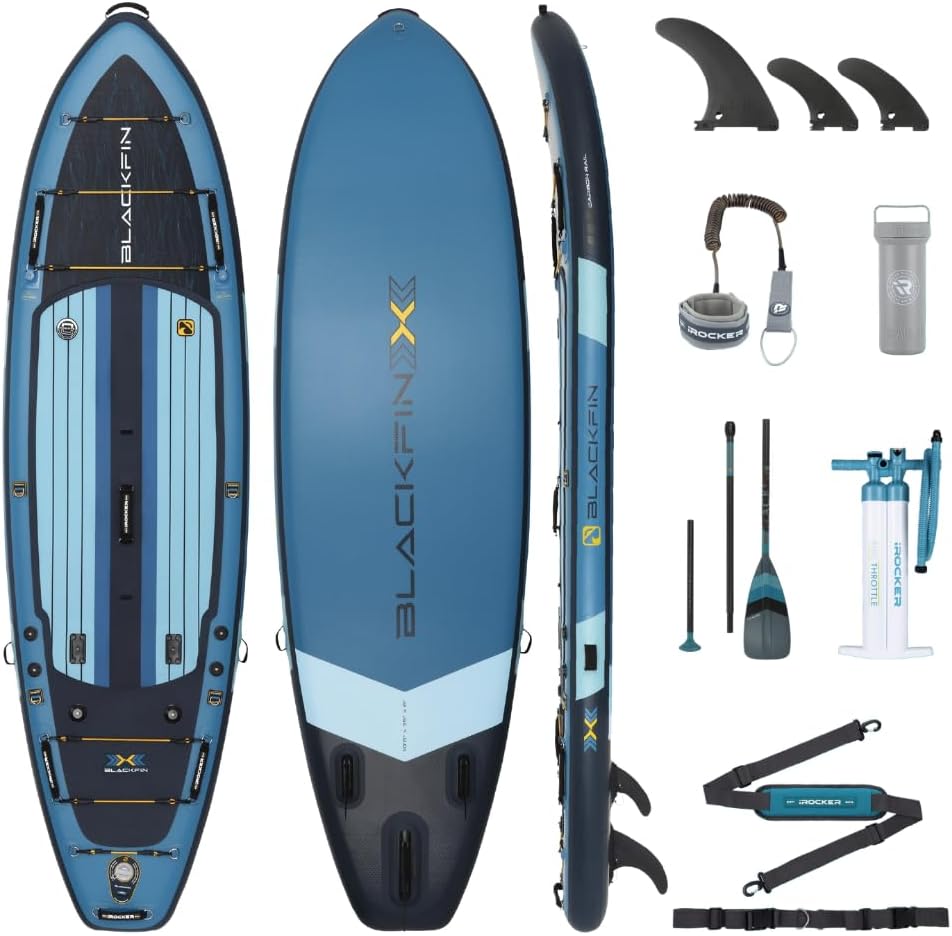
iROCKER Blackfin Model X 7.0 Inflatable Stand Up Paddle Board
The Blackfin Model X 7.0 is iROCKER’s answer to paddlers who want more glide, more speed, and a board that rewards a stronger stroke. Unlike wider recreational boards, the Blackfin trims down its rail width to cut through chop more efficiently, which makes it noticeably faster over long, flat stretches of water.
On-Water Performance
The narrower profile means the Blackfin Model X 7.0 does ask a bit more of your balance in the first few sessions, especially if you’re coming from a wide recreational board. Once you find your footing, though, the tradeoff pays off: the board tracks straighter with less correction paddling, holds speed through glide phases, and feels noticeably livelier when you pick up your cadence. Riders who log miles rather than casually float around a cove will feel the difference almost immediately.
Stability
Stability is respectable for a performance-shaped board but is clearly not its primary design goal. Paddlers under roughly 200 lbs with some balance experience will feel confident within a session or two. Complete beginners, or anyone planning to bring along a dog or small child, will likely find the All Around or Cruiser more forgiving.
Build Quality
Like the rest of the iROCKER catalog, the Blackfin Model X 7.0 uses military-grade PVC construction with drop-stitch core technology, which keeps the deck rigid even at lower pump pressures than cheaper competitor boards require. This rigidity is a big part of why the board can maintain its speed advantage — a soft, flexing deck bleeds paddle energy instead of converting it into forward motion.
Who Should Actually Buy This Board
The Blackfin Model X 7.0 makes the most sense for paddlers who already have a season or two of experience under their belt, or anyone coming from a background in surfing, skateboarding, or another balance-heavy sport. If your idea of a good paddling session is covering distance rather than floating in place, this board’s shape rewards exactly that kind of paddling. It’s also a strong pick for anyone training for a longer event, since the extra glide efficiency means you can maintain a faster average pace for the same amount of effort compared to a wider recreational board.
On the other hand, if your paddling plans mostly involve calm afternoons with a drink in the cup holder and minimal risk of falling in, the added speed of the Blackfin won’t matter nearly as much as the extra stability you’d get from the Cruiser or All Around. It’s worth being honest with yourself about which category you fall into before committing to the narrower stance.
Real-World Handling Notes
In light wind, the Blackfin Model X 7.0 holds its line with minimal correction strokes, which is a meaningful quality-of-life improvement on longer paddles — nobody wants to fight a wandering board for an hour straight. In choppier conditions, the narrower rails do cut through wakes and small waves more cleanly than a flat, wide deck would, though this comes with the tradeoff of the board feeling a bit more reactive underfoot when a wake hits at an angle.
Turning radius is tighter than you might expect from a board built for straight-line speed, which makes it reasonably practical for exploring shoreline or navigating around obstacles without feeling like you’re piloting something unwieldy.
Check Price on Amazon
Pros
- Faster glide and better tracking than typical all-around boards
- Rigid drop-stitch core resists flex under paddle power
- Great for fitness paddling and longer-distance sessions
Cons
- Narrower stance takes some adjustment for beginners
- Less forgiving with kids or pets aboard
iROCKER Cruiser 8.0 Inflatable Stand Up Paddle Board

The Cruiser 8.0 leans into stability and comfort over outright speed, which makes it the pick for paddlers who want an easygoing afternoon on the water rather than a workout. Its wider deck and generous volume translate into a board that feels planted from the moment you stand up.
On-Water Performance
Where the Blackfin rewards a strong stroke, the Cruiser 8.0 rewards patience — it glides steadily, holds a line well in light wind, and doesn’t punish minor footwork mistakes the way narrower boards do. This makes it an easy recommendation for anyone paddling with kids, dogs, or a cooler strapped to the deck.
Stability
This is where the Cruiser 8.0 really separates itself. The wider rail-to-rail profile creates a noticeably larger stability envelope, so first-time paddlers spend less time wobbling and more time actually paddling. It’s a natural fit for family outings, yoga sessions, or slow exploration of calm lakes and bays.
Build Quality
The Cruiser 8.0 shares the same fused-layer PVC and drop-stitch approach used across the iROCKER lineup, which means it holds air well and resists the sagging some cheaper inflatables develop after a season of use. For more on what determines how long an inflatable board actually lasts, our guide on how long inflatable paddle boards last covers the construction details that matter most.
Who Should Actually Buy This Board
The Cruiser 8.0 is the board we’d point almost any first-time buyer toward, especially households where more than one person — with more than one skill level — will be using it. New paddlers get a much shorter learning curve on a wide, stable deck, and experienced paddlers can still comfortably use the same board for a relaxed day out without feeling like they’re overcompensating on a race-shaped hull. Parents paddling with kids in the front, or owners bringing a dog along, will especially appreciate the extra square footage and the forgiving stability envelope.
It’s also a sensible choice for anyone who plans to do more standing-and-fishing than fast-paced touring, since the flat, wide deck gives you a stable platform to cast from without constantly managing your balance.
Real-World Handling Notes
Where the Cruiser 8.0 shines is in its predictability. There’s no sudden tipping point where the board feels like it’s about to dump you — the stability degrades gradually and gently as you move toward the rails, which builds confidence quickly for anyone still learning. The tradeoff, as expected, shows up in cruising speed: covering the same distance as a Blackfin rider takes noticeably more effort, though most casual paddlers won’t mind the extra work in exchange for the added peace of mind.
Wind resistance is a bit more noticeable on the Cruiser given its wider profile, so paddlers in consistently breezy areas may want to plan routes that don’t require fighting a headwind the entire way back to shore.
Check Price on Amazon
Pros
- Excellent stability for beginners, families, and pets
- Comfortable, forgiving ride on calm to moderately choppy water
- Great value for casual, low-commitment paddlers
Cons
- Slower top speed compared to performance-shaped boards
- Wider profile is less efficient for long-distance touring
iROCKER All Around 11 8.0 Inflatable Stand Up Paddle Board

As the name suggests, the All Around 11 8.0 is built to be the jack-of-all-trades option in the lineup. Its extra length adds glide efficiency over the Cruiser while its generous width and volume keep stability high, making it a strong fit for taller or heavier paddlers who found other boards feeling undersized.
On-Water Performance
The added length gives the All Around 11 8.0 noticeably better glide than the Cruiser without sacrificing much stability, striking a middle ground that suits paddlers who want one board to handle everything from a quiet morning float to a longer weekend paddle. It’s a particularly good fit for anyone who plans to load the board with gear for camping or fishing trips.
Stability
Weight capacity is a standout here — the higher volume construction lets this board comfortably support heavier riders, tandem paddling, or a rider plus a full day’s worth of gear without sitting low in the water. If you’re unsure how much a board like this can realistically carry, our guide on how much weight a paddle board can hold breaks down the numbers in more detail.
Build Quality
Construction mirrors the rest of the lineup, with reinforced rails and a rigid drop-stitch core that keeps the extra-long deck from bowing under load — a common failure point on cheaper long-format inflatables.
Who Should Actually Buy This Board
This is the board we’d steer larger or taller riders toward first, since undersized boards are one of the most common regret-purchases in the inflatable SUP world — a board that sits low in the water under load feels unstable no matter how well it’s built. The All Around 11 8.0’s extra volume solves that problem directly, giving heavier paddlers the same confident, planted feeling that lighter riders get on smaller boards.
It’s also the natural choice for anyone planning multi-hour outings that involve packing a cooler, dry bag, camera gear, or fishing equipment, since the added buoyancy absorbs that extra weight without meaningfully changing how the board handles.
Real-World Handling Notes
Despite its size, the All Around 11 8.0 doesn’t feel like a barge — the added length actually helps it track straighter than the Cruiser, so you get some of the Blackfin’s directional stability without giving up the wide, stable stance. The main handling tradeoff is maneuverability in tight quarters; turning takes a bit more deliberate effort compared to the shorter boards in this lineup, which is worth keeping in mind if you’re paddling in narrow creeks or crowded launch areas.
Loading and unloading is also slightly more involved simply due to the board’s size and weight once inflated, so solo paddlers should plan for a bit more effort getting it on and off a vehicle roof rack compared to the shorter Cruiser or Blackfin.
Check Price on Amazon
Pros
- High weight capacity, great for heavier or taller riders
- Balanced blend of stability and glide efficiency
- Well suited to gear-loaded trips and tandem paddling
Cons
- Longer length makes storage and transport slightly bulkier
- Not as nimble as shorter boards in tight spaces
Side-by-Side Comparison
Here’s how all three boards stack up when placed head-to-head across the factors that matter most for day-to-day paddling.
| Model | Best For | Stability | Speed / Glide | Ideal Rider |
|---|---|---|---|---|
| Blackfin Model X 7.0 | Performance & fitness paddling | Moderate | High | Experienced, active paddlers |
| Cruiser 8.0 | Casual, recreational paddling | High | Moderate | Beginners, families, pet owners |
| All Around 11 8.0 | Versatility & heavier riders | High | Moderate-High | Larger riders, gear-loaded trips |
If none of these three feel like a perfect match, our roundup of the best inflatable paddle boards covers additional options across other brands and price points.
Matching Board Length and Width to Your Body Type
Board dimensions aren’t arbitrary — length, width, and thickness all interact to determine how much weight a board can support while staying stable and responsive. A shorter, narrower board like the Blackfin Model X 7.0 is lighter and quicker to accelerate, but it also sits lower in the water under a heavier rider, which reduces its stability advantage. A longer, wider board like the All Around 11 8.0 spreads that same rider’s weight over more surface area, keeping the board riding higher and feeling more stable even though it’s objectively larger.
As a general rule of thumb, lighter and more experienced paddlers can comfortably size down toward a narrower, faster board without sacrificing much stability, while heavier or less experienced paddlers benefit from sizing up toward more volume, even if that means giving up some top-end speed. Height matters less than weight in this equation, though taller paddlers often prefer slightly longer boards simply for a more proportional stance.
| Rider Profile | Recommended Model | Why It Fits |
|---|---|---|
| Lighter, experienced paddler chasing speed | Blackfin Model X 7.0 | Lower volume needed, glide efficiency rewarded |
| Average-weight beginner or family use | Cruiser 8.0 | Maximum forgiveness and stability |
| Heavier or taller rider, or gear-loaded trips | All Around 11 8.0 | Higher volume keeps board riding high in the water |
If you’re paddling with a partner or family member of a significantly different size or skill level than yourself, it’s worth considering that the “best” board is really a compromise — in that case, leaning toward more stability than the lightest or most experienced paddler in the group technically needs is usually the safer call.
Buying Guide: Which Board Fits You?
Choosing between these three really comes down to how you plan to spend your time on the water more than which board is objectively “best.”
- Choose the Blackfin Model X 7.0 if you want fitness-oriented paddling, longer sessions, and don’t mind a slightly narrower stance.
- Choose the Cruiser 8.0 if stability, comfort, and ease of use for beginners or family outings are your top priority.
- Choose the All Around 11 8.0 if you’re a heavier or taller rider, plan to carry gear, or want one board that reasonably covers multiple paddling styles.
It’s also worth thinking about who else will be using the board. A single dedicated paddler chasing distance and speed has very different needs than a household sharing one board across skill levels — in the latter case, the extra forgiveness of the Cruiser or All Around tends to keep everyone happier long-term.
Think About Where You’ll Actually Paddle
A board that feels great on a calm, glassy lake can behave very differently on a windy bay or a river with current. If most of your paddling happens on small, sheltered ponds, almost any of these three boards will serve you well. If you’re regularly dealing with wind, boat wakes, or open water crossings, the tracking advantages of the Blackfin Model X 7.0 or the added volume of the All Around 11 8.0 become more valuable than they would be on a quiet farm pond.
Consider Your Storage and Transport Situation
Because all three boards deflate for storage, space isn’t as much of a constraint as it would be with a hard board — but inflated size still matters for actually using the thing day to day. The Cruiser and Blackfin are a bit easier for one person to carry to the water’s edge, while the All Around 11 8.0’s extra length and volume are worth the tradeoff if you need the weight capacity, but plan for slightly more effort getting it from car to shoreline.
Don’t Overbuy (or Underbuy) on Stability
It’s tempting to assume “more stable is always better,” but extra stability generally comes at the cost of speed and glide efficiency. A board that’s more stable than you need just makes casual paddling feel slower and less engaging over time. Matching the board’s stability profile to your actual skill level and paddling goals — rather than defaulting to the widest option available — tends to produce the most satisfying long-term ownership experience.
Durability & Materials
All three boards share the same core construction philosophy: military-grade PVC layers fused around a drop-stitch interior, which is what allows an inflatable board to hold its shape and rigidity once pumped to operating pressure. This is the single biggest differentiator between a board that lasts for years and one that develops soft spots and pressure loss within a season.
Reinforced rails add impact resistance along the edges, which matters most when a board bumps a dock, rocks, or another board while loading and unloading. None of these models are meant to be treated as disposable gear — with basic care, each is built to handle regular seasonal use for years.
What Actually Causes Inflatable Boards to Fail Early
Most premature failures in inflatable paddle boards trace back to a handful of preventable causes: chronic underinflation that lets the deck flex repeatedly until seams fatigue, prolonged storage fully inflated in direct sunlight, and dragging the board across rough, abrasive surfaces like concrete or gravel instead of carrying it. iROCKER’s construction is more resistant to these stresses than budget alternatives, but “more resistant” doesn’t mean “immune” — the habits you build around using and storing the board still matter.
Seam and Rail Construction
The quality of a board’s seams is often invisible until something goes wrong, which is why it’s worth paying attention to. Fused, reinforced seams distribute stress more evenly across the material than simple glued seams, reducing the odds of a slow leak developing at a stress point after repeated use. The rail tape wrapping the board’s perimeter is another area worth a quick visual check each season, since this is typically the first place wear shows up on a well-used board.
Accessories & What’s Included
iROCKER packages tend to include the essentials needed to get on the water without hunting down extra gear separately: a backpack-style carry bag, a hand or dual-action pump, an adjustable paddle, a coiled ankle leash, and a repair kit for minor punctures. Fin setups vary slightly by model but generally support quick-release removable fins for easier transport and storage.
Because inflatable boards deflate down to a fraction of their inflated size, the included carry bag is more than a convenience — it’s genuinely what makes these boards practical for apartment dwellers, car-based trips, or anyone without space to store a rigid board.
Pump Quality Matters More Than People Expect
A weak or poorly sealed hand pump can turn what should be an 8-minute inflation into a 20-minute chore, so it’s worth paying attention to pump quality rather than treating it as an afterthought. Dual-action pumps, which push air on both the up and down stroke, noticeably cut down inflation time compared to single-action designs, especially in the final stretch when pressure resistance builds up.
Paddle and Fin Considerations
The included adjustable paddles are functional for getting started, though paddlers who stick with the sport often eventually upgrade to a lighter carbon or fiberglass paddle to reduce fatigue on longer sessions. Quick-release fin systems are a small but genuinely useful detail, since they make packing the board down for transport meaningfully faster than boards with fixed or bolted fin setups.
Care, Storage & Longevity
Rinsing a board with fresh water after use in salt water or heavily chlorinated pools goes a long way toward preserving the PVC coating over time. Storing the board partially deflated in a cool, dry place — rather than fully inflated in direct sun for long stretches — also helps prevent premature material breakdown.
Routine pressure checks before each outing are worth the thirty seconds they take; a board that’s underinflated will flex more, feel slower, and put more strain on the seams over repeated sessions.
Cleaning Without Damaging the Material
A soft brush and mild soap are usually enough to clean off sand, sunscreen residue, or algae buildup after a day on the water. Harsh solvents or abrasive scrubbing pads can degrade the protective coating over time, so it’s worth sticking to gentle cleaning methods even when a board looks like it needs a more aggressive scrub.
Seasonal Storage Checklist
Before putting a board away for an extended period, it helps to make sure it’s fully dry to prevent mildew developing inside the rolled material, lightly dust the deck pad and rails if storing for several months, and check the valve for any debris that could prevent a clean seal next time you inflate it. Storing the board loosely rolled rather than tightly compressed also reduces long-term stress on the material at the fold points.
Safety Considerations
Regardless of which model you choose, a properly fitted leash and a well-rated personal flotation device are non-negotiable basics, especially in open water or areas with boat traffic. For a full rundown of what’s legally required and generally recommended, our guide to paddle board safety requirements is a useful companion read before your first outing on a new board.
Checking local weather and wind forecasts before heading out is especially important on wider, lighter boards like the Cruiser 8.0, since increased surface area catches more wind than a narrower board would. It’s also worth telling someone your planned route and expected return time whenever you’re paddling alone in open or unfamiliar water, and building the habit of a quick pre-launch check of your leash attachment, fin security, and pump valve seal before pushing off.
iROCKER vs Other Popular Brands
Compared to budget-tier inflatable brands, iROCKER’s boards consistently hold pressure better over a full season and flex noticeably less underfoot — a difference that becomes obvious the moment you paddle a soft, underbuilt board back to back with one of these. Against other well-regarded brands, iROCKER tends to compete well on price while matching or exceeding the accessory packages included in the box.
If you’re weighing iROCKER against a specific competitor board, our reviews of the Retrospec Weekender and the BOTE inflatable paddle board offer useful points of comparison for shoppers cross-checking multiple brands before buying.
Where Budget Brands Fall Short
Budget-tier inflatable boards often cut costs in ways that aren’t obvious from product photos: thinner PVC layers, fewer drop-stitch threads per square inch, and lighter-duty seams that hold up fine for a demo paddle but start showing wear within a season of regular use. The practical result is a board that feels acceptable in a driveway test but disappoints once it’s actually out on the water carrying real weight in real conditions.
Where Premium Brands Add Cost Without Adding Value
On the opposite end, some premium brands charge a significant markup for marginal construction improvements or brand prestige rather than meaningful performance gains. iROCKER’s positioning in the middle of the market — solid, tested construction without the premium-brand markup — is a big part of why it’s become a go-to recommendation for paddlers who want a board that performs well without overpaying for a logo.
Value for Money: Are These Boards Worth It?
Price is always relative to what you’re actually getting, and in the inflatable SUP category, the real cost comparison isn’t just sticker price — it’s sticker price divided by how many seasons the board realistically lasts before something fails. A cheaper board that needs replacing after a single summer of moderate use often ends up costing more over a few years than a more durable board purchased once.
Judged against that lens, all three iROCKER models reviewed here land in a sweet spot: mid-range pricing paired with construction quality that competes with noticeably more expensive boards. The accessory packages included with each purchase also reduce the need for immediate add-on spending, since you’re not stuck buying a separate pump, paddle, or leash just to get on the water for the first time.
Common Mistakes First-Time Buyers Make
The most frequent regret we hear from first-time inflatable SUP buyers isn’t about brand — it’s about sizing. Buying a board that’s too narrow or too low-volume for your weight and experience level is the single most common reason people end up disliking paddle boarding after their first few outings, when in reality the issue was board fit rather than the sport itself. Taking an honest look at your weight, height, and intended use before choosing between these three models will do more for your long-term enjoyment than chasing the fastest or flashiest option on the shelf.
A second common mistake is underestimating how much wind and chop change a board’s behavior compared to calm-day testing. A board that feels perfectly stable in a store demo pool or a glassy morning lake can feel very different in afternoon wind, which is worth factoring in if you plan to paddle regularly in an exposed area.
Traveling and Transporting Your Board
One of the biggest practical advantages of an inflatable board over a hard-shell board is how dramatically it shrinks down for transport. Once deflated and rolled, any of these three iROCKER boards fits into the included backpack-style bag and can be checked as luggage on most airlines, tossed in the trunk of a compact car, or carried on public transit — none of which is realistic with a rigid board that needs roof racks or a dedicated trailer.
That said, the three models differ meaningfully in how easy they are to actually carry once packed down. The Blackfin Model X 7.0 and Cruiser 8.0, being shorter overall, roll into a more compact and noticeably lighter package than the All Around 11 8.0, whose extra length adds both bulk and weight to the rolled bag. If you’re planning to fly with your board regularly, or you’ll be hiking any real distance to reach the water, that weight difference is worth factoring into your decision alongside on-water performance.
Car Transport Tips
Even inflated, these boards are light enough for one person to carry short distances, though a padded shoulder strap (often included, or available as an inexpensive add-on) makes the walk from car to shoreline considerably more comfortable, especially with the longer All Around 11 8.0. For longer drives, deflating the board and packing it in its bag is almost always more practical than strapping an inflated board to a roof rack, since it eliminates wind drag and the risk of damage from flapping or shifting at highway speeds.
Flying With an Inflatable Paddle Board
Airlines generally treat a packed paddle board bag as oversized checked luggage rather than sporting equipment requiring special handling, though policies and fees vary by carrier, so it’s worth checking directly before booking a trip. Padding the board within its bag using clothing or a dedicated protective layer is a smart habit for anyone checking a board regularly, since baggage handling can be rougher than typical car transport.
What Long-Term Owners Tend to Say
Patterns tend to emerge once you look past individual reviews and consider what paddlers report after a full season or more of ownership rather than just their first impressions out of the box. For the Blackfin Model X 7.0, the most consistent long-term feedback is that the learning curve pays off — paddlers who stick with it for the first few sessions report that the speed and glide advantage becomes second nature, and going back to a wider board afterward feels noticeably sluggish by comparison.
Cruiser 8.0 owners most commonly highlight how well the board holds up to being the “default” board in a multi-person household — the one everyone from a first-time guest to an experienced regular can hop on without a second thought. This versatility across skill levels is repeatedly cited as the main reason people recommend it as a first purchase.
All Around 11 8.0 owners, particularly heavier or taller paddlers, frequently mention relief at finally finding a board that doesn’t feel undersized. A recurring theme in long-term feedback for this model is that the extra weight capacity isn’t just about avoiding instability — it’s also about the ride staying dry, since a board riding low in the water tends to splash and drag more than one with adequate volume for the rider’s weight.
Across all three models, the most common maintenance-related feedback centers on the value of routine pressure checks and proper drying before storage — the paddlers who report the longest-lasting boards are consistently the ones who treat these small habits as non-negotiable rather than optional.
Frequently Asked Questions
Which iROCKER board is best for a complete beginner?
The Cruiser 8.0 is the easiest to learn on thanks to its wide, stable platform, though the All Around 11 8.0 is a close second if you’re on the taller or heavier side. Beginners generally find that the wider deck forgives small footwork mistakes and lets them focus on developing a proper paddle stroke instead of constantly fighting to stay upright, which shortens the overall learning curve considerably compared to starting on a narrower board.
Are iROCKER boards good for ocean or open water use?
Yes, though calmer conditions are recommended for beginners on any of these boards. The Blackfin Model X 7.0’s tracking and glide make it the most confident option in light chop, since its narrower rails cut through small wind waves more efficiently than a flatter, wider deck. That said, none of these boards are designed for serious surf conditions, and paddlers heading into open water should always check local conditions and wear appropriate safety gear regardless of which model they choose.
How do these three boards compare on price?
Pricing across the lineup is generally competitive relative to board size and included accessories, with the Blackfin Model X 7.0 typically positioned closest to entry-level pricing given its smaller footprint, while the longer All Around 11 8.0 sits slightly higher due to the extra material and volume involved in its construction. Checking current listings is the best way to compare exact pricing, since promotions and availability shift over time.
Can these boards be used for activities other than standard paddling, like yoga or fishing?
Yes — the Cruiser 8.0’s wide, stable deck makes it particularly well suited to SUP yoga, while the All Around 11 8.0’s higher weight capacity and stable platform work well for anglers who want a stable base to cast from without excessive rocking underfoot.
How much weight can these boards hold?
Capacity varies by model, with the All Around 11 8.0 offering the highest volume and weight support of the three. See our detailed weight capacity guide linked above for specific numbers by board type.
Do these boards come with a pump and paddle included?
Yes, all three typically ship with a pump, adjustable paddle, leash, and carry backpack as part of the standard package.
How long does it take to inflate an iROCKER board?
Most paddlers can fully inflate these boards to operating pressure in roughly 8–12 minutes using the included manual pump, faster with an electric pump.
Can two people ride the same board at once?
The All Around 11 8.0’s higher weight capacity makes it the most practical choice for occasional tandem use, though it’s still primarily designed as a single-rider board.
Is the Blackfin Model X 7.0 too advanced for a first board?
Not necessarily, but its narrower profile does ask more of your balance early on. Paddlers with some prior board sport experience adjust fastest.
How do I store an inflatable paddle board long-term?
Deflate it partially, roll it loosely, and store it in a cool, dry space out of direct sunlight to protect the PVC material over time.
What’s the difference between the Cruiser 8.0 and the All Around 11 8.0?
The Cruiser prioritizes maximum stability for casual paddling, while the All Around adds length for better glide and a higher weight capacity, making it more versatile for larger riders and gear-loaded trips.
Are these boards repairable if punctured?
Yes, each comes with a basic repair kit suitable for small punctures, and the reinforced PVC construction is generally more puncture-resistant than budget alternatives.
Quick Picks by Scenario
If you’d rather skip straight to a recommendation based on your specific situation, these quick scenario-based picks summarize everything covered above.
- Training for distance or fitness paddling: Blackfin Model X 7.0 — the glide efficiency and tracking make longer sessions noticeably less tiring.
- First board ever, or paddling with kids and pets: Cruiser 8.0 — the widest stability margin of the three makes early sessions far less intimidating.
- Heavier or taller rider, or frequent gear-loaded trips: All Around 11 8.0 — the added volume keeps the board riding high and stable under extra weight.
- Sharing one board across a household with mixed skill levels: Cruiser 8.0 or All Around 11 8.0 — both offer enough forgiveness for beginners while remaining enjoyable for more experienced paddlers.
- Frequent air travel or long hikes to the water: Blackfin Model X 7.0 or Cruiser 8.0 — both pack down lighter and more compactly than the longer All Around model.
Whichever scenario matches your situation, the underlying construction quality across all three boards means you’re not gambling on durability the way you might with a lesser-known budget brand — the decision really does come down to matching shape and volume to how, and with whom, you plan to paddle.
Final Verdict
All three of these iROCKER boards deliver on the brand’s core promise: rigid, dependable construction paired with a board shape actually suited to a specific kind of paddling. There isn’t a single “best” board here — there’s a best board for you, depending on whether you’re chasing speed, comfort, or capacity.
If you want a fast, capable board for fitness paddling, the Blackfin Model X 7.0 is the clear pick. If stability and ease of use matter most, especially for beginners or family outings, go with the Cruiser 8.0. And if you need a board that can comfortably handle a bigger rider or a loaded-down gear trip, the All Around 11 8.0 is the most versatile choice of the three.
See iROCKER Boards on Amazon