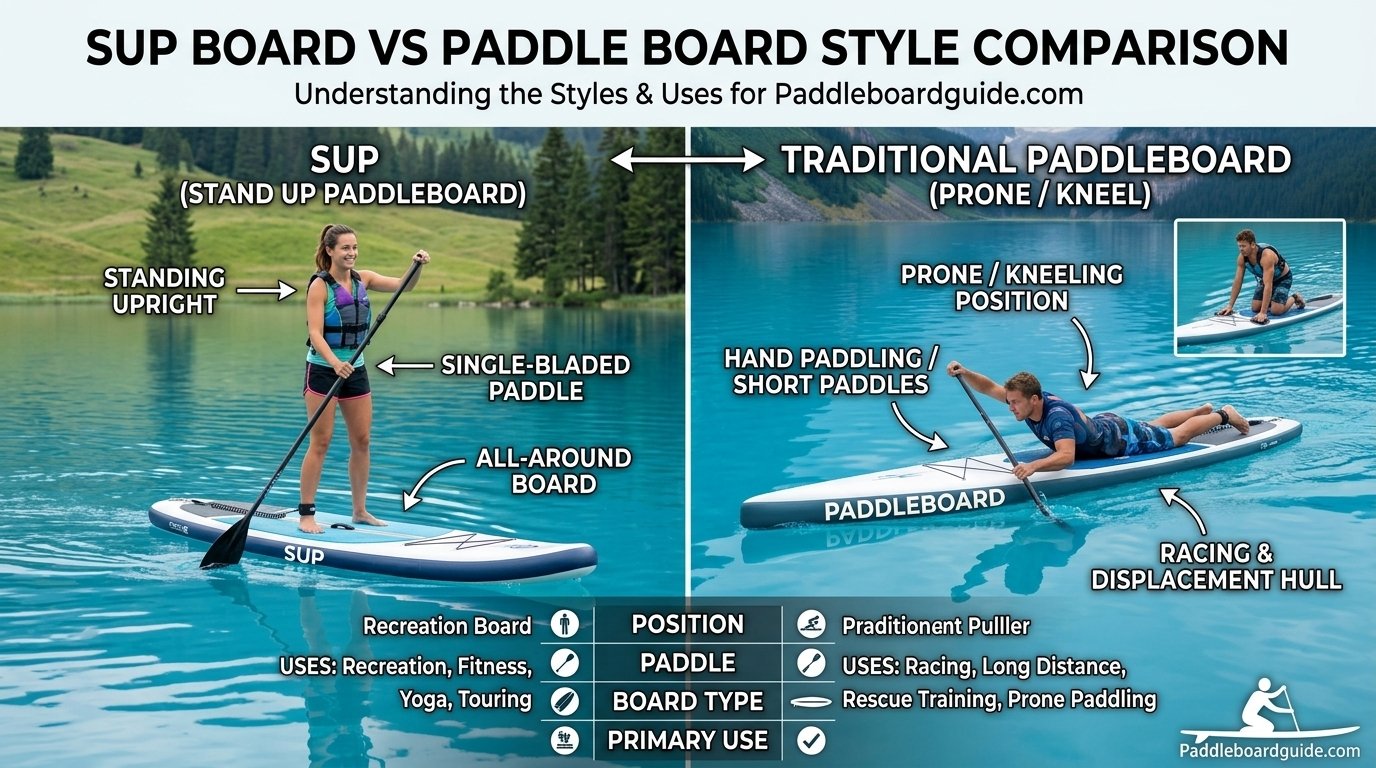
Understanding the real difference between a SUP board and a traditional paddle board can save you from buying the wrong gear.
SUP Board vs Paddle Board: What’s the Real Difference (And Which One Should You Buy)?
If you’ve spent any time shopping for water gear, you’ve probably run into two terms that seem to describe the exact same thing: “SUP board” and “paddle board.” Retailers use them interchangeably, friends use them interchangeably, and yet somehow the confusion never quite goes away. Are they the same product with two different names, or is there something genuinely different going on beneath the surface?
The short answer is that the terms overlap more than they conflict, but there are real distinctions worth understanding before you spend your money — especially once you start comparing inflatable paddle boards, hard-shell touring boards, racing shapes, and the various “paddle board” styles that don’t involve standing at all, like kayak-style seated paddle boards or traditional canoe paddling. This guide breaks down exactly where SUP boards and paddle boards overlap, where they diverge, and how to figure out which one actually fits the way you want to spend your time on the water.
We’ll walk through the vocabulary confusion first, then move into the design elements, performance characteristics, and price ranges that actually separate one board from another regardless of what the listing calls it. By the end, you should be able to walk into any outdoor retailer or scroll through any online marketplace and immediately understand what you’re looking at — no more guessing whether “paddle board” and “SUP board” are secretly two different purchases, and no more second-guessing whether you’re about to buy the wrong thing.
What Is a SUP Board, Exactly?
SUP stands for “stand up paddle,” and a SUP board is purpose-built for exactly that activity: standing upright on a wide, buoyant deck and propelling yourself forward with a long single-bladed paddle. The sport traces its roots to Hawaiian surf culture, where instructors would stand on their longboards and use a canoe paddle to get a better vantage point of incoming swells. That practical trick evolved into its own discipline, and by the time it reached mainland beaches, lakes, and rivers, it had become one of the fastest-growing paddle sports in the world.
A modern SUP board typically features a flat, stable deck with a textured traction pad in the standing zone, a fin or fin system on the underside for tracking, and a shape that ranges from short and surf-oriented to long and touring-oriented. Most recreational SUP boards fall somewhere between 10 and 12 feet long and 30 to 34 inches wide, which strikes a balance between stability and glide.
When people search for “SUP board,” they’re almost always referring to this specific standing paddle discipline — not canoeing, not kayaking, and not lying prone on a board like a traditional surfer paddling out. If you want to understand exactly how these boards come together, our breakdown of how paddle boards are made walks through the construction process in detail.
The sport’s growth curve is worth appreciating, too. What began as a niche practice among a handful of Waikiki surf instructors in the 1960s and 70s stayed largely regional for decades. It wasn’t until the early 2000s, when watermen began adapting the technique for flatwater fitness and touring rather than just surf line-ups, that SUP started spreading to lakes, rivers, and coastal towns far removed from Hawaii. Inflatable technology arriving in the following decade removed the last major barrier — the need for a car, a roof rack, and dedicated storage space — and that combination of accessibility and low-impact, full-body exercise is largely why SUP has become one of the most-purchased paddle sports categories at outdoor retailers today.
Anatomically, every SUP board shares a handful of core reference points that show up again and again in product descriptions, and understanding them makes comparison shopping much easier. The “nose” is the front tip, the “tail” is the back, “rails” are the side edges, and the “deck” is the top surface you stand on. Underneath, you’ll find the “hull,” which can be either planing (flat-bottomed, stable, beginner-friendly) or displacement (V-shaped at the nose, faster, more efficient for touring). The fin box or fin system sits toward the tail on the underside, and D-rings or bungee attachment points on the deck let you strap down a dry bag, cooler, or extra gear for longer outings.

Curious What a Modern SUP Package Includes?
Most all-around SUP boards ship with a paddle, pump, fin, and repair kit — everything you need to get on the water the same day.
Browse SUP Boards on AmazonWhat Is a “Paddle Board” in the Broader Sense?
Here’s where things get genuinely murky. “Paddle board” is an umbrella term that predates the modern SUP boom and technically covers any board propelled by a paddle rather than by fins or a motor. Historically, that includes prone paddle boards — long, narrow boards that a paddler lies flat on and propels using their arms like a swimmer, a discipline still practiced in ocean paddleboard racing circuits. It can also loosely refer to kneeling paddle boards, seated paddle craft, and even some hybrid kayak-SUP designs that let you switch between sitting and standing.
In everyday retail use, though, “paddle board” has mostly become shorthand for the same product as a SUP board. Search engines, product listings, and casual conversation treat the two as synonyms about 90% of the time. If someone tells you they’re “going paddle boarding this weekend,” they almost certainly mean stand up paddle boarding, not prone paddling or kneeling.
So while there’s a legitimate historical and technical distinction, the practical reality for most shoppers is this: unless a product listing specifically says “prone” or “racing prone board,” a “paddle board” for sale today is a SUP board. The naming difference is more about vocabulary drift than two genuinely separate product categories.
Prone paddleboarding deserves a closer look precisely because it’s the one context where “paddle board” genuinely means something different from “SUP board.” Prone boards are long, narrow, and low-volume, sometimes under 20 inches wide, and paddlers lie flat, alternating overhand arm strokes similar to freestyle swimming. This discipline remains popular in Southern California, Hawaii, and Australia, particularly among lifeguards who use prone boards for open-water rescues because the low profile cuts through wind and chop with minimal resistance. Kneeling paddle boards occupy a middle ground: wider than prone boards but still paddled with a shorter, canoe-style stroke from a kneeling position, often used by surfers building paddling endurance or by paddlers recovering from a knee, ankle, or balance-related injury who aren’t ready to stand.
Neither of these niche disciplines shows up in mainstream sporting goods aisles the way standing SUP boards do, which is a big part of why “paddle board” defaulted to meaning “SUP board” in common usage. If you do encounter genuine prone or kneeling boards for sale, they’re almost always sold through specialty paddle-sport retailers rather than big-box outdoor stores or general marketplaces.
There’s also a fitness-specific hybrid worth mentioning: paddle board ergometers and prone paddle trainers, used by competitive paddlers for dryland or pool-based conditioning. These aren’t really “boards” in the sense most shoppers care about, but they show up occasionally in searches because they borrow the same paddle board vocabulary, which is yet another small contributor to the overall terminology soup surrounding this sport.
Where the Terminology Confusion Comes From
The confusion didn’t happen by accident. Paddle sports have a tangled family tree, and SUP borrowed equipment, vocabulary, and even paddlers from several older disciplines at once. Surfers already called their boards “boards.” Canoeists already had “paddles.” When the two merged into a new activity, marketers reached for the most familiar combination of words — “paddle board” — rather than coining something entirely new. “SUP” came later as a more precise, sport-specific abbreviation once the activity had enough of an identity to need one.
Add in the fact that outdoor retailers, rental shops, and manufacturers all optimize their websites for whichever search term gets more traffic, and you end up with both terms being used constantly, sometimes on the very same product page. It’s not unusual to see a listing titled “Inflatable Paddle Board — SUP Package” using both terms in a single headline for maximum search visibility.
The takeaway: if you’re shopping online and see “paddle board,” assume it’s a SUP board unless the description explicitly says otherwise (prone, racing, kneeling, or touring-specific language). This guide will use “SUP board” and “paddle board” interchangeably from here on for the standing discipline, and will call out the rarer prone and kneeling variants specifically when they come up.
There’s also a regional flavor to the terminology worth mentioning. In Australia and parts of the UK, “paddle boarding” is by far the more commonly used phrase in everyday conversation, while “SUP” shows up more in technical or club contexts. In North America, the reverse is often true — enthusiasts and shops lean toward “SUP” or “SUP board,” while general consumers searching online tend to type “paddle board” out of habit, since it reads more like plain English. Search engines have adapted to this by treating both terms as near-synonyms in results, which is exactly why you’ll see identical products ranking for both queries. None of this changes what you’re buying, but it explains why you shouldn’t feel like you’re missing some secret distinction when the same board shows up under two different names.
Design Differences That Actually Matter
Even within the “SUP board equals paddle board” world, not all boards are built the same, and understanding the design language helps you read product listings more confidently.
Deck Shape and Standing Platform
Because you’re standing for the entire session, deck width and thickness matter enormously. Wider decks (32 to 34 inches) offer more side-to-side stability, which is why beginner-oriented boards tend to run wide. Narrower decks (28 to 30 inches) sacrifice some stability for speed and are common on touring and racing shapes.
Nose and Tail Profile
A rounded, wide nose displaces water gently and suits flatwater cruising and yoga sessions. A pointed, displacement-style nose slices through chop and headwind more efficiently, which is why touring boards almost always feature this shape. Tail shapes affect maneuverability — a squared-off tail improves tracking, while a rounded pintail improves turning radius for surf-style boards.
Rocker Profile
Rocker refers to the curve running from nose to tail. A flatter rocker line maximizes glide efficiency on calm water, while more pronounced rocker helps a board handle waves and chop without nose-diving. If you plan to paddle in coastal or river conditions, rocker becomes a much bigger factor than it would for a calm inland lake.
Fin Setup
Most modern boards use a removable fin system, often a single large center fin plus two smaller side fins (a “2+1” setup). More fin surface area improves tracking in a straight line; less fin surface area improves maneuverability for surf-style riding.
Deck Padding and Traction
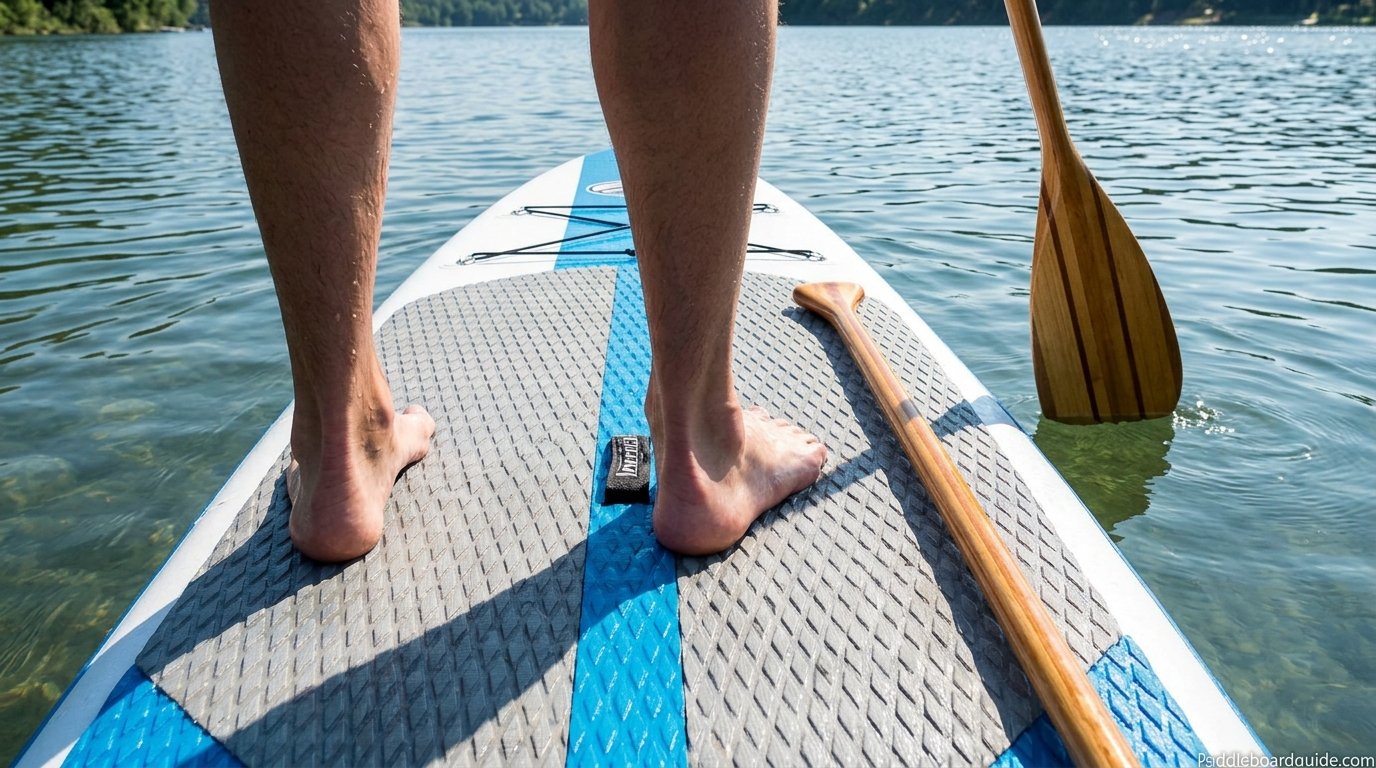
The foam traction pad covering the standing area does more than just look good in product photos — it’s the difference between a board that feels secure underfoot and one that turns slippery the moment your feet get wet. Thicker, diamond-grooved EVA foam pads absorb impact on your joints during longer sessions and provide meaningfully better grip than the thin, smooth pads found on budget boards. Some boards extend the pad the full length of the deck for yoga or fishing use, while others keep it limited to the central standing zone to save weight and cost.
Rail Shape and Thickness
Rail shape (the profile of the board’s side edges) affects both stability and how a board handles waves. Boxier, harder rails increase secondary stability — meaning the board resists tipping further once it’s already leaning — which is reassuring for beginners. Softer, rounded rails release water more smoothly during turns and are preferred by more advanced paddlers riding in surf. Overall board thickness, usually 4 to 6 inches on inflatables, also affects stiffness and buoyancy: thicker boards float higher and carry more weight capacity but can feel a bit less connected to the water at speed compared to lower-profile hard-shell boards.
Stance and Paddling Technique
One of the clearest differences between the standing SUP discipline and the older prone or kneeling “paddle board” styles is body position, and it changes everything about how the sport feels.
On a stand up paddle board, you’re upright, using your core and legs to balance while a single long paddle with an angled blade drives you forward. The stance is closer to skiing or snowboarding than to traditional canoeing — your knees stay soft, your weight shifts with the board’s motion, and your paddle strokes alternate sides to keep a straight line.
On a prone paddle board, you lie flat on your stomach and paddle with your hands, similar to bodysurfing or traditional Hawaiian surfboard paddling, and it’s almost entirely an upper-body and shoulder workout. Kneeling paddle boards split the difference, offering more stability than standing while still requiring core engagement.
For most recreational buyers, the standing SUP stance is what they picture when they imagine “paddle boarding,” and it’s the technique this guide focuses on for the remainder of the comparison, since it’s what the overwhelming majority of paddle board and SUP board purchases are actually for.
Basic Stroke Mechanics
A proper SUP stroke starts with the paddle blade reaching forward, angled slightly away from the board, and entering the water cleanly near the nose. Power comes from rotating the torso and pulling with the core rather than yanking with the arms alone — a common beginner mistake that leads to shoulder fatigue within the first ten minutes. The stroke finishes once the blade reaches your ankle, at which point you slice it back out of the water and repeat on the same or opposite side. Most paddlers switch sides every three to five strokes to maintain a straight line without constantly adjusting with a rudder-style steering stroke.
Balance and Micro-Adjustments
Standing balance on a SUP board comes less from rigid stillness and more from constant, small adjustments in the ankles, knees, and hips — much like balancing on a moving train. Keeping your gaze on the horizon rather than down at your feet, maintaining soft (slightly bent) knees, and spacing your feet roughly hip-width apart and parallel to the board’s stringer line all contribute to a stable, sustainable stance over a full session.
Board Types: Inflatable, Hard-Shell, Touring, and More
Whether you call it a SUP board or a paddle board, the real decision that shapes your experience is which construction and shape category you buy into.
Inflatable SUP Boards (iSUPs)
Inflatable boards dominate the recreational market today, and for good reason. Built from military-grade PVC layers with drop-stitch cores, a quality inflatable can be pumped to 12–15 PSI and becomes surprisingly rigid — rigid enough for touring, yoga, fishing, and even light whitewater. The obvious appeal is storage and transport: an iSUP rolls down into a backpack-style bag that fits in a closet or car trunk, no roof rack required. Our roundup of the best inflatable paddle boards covers the top performers across budgets.
Hard-Shell (Epoxy) SUP Boards
Traditional hard boards, usually built from an EPS foam core wrapped in epoxy resin and fiberglass, offer a stiffer platform and slightly better glide efficiency than inflatables of the same length. They’re the preferred choice for racing and advanced surfing, but they require roof rack transport and dedicated storage space, which puts many casual buyers off.
All-Around Boards
These are the generalists of the paddle board world — wide, stable, moderate length, and forgiving for beginners. If you’re not sure what kind of paddling you’ll do most, an all-around shape is the safest starting point.
Touring Boards
Longer (typically 12’6″ to 14′) with a displacement nose, touring boards trade a bit of stability for significantly better tracking and speed over distance, ideal for multi-mile paddles and exploring coastline or lake shoreline.
Racing Boards
Narrow, long, and unstable for beginners, racing boards prioritize pure speed above everything else and are built for competitive paddlers who’ve already developed strong balance.
Yoga and Fitness Boards
Extra-wide, extra-stable, and often featuring a full-deck traction pad, these boards are optimized for on-water yoga, Pilates, and fitness classes rather than distance paddling.
Fishing SUP Boards
Reinforced with rod holders, gear mounts, and higher weight capacities, fishing-specific boards let anglers stand and cast from a stable platform in shallow water where boats can’t easily go.
Surf SUP Boards
Shorter, with more pronounced rocker and a narrower tail, surf-specific SUP boards are designed to catch and ride breaking waves in a way that longer touring or all-around shapes simply can’t manage. They sacrifice flatwater glide efficiency for quick turning and wave-face maneuverability, and they’re generally a poor choice as a first board unless you already live near consistent, rideable surf.
Whitewater SUP Boards
Built shorter and wider than typical touring boards, with reinforced rails and often a soft, forgiving deck material, whitewater SUP boards are meant to absorb impacts against rocks and bounce through rapids rather than glide efficiently across flat lakes. River paddlers often add a retractable or removable fin system so the fin can be pulled up in shallow, rocky stretches to avoid damage.
Kids’ and Youth SUP Boards
Scaled-down versions of all-around boards, youth SUPs are shorter and lighter so smaller paddlers can actually lift and carry their own gear, with lower weight capacities and extra-grippy deck pads to build confidence early.
Reviewing real-world options side by side helps a lot here — our in-depth looks at the Retrospec Weekender, the Bote inflatable paddle board, and the iRocker paddle board each represent a slightly different point on the spectrum from beginner-friendly all-around boards to more performance-oriented touring shapes.

Shopping for a Touring or All-Around Board?
Compare current top-rated inflatable and hard-shell boards before you commit to a shape and length.
Compare Boards on AmazonPerformance on the Water
Once you’re past the naming question, the performance conversation is really a comparison of board shapes and construction rather than “SUP” versus “paddle board” as categories. That said, a few consistent performance patterns are worth knowing.
Longer, narrower boards with displacement noses glide farther per stroke and hold a straighter line, which matters most on open water, rivers with current, or windy conditions where you’re fighting to stay on course. Shorter, wider boards turn more easily and feel more playful in small surf or tight coves, but they’ll tire you out faster over long distances because you’re expending more energy per mile covered.
Inflatable boards have closed most of the performance gap with hard boards over the last several years thanks to improved drop-stitch weaving and dual-layer construction, but a premium hard-shell board still edges out an equivalent inflatable in outright glide efficiency and responsiveness, especially at racing speeds. For casual paddling under 5 miles per hour, most people genuinely cannot feel the difference.
Wind is the single biggest performance variable most new paddlers underestimate. A wide, high-volume board catches more wind and becomes noticeably harder to control once gusts exceed 12–15 mph, which is why experienced paddlers often keep a narrower touring board specifically for breezy days.
Glide Efficiency in Practice
Glide efficiency — how far a board coasts after a single stroke — is one of the clearest ways paddlers actually feel construction and shape differences on the water. A well-built touring board with a displacement hull can glide noticeably farther per stroke than a short, wide all-around board, which translates directly into less fatigue over a multi-mile paddle. Paddlers who log distance regularly often notice they can maintain the same cruising speed at a meaningfully lower stroke rate once they upgrade from a short recreational board to a longer touring shape.
Tracking and the Role of Fin Size
Tracking refers to how well a board holds a straight line without constant steering corrections. Fin size and placement play an outsized role here: a larger, deeper center fin resists sideways drift and keeps the board tracking straight, while a smaller fin allows quicker, looser turning at the cost of some straight-line efficiency. Paddlers who primarily paddle in a straight line across open water benefit from a larger touring fin, while those weaving through coves, docks, or small surf often prefer a smaller, more maneuverable setup.
Stability and Learning Curve
Stability comes down to three factors: width, thickness, and volume (a rough measure of how much the board displaces, usually listed in liters). A wider, thicker board with higher volume relative to the paddler’s weight will feel dramatically more stable than a narrow, low-volume board.
For a first-time buyer, the general rule of thumb is to choose a board with at least 30 inches of width and enough volume to comfortably support your body weight plus about 25–30% extra capacity for gear, a passenger, or a dog. Manufacturers list maximum weight capacity for exactly this reason, and it’s covered in more detail in our guide to how much weight a paddle board can hold.
Most beginners find their balance within the first 20–30 minutes on flat, calm water, and full confidence typically develops within two or three sessions. Falling in is a normal and expected part of the learning curve — even experienced paddlers fall in choppy conditions — so approaching your first outings on a lake or protected bay rather than open ocean swell will make the process far less intimidating.
Quick Tips for Improving Balance Faster
- Start kneeling in the center of the board before standing up, then rise to standing once you feel settled.
- Keep your feet parallel and roughly hip-width apart, positioned around the board’s carry handle or center point.
- Look at the horizon, not down at your feet — fixing your gaze on a distant point improves balance almost immediately.
- Bend your knees slightly rather than locking them, letting your legs absorb small wobbles instead of your whole body.
- Practice on flat, wind-protected water for your first few sessions before progressing to open or choppy conditions.
Board volume, measured in liters, is a more precise stability indicator than width alone. As a rough guideline, dividing your body weight in pounds by 2.2 gives you a rough kilogram figure, and a board’s liter volume should generally sit comfortably above that number for confident, stable paddling — the more it exceeds your weight, the more stable and forgiving the board will feel, especially for beginners still building their balance.
Portability, Storage, and Transport
This is where the inflatable-versus-hard-shell decision really overshadows the SUP-versus-paddle-board naming question. A hard-shell board, typically 9 to 12 feet long, needs roof rack straps, a truck bed, or a dedicated storage rack in a garage. Apartment dwellers and anyone without a large vehicle often find hard boards impractical no matter how much they like the performance.
An inflatable board rolls down to roughly the size of a duffel bag and typically weighs 18–24 pounds when deflated and packed, making it checkable on a flight, storable in a closet, and transportable in almost any car trunk. The tradeoff is setup time — inflating a board to proper PSI with a manual or electric pump takes anywhere from 5 to 15 minutes before you can launch, and packing it back down after a session adds a similar amount of time.
If you paddle frequently from the same home dock or nearby put-in, a hard board’s zero-setup convenience might outweigh its storage footprint. If you travel, live in a smaller space, or paddle from multiple locations, an inflatable is almost always the more practical answer, and understanding how long inflatable paddle boards last can help you weigh that convenience against long-term durability.
Apartment and Small-Space Storage
For apartment dwellers, an inflatable board’s packed size — usually somewhere in the neighborhood of a large duffel bag — fits in a hall closet, under a bed, or in a car trunk without any special accommodation. Hard boards, by contrast, generally require either wall-mounted racks, ceiling hoists, or a garage corner, none of which are realistic in most rental apartments.
Air Travel and Road Trips
Many inflatable boards pack down small enough to check as standard luggage on flights, opening up destination paddling trips that would be completely impractical with a 10-foot hard board strapped to a rental car roof. For road trips, an inflatable in its backpack simply rides in the trunk alongside the rest of your luggage, with no roof rack, no straps, and no risk of wind noise or highway damage during transport.
Price Comparison
Pricing spans a wide range on both sides of the inflatable-versus-hard-shell divide, and shape/brand matter more than the “SUP” or “paddle board” label ever will.
| Board Category | Typical Price Range | Best For |
|---|---|---|
| Budget inflatable all-around | $180 – $350 | First-time buyers, occasional use |
| Mid-range inflatable all-around | $350 – $600 | Regular recreational paddlers |
| Premium inflatable touring | $600 – $1,100 | Distance paddling, multi-day trips |
| Entry hard-shell epoxy | $500 – $900 | Dedicated home storage, performance |
| Performance/racing hard-shell | $1,200 – $2,500+ | Competitive paddlers |
| Fishing-specific (inflatable or hard) | $500 – $1,400 | Anglers needing rod mounts and stability |
Package deals that include the paddle, pump, fin, leash, and carry bag typically add $50–$150 of value compared to buying each accessory separately, so factor that in when comparing sticker prices between listings.
Hidden Costs to Budget For
The sticker price rarely tells the full story. A carbon-fiber paddle upgrade, which reduces swing weight and shoulder fatigue on longer sessions, can run anywhere from $80 to $250 on top of the stock aluminum or fiberglass paddle most packages include. A proper roof rack system for a hard board, if you don’t already own one, can add another $150–$400. Deck bags, coolers, phone mounts, and a quality repair kit for inflatables are all worth budgeting a modest amount for as well, even though none of them are strictly mandatory at the outset.
On the flip side, inflatable boards generally save money over time on transport-related costs — no roof rack to buy, no risk of rack-related dings or scratches, and no need for a bigger vehicle just to fit your gear.
Safety Gear and Requirements
Regardless of which term you use, SUP boards are legally classified as vessels by the U.S. Coast Guard in most waterways, which means specific safety equipment isn’t optional — it’s required by law in many jurisdictions once you paddle beyond a swimming area.
- Personal Flotation Device (PFD): A Coast Guard–approved PFD is required for paddlers on most bodies of water outside designated swim zones.
- Leash: Keeps you connected to your board if you fall, preventing it from drifting away, especially important in current or wind.
- Whistle or sound signaling device: Often required alongside the PFD for signaling other watercraft.
- Lighting: Required if paddling between sunset and sunrise.
Our full breakdown of paddle board safety requirements covers state-by-state nuances, because rules can vary meaningfully depending on where you paddle.
Reading Conditions Before You Launch
Beyond gear, situational awareness prevents the vast majority of paddle board incidents. Check wind forecasts before heading out — onshore wind is generally more forgiving because it pushes a struggling paddler back toward shore, while offshore wind can carry a fatigued paddler out to open water surprisingly quickly. Tidal current matters just as much on coastal and estuary paddles, since a strong outgoing tide can easily overpower a beginner’s paddling speed. On rivers, always check flow rates and be aware of strainers (fallen trees or debris) that can trap a board or a swimmer.
Basic Self-Rescue Skills
Every paddler should practice climbing back onto their board from the water before they actually need to do it in choppy or cold conditions. The general technique involves grabbing the center handle, kicking to build momentum, and pulling your torso across the board before rotating into a seated or kneeling position. Practicing this in calm, shallow water builds the muscle memory needed to stay calm if a real fall happens somewhere less forgiving.

Gear Up Before You Launch
A Coast Guard–approved PFD, a coiled ankle leash, and a whistle cover the legal basics for most paddlers.
Shop Safety Gear on AmazonWhich One Is Best for You?
Since “SUP board” and “paddle board” almost always describe the same core product for the average shopper, the more useful question is which board type and construction style fits your lifestyle. Here’s a quick framework:
Choose an Inflatable All-Around SUP If You:
- Have limited storage space at home
- Want to travel with your board or paddle from multiple locations
- Are new to the sport and want maximum stability
- Plan to use it for yoga, fishing, or casual family outings
Choose a Hard-Shell Touring or Racing Board If You:
- Have a garage or roof rack and don’t mind the setup
- Prioritize speed, glide, and long-distance performance
- Already have solid balance and paddling experience
- Plan to race or train competitively
For most first-time buyers, a mid-range inflatable all-around board in the 10’6″ to 11’6″ range with at least 32 inches of width represents the safest, most versatile starting point, and it’s the category the majority of recreational paddlers stick with long term.
Scenario-Based Recommendations
It also helps to think in terms of real scenarios rather than abstract categories. A family with young kids and a dog will likely be happiest with a wide, high-volume all-around board and a second, smaller youth board rather than trying to fit everyone on one board. A solo paddler chasing a daily fitness routine on a nearby lake might prioritize a slightly narrower, faster all-around or light-touring shape that still forgives the occasional wobble. An angler working shallow flats will want a wide, stable platform with mounted rod holders and a higher weight capacity to account for tackle and a cooler. And a frequent traveler who wants to paddle on every vacation should weight the decision heavily toward a compact, lightweight inflatable that packs down small enough to check as luggage.
Side-by-Side Comparison Table
| Feature | Stand Up Paddle (SUP) Board | Prone / Kneeling Paddle Board |
|---|---|---|
| Body position | Standing upright | Lying flat or kneeling |
| Paddle type | Long single-blade paddle | Hands or short paddle |
| Primary muscles used | Core, legs, shoulders | Shoulders, arms, back |
| Typical board width | 28″ – 34″ | 19″ – 24″ |
| Learning curve | Moderate (balance-focused) | Steeper (endurance-focused) |
| Common use case | Recreation, fitness, touring, fishing | Ocean racing, lifeguard training |
| Market availability | Widespread, mainstream | Niche, specialty retailers |
As the table shows, the moment you step outside the mainstream retail meaning of “paddle board,” the differences from a SUP board become much more pronounced — different stance, different muscle groups, and a narrower, more specialized board shape entirely.
Buying Guide: What to Look For
1. Board Length and Width
Match length and width to your primary use case: wider and shorter for stability and casual paddling, longer and narrower for speed and distance.
2. Weight Capacity
Always leave a buffer above your body weight for gear, pets, or a second passenger rather than buying right at the board’s stated maximum.
3. Construction Quality
For inflatables, look for dual-layer or fusion-layer PVC construction rated to at least 12–15 PSI. For hard boards, check whether the core is EPS foam wrapped in epoxy/fiberglass versus cheaper single-layer builds that dent easily.
4. Included Accessories
Confirm whether the paddle, pump, fin, leash, and repair kit are included, since these add real cost if purchased separately afterward.
5. Fin Configuration
A removable 2+1 fin setup offers the most versatility for mixed-condition paddling; a single large fin is simpler but less adjustable.
6. Warranty and Brand Reputation
Reputable paddle board brands typically offer at least a one- to two-year warranty against manufacturing defects — a useful signal of build confidence.
9. Read Verified Owner Reviews, Not Just Star Ratings
A 4.5-star average can hide a lot of variance, so it’s worth skimming a handful of detailed reviews specifically looking for mentions of seam durability, valve quality, and how the board holds pressure after repeated use over a season rather than just an unboxing impression. Reviews that mention multi-month or multi-season use tend to be far more useful than first-week reactions for judging long-term reliability.
It also helps to understand the different paddle board types available before narrowing your shortlist, since shape and category will influence nearly every other buying decision you make.
7. Match the Board to Your Skill Level
Complete beginners are almost always better served by a wider, more forgiving all-around shape even if a faster touring board looks more appealing on paper — a board that feels unstable on day one often ends up gathering dust in a garage instead of getting used. Intermediate and advanced paddlers who already have solid balance can comfortably size down in width to gain speed and glide without sacrificing too much confidence on the water.
8. Consider Where You’ll Paddle Most
A calm lake, a windy coastal bay, and a moving river each reward different design priorities. Flatwater lake paddlers can prioritize stability and comfort features like a full deck pad. Coastal and bay paddlers benefit from a board with reasonable rocker and wind resistance. River paddlers should look specifically for reinforced rails and a fin system designed to handle shallow, rocky conditions without snapping off.
Fitness and Wellness Benefits
Beyond the naming debate and gear specifications, it’s worth stepping back to look at why paddle boarding has become such a popular fixture in fitness routines and outdoor wellness circles. Standing on a moving board engages stabilizer muscles throughout the core, hips, and legs almost continuously, even during a relatively relaxed cruise, which is why many paddlers report noticeable core and balance improvements after just a few weeks of regular sessions.
Because it’s low-impact, SUP is friendly to joints that might struggle with running or high-impact gym work, making it an appealing option for people recovering from certain injuries or simply looking for a gentler form of cardio. A moderate-paced hour on the water burns a meaningful number of calories — comparable to a brisk hike — while feeling far less taxing than a traditional cardio workout, largely because the water and scenery provide a natural distraction from the effort involved.
The mental health side of paddle boarding shouldn’t be underestimated either. Time on open water, away from screens and traffic, has been widely reported by paddlers as a meaningful stress-reduction activity, and the rhythmic nature of paddling strokes has a calming, almost meditative quality for many people. That combination of physical and mental benefit is a big part of why paddle board yoga classes and dedicated SUP fitness programs have grown alongside the broader recreational paddling market.
Building Endurance Over Time
New paddlers often notice that a 30-minute session feels surprisingly tiring in the first few weeks, primarily due to unfamiliar stabilizer muscle engagement rather than cardiovascular limits. That initial fatigue typically fades within a handful of outings as the body adapts, at which point many paddlers naturally extend their sessions toward an hour or more and start exploring longer touring routes.
Cross-training paddlers also tend to notice benefits carrying over into other sports and activities. The rotational core strength built through repeated paddle strokes transfers well to golf, tennis, and skiing, while the balance work improves confidence in anything requiring a stable base, from hiking uneven trails to simply standing comfortably on a moving bus or train.
Maintenance and Lifespan
Both inflatable and hard-shell boards reward basic care with significantly longer usable lifespans. Rinse boards with fresh water after any use in saltwater, chlorinated pools, or muddy lakes to prevent material breakdown and fin-box corrosion. Dry boards fully before rolling or storing them to avoid mildew, especially inside the fabric bag of an inflatable.
Store boards out of direct, prolonged sunlight when not in use, since UV exposure gradually degrades both PVC and epoxy resin over time. For inflatables, avoid leaving a board fully pumped and sitting in a hot car or direct sun for extended periods, as internal pressure can rise and stress the seams.
With reasonable care, a quality inflatable SUP board typically lasts 5–10 years of regular recreational use, while a well-maintained hard-shell board can last a decade or longer, since it has no seams or bladder to eventually fatigue. Small dings on hard boards should be patched promptly with a proper epoxy repair kit to prevent water intrusion into the foam core.
Using Your Repair Kit
Most inflatable boards ship with a basic repair kit containing PVC patches and adhesive for small punctures. For a successful repair, the area around the puncture needs to be completely clean and dry before the patch is applied, and the board should stay deflated with firm, even pressure on the patch for the full cure time listed on the adhesive — usually several hours to overnight. Rushing this step is the most common reason DIY patches fail to hold under pressure once the board is reinflated.
Seasonal and Off-Season Storage
If you’re storing a board through a cold winter or a long off-season, deflate inflatables fully and store them loosely rolled rather than tightly compressed for extended periods, which helps the material relax and reduces stress on seams. Hard boards should be stored fin-up or on padded racks rather than leaning directly on a hard edge, which can create pressure dents in the foam core over months of storage. Keeping either board type away from extreme heat (like a non-climate-controlled attic or garage in summer) will meaningfully extend its usable lifespan.
Frequently Asked Questions
Is a SUP board the same thing as a paddle board?
In everyday retail use, yes — “SUP board” and “paddle board” almost always refer to the same standing paddle craft. The only meaningful exception is the smaller, specialty category of prone or kneeling paddle boards, which use a different stance and technique entirely.
Which is better for beginners, inflatable or hard-shell?
Inflatable boards are generally friendlier for beginners because of their forgiving, cushioned deck, easier storage, and lower upfront commitment, while still offering enough rigidity for most recreational paddling once properly inflated.
How long does it take to inflate a SUP board?
With a manual dual-action pump, expect 8–15 minutes to reach 12–15 PSI. An electric pump can cut that down to 5–8 minutes with far less physical effort.
What size paddle board should I buy?
As a starting point, choose a board around 10’6″ to 11′ long and at least 32 inches wide if you weigh under roughly 200 pounds, sizing up in width and volume as body weight or gear load increases.
Can two people ride the same paddle board?
Yes, as long as the board’s rated weight capacity comfortably covers both paddlers plus any gear, which usually means looking at boards in the 11′ to 12’6″ range with higher volume ratings.
Do I need a permit or license to paddle board?
Most states don’t require a license for recreational paddle boarding, but many do require a PFD, leash, and whistle once you’re outside a designated swim area, and some states require registration for boards used on certain waterways.
How much weight can a paddle board hold?
Weight capacity varies by board size and volume, typically ranging from around 200 pounds on compact boards up to 400+ pounds on larger touring and multi-person boards.
Are inflatable paddle boards durable enough for rivers and rocks?
Quality inflatables with military-grade PVC and reinforced rails handle light rapids and occasional rock contact well, though repeated impacts on sharp rocks can eventually wear through the outer layer, so caution is still warranted in technical whitewater.
What’s the difference between touring and all-around paddle boards?
Touring boards are longer and narrower with a pointed nose for better glide and tracking over distance, while all-around boards are shorter and wider, prioritizing stability and versatility for general recreational use.
How long do paddle boards typically last?
With proper care, inflatable boards commonly last 5–10 years, and hard-shell boards can last well over a decade, since seamless epoxy construction avoids the wear points found in inflatable material.
Can you paddle board in the ocean, or is it only for lakes?
Both, though ocean paddling adds variables like tide, current, and swell that beginners should approach cautiously; a wider, more stable board and calm, wind-protected bay conditions are the safer starting point before progressing to open coastal water.
Do paddle boards puncture easily?
Quality inflatable boards built with military-grade PVC and drop-stitch construction are quite puncture-resistant for normal recreational use, though sharp rocks, oyster beds, or careless handling on pavement can still cause damage, which is why a repair kit is worth keeping on hand.
Final Verdict: SUP Board or Paddle Board?
At the end of the day, “SUP board” and “paddle board” describe the same standing paddle sport for roughly 90% of shoppers, and the real decision isn’t about which name to search for — it’s about choosing the right length, width, and construction for how and where you plan to paddle. Beginners and space-conscious buyers will almost always be happiest with a mid-range inflatable all-around board, while experienced paddlers chasing speed and distance should look toward touring or hard-shell performance shapes.
Whichever direction you go, prioritize proper safety gear, size the board to your weight and skill level, and take the time to compare a few real options before committing.
Shop Top-Rated Paddle Boards on Amazon