
How Paddle Boards Are Made: The Complete Journey From Raw Material To Finished Board
A deep look inside the factories, materials, and engineering that turn foam, resin, and PVC fabric into the paddle board under your feet.
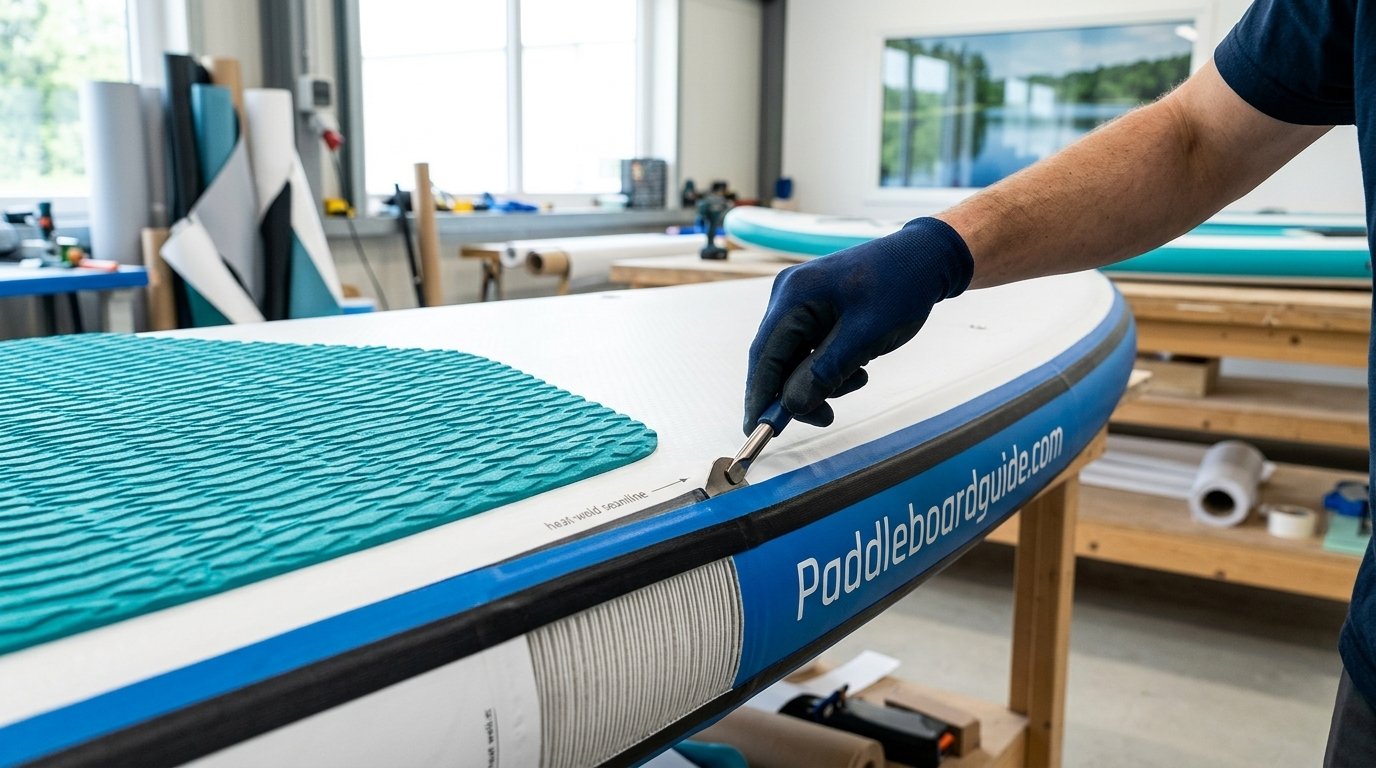
Pick up almost any paddle board and you’re holding the end result of a surprisingly intricate manufacturing process — one that blends old-school surfboard shaping traditions with modern industrial textile engineering. Understanding how these boards actually come together doesn’t just satisfy curiosity. It explains why one board costs $300 and another costs $1,800, why some boards go soft after a season while others last a decade, and why the marketing term “military-grade PVC” on a listing page actually means something specific on a factory floor.
Paddle boards fall into two fundamentally different manufacturing families: solid boards, built around a rigid foam core wrapped in fiberglass and resin, and inflatable boards, built from layered PVC fabric fused around a fiber-thread core. The two processes share almost nothing in common — different factories, different machinery, different skilled trades, and different failure points. This guide walks through both manufacturing paths from raw material sourcing all the way to the final pressure test, so the next time you’re comparing two boards side by side, you’ll actually understand what’s happening beneath the paint job.
If you’re still getting familiar with the category, it helps to first understand the broader landscape of paddle board types before diving into how each one is physically built, since construction method and board category are closely linked.
It’s also worth setting expectations up front: no single manufacturing process is universally “correct.” A racing paddler chasing every ounce of weight savings and a rental fleet operator prioritizing abuse resistance are looking for boards built through entirely different material choices, even if both boards look similar in a catalog photo. The goal of this guide isn’t to crown one construction method as superior, but to give you the vocabulary and process knowledge to match a board’s construction to your own priorities — speed, durability, portability, or budget — rather than relying on marketing copy alone.
A Short History Of Paddle Board Manufacturing
Stand-up paddling traces back to Hawaiian surf culture, where instructors stood on oversized wooden surfboards and used a paddle to get a better vantage point of students in the water. Those earliest boards were solid wood, hand-shaped, heavy, and built with none of the composite technology that defines the category today. As the sport grew into mainstream popularity, manufacturing followed the same evolutionary path surfboards had already taken decades earlier: wood gave way to polyurethane foam and polyester resin, which then gave way to lighter EPS foam and epoxy resin as riders demanded lighter, more durable boards that could survive years of sun exposure and repeated impact.
Inflatable construction entered the paddle board world later, borrowing directly from whitewater rafting and inflatable kayak technology, where drop-stitch fabric had already been in industrial use for years. Early inflatable paddle boards were thin, soft-flexing, and closer to a novelty than a serious performance product. As drop-stitch thread density improved and PVC lamination methods matured through double-layer and eventually fusion construction, inflatable boards closed the performance gap with hardboards dramatically, to the point where many recreational and touring paddlers today can’t feel a meaningful rigidity difference underfoot. That manufacturing evolution — measured in thread counts, PVC gauges, and lamination methods rather than flashy marketing language — is really the story of how the entire modern paddle board category came to exist.
Raw Materials Used In Paddle Board Construction
Every paddle board, regardless of category, begins as a pile of unglamorous industrial inputs. The specific combination of materials determines weight, rigidity, buoyancy, impact resistance, and ultimately price.
Core Materials
- Expanded Polystyrene (EPS) foam: The lightweight, closed-cell foam blank used as the buoyant core of virtually every solid paddle board. Density is measured and selected specifically for water sports use — too light and the board dents easily, too dense and it becomes heavy and expensive.
- Polyurethane (PU) foam: Used in some traditional surf-style boards as an alternative to EPS, generally denser and paired with polyester resin rather than epoxy.
- Drop-stitch fabric: A woven or knitted polyester core material used exclusively in inflatable boards, where thousands of threads connect a top and bottom fabric layer.
- PVC (polyvinyl chloride) sheeting: The outer shell material for inflatable boards, available in single-layer, double-layer, and fused constructions of varying thickness and reinforcement.
Reinforcement And Skin Materials
- Fiberglass cloth: Woven glass fiber fabric, typically rated in ounces per square yard, layered over an EPS or PU core to create a rigid, impact-resistant outer skin.
- Epoxy resin: A two-part liquid resin system that saturates fiberglass cloth and cures into a hard, glass-like shell. Epoxy is lighter and more impact-resistant than the polyester resin used in older surfboard construction.
- Carbon fiber: Used selectively as a reinforcement layer or full skin on premium boards, prized for its stiffness-to-weight ratio.
- Wood veneer and bamboo: Used as a compression-resistant standing-area layer or full deck skin on hybrid “wood sandwich” boards, adding stiffness without much added weight.
Hardware And Finishing Components
Beyond the core structural materials, every board needs fin boxes, EVA foam deck padding, D-rings for bungee and leash attachment, a handle (inset or molded), and — for inflatables — a high-pressure valve assembly. None of these are decorative; each is load-bearing in its own way, and cheap hardware is one of the most common places manufacturers cut corners to hit a lower price point.
Where These Materials Actually Come From
Very few paddle board brands manufacture their own raw materials in-house. EPS foam blanks are typically produced by dedicated foam suppliers who serve the entire surf and paddle industry, drop-stitch fabric comes from specialized textile mills, and PVC sheeting is often sourced from broader industrial plastics manufacturers who also supply inflatable boats, air mattresses, and pool products. A paddle board brand’s real manufacturing expertise usually lies in design, quality specification, and final assembly — sourcing the right-grade materials from the right suppliers and overseeing a factory partner’s execution — rather than producing raw materials from scratch. This is also why supply chain disruptions in unrelated industries, like a shortage of a particular PVC additive, can quietly affect paddle board availability and pricing.

See Current Paddle Board Prices On Amazon
Compare construction types, thicknesses, and included accessories before you buy.
Check Prices on AmazonSolid vs Inflatable: Two Completely Different Manufacturing Worlds
Before going deeper, it’s worth understanding that “how paddle boards are made” really means two separate questions. A solid, or hardboard, paddle board is manufactured more like a surfboard: a foam blank is shaped, wrapped in cloth, and saturated with resin in a process largely unchanged in principle since the 1960s, just refined with vacuum bagging and CNC shaping. An inflatable paddle board, by contrast, is manufactured more like a technical textile product — closer to how an industrial air mattress or a whitewater raft is built, using woven fabric, heat-sealing, and high-frequency welding rather than resin and cloth.
The distinction matters because it explains real performance differences. If you’ve ever compared a SUP board against a traditional paddle board, much of what you’re actually noticing is the downstream effect of these two manufacturing philosophies rather than shape alone.
| Attribute | Solid (Hardboard) Construction | Inflatable (iSUP) Construction |
|---|---|---|
| Core material | EPS or PU foam blank | Drop-stitch woven fabric |
| Outer shell | Fiberglass or carbon + epoxy resin | PVC layers (single, double, or fused) |
| Primary process | Shaping, lamination, vacuum bagging, curing | Weaving, cutting, gluing/welding, heat-fusing, inflation testing |
| Typical factory type | Composite/resin workshop | Industrial textile and PVC fabrication plant |
| Storage footprint | Full board length, rigid | Rolls into a backpack-sized bag |
How Solid (Hardboard) Paddle Boards Are Made
Solid paddle board manufacturing borrows directly from surfboard shaping, adapted for the larger dimensions and higher volume that stand-up paddling requires.
Step 1: Foam Blank Selection And Rough Shaping
Manufacturing starts with an EPS foam blank, pre-molded roughly to the target length, width, and thickness. Larger factories use CNC shaping machines that carve the blank to precise rocker (the curve from nose to tail), rail shape, and outline dimensions based on a digital board design file. Smaller or premium custom operations still rely on hand-shaping with sanding blocks and templates, a skill that takes years to develop.
Step 2: Stringer And Reinforcement Placement
Many hardboards include a thin wood or composite stringer running down the centerline, added for torsional stiffness. On sandwich-construction boards, a wood veneer or additional foam reinforcement is bonded into the standing area before lamination, since this is the highest-stress zone on the entire board.
Step 3: Fiberglass Wrapping
Once shaped, the foam blank is wrapped in one or more layers of fiberglass cloth. Cloth weight is chosen based on target durability and weight — a lighter racing board might use a single 4oz layer, while a rental-fleet workhorse board might use two or three heavier layers for impact resistance.
Step 4: Resin Saturation And Vacuum Bagging
Epoxy resin is applied over the cloth, either poured and hand-spread or, in higher-end production, applied and then vacuum-bagged. During vacuum bagging, a sealed plastic bag is placed over the wet laminate and a pump draws out the air, pressing a peel-ply fabric against the surface and pulling excess resin out into an absorbent layer. This produces a stronger, lighter, void-free laminate compared to hand lay-up alone, because it eliminates air pockets and removes resin the board doesn’t structurally need.
Step 5: Curing, Sanding, And Finishing
The laminated board cures for several hours to a full day depending on resin chemistry and shop temperature. Once cured, the edges are trimmed, the surface is sanded smooth, and a final clear coat or paint layer is often applied for UV protection and graphics. Fin boxes are routed into the underside and bonded in place at this stage, before the final hardware — handle, deck pad, and D-rings — is installed.
Throughout every step of hardboard production, the craftsperson operating the shaping room is making dozens of small judgment calls that never appear on a spec sheet: how aggressively to thin the rails for a lighter swing weight, how much rocker to leave in the tail for surf performance versus flat-water glide, how evenly to feather the fiberglass overlap at the nose where impact risk is highest. This is part of why two boards with identical published dimensions from different factories can paddle noticeably differently — the shaping process is equal parts engineering and craft, and factories with more experienced shapers tend to produce more consistent, better-balanced boards batch after batch.
Molds, Templates, And CNC Shaping Technology
Modern hardboard factories rely heavily on computer-controlled shaping to keep production consistent across hundreds or thousands of units of the same model, a level of repeatability that hand-shaping alone can’t reliably deliver at scale.
CNC Foam Shaping
A digital board design — outline, rocker curve, rail profile, and thickness distribution — is translated into a toolpath that a CNC router follows to carve a raw EPS blank into a precise, repeatable shape in a fraction of the time hand-shaping would take. This is especially valuable for brands producing dozens of board models across multiple size ranges, since a single design file can be resized and re-cut without a shaper starting from scratch each time.
Compression Molding For Inflatable Panels
On the inflatable side, factories use heated compression molds and press tables rather than CNC routers, since the drop-stitch and PVC materials involved need heat and pressure rather than cutting. Large hydraulic presses apply even pressure across the entire panel during fusion lamination, ensuring the PVC bonds uniformly rather than leaving weaker spots where pressure was inconsistent.
Where Hand Skill Still Matters
Even with CNC and molding technology handling the bulk shaping work, final sanding, resin application, seam sealing, and hardware installation remain largely manual processes on both board types. Automation has made the underlying shapes more consistent, but the finishing quality of any individual board still depends heavily on the skill and attentiveness of the factory floor team assembling it.
Fiberglass Lamination And Epoxy Curing In Detail
Lamination quality is arguably the single biggest driver of a hardboard’s real-world durability, and it’s worth understanding what separates a well-built board from a bargain one.
Why vacuum bagging matters: Hand-laminated boards without vacuum bagging tend to carry more resin than structurally necessary, adding weight without adding strength, and are more prone to trapped air pockets that later show up as small bubbles or delamination spots after repeated sun exposure and flexing.
Single vs Double Glass Construction
A single-glass board uses one layer of fiberglass cloth on the deck and bottom, keeping weight low but sacrificing some impact resistance. Double-glass construction adds a second layer, common on boards intended for rental fleets, schools, or heavier riders who need more margin for dings and drops. Some manufacturers go further with a “2+4” or similar layup, using extra reinforcement strips specifically around the rails and standing area where impacts concentrate.
Wood Veneer Sandwich Construction
A popular mid-tier approach sandwiches a thin wood veneer — often bamboo — between two layers of fiberglass over the EPS core. This adds meaningful compression resistance in the deck without a large weight penalty, and it’s why many mid-priced boards feature a natural wood-look deck rather than plain painted fiberglass; the wood isn’t just cosmetic, it’s structural.
Common Lamination Defects To Understand
- Delamination: Separation between the foam core and the fiberglass skin, usually from trapped air, resin starvation, or repeated flex stress over time.
- Pressure dings: Small dents where the fiberglass has compressed the foam beneath it without cracking the surface — extremely common and largely cosmetic if caught early.
- UV degradation: Extended sun exposure gradually breaks down epoxy resin, which is why manufacturers add UV-inhibiting additives and recommend board bags or covers for storage.
How Inflatable Paddle Boards (iSUPs) Are Made
Inflatable paddle board manufacturing looks nothing like a surfboard shaping bay. It happens in a textile and PVC fabrication facility, using large-format cutting tables, industrial sewing and welding equipment, and pressure-testing rigs instead of sanders and resin.
The finished product needs to do something genuinely difficult from an engineering standpoint: roll up flat into a bag small enough to carry, then inflate into a rigid, flat-surfaced board capable of holding 12–20 PSI without ballooning into a round tube. That requirement is what makes drop-stitch technology the foundation of every inflatable board on the market. If you’re curious how that translates into real-world longevity, our breakdown of how long inflatable paddle boards actually last goes deeper into the wear factors that trace directly back to these manufacturing choices.
Step 1: Drop-Stitch Core Fabrication
The process begins at a specialized drop-stitch fabric supplier, often a different company entirely from the brand whose name ends up on the board. Two parallel sheets of woven polyester fabric are connected by thousands of short nylon threads, spaced and tensioned to a precise length that determines the board’s final inflated thickness — typically 4 to 6 inches for modern boards.
Step 2: PVC Coating Or Lamination
The raw drop-stitch fabric is airtight-porous on its own, so it must be coated or laminated with PVC to hold pressure. This is done either by machine-laminating pre-formed PVC sheets onto the fabric (fusion-style construction) or by applying liquid PVC coating directly to the woven surface (lower-cost single-layer construction).
Step 3: Cutting To Board Outline
Once laminated, the flat drop-stitch panel is cut to the target board outline — nose, tail, rail curves, and width — using a template or CNC cutting table. This flat panel becomes the core “sandwich” of the board, sitting between what will become the top deck and bottom hull surfaces.
Step 4: Rail Construction And Sealing
PVC rail strips are wrapped around the entire perimeter of the drop-stitch core and bonded using glue, heat-welding, or a combination of both, sealing the internal air chamber completely. This rail seam is the single most failure-prone area on any inflatable board, which is why premium manufacturers double or triple-layer the rail tape and overlap seams generously.
Step 5: Valve Installation And Pressure Testing
A high-pressure valve assembly is bonded into the tail or rail of the board and the entire chamber is inflated to well beyond its rated working pressure during factory testing, then held under pressure and monitored for any drop that would indicate a leak.
Inside The Drop-Stitch Weaving Process
Drop-stitch is the single most important piece of technology in inflatable paddle board manufacturing, and it’s worth understanding on its own because nearly every spec claim on an iSUP listing traces back to it.
Simplified cross-section: thousands of vertical threads hold the top and bottom fabric layers a fixed distance apart, keeping the inflated board flat instead of ballooning round.
Picture two flat sheets of woven fabric, and thousands of individual threads sewn back and forth between them at a fixed, uniform length — the same basic principle used in some inflatable air mattresses, just engineered to far higher pressure tolerances. When the chamber is inflated, those threads pull taut simultaneously, and because they’re all the same length, the top and bottom surfaces are forced to stay parallel rather than bulging outward into a round tube. That’s the entire secret behind why an inflatable board can hold a rider’s full body weight and feel almost as rigid underfoot as a solid board.
Thread Density And Board Rigidity
More threads per square inch generally means a stiffer, more evenly supported surface, though it also adds weight and material cost. Budget boards typically use lower thread density, which is part of why they can feel slightly springy or “trampoline-like” underfoot compared to premium models.
Cross-Woven vs Linear Drop-Stitch
Standard drop-stitch runs threads in a single vertical direction. Newer cross-woven variants interlace fibers diagonally as well as vertically, distributing load across a wider area of the panel rather than along isolated thread lines, which reduces flex and improves the board’s resistance to pressure loss over repeated use.
Rated Pressure And What PSI Actually Reflects
The PSI number printed on an inflatable board’s spec sheet is really a proxy for how much confidence the manufacturer has in their drop-stitch and seam construction combined. Higher-rated boards aren’t inflated to a higher pressure during normal use than lower-rated ones by much in absolute terms — most recreational iSUPs are pumped to somewhere between 12 and 15 PSI regardless of rating — but a higher factory-tested ceiling indicates thicker thread stock, tighter weaving tolerances, and stronger seam bonding, all of which translate into a stiffer-feeling board at any given inflation pressure and a wider safety margin before the chamber is genuinely stressed.
PVC Layering, Gluing, And Fusion Technology
Once the drop-stitch core exists, how the PVC shell is applied to it is what separates entry-level boards from premium ones — and it’s the single biggest factor behind price differences between two boards that otherwise look identical in photos.
| Construction Type | How It’s Made | Typical Lifespan | Relative Cost |
|---|---|---|---|
| Single-layer PVC | Liquid PVC coated directly onto drop-stitch fabric | Shortest, thinner deck skin | $ |
| Double-layer hand-glued | PVC tarpaulin layer hand-glued over the base coating | 4–7 years with care | $$ |
| Fusion (machine-laminated) | PVC layers heat-fused without glue, unidirectional fiber inserted between layers | 2–3 years typical, though rigidity is excellent while intact | $$$ |
Fusion construction heat-bonds two PVC layers with an inserted fiber layer, removing the need for glue entirely.
Why Fusion Technology Changed The Category
Fusion construction emerged specifically to remove glue from the equation entirely, since glue was the remaining weak point once drop-stitch and PVC materials themselves were already well optimized. In fusion boards, a second PVC layer is fused directly onto the first under heat and pressure, with a unidirectional fiber layer inserted between them for extra tensile strength. The result is typically lighter, more rigid, and free of the small wrinkles or bubbles that hand-glued layers can develop, though it commands a noticeably higher price and, according to industry testing, doesn’t always outlast simpler hand-glued double-layer construction over many seasons of hard use.
Rail Welding And Seam Strength
Along the rails, where the top and bottom PVC panels meet the drop-stitch core, manufacturers use either hand-gluing with overlapping tape strips or automated heat-welding. Heat-welded seams tend to be more consistent since they remove human variability from the equation, while hand-glued seams depend heavily on the skill and consistency of individual factory workers — one reason quality can vary noticeably even within the same board model across production batches.

Browse Top-Rated Inflatable Paddle Boards
See fusion and double-layer construction options ranked by rider reviews.
Shop Inflatable SUPs on AmazonFins, Fin Boxes, And Hardware Assembly
Fins do the quiet work of keeping a board tracking straight, and how they’re mounted is a manufacturing detail that has real consequences for repairability and performance.
US Fin Boxes vs Slide-In Fins
Most quality boards use a routed or molded fin box — a slot bonded into the underside of the board during lamination (hardboards) or built into the tail panel during assembly (inflatables) — that accepts a removable fin secured with a bolt and plate. This lets riders swap fin sizes for different water conditions and replace a damaged fin without replacing the whole board. Budget boards sometimes use a simpler slide-in or snap-in fin with no bolt, which is faster to manufacture but less secure and more prone to popping out on impact.
Multi-Fin Setups
Touring and all-around boards often ship with a single large center fin, while surf-oriented and performance boards may use a 2+1 or thruster setup with additional smaller side fins bonded or bolted near the tail, added specifically for extra hold when paddling waves or wind chop.
Fin Box Bonding On Inflatable Boards
Since inflatable boards can’t be routed the way foam can, fin boxes are heat-welded or glued directly onto the outer PVC skin near the tail during final assembly. This is another seam-dependent area, and it’s why fin box separation is one of the more common warranty claims on lower-end inflatable models.
Fin Material And Molding
Fins themselves are typically injection-molded plastic on budget and mid-tier boards, valued for consistency and low manufacturing cost, while performance-oriented boards often ship with fiberglass-reinforced nylon or full composite fins that flex less under load and hold a cleaner shape through a turn. A flexible plastic fin isn’t necessarily a defect — it’s frequently a deliberate cost and safety trade-off, since a stiffer fin transmits more force back through the fin box on a hard grounding, increasing the risk of box damage on rocky or shallow water.
Deck Pads, Handles, D-Rings, And Final Rigging
The final assembly stage is where a bare board turns into a usable product, and it happens the same way on both hardboards and inflatables: everything is glued on as the last manufacturing step.
EVA Foam Deck Pads
A textured EVA foam pad is die-cut to the standing area outline and adhered to the deck with contact adhesive, sometimes reinforced with edge stitching or a heat-press bond for extra hold. Deck pad texture — grooved, diamond, or brushed — is chosen for grip underfoot, and thickness affects both comfort and how much the pad compresses under standing weight.
Carry Handles
Inflatable boards typically use a molded or webbing handle bonded into the deck at the balance point, sometimes with a soft-grip insert. Hardboards may use an inset recessed handle molded during lamination, or a surface-mounted webbing handle bonded on afterward.
D-Rings And Bungee Rigging
Small PVC or fabric D-ring patches are heat-welded or glued at the nose and tail for bungee cargo netting and leash attachment points. These small components rarely fail on their own, but they’re a useful indicator of overall build quality — evenly spaced, symmetrically placed D-rings with clean weld lines usually signal a factory paying attention to finishing detail across the whole board.
Quality Control, Pressure Testing, And Inspection
Before any board reaches a shipping container, reputable manufacturers run it through a series of checks that map directly onto how the board was built. This stage is where a factory either catches a production mistake before it reaches a customer or lets it slip through, and it’s genuinely one of the least visible parts of the entire manufacturing story since none of it shows up in a listing photo.
What Quality Factories Typically Test
- Overpressure hold testing on inflatables, often to 2–3x rated PSI
- Visual seam and weld inspection under bright lighting
- Weight capacity load testing on sample units
- Fin box pull-strength testing
- Valve seal testing for slow leaks over 24–48 hours
Where Corners Commonly Get Cut
- Skipping extended-duration leak testing to save production time
- Reduced fiberglass layer count without disclosure
- Thinner PVC gauge marketed under vague “military-grade” language
- Lower thread-count drop-stitch cores in budget lines
- Minimal batch sampling instead of per-unit inspection
Weight capacity is one of the more measurable outcomes of all this quality control, and it’s worth checking directly rather than assuming — our guide on how much weight a paddle board can hold explains how construction quality and core volume combine to set that number, and why two boards with identical dimensions can have noticeably different rated capacities. Manufacturing quality also directly informs the safety margins covered in general paddle board safety requirements, since a poorly sealed valve or under-tested seam is a safety issue as much as a durability one.
Batch Sampling vs Per-Unit Testing
Large-scale factories rarely pressure-test every single unit that rolls off the line; instead, they typically pull a statistical sample from each production batch and test those units to a higher standard, extrapolating quality confidence across the rest of the run. Smaller or premium manufacturers sometimes test closer to 100% of units, particularly for flagship models, which is one reason boutique brands can justify higher price points even when the underlying materials look similar to a mass-market competitor on paper.
Third-Party Inspection And Certification
Many established brands contract independent third-party inspection agencies to audit factory production runs before shipment, checking a random sample against agreed specifications for material thickness, seam strength, and weight tolerance. This adds cost and time to the supply chain, but it gives buyers a layer of assurance beyond the factory’s own internal quality claims, and it’s part of why established brands with long-term factory relationships tend to show more batch-to-batch consistency than newer brands sourcing from whichever factory currently offers the lowest unit cost.
Common Manufacturing Defects And What They Mean For Warranty Claims
Understanding where defects originate in the manufacturing process makes it much easier to evaluate whether a warranty claim is likely to be approved, and what kind of damage is considered a manufacturing issue versus normal wear.
| Defect | Likely Manufacturing Cause | Typically Covered By Warranty? |
|---|---|---|
| Delamination bubble on deck | Trapped air during lamination or resin starvation | Usually yes, within warranty window |
| Slow air leak from a seam | Incomplete weld or glue bond at rail seam | Usually yes if not caused by puncture |
| Fin box pulling loose | Insufficient bonding time or adhesive coverage | Usually yes unless impact-related |
| Faded or chalky finish | UV degradation of resin or PVC over time | Rarely, considered normal wear |
| Valve thread stripping | Manufacturing tolerance issue or cross-threading during use | Depends on cause; often reviewed case by case |
A useful rule of thumb: defects that appear early, in a location unrelated to any impact or misuse, and that follow a pattern seen across multiple units of the same model are strong indicators of a manufacturing issue rather than user error. Reputable manufacturers track these patterns closely, since a recurring defect in the same production batch often points to a specific process failure — an underheated press cycle, an inconsistent adhesive mix ratio, or a worn CNC bit — that can be corrected in future runs.
Documenting a defect well also speeds up any warranty process considerably. Clear photos taken in good lighting, the specific location of the issue relative to a landmark like the fin box or valve, and how long after purchase the issue appeared all help a manufacturer’s quality team distinguish a genuine production flaw from impact damage or improper storage, which is usually excluded from warranty coverage regardless of how the board was built.
How Board Category Changes Manufacturing Choices
“Paddle board” covers a wide range of intended uses, and manufacturers make different construction trade-offs depending on which category a specific model is designed for.
All-Around And Beginner Boards
These prioritize stability and forgiveness over raw performance, which usually means a wider outline, moderate PVC gauge or fiberglass layer count, and construction choices that favor durability and cost efficiency over minimizing weight — since the target buyer is more likely to bump docks and drop the board than chase race times.
Touring And Flat-Water Boards
Built for glide efficiency over long distances, touring boards often use higher thread-density drop-stitch cores or additional fiberglass stringers to minimize flex, since even small amounts of hull flex measurably slow a board down over a multi-mile paddle.
Surf-Specific Boards
Designed for wave performance, these tend to be shorter and use thinner, more responsive laminate schedules with less overall material, accepting a durability trade-off in exchange for the lighter, looser feel that wave riding rewards.
Fishing And Yoga Boards
These prioritize deck space and stability above all else, often using wider drop-stitch panels or foam cores, reinforced mounting points for rod holders or accessory tracks, and extra-thick, extra-grippy deck padding rather than lightweight, high-performance materials.
Racing Boards
At the performance extreme, racing boards use the lightest viable materials at every stage — minimal fiberglass or full carbon layups on hardboards, and the highest available thread-density drop-stitch on inflatables — since shaving even a pound of weight has a measurable effect on race results.
Sustainability In Paddle Board Manufacturing
Paddle board manufacturing has an environmental footprint worth understanding, since most of the core materials — EPS foam, PVC, and epoxy resin — are petroleum-derived and not easily recyclable in their finished, bonded form.
- Bio-based epoxy resins: Some manufacturers now use partially plant-based epoxy formulations that reduce petroleum content without sacrificing cure strength.
- Recycled PVC content: A growing number of inflatable board brands incorporate recycled PVC into rail tape or lower-visibility panels.
- Water-based adhesives: Some factories have shifted away from solvent-based contact adhesives for deck pads and D-ring bonding to reduce workplace VOC exposure and emissions.
- Durability as sustainability: Because the materials involved are hard to recycle, a board’s real environmental impact is often more closely tied to how many years it stays in service than to the specific formulation of its resin — which is another reason construction quality matters beyond just performance.
Manufacturing Waste And Factory Practices
Beyond the finished board’s materials, the manufacturing process itself generates waste worth considering — offcut foam from CNC shaping, trimmed fiberglass and PVC scrap, and resin mixing byproducts. Factories increasingly recover EPS offcuts for regrinding into lower-grade packaging foam or insulation rather than sending them to landfill, and some PVC scrap gets reprocessed into non-structural components like carry bag panels or fin plugs. None of this fully offsets the underlying petroleum footprint of the core materials, but it does meaningfully reduce total waste per unit produced compared to a decade ago, when most offcuts simply went into a dumpster.
What Buyers Can Actually Control
From a purchasing standpoint, the most impactful sustainability decision isn’t picking a bio-resin board over a standard one — it’s buying a well-built board that survives many seasons instead of replacing a cheaply made one every year or two. A board with better lamination, denser drop-stitch, and stronger seams that lasts twice as long effectively cuts its own manufacturing footprint in half on a per-year-of-use basis, which is a more meaningful lever than any single material substitution.
Manufacturing Comparison: Hardboard vs Inflatable, Side By Side
Putting the two manufacturing paths next to each other makes it easier to see why each type of board rides, travels, and ages the way it does.
Solid Hardboard Advantages
- Maximum rigidity and glide efficiency from a true rigid core
- No pressure loss over time or in cold weather
- Generally faster in a straight line for the same rider effort
- No valve or seam-related failure points
Inflatable Advantages
- Rolls into a bag for storage and airline travel
- More impact-resistant against dock and rock strikes
- Typically lower shipping cost and damage risk
- Easier for apartment dwellers and small vehicles
Neither manufacturing path is objectively “better” — they’re optimized for different priorities. Someone chasing race-day glide speed will almost always land on a hardboard, while someone who needs to store a board in a closet will lean inflatable regardless of the small rigidity trade-off. For a broader look at how these categories map onto real board shapes and use cases, see our full breakdown of paddle board types.
It’s also worth noting that the performance gap between the two manufacturing paths has narrowed considerably as drop-stitch and fusion PVC technology have matured. A decade ago, the difference between a solid board and an inflatable was immediately obvious underfoot; today, a well-built premium inflatable with dense drop-stitch and fused rails can feel remarkably close to a mid-range hardboard for most recreational paddling, flattening out the decision for a large share of buyers into a question of storage and transport rather than raw performance.
What Construction Quality Actually Means For Buyers
Once you understand the manufacturing process, a handful of spec-sheet terms suddenly become meaningful shortcuts for judging build quality at a glance.
Reading Between The Lines Of A Product Listing
- “Fusion construction” or “military-grade PVC”: Look for an actual denier or gauge number; vague marketing language without a spec is a signal to dig deeper, not a guarantee of quality on its own.
- “Double-layer” claims: Worth confirming whether that means a true second PVC layer across the whole board or reinforcement limited to the rails only.
- Thread count or drop-stitch density: Higher numbers generally correlate with a stiffer, more supportive deck.
- Rated PSI and weight capacity: Both are direct outputs of the manufacturing choices covered throughout this guide, not arbitrary marketing numbers.
How To Read A Factory’s Testing Claims
When a listing mentions pressure testing, seam inspection, or warranty length, it’s reasonable to treat longer stated warranty periods as a weak but real proxy for manufacturer confidence in their own construction quality — a factory building thin single-layer PVC with minimal quality control has little incentive to offer a generous multi-year warranty, since they’d absorb the cost of their own shortcuts. That said, warranty length alone isn’t proof of quality; it’s most useful combined with the specific construction details covered throughout this guide, and with independent, real-world reviews rather than manufacturer claims alone.
Real-world reviews are one of the most reliable ways to see how a given manufacturing approach holds up after months of actual use rather than in a factory test lab. Our in-depth looks at the Retrospec Weekender, the BOTE inflatable paddle board, and the iRocker paddle board each dig into how these specific construction choices play out in day-to-day paddling, and our roundup of the best inflatable paddle boards compares several of these manufacturing approaches directly against each other.
Ultimately, the most reliable way to judge construction quality before buying is to combine three sources: the manufacturer’s stated specifications (thread density, PVC gauge, layer count), any third-party or independent testing data available, and real owner reviews that cover more than a few weeks of use. Any single source on its own can be misleading — specs can be marketed selectively, and early reviews rarely capture the slow degradation that separates a great board from a mediocre one over several seasons of real use.

Complete Your Paddle Board Setup
Pumps, fins, repair kits, and deck bags to match your board’s construction.
Shop Paddle Board AccessoriesFrequently Asked Questions
What material are most paddle boards made of?
Solid paddle boards are built around an EPS foam core wrapped in fiberglass or carbon cloth saturated with epoxy resin. Inflatable paddle boards use a drop-stitch fabric core coated or laminated with PVC sheeting, sealed into an airtight chamber.
How long does it take to manufacture a paddle board?
A solid board typically takes a full day to several days once shaping, lamination, and full resin curing are all accounted for. An inflatable board can move through cutting, welding, and pressure testing in a shorter cycle, though large factories run these as continuous batch processes rather than single-unit timelines.
Why are some inflatable paddle boards so much more expensive than others?
Price differences usually trace back to PVC layering method (single-layer vs double-layer vs fusion), drop-stitch thread density, seam construction quality, and the amount of factory testing and quality control applied before shipping.
What is drop-stitch technology?
Drop-stitch is a fabric construction method where thousands of threads connect a top and bottom fabric layer at a fixed length, allowing an inflated chamber to stay flat and rigid instead of ballooning into a round tube shape.
Are solid paddle boards stronger than inflatable ones?
Solid boards generally offer more consistent rigidity and glide efficiency, but inflatable boards are often more resistant to impact damage from rocks and docks since the PVC shell flexes rather than cracking. “Stronger” depends heavily on the specific failure mode you’re testing for.
What is fusion construction on an inflatable paddle board?
Fusion construction heat-bonds two PVC layers together with an inserted fiber layer, eliminating the glue used in traditional double-layer construction. It typically produces a lighter, more rigid, smoother-finished board at a higher price point.
Can paddle boards be recycled at the end of their life?
Recycling is limited because EPS foam, cured epoxy resin, and bonded PVC layers are difficult to separate and reprocess. Some manufacturers now use recycled PVC content or bio-based resins to reduce the environmental footprint of new production.
What causes an inflatable paddle board to lose air pressure?
Slow pressure loss typically traces back to a seam or weld imperfection, a valve seal issue, or a small puncture rather than the PVC material itself failing, which is why factory pressure testing focuses heavily on seams and valves.
Why do fiberglass paddle boards sometimes develop bubbles or soft spots?
This usually indicates delamination — separation between the fiberglass skin and the EPS foam core — often caused by trapped air during lamination, UV degradation of the resin over time, or repeated flex stress at a weak point in the layup.
Is carbon fiber worth it on a paddle board?
Carbon fiber meaningfully reduces weight and increases stiffness compared to standard fiberglass or PVC construction, which matters most for racing, touring, and performance paddling, but it adds significant cost and generally isn’t necessary for casual recreational use.
How is the fin box attached during manufacturing?
On solid boards, the fin box is routed into the shaped foam core and bonded in place before or during lamination. On inflatable boards, the fin box is heat-welded or glued directly onto the outer PVC skin near the tail as part of final assembly.
Do all paddle board factories test boards before shipping?
Reputable manufacturers run pressure-hold tests, seam inspections, and weight-capacity checks on production samples, but testing rigor varies significantly between factories, which is part of why identical-looking boards from different brands can have very different real-world durability.
Final Thoughts On How Paddle Boards Are Made
The gap between a board that lasts a decade and one that’s delaminating or losing air pressure by its second season almost always comes down to the manufacturing choices covered in this guide — core material, lamination method, PVC layering, seam construction, and how thoroughly the factory tested the finished product before it shipped. None of that shows up clearly in a product photo, which is exactly why understanding the process pays off the next time you’re comparing boards.
Whether you end up choosing a solid fiberglass board built through vacuum-bagged lamination or an inflatable built on dense, fused drop-stitch construction, the same principle holds: the boards that perform best over years of use are the ones where every stage of manufacturing, from foam core to final seam weld, was executed with genuine attention rather than cut to hit the lowest possible price point.
Ready to put this knowledge to use? Compare current models built with the construction standards discussed above before you buy.
Shop Paddle Boards on Amazon
Pingback: iRocker Nautical Paddle Board Review