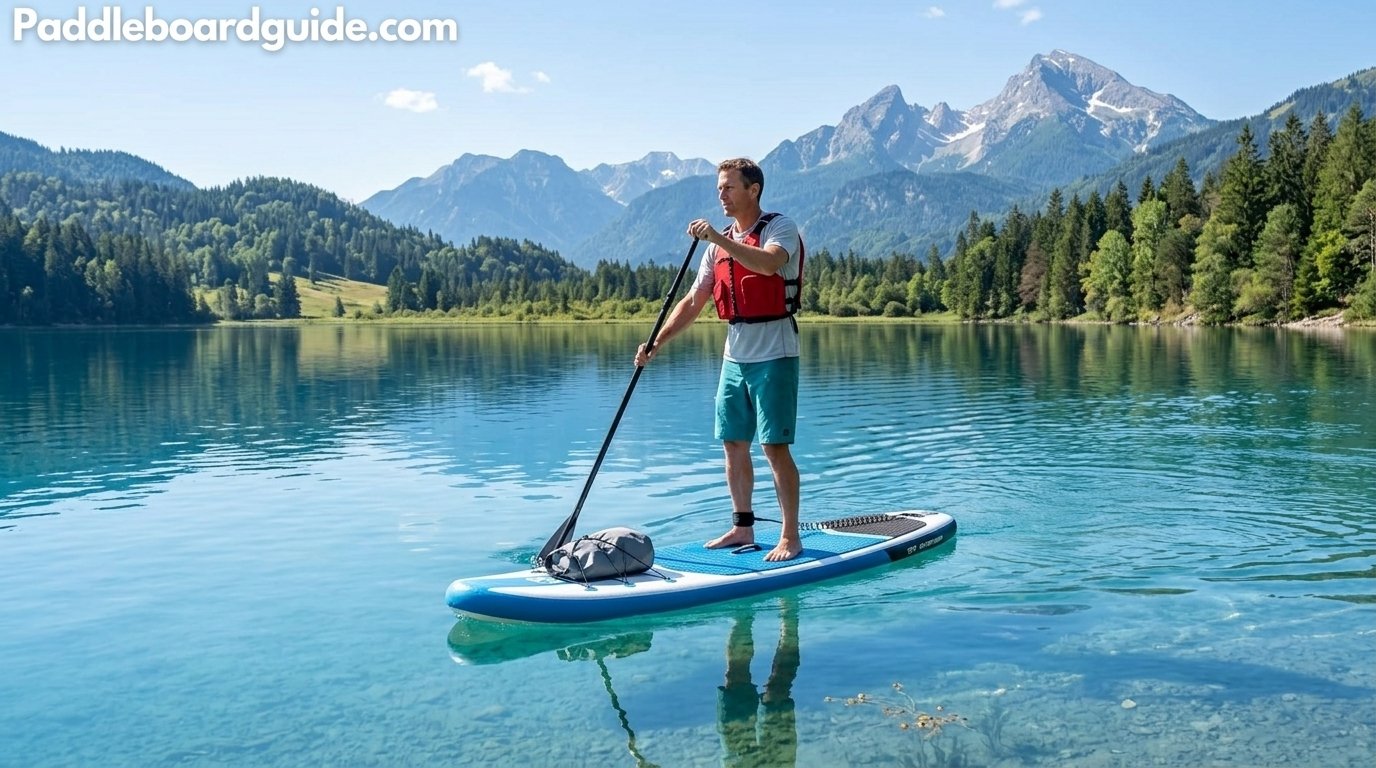
Paddle Board Types Explained: Which SUP Style Actually Fits How You Paddle
Inflatable, epoxy, touring, fishing, yoga, hybrid — the SUP market throws a lot of labels at new buyers. Here’s what each type is actually built for, how they differ underwater and on deck, and how to match a board to the way you really plan to use it.
What Actually Defines a “Type” of Paddle Board
Walk into any paddle sport shop, or scroll through a page of listings online, and you’ll see boards labeled “all-around,” “touring,” “inflatable,” “yoga,” and half a dozen other names. It’s tempting to think these are marketing categories designed to make the buying decision more confusing than it needs to be. In reality, each label describes a genuine set of design trade-offs: hull shape, rail profile, length-to-width ratio, rocker, fin configuration, and construction material all shift depending on what a board is meant to do on the water.
A board built to plane efficiently across a lake for a lazy Saturday paddle behaves completely differently from one built to hold a straight line for eight miles, or one built to survive being dropped, kneeled on, and dragged across gravel by a dog and two kids. Understanding paddle board types isn’t about memorizing marketing terms — it’s about recognizing which hull shape and build quality actually solves the problem you have.
Before diving into each category, it helps to understand the three variables that do most of the work in separating one SUP type from another:
- Hull shape — planing hulls (flat bottom) are stable and maneuverable; displacement hulls (pointed nose, like a canoe) cut through water efficiently for speed and tracking.
- Length and width — longer and narrower boards go faster and track straighter; shorter and wider boards are more stable and easier to turn.
- Construction — inflatable drop-stitch PVC, epoxy/fiberglass over foam, and composite carbon layups each change weight, rigidity, durability, and price dramatically.
With that framework in mind, here’s a full breakdown of the paddle board types you’re actually going to encounter while shopping, starting with the category most first-time buyers land on.
It’s also worth noting that these categories aren’t always as rigidly separated as a spec sheet implies. Manufacturers frequently blend traits from two categories into a single board — a wide touring hull with extra deck padding, or a fishing platform with a slightly sharper nose for better glide between casting spots. Treat the categories below as reference points on a spectrum rather than strict boxes, and pay closer attention to the actual dimensions and hull shape of any specific board than to the marketing name printed on the deck.
One more variable worth flagging early: fin setup. Most SUPs ship with either a single large center fin, a 2+1 setup (one center fin plus two smaller side fins), or a thruster arrangement borrowed from surfboard design. Center fins favor straight-line tracking and are common on all-around and touring boards, while multi-fin setups favor maneuverability and show up more often on surf-oriented shapes. Fin choice doesn’t define a board’s type on its own, but it reinforces the intended use case and is a useful detail to check when a board’s category feels ambiguous from photos alone.
All-Around Boards
All-around boards are the “does a bit of everything” category, and they’re the default recommendation for most beginners for good reason. They typically run 10 to 11 feet long and 30 to 34 inches wide, with a rounded nose and a planing hull that keeps the board flat and stable on the water rather than knifing through it.
That width and flat bottom translate into forgiving balance, which matters enormously for someone standing on a board for the first handful of sessions. All-around boards handle flat lakes, mellow rivers, small coastal chop, and casual bay paddling without punishing the rider for imperfect technique. They’re not the fastest boards on the water and they won’t track as straight over long distances as a touring hull, but that’s the trade-off for the stability that makes them approachable.
If you’re comparing your first purchase against dedicated categories like SUP boards versus other paddle board formats, an all-around inflatable is usually the safest entry point because it tolerates mistakes in both technique and storage.
The rounded nose on an all-around board isn’t purely cosmetic — it reduces the chance of the board diving under a small wave or wake and lets the hull ride up and over chop instead of plowing through it. That same rounded profile costs a bit of glide efficiency compared to a pointed touring nose, which is the central compromise built into the entire all-around category: everything is tuned toward “good enough at everything” rather than “excellent at one thing.”
Deck layout on all-around boards also tends to be the most beginner-friendly of any category. Expect a generous diamond-shaped traction pad centered around the carry handle, front and rear bungee cargo areas for a dry bag or cooler, and multiple D-rings for attaching a leash or extra gear. Because the stance area is wide and centered, new paddlers have more room to shift their feet and recover balance mid-stroke, which meaningfully shortens the learning curve compared to narrower shapes.
Weight capacity on a typical 10 to 11 foot all-around board usually lands between 220 and 350 pounds, which comfortably covers most solo adult paddlers along with a small dry bag or a light dog. Heavier paddlers, or anyone planning to bring along a passenger, should size up toward the higher end of that length range or consider a wider board specifically rated for extra capacity rather than assuming any all-around board will do.
All-around boards also tend to be the most forgiving category when it comes to storage and neglect — a trait that matters more than most new owners expect. A hard-shell touring board left in direct sun for a full season can suffer more UV degradation to its resin coat than a similarly priced all-around inflatable that gets rolled up and stored indoors between sessions. That’s not a universal rule, but it’s a pattern worth factoring in if storage conditions at home are less than ideal.
It’s also worth mentioning how forgiving all-around boards are toward mixed-use households. A single all-around board can reasonably cover a beginner learning to balance, an intermediate paddler out for exercise, and a parent taking a child along for a slow paddle near shore — all without needing three separate boards in the garage. That flexibility is a large part of why this remains the single best-selling category across nearly every major SUP brand, year after year, regardless of what specialty categories happen to be trending.
Nose and tail shape variations within the all-around category are worth a closer look too. Some manufacturers taper the tail slightly narrower than the nose to improve turning responsiveness, while others keep both ends similarly rounded for maximum straight-line stability. Neither approach is objectively better — a slightly tapered tail helps with tighter turns around obstacles or when navigating a winding river, while a fully rounded, symmetric shape favors paddlers who mostly go in a straight line and back.
Pros
- Extremely stable for new paddlers
- Versatile across calm lakes, bays, and mellow rivers
- Usually the most affordable category
Cons
- Slower than touring or race hulls
- Doesn’t track as straight over long distances
- Not ideal for surf or heavy chop

Looking for a solid all-around starter board? Check current pricing and package deals on Amazon.
Check Price on AmazonInflatable (iSUP) Boards
Inflatable paddle boards deserve their own category rather than being lumped in as “just another all-around,” because the construction itself changes the ownership experience more than almost any other variable. Built from military-grade PVC layered over a drop-stitch core, a quality inflatable rolls up into a backpack-sized bag, inflates with a hand or electric pump in under ten minutes, and reaches a rigidity that’s remarkably close to a hard board once pumped to 15 PSI or higher.
The appeal is obvious for anyone without a garage, roof rack, or truck bed: no need to strap an unwieldy 10-foot hard shell to a car roof, no dedicated storage space, and dramatically lower risk of denting or cracking if the board bumps against a dock or rocky shoreline. For a full breakdown of which specific inflatable models hold up best over repeated seasons, this guide to the best inflatable paddle boards compares construction quality across the major brands.
Inflatables aren’t limited to the all-around shape either — you’ll now find inflatable touring boards, inflatable fishing platforms, and even inflatable race boards, since drop-stitch technology has matured enough to hold rocker and rigidity across longer, narrower hulls. The main trade-off remains a slightly softer feel underfoot compared to a hard epoxy deck, and a shorter usable lifespan if the PVC skin isn’t cared for. Understanding how long inflatable paddle boards typically last is worth reading before buying, since UV exposure and storage habits affect longevity more than most buyers expect.
Drop-stitch construction works by connecting the top and bottom PVC layers of the board with thousands of tightly woven internal threads, which is what allows the board to hold a flat, rigid shape once pressurized rather than ballooning into a tube. Cheaper single-layer PVC boards use one layer of material fused directly to the drop-stitch core, which keeps weight and cost down but leaves the board more vulnerable to abrasion and slow leaks over time. Fusion or double-layer construction adds a second, often heat-welded or woven layer over the same core, meaningfully improving puncture resistance and rigidity at the cost of a bit of extra weight and a higher price tag.
Recommended inflation pressure typically sits between 12 and 15 PSI for recreational inflatable boards, and going a few PSI under that range is one of the most common reasons a rider feels their inflatable “bouncing” or flexing underfoot during a stroke. A properly inflated board should feel taut enough to knock on like a drum; if it still gives noticeably under body weight at the recommended PSI, that’s usually a sign of a lower-quality drop-stitch core rather than a pump problem.
Repairability is another underrated advantage of the inflatable category. Most inflatable SUPs ship with a basic PVC patch kit, and small punctures from rocks, oyster beds, or a dog’s nails can typically be repaired at home in under an hour. A cracked hard-shell board, by comparison, often requires a proper fiberglass repair or a trip to a shaping shop, which costs more in both time and money for a comparable amount of damage.
Pump quality is another factor that shapes the day-to-day inflatable ownership experience far more than most buyers expect going in. A basic dual-action hand pump can take 10 to 15 minutes of real physical effort to reach 15 PSI, especially on a larger board, while an electric pump reduces that to a few minutes of essentially hands-off waiting. Buyers who plan to paddle frequently, or who simply want less friction between deciding to paddle and actually being on the water, often find an electric pump upgrade pays for itself in convenience within the first season.
Seam construction is worth a closer look when comparing inflatable boards across price points too. Budget boards often use glued seams along the rails, which can be a weak point for slow leaks over time if the adhesive isn’t applied evenly. Higher-end boards increasingly use heat-welded seams, which fuse the PVC layers together rather than relying purely on adhesive, producing a more consistent and generally more durable bond. This detail rarely appears prominently in marketing copy, but it’s one of the better predictors of how a board will hold up after several seasons of regular use.
| Feature | Inflatable SUP | Hard-Shell SUP |
|---|---|---|
| Storage | Deflates into a bag | Needs rack or wall space |
| Transport | Carries in a backpack | Requires roof rack or truck bed |
| Rigidity | Very good at high PSI | Excellent, no flex |
| Durability vs impact | Bounces off rocks/docks | Can dent or crack |
| Typical price | Lower to mid-range | Mid to high-range |
Epoxy / Hard-Shell Boards
Hard-shell boards — usually epoxy resin and fiberglass wrapped around an EPS foam core — remain the choice for paddlers who prioritize performance over convenience. Because the shape is molded rather than inflated, manufacturers can sculpt more aggressive rocker lines, sharper rails, and thinner, more hydrodynamic profiles than drop-stitch construction allows. That translates into noticeably better glide, more predictable turning, and a stiffer platform that transmits paddle power more directly into forward motion.
The trade-offs are practical rather than performance-related: a hard board needs a roof rack or truck bed for transport, dedicated storage space at home, and more careful handling since a hard impact against a rock or dock edge can crack the shell or delaminate the fiberglass layer. For buyers curious about how these boards are actually built layer by layer, this explainer on how paddle boards are made walks through the molding and lamination process in detail.
Epoxy boards dominate in categories where performance genuinely matters most: racing, long-distance touring, and surf-specific shapes, all covered in more detail below.
The EPS foam core inside a hard-shell board is typically shaped on a CNC machine to precise rocker and rail specifications before being wrapped in fiberglass cloth and saturated with epoxy resin. Higher-end boards add extra stringers — thin strips of wood or additional fiberglass laid along the length of the board — to reduce flex under load, which matters more than it sounds for larger paddlers or anyone covering long distances, since a flexing hull bleeds paddle energy that should be going into forward motion.
Weight is the other major differentiator inside the hard-shell category. A recreational epoxy all-around board might weigh 25 to 30 pounds, while a performance touring or race shape built with lighter foam and fewer fiberglass layers can come in under 20 pounds — a meaningful difference when carrying a board down to the water solo, especially over any real distance from car to shoreline.
Maintenance on a hard-shell board is generally lower-effort than people expect, provided a few basics are followed: rinse off salt water and sand after ocean sessions, avoid leaving the board in direct sun for extended periods when not in use, and store it out of direct ground contact to avoid pressure dings on the rails. Small dings from a knock on a dock or a fall onto a rock can usually be patched with a basic epoxy repair kit, though larger cracks that expose the foam core should be dealt with quickly, since foam absorbs water readily once the fiberglass barrier is broken.
Touring & Race Boards
Touring and race boards share the same core design logic — a displacement hull with a pointed nose that slices through water instead of riding on top of it — but they diverge at the extremes. Touring boards run roughly 12 to 12’6″ long and around 28 to 30 inches wide, striking a balance between speed and enough stability for multi-hour paddles with gear strapped to the deck. Race boards push further: 12’6″ to 14 feet long, often under 26 inches wide, purpose-built to be as fast as possible with stability treated as a secondary concern.
Both categories reward efficient technique and punish sloppy balance more than an all-around board would. A paddler who has logged real hours on flat water will find a touring board faster and more satisfying for open-water crossings, while a true beginner will likely find the narrower width intimidating until their balance catches up. If distance and speed matter more to you than forgiving stability, it’s worth reviewing how much weight a paddle board can hold before choosing a touring shape, since narrower hulls typically have a lower practical weight capacity than wide all-around boards of the same length.
Pros
- Tracks straight with minimal correction strokes
- Significantly faster than planing-hull boards
- Better for multi-mile paddles and open water
Cons
- Narrower stance takes longer to get comfortable on
- Less maneuverable in tight spaces
- Not ideal for surf or whitewater
The displacement nose on a touring or race board is designed to part water rather than climb over it, which is why these boards feel noticeably different underfoot the moment you start paddling: less bob and lift with each stroke, and a more continuous, glide-forward sensation once the board is moving. That efficiency compounds over distance — a small speed advantage per stroke adds up to a meaningfully shorter, less fatiguing crossing over two or three miles compared to a planing-hull board covering the same distance.
Race boards take the displacement concept further with a technical class system that governs board length for competitive events, most commonly 12’6″ and 14-foot classes recognized in most SUP racing circuits. Buyers who don’t plan to compete rarely need to think about class rules, but it explains why race boards cluster tightly around those two lengths rather than spanning a wider range like recreational categories do.
Touring boards typically retain a slightly wider, more forgiving stance than dedicated race boards specifically so recreational paddlers can carry a loaded dry bag, a cooler, or camping gear for a multi-day paddle trip without the balance penalty a true race hull would impose. That middle ground — meaningfully faster than an all-around board, meaningfully more stable than a race board — is exactly why touring remains the more popular choice for paddlers who want speed without dedicating themselves to competition.
Deck rigging on touring boards also tends to be more elaborate than on all-around shapes, with larger front cargo areas designed to accommodate a dry bag, tent, or cooler for overnight paddle-camping trips, along with additional D-rings along the rails for securing gear that might otherwise shift during longer crossings. Some dedicated touring boards even include a rear kick pad, letting a paddler shift weight onto the tail briefly to lift the nose for a quicker pivot turn — a maneuver that’s far more difficult on a board without that reinforced tail section.
Wind and current management is another skill that becomes more relevant once a paddler moves into touring distances. A narrower, faster hull is more efficient in calm conditions but can be more affected by crosswind due to its lower stability margin, requiring a slightly wider stance and more deliberate corrective strokes to hold a line in gusty conditions. Paddlers transitioning from an all-around board to a touring shape often need a session or two to adjust their technique before the speed advantage fully translates into a more enjoyable — rather than more exhausting — paddling experience.
Yoga & Fitness Boards
Yoga and fitness SUPs take the all-around shape and widen it further — often 32 to 36 inches wide — while flattening the deck pad into one continuous, cushioned surface instead of a smaller traction pad near the paddler’s stance. The extra width and full-deck padding create a stable, comfortable platform for poses, stretching routines, or simply lounging, since there’s rarely a need to move around the board the way a paddler would when covering distance.
Many yoga-specific boards also include D-ring anchor points positioned for securing the board in place with a small anchor, since these sessions are typically done stationary on calm water rather than paddled point-to-point. If flat-water fitness use is the primary goal rather than covering ground, this category consistently outperforms all-around boards for comfort, even though it sacrifices some paddling efficiency in exchange.
Deck padding is the real differentiator in this category rather than hull shape. Where most SUPs use a smaller traction pad centered around the standing stance, yoga and fitness boards typically extend soft EVA foam padding across nearly the entire top surface — nose to tail — so a pose that shifts hands or knees toward the front or back of the board still lands on cushioned, grippy material rather than bare, harder deck. That full-length pad also happens to make these boards comfortable for simply lying down to relax on the water, which is part of why the category has grown well beyond dedicated yoga practitioners into general leisure use.
Because stability at rest matters more than glide for this category, fitness boards tend to be among the widest recreational SUPs on the market, frequently exceeding 34 inches. That width does come with a real trade-off in paddling efficiency and wind resistance — a wide, flat-decked board catches more crosswind than a narrower hull, which can make paddling back to shore against a stiff breeze more tiring than expected. Anyone planning regular sessions on open, breezy water should weigh that against the stability benefit before committing to the widest board available.

Want extra stability for yoga or fitness sessions on the water? Compare wide-deck SUP options here.
Check Price on AmazonFishing SUPs
Fishing paddle boards are essentially all-around boards reinforced and reshaped to carry gear and support a stationary angler. They tend to run wider — often 34 to 36 inches — with a flatter, more stable planing hull, multiple mounting points for rod holders and tackle trays, and reinforced deck pads that hold up to hooks, pliers, and a cooler dragged across the surface. Weight capacity is usually pushed higher than a standard all-around board of the same length, since anglers are strapping down coolers, tackle boxes, anchors, and sometimes a small motor mount in addition to their own body weight.
Stability at a dead stop matters more here than glide or speed, since much of a fishing session is spent standing still casting rather than paddling continuously. Buyers coming from a kayak or small boat background should read through general paddle board safety requirements before combining fishing gear with SUP use, since the added weight and standing posture change the board’s balance characteristics compared to recreational paddling.
Rod holder placement is one of the more overlooked details when comparing fishing SUPs. Flush-mounted holders positioned too close to the paddler’s stance can interfere with paddling stroke or footwork when moving between spots, while holders mounted too far toward the nose or tail can make a hooked fish harder to manage. Better fishing-specific boards position at least two holders within easy reach of a seated or kneeling angler without crowding the primary standing area.
Many fishing SUPs also support an optional seat conversion using the deck’s front and rear D-rings, letting a paddler switch between standing to sight-cast and sitting low for a more stable, kayak-like position while actively fighting a fish or paddling longer distances between spots. That flexibility is a major reason dedicated fishing boards have grown into their own category rather than staying a niche accessory setup on top of a standard all-around board.
Anchor systems matter more here than almost any other category too. A simple anchor trolley run along one rail lets an angler hold position in light current or wind without constantly re-paddling, which conserves energy over a multi-hour session and keeps the board oriented correctly relative to a fishing spot rather than slowly drifting off target.
Storage capacity is another area where fishing SUPs diverge sharply from other categories. Beyond the standard bungee cargo area found on most boards, dedicated fishing platforms often include recessed tackle tray mounts, action-camera mount points for recording catches, and sometimes an integrated cooler mount positioned to double as a stable seat. These additions add weight compared to a stripped-down all-around board, but they remove the need for improvised bungee-and-strap workarounds that less specialized boards require.
Stability under lateral movement — leaning to net a fish or reaching to unhook a line boat-side — is arguably the most important stability metric for this category, even more than stability while simply standing still. Wider fishing boards with a flatter rocker profile and higher rail volume near the edges resist tipping during these off-balance moments far better than a narrower all-around board would, which is part of why serious anglers rarely try to make do with a standard recreational shape once they’ve paddled a purpose-built fishing platform.
SUP Surf Boards
SUP surf boards borrow more from traditional surfboard shaping than any other paddle board type. They’re shorter — often 8 to 10 feet — with a narrower tail, more pronounced rocker curving up at the nose and tail, and a lower volume that lets the board carve through breaking waves rather than plane flat across them. That lower volume also means less stability at rest, which is why this category is generally recommended only after a paddler has built solid balance on a wider board first.
Fin setup on SUP surf boards typically favors a thruster (three-fin) or quad configuration for the same reason surfboards use them: sharper, more responsive turning when carving down the face of a wave. This is a specialist category, and buyers shopping for one board to cover surf, lakes, and long-distance touring will find that a dedicated surf shape compromises heavily everywhere except in actual waves.
Volume — the total displacement of the board measured in liters — is the key spec to understand in this category, since it correlates directly with paddling stability and how easily a rider can catch a wave. A higher-volume SUP surf board, sometimes ranging from 90 to well over 120 liters depending on the rider’s weight and skill, floats a paddler more easily and forgives mistakes better, while lower-volume boards favor advanced riders who prioritize sharp turning and a more surfboard-like feel over flotation.
Because SUP surf boards are shorter and carry a more pronounced rocker curve, they don’t paddle efficiently on flat water compared to a longer touring or all-around hull — every stroke does less work moving the board forward. That’s an intentional trade for wave performance, but it’s exactly why this category performs so poorly as a do-everything board and is generally recommended as a second or third purchase for a rider who has already built comfort on a more stable shape.
Youth & Kids Boards
Kids’ paddle boards scale down the all-around shape — shorter length, lighter overall weight, and a lower recommended PSI for inflatables — so smaller paddlers can actually lift, carry, and control the board themselves rather than depending entirely on an adult. Widths are often kept proportionally generous relative to length to maximize stability, since a wobbly board is the fastest way to turn a first paddling experience into a bad one.
Weight capacity on youth boards is intentionally modest, so parents should double check the manufacturer’s rated capacity against the child’s weight plus any life jacket or gear before buying, rather than assuming a smaller board scales safety limits down proportionally with size.
Grip and traction matter disproportionately on kids’ boards, since younger paddlers tend to shift their footing more frequently and less predictably than adults as they find their balance. Better youth boards extend the traction pad closer to full deck coverage, similar to a yoga board, specifically to reduce the chance of a slip during the wobblier early sessions most young paddlers go through before their balance stabilizes.
A shorter carry handle placement and a lighter overall pump-up weight also make a real difference in whether a child can participate in setup and carrying the board to the water, rather than treating the whole process as something only a parent handles. That sense of ownership tends to keep kids more engaged with the activity over multiple seasons compared to simply being placed on an adult-sized board that they can’t manage themselves.
Multi-Person & Family Boards
Multi-person boards stretch the all-around concept to genuinely oversized dimensions — frequently 12 to 15 feet long and 34 to 38 inches wide — to support two or more paddlers, a child, or a dog simultaneously. Weight capacities regularly exceed 400 to 500 pounds, and multiple D-ring attachment points down the centerline let more than one rider secure gear or a seat in different positions along the deck.
Because of their size and construction demands, most multi-person boards are inflatable rather than hard-shell, simply because a rigid board that large would be extremely difficult to store or transport. Reviews like the Retrospec Weekender review and the Bote inflatable paddle board review both cover models in this oversized, family-friendly category in more depth.
Rigidity becomes a bigger engineering challenge as board length increases, since a longer inflatable hull has more surface area that can flex under distributed weight. Better multi-person boards compensate with higher recommended PSI ratings, thicker drop-stitch cores, and sometimes additional internal reinforcement rails running the length of the board specifically to resist the kind of middle sag that shows up when two adults and a cooler are all loaded onto the same platform at once.
Practically speaking, most owners of multi-person boards don’t paddle them fully loaded on every outing — the extra size is there for the occasional family trip or a day out with a dog, while solo sessions on the same board simply mean more stability than necessary rather than a downside. That flexibility is the main selling point of the category: one board that scales from a relaxed solo paddle to a full family outing without needing a second purchase.
Handle placement is a small but meaningful detail on multi-person boards, since a board this size is rarely carried by one person alone. Better designs place a center carry handle for two-person lifting in addition to the standard front handle, making the process of getting a bulky, heavier board from car to water noticeably less awkward. Buyers who plan to transport a multi-person board solo on a regular basis should weigh this carefully, since even a folded, deflated inflatable in this size range can be a genuine two-person carry once packed into its bag.
Seating configuration is worth planning for as well. Many families use multi-person boards with a removable kayak-style seat attached to the front or rear D-rings, converting the SUP into a stable, low-profile sit-down paddling platform for a child or a less confident adult passenger, while the primary paddler stands and steers from the rear. This dual-mode flexibility — stand-up for the experienced paddler, seated for a passenger — is one of the more practical reasons this category has grown well beyond a novelty purchase into a genuine mainstream option for paddling households.

Paddling with kids, a dog, or a partner? See current pricing on oversized multi-person SUPs.
Check Price on AmazonHybrid & Windsurf-Ready Boards
Hybrid boards are designed to flex between roles: a wide, stable all-around hull with a mast mount fitted in for occasional windsurfing, or a shape that splits the difference between touring speed and all-around stability. These boards make sense for paddlers who want to try multiple disciplines without owning a quiver of specialized shapes, though — like most hybrids — they rarely match a dedicated board’s performance in any single category.
Buyers weighing a hybrid against a purpose-built board should be honest about how often they’ll actually use the secondary feature. A windsurf-ready SUP that gets rigged twice a year is still a perfectly good all-around paddle board the rest of the time, which is often reason enough to justify the compromise.
Windsurf-compatible SUPs typically add a standardized mast mount point (commonly a US Box fin box combined with a threaded deck insert) positioned toward the center of the board, along with a slightly deeper, wider fin than a standard all-around board would use to resist the sideways pull generated by a sail. That added fin and mount hardware adds a small amount of weight and drag during regular paddling, which is the trade-off hybrid buyers accept in exchange for not needing two separate boards in the garage.
Some hybrids extend the concept further with modular fin systems that let a single board swap between a paddle-focused fin setup and a windsurf-oriented one in a few minutes without tools. That kind of modularity is worth prioritizing for anyone seriously considering a hybrid, since it narrows the performance gap between the board’s two roles more effectively than a fixed, compromise fin setup ever could.
Construction & Materials Compared
Regardless of shape category, every paddle board is built from one of a handful of core material systems, and understanding them clarifies a lot of the price spread you’ll see while shopping.
| Construction | Typical Weight | Rigidity | Durability | Price Range |
|---|---|---|---|---|
| Single-layer PVC inflatable | Light–Moderate | Good | Moderate | Budget |
| Fusion / double-layer PVC inflatable | Moderate | Very Good | High | Mid-range |
| EPS foam + epoxy/fiberglass | Moderate | Excellent | Moderate (impact-sensitive) | Mid to High |
| Carbon fiber composite | Very Light | Excellent | Moderate (impact-sensitive) | Premium |
| Wood veneer / bamboo composite | Moderate | Excellent | High with care | Premium |
IRocker and similar brands have built a reputation specifically around fusion-layer PVC that closes the rigidity gap with hard boards; the iRocker paddle board review breaks down how that construction performs after repeated seasons of use.
Carbon fiber composite construction sits at the top of the price ladder for a reason: it delivers hard-shell rigidity at a fraction of the weight of a standard epoxy layup, which matters enormously for race and performance touring boards where every extra pound directly costs speed and increases paddler fatigue over distance. The trade-off is cost and, in many cases, a slightly more brittle feel on impact compared to a standard fiberglass layup — carbon panels can crack rather than flex under a hard enough hit, which is part of why most recreational buyers don’t need to reach for this tier of construction.
Wood veneer and bamboo composite boards occupy a smaller, more premium niche, prized as much for their appearance as their performance. A thin wood veneer layer is typically bonded over an EPS core and sealed with epoxy, producing a board that’s both visually distinctive and genuinely durable when properly cared for, though the wood layer does require more attentive maintenance — regular rinsing, careful storage away from moisture buildup, and periodic resealing — than a standard painted fiberglass finish.
One detail that catches new buyers off guard: PSI ratings aren’t directly comparable across brands, since drop-stitch core density varies. A board rated for 15 PSI from one manufacturer isn’t necessarily as rigid as a different brand’s 15 PSI board if the underlying drop-stitch weave is less dense. When comparing inflatable boards on paper, rigidity claims and independent reviews matter more than the PSI number alone.
Fin Configurations Explained
Fins do more to shape a board’s on-water behavior than most buyers realize when they’re focused purely on length and width. The three most common setups are single-fin, 2+1, and thruster/quad arrangements, and each favors a different balance of tracking versus maneuverability.
Single-fin setups
A single, larger center fin is the most common configuration on all-around, touring, and race boards. It maximizes straight-line tracking, which matters most when the goal is covering distance efficiently or holding a course across open water without constant correction strokes. The trade-off is reduced maneuverability — turning a single-fin board tends to require a wider arc or a dedicated pivot stroke rather than a quick, tight turn.
2+1 setups
This configuration pairs a standard center fin with two smaller side fins, and it’s common on hybrid and some all-around boards that want a bit of both worlds. The side fins add stability and a touch of turning responsiveness without sacrificing much of the tracking benefit the center fin provides. Many 2+1 setups allow the center fin to be removed entirely, effectively converting the board into a looser, more maneuverable shape for surf-style use when needed.
Thruster and quad setups
Borrowed directly from surfboard design, these multi-fin arrangements prioritize sharp, responsive turning over straight-line efficiency, which is exactly why they dominate the SUP surf category. A thruster’s three fins work together to grip the wave face during a turn, while a quad’s four smaller fins spread that grip across a slightly wider stance, often favored in faster, more powerful wave conditions.
Fin material also affects performance more than it might seem. Flexible plastic fins are common on budget and beginner boards and hold up well to the occasional bump against a rock or sandbar without cracking, while stiffer fiberglass or carbon fins found on performance boards transmit more directional control at the cost of being more prone to snapping on a hard impact. Most fins today use a standard slide-in box system, making it straightforward to swap a stock fin for an aftermarket one if a paddler wants to fine-tune tracking or turning behavior without buying an entirely new board.
For inflatable boards specifically, fin setup usually comes down to a choice between a permanently glued-on fin and a removable click-fin or slide-in fin. Removable setups are strongly preferable for anyone transporting the board rolled up in a bag, since a fixed fin adds bulk and risk of damage during packing, while a click-fin system detaches in seconds and packs flat alongside the rest of the kit.
Rocker and Volume: The Specs Behind the Specs
Length, width, and thickness get most of the attention on a spec sheet, but two less-visible measurements — rocker and volume — often explain why two boards with nearly identical dimensions can feel completely different on the water.
Understanding rocker
Rocker refers to the upward curve of the board’s nose and tail when viewed from the side, similar to the curve of a banana. A flatter rocker profile maximizes waterline length and glide efficiency, which is why touring and race boards keep rocker to a minimum — every bit of flat hull in contact with the water improves speed on calm conditions. A more pronounced rocker, lifting the nose and tail higher, helps a board rise over chop, wind waves, and swell instead of plowing through them, which is why surf-specific boards and boards intended for rougher coastal conditions carry noticeably more rocker than a flat-water touring hull.
The practical impact of rocker becomes obvious the first time a paddler takes a flat, low-rocker touring board into moderate chop: the nose tends to dig into oncoming waves rather than rising over them, slowing the board and occasionally sending spray up over the deck. The same board on dead-flat water, meanwhile, will out-glide a higher-rocker all-around or surf board stroke for stroke, since more of its length stays in efficient contact with the water.
Understanding volume
Volume, measured in liters, represents the total water displacement of the board and correlates directly with how much weight it can float and how stable it feels at a given paddler weight. Two boards of identical length and width can have meaningfully different volume depending on thickness and rail shape, which is why comparing raw length and width alone doesn’t tell the whole story about how stable or capable a board will actually feel underfoot.
As a rough guide, recreational all-around and touring boards for an average adult paddler typically fall in the 240 to 320 liter range, while dedicated SUP surf boards intentionally run lower — sometimes well under 150 liters — to keep the board responsive and low-profile in the water. Fishing and multi-person boards trend toward the higher end of the volume spectrum, often exceeding 350 liters, specifically to support the additional weight of gear, coolers, or a second rider without sacrificing stability.
Matching volume to paddler weight and skill level is arguably a better predictor of how comfortable a board will feel than length and width alone, particularly for buyers moving between categories — someone comfortable on a high-volume all-around board may find a lower-volume touring or surf shape considerably less stable at first, even if the width numbers look similar on paper.
How to Choose the Right Type
With the categories laid out, narrowing down a choice usually comes down to answering four questions honestly rather than getting pulled in by a single spec sheet.
1. Where will you actually paddle most often?
Flat lakes and calm bays favor all-around or touring boards. Ocean surf breaks call for a dedicated surf shape. Rivers with light current are usually fine on an all-around board, though whitewater demands a specialized hull entirely outside this list.
2. How will you store and transport it?
No garage, no roof rack, or a small apartment strongly favors inflatable construction across almost any shape category. A dedicated garage and a roof rack open up hard-shell options without the transport penalty.
3. Are you paddling solo, with a passenger, or with gear?
Solo recreational paddling fits an all-around board comfortably. Fishing gear, a passenger, or a dog pushes toward wider, higher-capacity shapes, and possibly the multi-person category.
4. How much does speed and distance matter to you?
If the plan is short, relaxed sessions, stability should outweigh speed every time. If the goal is covering real distance efficiently, a touring or race hull earns back its narrower learning curve quickly.
5. What’s your realistic skill trajectory over the next year or two?
It’s worth buying slightly ahead of current skill level rather than strictly for day one. A paddler who knows they’ll want to cover more distance within a season or two might be better served by a touring board with a short adjustment period than an all-around board they’ll outgrow the efficiency of within a summer. That said, buying too far ahead — a race board for a first-time paddler, for instance — usually backfires by making early sessions frustrating enough to discourage continued practice.
6. Who else will be using the board?
A board purchased for shared household use — a partner, kids, or houseguests trying it out — benefits from leaning toward the more forgiving end of whichever category fits, since stability accommodates a wider range of skill levels and body weights than a performance-tuned shape ever will.
Running through these six questions before comparing specific models tends to narrow the field from “every SUP on the market” down to two or three realistic candidates within a single category, which is a far more manageable comparison than trying to evaluate touring, fishing, and yoga boards side by side as if they were interchangeable.
Common Mistakes When Choosing a Paddle Board Type
A handful of buying mistakes show up repeatedly across first-time SUP purchases, and most of them trace back to focusing on the wrong spec first.
Buying based on length alone
Length gets the most attention in product titles, but width and hull shape affect the actual paddling experience just as much, if not more. A short, wide board can be more stable than a longer, narrower one, despite the shorter length looking less capable on paper.
Underestimating weight capacity needs
Buyers frequently size a board to their own body weight without accounting for a dry bag, cooler, dog, or passenger they plan to bring along regularly. It’s worth reviewing how much weight a paddle board can hold in the context of everything that will realistically end up on deck, not just the paddler.
Choosing a performance shape before building balance
Touring, race, and surf shapes reward existing paddling skill rather than building it from zero. A narrower board bought too early often gets used less, not more, simply because early sessions feel unstable and unrewarding.
Ignoring storage and transport realities
A hard-shell board that looks great in reviews becomes a liability if there’s no roof rack, no garage space, and no realistic way to get it to the water regularly. Matching construction type to actual logistics matters as much as matching hull shape to paddling style.
Overlooking accessory and mounting needs
Anglers who buy a standard all-around board often find themselves retrofitting rod holders and anchor points that a dedicated fishing board would have included from the start. Thinking through accessory needs before buying avoids a second purchase down the line.
Chasing the lightest possible board without context
Lighter boards are easier to carry, but shaving weight often comes from thinner rail construction or a lower-density foam core, both of which can reduce durability and rigidity. A moderate weight increase in exchange for meaningfully better durability is usually the better trade for anyone who isn’t specifically training for competition, where every fraction of a pound genuinely matters.
Assuming a higher price always means a better fit
Premium construction and performance-tuned shapes matter enormously for advanced paddlers pushing the limits of their category, but a beginner is often better served by a mid-priced, stable all-around board than a top-tier race or surf shape that punishes imperfect technique. Matching the board to genuine skill level and use case delivers more real-world satisfaction than matching it to the highest available price point.
Care and Maintenance Across Types
Maintenance requirements shift somewhat by construction type, but a few habits extend the usable life of any paddle board regardless of category. Rinsing a board with fresh water after every session in salt water or heavily silted lakes prevents grit from working into seams, valves, and fin boxes over time. Drying a board fully before folding and storing an inflatable prevents mildew from developing inside the rolled material, which is one of the more common — and avoidable — reasons inflatable boards degrade faster than expected.
UV exposure deserves more attention than most new owners give it. Both PVC and epoxy/fiberglass surfaces degrade under prolonged direct sunlight, becoming more brittle and prone to cracking or fading over repeated seasons. Storing a board in a garage, a padded bag, or at minimum under a breathable cover between sessions meaningfully slows that degradation compared to leaving it inflated and exposed on a dock or deck all summer.
For inflatables specifically, releasing some air pressure during long-term off-season storage — rather than leaving the board fully pressurized for months — reduces stress on seams and valve housings. For hard-shell boards, storing the board on padded racks rather than leaning it against a wall on one rail edge prevents slow pressure dings from developing at a single stress point over time.
Valve maintenance is a small habit that pays off disproportionately for inflatable owners. Rinsing sand and grit away from the valve area before deflating prevents debris from working into the valve mechanism, which over time can cause slow air leaks that are frustrating to diagnose since they’re easy to mistake for a puncture elsewhere on the board. Occasionally applying a small amount of silicone lubricant to the valve’s rubber seal, per most manufacturers’ guidance, keeps it sealing properly across many inflate-deflate cycles.
Fin care is often overlooked but matters across every category. Removable fins should be rinsed and dried before long-term storage to prevent salt buildup in the fin box, which can make the fin difficult to remove later and, in worse cases, cause the box itself to degrade. For boards used in sandy or rocky shallows, periodically checking the fin box for cracks or looseness catches minor damage before it turns into a fin that snaps off entirely mid-paddle.
Finally, seasonal transitions are a good checkpoint for a more thorough inspection regardless of board type: checking seams and glue lines on an inflatable, inspecting the deck pad for lifting edges, testing the pump and repair kit before the first outing of a new season, and confirming that D-rings and bungee cords haven’t degraded from UV exposure over months of storage. A ten-minute inspection at the start of each season catches most of the issues that would otherwise turn into a ruined outing once already on the water.
Full Comparison Table
| Type | Length | Width | Stability | Speed | Best Use |
|---|---|---|---|---|---|
| All-Around | 10–11 ft | 30–34 in | High | Moderate | Beginners, general recreation |
| Touring | 12–12.6 ft | 28–30 in | Moderate | High | Long-distance flat water |
| Race | 12.6–14 ft | <26 in | Low | Very High | Competitive paddling |
| Yoga/Fitness | 10–11 ft | 32–36 in | Very High | Low | Stationary fitness, poses |
| Fishing | 10.5–12 ft | 34–36 in | Very High | Low–Moderate | Angling, gear hauling |
| Surf | 8–10 ft | 27–30 in | Low | Moderate | Wave riding |
| Multi-Person | 12–15 ft | 34–38 in | Very High | Low | Families, dogs, groups |
Frequently Asked Questions
What is the most versatile type of paddle board for a beginner?
An all-around inflatable board between 10 and 11 feet long is generally the most versatile starting point, since it balances stability, portability, and a low price point against nearly every recreational paddling scenario.
Are inflatable paddle boards as good as hard boards?
Modern fusion-layer inflatables come very close in rigidity to hard-shell boards for recreational use, though hard boards still edge them out in pure performance categories like racing and surf, where hull precision matters more.
What length paddle board is best for stability?
Shorter, wider boards in the 10 to 11 foot range with 32 inches or more of width tend to be the most stable, since the extra surface area spreads the paddler’s weight more evenly across the water.
Can one paddle board work for both touring and fishing?
It’s possible with a wide all-around board that has extra D-rings and weight capacity, though a dedicated touring hull won’t carry gear as comfortably and a dedicated fishing board won’t glide as efficiently over distance.
Do yoga paddle boards work for regular paddling too?
Yes, though their extra width and flatter rocker make them noticeably slower and less efficient over distance compared to a standard all-around shape.
What type of paddle board is best for ocean use?
A touring board handles ocean flat water and light chop well, while a dedicated SUP surf board is built specifically for riding waves rather than covering distance.
How much weight can a typical all-around paddle board hold?
Most all-around boards in the 10 to 11 foot range hold between 220 and 350 pounds, though capacity varies by brand and construction, so checking the specific model’s rated capacity is worth the extra minute.
Is a longer paddle board always faster?
Generally yes, since a longer waterline improves glide efficiency, but width and hull shape matter just as much — a long, wide board won’t necessarily outpace a shorter, narrower displacement hull.
What’s the difference between a planing hull and a displacement hull?
A planing hull is flat and rides on top of the water, favoring stability and maneuverability, while a displacement hull has a pointed nose that cuts through water, favoring speed and straight-line tracking.
Are multi-person paddle boards harder to paddle solo?
They can feel less responsive solo due to their size and weight, though most remain paddleable by one person — they’re simply less nimble than a board sized for a single rider.
Do kids need a specific type of paddle board?
Youth-specific boards are lighter and easier for smaller paddlers to carry and control, but a properly fitted life jacket and close supervision matter more for safety than the board category itself.
Which paddle board type lasts the longest?
With proper care, both hard epoxy boards and fusion-layer inflatables can last many seasons; inflatables tend to resist impact damage better, while hard boards resist UV and puncture-related wear better.
Do I need a different paddle for different board types?
The paddle itself doesn’t need to match board type in most cases, though touring and race paddlers often prefer a slightly smaller blade for higher-cadence strokes over long distances, while all-around and fishing paddlers typically favor a larger blade for stronger, less frequent strokes.
What does board volume actually tell you?
Volume, measured in liters, indicates how much weight a board can float at a given stability level; two boards with similar length and width can still feel very different if their volume — driven by thickness and rail shape — differs significantly.
Should beginners avoid boards with more rocker?
Not necessarily — a bit of rocker helps a board handle chop and small waves more comfortably, which can actually make early sessions less intimidating; it’s extreme, surf-specific rocker combined with low volume that tends to challenge new paddlers rather than rocker on its own.
Conclusion
There’s no single “best” paddle board type — only the type that matches where you paddle, how you transport and store gear, and what you actually want out of time on the water. Beginners and casual paddlers are almost always best served by a wide, stable all-around inflatable. Distance-focused paddlers should look toward touring or race hulls. Anglers, yoga practitioners, and families each have a purpose-built category waiting for them once the core hull shapes make sense.
Whichever direction fits your paddling plans, comparing a few well-reviewed models before buying will save far more frustration than chasing the lowest price alone.
Browse Paddle Boards on AmazonAs an Amazon Associate, this site earns from qualifying purchases. Product links on this page may be affiliate links, and prices/availability are accurate as of the time of publishing but may change.