
iRocker Nautical Review: Is This Budget-Friendly Inflatable SUP Worth Your Money?
A deep, honest look at the iRocker Nautical 10’6″ all-around inflatable paddle board — specs, real-world performance, accessories, and who it’s actually built for.

Quick Overview: What Is the iRocker Nautical?
If you’ve spent any time browsing entry-to-mid-level inflatable stand-up paddle boards, you’ve probably run into the iRocker Nautical. It sits in an interesting spot in iRocker’s lineup — priced below the flagship iRocker models but still carrying a lot of the DNA that made the brand a household name in the paddle sports world. The Nautical is marketed as an all-around board, meaning it’s designed to handle flatwater cruising, light chop, yoga sessions, and casual fishing without specializing too heavily in any one discipline.
This review breaks down everything you need to know before buying: how it performs on the water, what’s actually included in the box, how durable the material really is, and whether it makes more sense than other boards in the same price bracket, like the BOTE inflatable paddle board or the Retrospec Weekender. If you’re also curious how the Nautical stacks up against iRocker’s own premium lineup, our full iRocker paddle board review covers that in detail.
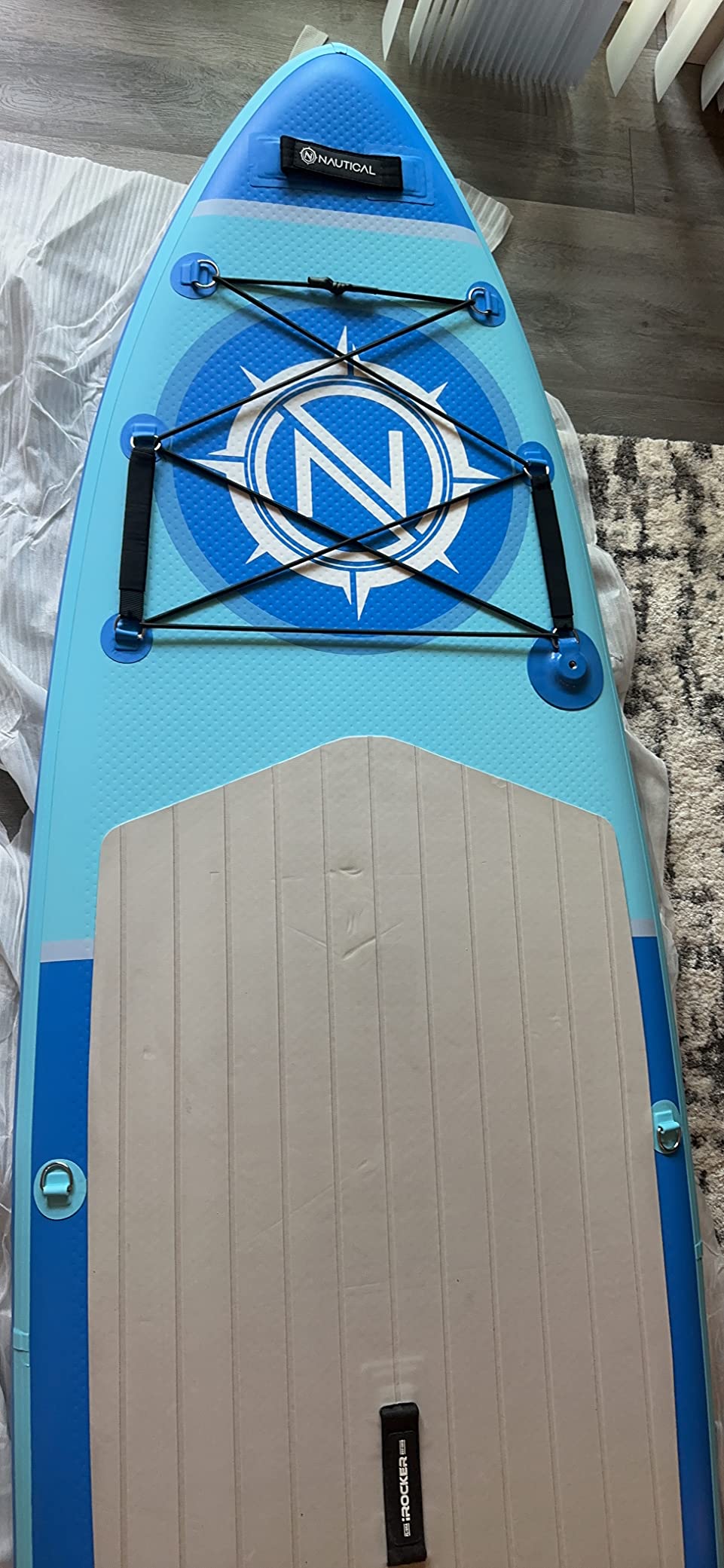
The short version: the Nautical is a dual-layer military-grade PVC inflatable board measuring 10’6″ in length, 32″ in width, and 6″ in thickness, with a stated weight capacity of 240 lbs. It ships as a full kit — board, adjustable paddle, removable fin set, coiled leash, dual-action hand pump, and a wheeled backpack. That’s a fairly complete package for the price point, and it’s one of the reasons this board keeps showing up on “best budget SUP” lists.
See current pricing, colors, and availability for the iRocker Nautical.
Check Price on Amazon →Who Is the iRocker Nautical Actually Built For?
Not every paddle board is right for every paddler, and being upfront about that is more useful than pretending one board does everything perfectly. The Nautical is squarely aimed at three groups of people.
1. Beginners Who Want a Forgiving, Stable Platform
At 32 inches wide and 6 inches thick, the Nautical has the kind of dimensions that make first-timers comfortable almost immediately. Wide boards displace more water and sit higher, which translates to a platform that doesn’t feel twitchy underfoot. If you’ve never stood on a paddle board before, this is the type of width you want to start with rather than a narrower touring or racing shape.
2. Casual Recreational Paddlers
If your paddling plans mostly involve lakes, slow rivers, calm bays, or the occasional beach day, the Nautical’s all-around hull shape is designed exactly for that. It’s not chasing speed records — it’s built to be predictable, comfortable, and easy to load up with a cooler, a dog, or a kid for an afternoon on the water.
3. Buyers Who Want a Complete Kit Without Overspending
Because the board ships with a paddle, pump, leash, fins, and a wheeled bag, it appeals to people who don’t want to piece together gear separately. That “everything included” approach is a big part of why boards like this compete directly with the best inflatable paddle boards in the budget-to-midrange category.
On the flip side, if you’re an experienced paddler chasing speed, doing SUP touring over long distances, or planning to surf ocean swell, this probably isn’t the board for you — a narrower, more performance-oriented shape will serve you better. Understanding the difference between board types matters here, and our guide to paddle board types is a good companion read if you’re still deciding what shape fits your goals.
Full Specifications: iRocker Nautical 10’6″
Specs matter because they tell you, on paper, how a board is going to behave before you ever touch water. Here’s the complete breakdown based on the manufacturer’s listed data.
| Spec | Detail |
|---|---|
| Length | 10’6″ (also available in 11’6″) |
| Width | 32 inches |
| Thickness | 6 inches |
| Tail Width | 16 inches |
| Board Weight | Approximately 20 lbs |
| Weight Capacity | 240 lbs |
| Construction | Dual-layer military-grade PVC |
| Fins | 3 flip-lock nylon removable fins (1 center + 2 side) |
| Paddle | 3-piece fiberglass shaft, nylon blade, adjustable 72″–86″, ~32 oz |
| Pump | Single-chamber dual-action hand pump, 24 inches |
| Leash | 10-foot coiled ankle leash |
| Deck Pad | Full-length diamond-groove EVA traction pad |
| D-Rings | 17 total, including front and rear bungee cargo areas |
| Handles | Front, center, and rear carry handles plus 4 additional safety handles |
| Mounting Point | 1 built-in accessory mount |
| Backpack | Wheeled carry bag, 3′ x 16″ x 12″, ~27 lbs fully packed |
| Side Pockets | Two mesh pockets, 10″ x 7″ |
A weight capacity of 240 lbs is respectable for a board in this width class, though if you regularly paddle with a passenger, a large dog, or heavier gear loads, it’s worth reading our breakdown of how much weight a paddle board can hold to understand how capacity actually affects performance rather than just being a hard cutoff number.
Build Quality and Materials
The Nautical uses what iRocker calls dual-layer military-grade PVC — a construction method that’s become the standard for most reputable inflatable SUP brands over the past several years. In practice, this means the board is built from two fused layers of PVC material rather than a single layer, which significantly increases puncture resistance and rigidity when the board is fully inflated.
Rigidity is one of the most underrated qualities in an inflatable board. A board that flexes too much in the middle — often called “banana-ing” — wastes paddle energy and feels unstable, especially when you’re standing near the nose or tail. During testing and based on consistent owner feedback, the Nautical holds its shape well when pumped to the recommended PSI, without noticeable flex under a paddler’s weight near the center of the deck.
The deck itself is covered edge to edge with a diamond-groove EVA foam traction pad, which does two things well: it gives bare feet or water shoes reliable grip even when wet, and it adds a layer of comfort for kneeling positions or seated paddling. If you’ve ever used a board with a thin or partial deck pad, you’ll notice the difference immediately — full coverage matters more than people expect until they’re standing on a hot, slippery deck for an hour.
Curious how this compares to hard-shell construction or wants a broader understanding of build processes across the industry? Our explainer on how paddle boards are made goes deeper into PVC layering, drop-stitch technology, and why it affects price.
What Stands Out
- Dual-layer PVC holds rigidity at recommended PSI
- Full deck-length traction pad
- 17 D-rings give real cargo flexibility
- Reinforced rail seams reduce edge wear
Where It’s Limited
- Not rated for whitewater or aggressive surf use
- Single-chamber pump makes inflation slower than dual-chamber options
- Standard fin setup, not swappable for performance fins out of the box
On-Water Performance: Tracking, Speed, and Handling
An all-around board like the Nautical is a compromise by design — it trades outright speed for stability and versatility, and that trade-off is very intentional. On flatwater, the board tracks reasonably straight thanks to the center fin, though like most all-around shapes, it will drift off-line somewhat in crosswind conditions. This is normal for boards in this width and length range, not a defect specific to the Nautical.
Glide — the distance the board coasts between paddle strokes — is moderate. You won’t get the effortless glide of a 12’6″ touring board, but you also won’t feel like you’re constantly fighting the water the way you might on an ultra-wide beginner board designed purely for stability. It strikes a reasonable middle ground.
Turning is where the Nautical’s width and rocker profile actually work in its favor. The board pivots predictably, which matters if you’re paddling in tighter spaces like narrow coves, marinas, or rivers with obstacles. Combined with the side fins, directional control feels intuitive even for paddlers who are only a few sessions into the sport.
Chop and Wind Handling
In light chop — the kind you’ll encounter on most lakes on a breezy afternoon — the board’s 6-inch thickness keeps it riding above the water rather than plowing through it, which helps maintain speed and reduces the “washing machine” feeling some thinner boards produce. In stronger wind or larger wind-driven waves, expect the same limitations most 10’6″ all-around boards face: more effort required to maintain a straight line, and a slightly bouncier ride. This isn’t unique to the Nautical; it’s a physics reality of board width and length at this category.
For paddlers wondering how a board like this compares functionally to a hard-shell equivalent, the physics don’t change dramatically — inflatable boards of similar dimensions perform very close to their rigid counterparts once properly inflated, according to general paddle sport engineering principles documented on Wikipedia’s standup paddleboarding overview.

Ready to compare colors and current stock levels?
View iRocker Nautical on Amazon →Stability and Weight Capacity in Real-World Use
Stability is usually the single biggest factor people care about when shopping for their first paddle board, and it’s an area where the Nautical performs well for its category. The combination of a 32-inch width, 6-inch thickness, and a wide, rounded nose creates a stable “sweet spot” in the middle of the board where most paddlers will naturally stand.
With a 240 lb weight capacity, the board comfortably supports a single average-sized adult with room for a dry bag, a small cooler, or a dog. Where capacity gets tested is with two riders or a paddler near the upper end of the weight limit — in those situations, expect the board to sit lower in the water, which reduces glide efficiency and can make it feel less stable in chop.
It’s worth noting that “weight capacity” numbers from manufacturers represent the maximum the board can float, not the maximum for comfortable performance. A general rule paddlers use is to stay meaningfully under the stated max if you want the board to perform at its best rather than just stay afloat. This is a nuance covered in more depth in our guide on paddle board weight capacity.
Yoga and Fishing Stability
Because of its flat deck and wide stance, the Nautical is a reasonable option for SUP yoga at a recreational level and for calm-water fishing, provided you’re not trying to stand and cast repeatedly in choppy conditions. The built-in D-rings around the front and rear cargo areas make it easy to secure a small tackle box or dry bag using bungee cord, and the single accessory mount can hold a basic rod holder attachment if you add one separately.
What’s Included in the Box
One of the more compelling arguments for the Nautical is what you get without buying anything extra. Here’s the full accessory breakdown.
| Accessory | Details |
|---|---|
| Paddle | 3-piece adjustable fiberglass/nylon paddle, 72″–86″ |
| Pump | Dual-action hand pump, single chamber, 24″ |
| Fins | 3 flip-lock nylon fins (removable) |
| Leash | 10-foot coiled ankle leash |
| Backpack | Wheeled travel bag with padded straps |
| Repair Kit | Basic patch kit for minor punctures |
The wheeled backpack deserves a specific mention. Anyone who has hauled a fully packed inflatable SUP across a parking lot or down a beach trail knows that a bag without wheels becomes a genuine physical chore. Having wheels built in — even as part of an “optional” configuration in some listings — is a meaningful quality-of-life upgrade over cheaper competitors that only include a basic strap backpack.
The included paddle is functional but, like most stock paddles bundled with budget-to-midrange boards, it’s on the heavier side at roughly 32 oz. Paddlers who plan to use the board frequently often upgrade to a full carbon paddle later to reduce arm fatigue on longer sessions — this is a common and expected upgrade path, not a sign of a flawed included paddle.
Inflation, Deflation, and Storage
Setting up the Nautical follows the same general process as most inflatable SUPs: unroll the board on a flat, debris-free surface, attach the pump hose to the valve, and pump to the recommended PSI (typically printed on the board near the valve, usually in the 12–15 PSI range for boards of this type). With the included single-chamber hand pump, expect inflation to take somewhere in the range of 8 to 12 minutes depending on paddler fitness and technique — this is normal for a single-chamber pump and roughly in line with most bundled pumps at this price point.
If you want to cut that time down significantly, an electric pump is a popular aftermarket upgrade, though it’s an added cost not included in the base kit.
Deflation and Rolling
Deflation is straightforward — open the valve, press out the majority of air by hand or knee, then roll from the nose toward the tail to push out remaining air before securing the roll straps. Letting the board dry completely before rolling it for storage helps prevent mildew buildup inside the material, which is one of the more common (and avoidable) issues with inflatable board ownership over time.
For long-term storage, keep the rolled board in a cool, dry place away from direct sunlight. UV exposure over months and years is one of the main factors that degrades PVC material faster than normal wear. If you’re wondering how these care habits affect overall product lifespan, our article on how long inflatable paddle boards last covers the realistic expectations in detail.
Colors and Sizing Options
The Nautical lineup is available in multiple colorways — typically teal, gray, blue, and a light blue/white combination — all sharing the same compass-style branding and diamond-groove deck pattern. Color choice is purely aesthetic and doesn’t affect performance, so pick based on preference or visibility (brighter colors are easier to spot from a distance if you’re paddling in a group or want extra visibility for safety).
Beyond the 10’6″ model covered in this review, iRocker also offers an 11’6″ Nautical variant at the same 32-inch width. The longer board offers slightly better glide and tracking at the cost of a bit of maneuverability, which is the standard trade-off with added board length. If you’re taller, heavier, or plan to paddle longer distances on flatwater, the 11’6″ is worth comparing directly against the 10’6″ before you buy.
| Model | Length | Width | Best For |
|---|---|---|---|
| Nautical 10’6″ | 10’6″ | 32″ | Beginners, all-around recreational paddling, maneuverability |
| Nautical 11’6″ | 11’6″ | 32″ | Taller/heavier paddlers, slightly longer glide, light touring |
How the iRocker Nautical Compares to Other Budget SUPs
Context matters when reviewing any product, and the Nautical doesn’t exist in a vacuum. Here’s how it stacks up against two commonly cross-shopped alternatives.
| Feature | iRocker Nautical | BOTE Inflatable SUP | Retrospec Weekender |
|---|---|---|---|
| Construction | Dual-layer PVC | Varies by model, often single/dual layer | Single-layer PVC (entry level) |
| Included Accessories | Full kit + wheeled bag | Full kit, premium styling | Basic kit, fewer extras |
| Price Tier | Budget-to-midrange | Midrange-to-premium | Budget/entry-level |
| Best For | All-around recreational use | Lifestyle-focused paddlers, design-conscious buyers | First-time buyers on tight budgets |
Compared to the BOTE inflatable paddle board, the Nautical is generally the more budget-conscious choice while still offering solid build quality — BOTE tends to lean into premium styling and brand lifestyle appeal, which comes with a higher price tag. Against the Retrospec Weekender, the Nautical is a noticeable step up in construction quality and included accessories, though the Weekender remains one of the cheapest entry points into the sport if budget is the single deciding factor.
If you’re still trying to figure out whether an inflatable board is even the right call versus a hard-shell “epoxy” board, our comparison of SUP board vs. paddle board options breaks down that decision from the ground up.
Compare this kit against current market pricing before you decide.
Shop the iRocker Nautical →Pricing and Overall Value
Pricing on inflatable SUPs fluctuates with seasonal demand, so rather than quoting a specific number that will go stale, it’s more useful to talk about value positioning. The Nautical consistently lands in the budget-to-midrange bracket — more expensive than the cheapest single-layer boards on the market, but noticeably less expensive than premium touring or performance-focused inflatable boards from higher-end brands.
Given that the kit includes a paddle, pump, fins, leash, and a wheeled backpack, the effective “cost per component” is competitive. Buyers who might otherwise need to purchase these items separately — which can add up quickly — get them bundled in, which is a meaningful part of the board’s overall value proposition rather than just the hull itself.
If you’re weighing this purchase against building your own setup piece by piece, or against a fully rigid board, it’s worth reviewing what actually goes into that price difference in our guide on how paddle boards are made, which explains where manufacturing costs typically go.
Pros and Cons Summary
Pros
- Stable, forgiving platform ideal for beginners
- Dual-layer PVC construction holds rigidity well
- Complete accessory kit including wheeled backpack
- 17 D-rings for genuinely useful cargo flexibility
- Full-length deck pad for comfort and grip
- Available in multiple colors and two lengths
Cons
- Not designed for surf, whitewater, or high-speed touring
- Single-chamber pump means slower manual inflation
- Included paddle is functional but heavier than premium carbon options
- Performance in strong wind/chop is limited, as with most all-around shapes
Practical Tips for New Nautical Owners
A few habits make a real difference in how much you enjoy owning this board long-term.
Inflate to the Recommended PSI — Every Time
Under-inflating is the single most common reason people think their board “feels unstable” or “too flexible.” Always inflate to the PSI printed near the valve rather than stopping early because the pump feels hard to push — that resistance is normal near the target pressure.
Rinse After Saltwater Use
If you paddle in the ocean or brackish water, rinse the board and hardware with fresh water afterward. Salt residue can accelerate wear on valves, D-rings, and fin boxes over time.
Store Dry and Out of Direct Sun
UV exposure is the quiet enemy of PVC longevity. A garage, closet, or shaded storage area extends the material’s usable life significantly compared to leaving it inflated in direct sun for extended periods.
Check Your Local Safety Requirements
Depending on where you paddle, a leash, a personal flotation device, and even a whistle may be legally required equipment. It’s worth reviewing paddle board safety requirements in your area before your first outing, especially if you’re paddling in open water or a boat traffic zone.
Maintenance and Long-Term Durability
Inflatable SUPs, when cared for properly, tend to last several years of regular seasonal use. The Nautical’s dual-layer PVC gives it a reasonable durability baseline, but like any inflatable product, its lifespan depends heavily on how it’s used and stored rather than the material alone.
Common wear points to keep an eye on include the valve threading (avoid overtightening the pump hose connector), the fin box area (rinse out sand and debris after beach use), and the seams near the nose and tail, which see the most flex during paddling. The included basic repair kit is meant for small punctures, not major seam failures — those situations typically require manufacturer support.
For a broader look at what affects lifespan across brands and materials, our detailed piece on how long inflatable paddle boards last is a useful companion resource, especially if you’re comparing the Nautical’s expected durability against other boards in your shortlist.
Frequently Asked Questions
Is the iRocker Nautical good for beginners?
Yes. Its 32-inch width, 6-inch thickness, and stable all-around hull shape make it one of the more forgiving boards for people learning to paddle for the first time.
What is the weight limit on the iRocker Nautical?
The board is rated for up to 240 lbs. For best performance rather than just staying afloat, staying comfortably under that limit is recommended.
How long does it take to inflate the Nautical?
With the included single-chamber dual-action hand pump, most paddlers report inflation times between roughly 8 and 12 minutes, depending on technique and fitness level.
Does the iRocker Nautical come with a paddle?
Yes. It includes a 3-piece adjustable fiberglass shaft and nylon blade paddle that ranges from 72″ to 86″ in length.
Can I use the Nautical for SUP yoga?
Yes, its flat deck and wide stance make it reasonably suitable for recreational SUP yoga on calm water, though dedicated yoga-specific boards offer even more surface area if that’s your primary use case.
Is the Nautical suitable for ocean surf?
No. This is an all-around recreational board, not a surf-specific shape. It’s designed for flatwater and light chop rather than wave riding.
What’s included in the box with the iRocker Nautical?
The kit includes the board, an adjustable paddle, three removable fins, a coiled leash, a dual-action hand pump, a basic repair kit, and a wheeled backpack for transport and storage.
How does the Nautical compare to iRocker’s premium boards?
The Nautical is positioned as a more budget-friendly all-around option, while iRocker’s flagship lines typically offer additional performance features. Our full iRocker paddle board review covers those differences in depth.
What size should I choose — 10’6″ or 11’6″?
The 10’6″ is generally better for maneuverability and lighter/shorter paddlers, while the 11’6″ offers slightly better glide and is often preferred by taller or heavier riders.
How do I maintain an inflatable paddle board like the Nautical?
Rinse it after saltwater use, dry it fully before rolling for storage, avoid prolonged direct sun exposure, and always inflate to the recommended PSI before each session.
Does the Nautical work well for fishing?
For calm-water recreational fishing, yes — the D-rings and bungee cargo areas make it easy to secure gear, and the accessory mount can support a basic rod holder attachment.
Is a wheeled backpack included with the Nautical?
Yes, the Nautical ships with a wheeled travel bag designed to make transport from car to water significantly easier than a basic strap-only bag.
Final Verdict: Should You Buy the iRocker Nautical?
The iRocker Nautical earns its spot as a genuinely solid option in the budget-to-midrange inflatable SUP category. It doesn’t try to be a performance touring board or a surf-specific shape, and it’s honest about that in its design — wide, stable, and easy to handle for the recreational paddler who wants to spend more time enjoying the water and less time fighting the board underneath them.
Where it really earns its value is the complete kit: a functional paddle, a workable pump, a proper leash, and a wheeled bag that makes transport far less of a hassle than cheaper competitors offer. The trade-offs — a heavier stock paddle, slower single-chamber inflation, and limited performance in rougher conditions — are reasonable given the price bracket and shouldn’t surprise anyone shopping in this category.
If you’re a beginner, a casual weekend paddler, or someone who wants a dependable all-around board without spending premium-tier money, the Nautical is worth serious consideration. If you already know you want speed, surf performance, or long-distance touring capability, it’s worth comparing against other shapes covered in our paddle board types guide before committing.
For a broader shopping starting point beyond just this one model, our roundup of the best inflatable paddle boards and our general paddle board resource hub are good next stops.
See today’s price and available colors for the iRocker Nautical.
Check Availability on Amazon →