Best Inflatable Paddle Boards: The Complete Buyer’s Guide
Everything you need to choose the right inflatable stand up paddle board for your budget, skill level, and the kind of water you actually paddle — plus in-depth reviews of the ten boards worth your money.
Why Inflatable Paddle Boards Have Taken Over the Water
Ten years ago, walking into a paddle sports shop meant staring at a wall of hard-shell epoxy boards, each one roughly the size and shape of a small canoe, and wondering how on earth you were supposed to get one home without a roof rack, a truck bed, or a very understanding friend with a minivan. Inflatable stand up paddle boards changed that equation almost overnight. Today, the majority of paddle boards sold to first-time buyers are inflatable, and for good reason: they roll up into a backpack-sized bundle, they survive bumps against rocks and docks that would gouge a hard board, and modern drop-stitch construction has closed the performance gap to the point where casual and even many intermediate paddlers genuinely cannot tell the difference on the water.
That said, “inflatable paddle board” is not a single product category — it is a spectrum. A budget board with a single-layer PVC skin and a hand pump will feel noticeably different underfoot than a premium double-layer fusion board pumped to 15 PSI with a high-volume electric pump. The gap between the cheapest and most expensive boards on this list is not just price; it is rigidity, tracking, weight capacity, and how the board behaves in wind and chop. This guide exists to help you understand those differences before you spend your money, not after.
We’re going to walk through what actually matters when shopping for an inflatable board, then review ten specific models that represent the best options across different price points and use cases — from a barebones weekend cruiser to a rugged expedition-ready package with a kayak seat included. If you’re brand new to the sport, you may also want to read our breakdown of the different types of paddle boards before diving into specific models, since not every board here is built for the same kind of paddling.
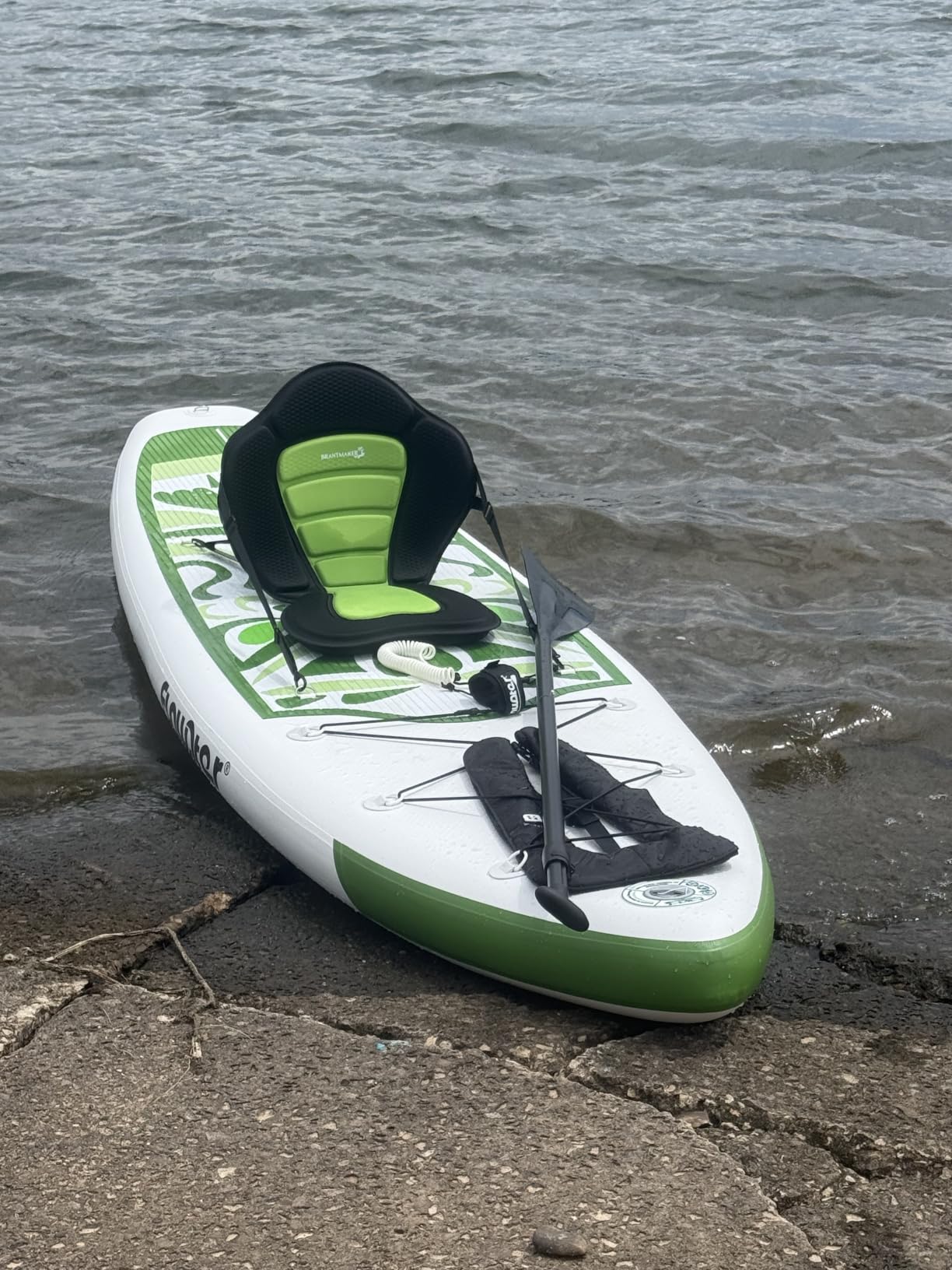
Our overall top pick combines rigidity, a stable stance, and a complete accessory kit for under the price of most hard boards.
Check Current Price on AmazonHow We Evaluate Every Board on This List
We don’t just read spec sheets and rewrite them. Every board on this list was assessed against the same core criteria so you can compare apples to apples, not marketing copy to marketing copy.
- Rigidity under load. How much does the board flex (“banana”) when a 180+ lb paddler stands at center with weight shifted toward the nose or tail? This single factor affects glide and paddling efficiency more than almost anything else.
- Tracking and glide. Does the board hold a straight line, or does it wander and require constant correction strokes? Fin design, rocker profile, and hull shape all play a role here.
- Stability footprint. Width, thickness, and rail shape combine to determine how forgiving a board is for a beginner finding their balance versus how efficiently it moves for an experienced paddler.
- Weight capacity versus real-world usability. A board rated for 350 lbs on paper often performs noticeably worse at 300 lbs than a board rated for 300 lbs performs at 250 lbs. We look at the practical sweet spot, not just the number on the box.
- Included accessories and build quality. Pump quality, paddle material, backpack durability, and D-ring placement all affect the ownership experience long after the unboxing.
- Value relative to price bracket. A $300 board and a $900 board are not competing for the same buyer, so we judge each one against its actual price tier.
For readers curious about the manufacturing side of things, our deep dive on how paddle boards are made explains why drop-stitch core construction is what allows an inflatable board to reach rigidity anywhere close to a hard-shell board, and why layer count and PSI rating matter so much more than most shoppers realize.
Buying Guide: What Actually Matters When Choosing an iSUP
Length, Width, and Thickness
Most all-around inflatable boards fall between 10 and 11’6″ in length and 30 to 34 inches in width. Longer boards generally track straighter and glide farther per stroke, which matters for touring and fitness paddling. Wider boards are more forgiving for beginners, yoga, or paddling with a dog or child on board, but they sacrifice some top-end speed. Thickness — almost universally 6 inches on modern boards — is what gives an inflatable board its rigidity; going with a 4 or 5 inch board might save a few dollars but will flex noticeably more under load.
PSI Rating and Layer Construction
Look for boards rated to at least 15 PSI. Single-layer PVC boards are lighter and cheaper but flex more and are more prone to punctures. Double-layer or “fusion” construction — where the PVC skin is fused rather than glued to the drop-stitch core — resists delamination far better over years of use and generally allows for a firmer, more consistent inflation.
Weight Capacity
Manufacturers list a maximum weight capacity, but you should shop for your comfortable capacity, not your maximum. As a rule of thumb, stay under about 80% of the stated maximum if you want the board to still feel stable and maintain reasonable freeboard (the distance between the deck and the waterline). Our detailed breakdown of how much weight a paddle board can actually hold walks through the math and why the printed number is more of a ceiling than a target.
Fin Setup
A single large center fin is the standard setup for touring and all-around paddling, offering the best straight-line tracking. A 2+1 setup (one large center fin plus two smaller side fins) improves stability and is common on beginner-oriented boards. Removable fin systems let you swap in a smaller fin for shallow or weedy water.
Pump Quality
This is the single most underrated spec on the box. A poor hand pump can turn a 10-minute inflation into a 25-minute cardio workout. Dual-action hand pumps (which pump air on both the push and pull stroke at low pressure, then switch to single-action for the final high-pressure push) are the current standard. Several boards on this list now ship with electric pumps, which is a meaningful upgrade if you plan to inflate and deflate regularly.
Deck Pad and D-Rings
A full-length or at least stance-length EVA foam deck pad with a grooved or diamond texture makes a real difference in grip, especially when wet. Bungee cargo areas at the nose (and sometimes tail) held down by D-rings let you strap a dry bag, cooler, or extra gear.
When an Inflatable Board Makes Sense
- You live in an apartment or have limited garage/storage space
- You don’t have a roof rack or vehicle suited to hauling a hard board
- You paddle a mix of lakes, mellow rivers, and coastal bays
- You want to travel with your board (fly, road trip, hike-in access)
- You’re budget-conscious and want durability against dock and rock impacts
When a Hard Board Might Be Better
- You’re racing competitively or chasing maximum top-end speed
- You surf waves regularly and need a rockered, performance shape
- You have secure, dry, spacious storage and a roof rack already
- You prioritize the absolute stiffest possible ride over portability
If you’re still deciding between the two categories entirely, our comparison of SUP boards vs. traditional paddle boards goes further into the performance and lifestyle trade-offs. And before you head out for the first time, it’s worth reading up on paddle board safety requirements in your area — many states legally classify a SUP as a vessel, which means specific gear (like a leash and a PFD) may be mandatory, not optional.
New to inflatable boards? Every model below includes a full kit — pump, paddle, fin, and backpack — so you can be on the water same-day.
See Full Board LineupTop 10 Inflatable Paddle Boards at a Glance
| Board | Best For | Length | Weight Capacity |
|---|---|---|---|
| Niphean Inflatable SUP | Best overall value | 10’6″ | Up to ~330 lbs |
| FEATH-R-LITE iSUP | Lightest carry weight | 10’6″ | Up to ~275 lbs |
| FunWater iSUP | Best beginner package | 10’6″ | Up to ~330 lbs |
| FBSPORT 11′ Premium | Best all-around touring | 11′ | Up to ~350 lbs |
| Retrospec Weekender | Best budget pick | 10′ | Up to ~250 lbs |
| SereneLife 10′ | Best for light/casual paddlers | 10′ | Up to ~275 lbs |
| AISUNSS iSUP | Best for families | 10’6″ | Up to ~350 lbs |
| ZLX 11’6″x35″ | Best for heavier paddlers | 11’6″ | Up to ~400 lbs |
| ISLE 2-in-1 Kayak Bundle | Best versatility | 10′ | Up to ~275 lbs |
| BOTE Wulf Aero | Best premium build | 11’6″ | Up to ~300 lbs |
1. Niphean Inflatable Stand Up Paddle Board — Best Overall Value

Why It Earns Our Top Spot
The Niphean lands in that sweet spot where price, rigidity, and completeness of the accessory kit all line up. At 10’6″ long and roughly 32 inches wide, it’s sized for exactly the kind of all-around paddling — calm lakes, slow rivers, protected bays — that the overwhelming majority of buyers actually do. The double-layer PVC construction pumps up firm and stays firm; even with a paddler in the 180–200 lb range shifting weight toward the nose, the deck doesn’t visibly flex the way cheaper single-layer boards do.
The deck pad runs nearly the full usable length with a comfortable diamond-groove texture, and the bungee cargo area up front is generously sized — big enough for a small dry bag and a water bottle without anything hanging over the rails. The included aluminum paddle is adjustable and, while not as light as a full carbon paddle, is more than serviceable for casual and fitness paddling alike.
Pros
- Excellent rigidity for the price point
- Complete kit: pump, paddle, fin, leash, backpack, repair kit
- Stable, forgiving stance width for beginners
- Backpack straps and padding are genuinely comfortable for longer carries
Cons
- Hand pump is functional but slow above 12 PSI
- Single-fin setup only — no 2+1 option
- Not ideal for paddlers over roughly 220 lbs
Niphean Inflatable Stand Up Paddle Board — our top overall pick for value and rigidity.
Check Price on Amazon2. FEATH-R-LITE Inflatable Stand Up Paddle Board — Lightest Carry Weight

Built for Paddlers Who Actually Carry Their Board
True to its name, the FEATH-R-LITE is noticeably lighter than most boards in its length class, which matters more than spec sheets tend to communicate. If your walk from car to water involves a hill, a dock, or more than fifty yards of sand, shaving five or six pounds off the rolled-up bundle makes a real difference by the third or fourth trip out.
The trade-off for that lighter weight is a slightly lower maximum capacity than boards like the ZLX or AISUNSS, which makes this a better match for lighter or smaller-framed paddlers, or for households where the board mostly sees solo use rather than tandem paddling with a passenger.
Pros
- Noticeably lighter carry weight than comparable 10’6″ boards
- Still holds firm rigidity despite the weight savings
- Compact backpack that fits easily in a car trunk
Cons
- Lower weight capacity limits use for larger paddlers
- Less cargo bungee space than some competitors
FEATH-R-LITE Inflatable Stand Up Paddle Board — the pick for easy solo transport.
Check Price on Amazon3. FunWater Inflatable Stand Up Paddle Board — Best Beginner Package

An Easy, Confidence-Building First Board
FunWater has built a reputation on making the entry point into paddle boarding as friction-free as possible, and this board continues that pattern. The stance width is generous, the rocker (the upward curve at the nose and tail) is gentle enough to keep the board tracking predictably, and the included pump has a clear pressure gauge that removes the guesswork for first-time inflation.
For anyone who read our guide on the different types of paddle boards and landed on “all-around” as the right category, this is a strong, low-risk place to start.
Pros
- Very forgiving stability for first-time paddlers
- Clear, easy-to-read pressure gauge on the pump
- Well-padded backpack with a dedicated pump/paddle pocket
Cons
- Tracks slightly less efficiently than longer, narrower boards
- Aluminum paddle is on the heavier side for full-day paddling
FunWater Inflatable Stand Up Paddle Board — the easiest board here to learn on.
Check Price on Amazon4. FBSPORT 11′ Premium Stand Up Paddle Board — Best All-Around Touring Board

The Extra Foot Makes a Real Difference
Stepping up to 11 feet in length brings a noticeable improvement in glide distance per stroke compared to the 10’6″ boards on this list, without sacrificing much in the way of stability thanks to a wider-than-average build. Paddlers who want to cover more distance — think multi-mile lake tours or fitness paddling — will feel the difference within the first few strokes.
The higher weight capacity also opens this board up to tandem use with a small child or a dog riding along, something the shorter, lighter boards on this list handle less comfortably.
Pros
- Excellent glide and tracking for its category
- High weight capacity supports tandem paddling
- Full-length deck pad with a comfortable kneeling zone
Cons
- Longer length is slightly less nimble in tight spaces
- Bulkier rolled-up size than the 10′ boards
FBSPORT 11′ Premium Stand Up Paddle Board — the touring pick for going the distance.
Check Price on Amazon5. Retrospec Weekender Inflatable Paddle Board — Best Budget Pick

Proof That Budget Doesn’t Have to Mean Flimsy
Retrospec has carved out a niche as the brand you recommend to someone who wants to try paddle boarding without committing serious money to a hobby they’re not sure will stick. The Weekender is exactly that: a shorter, lighter, simpler board that still uses single-layer military-grade PVC and delivers acceptable rigidity for casual, calm-water paddling.
It won’t out-glide the longer boards on this list, and it’s not the pick for a 220 lb paddler looking for a firm platform, but for a lighter or younger paddler on a budget, it punches above its price.
Pros
- Genuinely affordable entry point into the sport
- Compact, easy-to-store rolled size
- Straightforward inflation with the included dual-action pump
Cons
- Lower weight capacity than most boards on this list
- Noticeably more flex under a heavier paddler
Retrospec Weekender Inflatable Paddle Board — read our full Retrospec Weekender review for a deeper breakdown.
Check Price on Amazon6. SereneLife 10′ Inflatable Stand Up Paddle Board — Best for Light or Casual Paddlers

A Simple, No-Fuss Cruiser
The SereneLife occupies similar territory to the Retrospec: a shorter, simpler board aimed at casual paddlers rather than fitness or touring paddlers. Where it distinguishes itself is a slightly wider stance for its length, which trades some glide efficiency for extra stability — a fair trade for anyone still building confidence on the water.
The included kit covers the basics well: a decent hand pump, adjustable aluminum paddle, coiled ankle leash, and a carry backpack that, while not padded as generously as premium options, is more than serviceable for occasional use.
Pros
- Wide, stable stance is confidence-inspiring for new paddlers
- Lightweight and easy to carry short distances
- Solid value for occasional, casual use
Cons
- Extra width slightly reduces glide compared to narrower boards
- Not built for frequent, heavy-use paddling seasons
SereneLife 10′ Inflatable Stand Up Paddle Board — an easygoing, stable cruiser.
Check Price on Amazon7. AISUNSS Inflatable Paddle Board — Best for Families

Room for the Whole Crew
With a higher weight capacity and a wide, stable deck, the AISUNSS is well suited to families who want one board that can handle a parent paddling solo one weekend and a parent-plus-kid tandem session the next. The extended bungee cargo area at the nose is large enough for a small cooler or multiple dry bags, which matters for full-day outings.
The deck pad extends further toward the tail than on some competitors, giving a second passenger a genuinely comfortable place to kneel or sit rather than perching on bare, textured PVC.
Pros
- High weight capacity supports tandem and family use
- Generous cargo bungee space front and center
- Extended deck pad comfortable for a second rider
Cons
- Wider stance trades off some solo-paddling efficiency
- Bulkier storage bag due to the larger board size
AISUNSS Inflatable Paddle Board — built for tandem and family paddling days.
Check Price on Amazon8. ZLX 11’6″x35″ Inflatable Paddle Board — Best for Heavier Paddlers

Length and Width Built for Bigger Loads
At 11’6″ long and 35 inches wide, the ZLX is the largest all-around board on this list, and that extra volume translates directly into the highest usable weight capacity here. Paddlers in the 220–280 lb range who have found other 10’6″ boards feel unstable or waterlogged at the rails will notice an immediate difference in freeboard and stability on the ZLX.
That extra size does come with trade-offs: it’s heavier to carry and slightly more affected by wind due to the larger surface area, so it’s a better fit for calmer, more protected water than for windy open bays.
Pros
- Highest weight capacity on this list
- Excellent stability for larger or heavier paddlers
- Strong tracking thanks to the added length
Cons
- Heaviest board here to carry and inflate
- More susceptible to wind due to larger surface area
ZLX 11’6″x35″ Inflatable Paddle Board — the highest-capacity board on our list.
Check Price on Amazon9. ISLE 2-in-1 Kayak & Paddle Board Bundle — Best Versatility
Two Watercraft in One Backpack
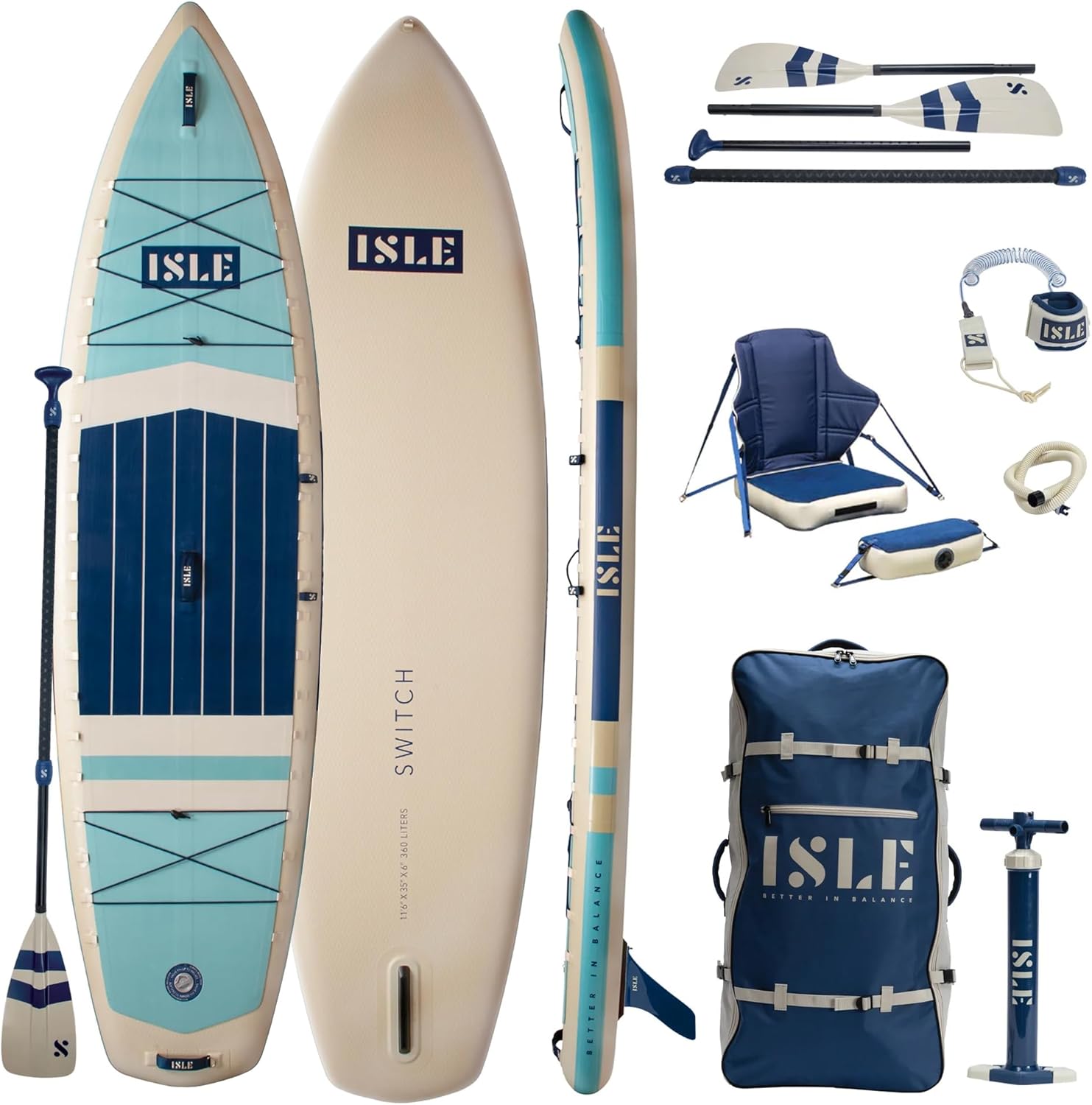
The ISLE bundle takes a different approach entirely: rather than optimizing purely for SUP performance, it ships with a removable kayak seat and a kayak-style paddle blade attachment, letting the same inflatable hull function as either a stand up paddle board or a sit-down kayak depending on the day, the weather, or who’s using it.
This is the pick for households that can’t decide between the two watercraft types, or for paddlers who want the option to sit and kayak on windier days when standing up is less appealing, without buying and storing two separate inflatables.
Pros
- Genuine two-in-one functionality, not a gimmick
- Kayak seat adds back support for long, relaxed paddles
- Great option for varying skill levels within one household
Cons
- Kayak mode isn’t as fast as a dedicated kayak
- More parts to track and store than a standard SUP kit
ISLE 2-in-1 Kayak & Paddle Board Bundle — two watercraft, one setup.
Check Price on Amazon10. BOTE Wulf Aero Inflatable Stand Up Paddle Board — Best Premium Build
When You Want the Nicest Board on the Water
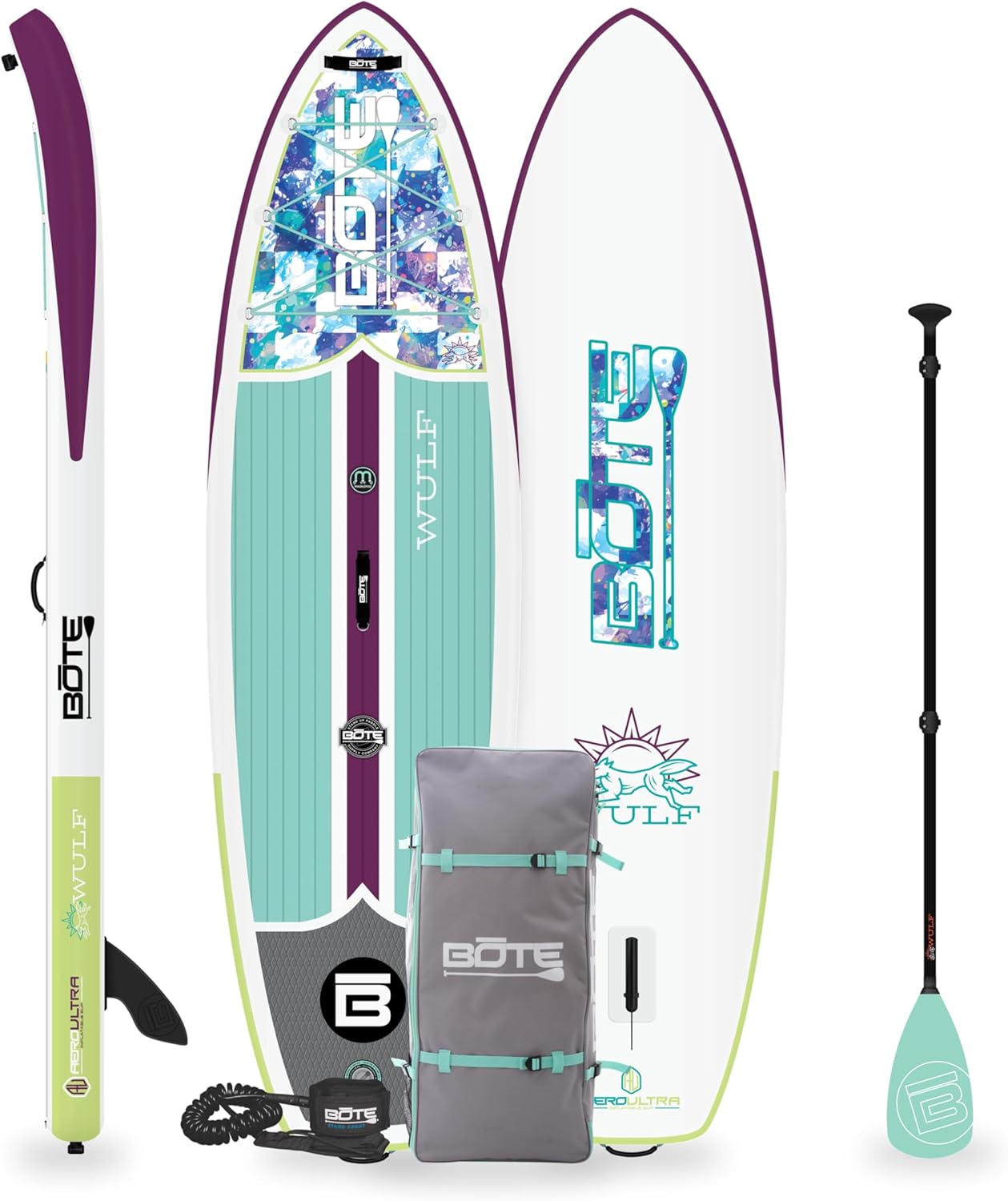
BOTE has built its brand around premium finishes and thoughtful design details, and the Wulf Aero is no exception. The rail taping is cleaner, the deck pad texture is more refined underfoot, and the overall fit and finish feels closer to a hard-shell board than most inflatables manage. At 11’6″, it shares the touring-friendly length of the FBSPORT and ZLX, with the rigidity to match thanks to BOTE’s fusion construction process.
This is the board for a buyer who has already owned a budget inflatable, knows exactly what they want out of the sport, and is ready to invest in a board they won’t outgrow.
Pros
- Exceptional rigidity and fit-and-finish for an inflatable
- Refined deck pad and rail design details
- Strong resale value relative to budget brands
Cons
- Highest price point on this list
- Overkill for a first-time or once-a-summer paddler
BOTE Wulf Aero Inflatable Stand Up Paddle Board — for more on BOTE’s build quality, see our full BOTE paddle board review. If you’re weighing BOTE against another premium brand, our iRocker review is a useful second data point.
Check Price on AmazonMaterials Deep Dive: PVC Types, Drop-Stitch, and What the Marketing Terms Actually Mean
Shopping for an inflatable paddle board means wading through a wall of marketing terminology — “military-grade PVC,” “fusion technology,” “double-wall drop-stitch” — much of which sounds impressive without explaining anything concrete. Understanding what’s actually happening inside the board’s skin helps you separate genuine engineering differences from repackaged marketing language.
At the core of every inflatable board is drop-stitch fabric: two layers of woven fabric connected by thousands of short polyester threads running perpendicular between them. When the board is inflated, those threads pull taut and hold the two fabric layers a fixed distance apart — typically six inches on modern all-around boards — which is what allows an air-filled board to hold a flat, rigid deck rather than ballooning into a tube shape the way a pool float would. The quality and density of that drop-stitch weave is one of the biggest hidden factors in how rigid a board feels, and it’s rarely listed on the spec sheet at all.
Wrapped around that drop-stitch core is the PVC skin, and this is where “single-layer” versus “double-layer” terminology comes in. A single-layer board has one sheet of PVC glued directly to the drop-stitch core. It’s lighter and cheaper to manufacture, but more prone to small punctures and, over years of UV exposure and repeated inflation cycles, more prone to seam separation. A double-layer or “fusion” board adds a second PVC layer, often heat-fused rather than glued, which meaningfully improves puncture resistance and long-term seam durability at the cost of a bit more weight and a higher price tag. Every board on this list uses some variation of double-layer or reinforced single-layer construction, but the boards toward the premium end of our list — the BOTE Wulf Aero in particular — use more advanced fusion processes that hold their PSI rating more consistently over a full paddling season.
Rail construction matters too, though it’s almost never discussed in product listings. The rails are the side edges of the board, and how they’re sealed affects both durability and, to a lesser extent, how the board tracks through the water. Boards with reinforced rail tape and a slightly rounded rail profile tend to shed water more efficiently and resist abrasion damage from dock bumps better than boards with a sharper, unprotected rail edge.
Hand Pump vs. Electric Pump: Which Should You Use?
Every board on this list ships with a manual dual-action hand pump, and for occasional paddlers — a handful of outings per season — that’s genuinely sufficient. A dual-action pump moves air on both the up and down stroke while you’re building initial pressure, then automatically switches to single-action mode as pressure climbs, since pushing air in on the pull stroke becomes physically difficult once the board starts holding real resistance. Expect roughly 300 to 400 total pump strokes to bring a 10’6″ board from flat to 15 PSI, which typically takes an average paddler somewhere between eight and fifteen minutes depending on fitness and pump quality.
An electric pump changes that math substantially. Battery-powered 12V pumps — either standalone units with a rechargeable battery or ones that plug into a car’s 12V outlet — can bring the same board to full pressure in five to eight minutes with essentially zero physical effort beyond attaching the hose and pressing a button. Many electric pumps also include an auto-shutoff feature that stops inflation at your target PSI, removing the guesswork and the risk of overinflating a board on a hot day.
The trade-off is upfront cost and one more piece of gear to charge, store, and eventually troubleshoot if the battery degrades. Our general recommendation: if you expect to paddle more than roughly ten times per season, or if you plan to deflate and re-inflate the board regularly rather than leaving it inflated in storage, an electric pump pays for itself in saved time and reduced pre-paddle fatigue within the first month of ownership.
Getting the Right Fit: Board Sizing by Paddler Weight and Experience
Board length and width interact with paddler weight in ways that aren’t always obvious from a spec sheet. A 10′ board rated for 275 lbs will still feel noticeably different under a 150 lb paddler than under a 250 lb paddler, even though both fall within the rated capacity — the lighter paddler will experience more freeboard (distance between the deck and the waterline), better maneuverability, and less flex, while the heavier paddler will sit lower in the water and feel more of the board’s inherent give.
| Paddler Weight | Recommended Board Width | Recommended Length |
|---|---|---|
| Under 150 lbs | 28–31 inches | 9’6″–10’6″ |
| 150–200 lbs | 31–33 inches | 10’–11′ |
| 200–250 lbs | 32–34 inches | 10’6″–11’6″ |
| 250+ lbs | 34–36 inches | 11’–12′ |
Experience level matters just as much as raw weight. A beginner at 180 lbs is often better served by a wider, more forgiving board than the table above might suggest, since stability while learning balance and stroke mechanics outweighs the marginal glide advantage of a narrower hull. As paddling skill improves, many paddlers eventually move toward a narrower board for the same body weight, trading a bit of initial stability for meaningfully better glide and speed.
Your First Time on the Water: What to Actually Expect
If you’ve never stood on a paddle board before, the first ten minutes can feel more precarious than they actually are. Most new paddlers overcorrect for wobble by tensing up and staring down at their feet, which paradoxically makes balance harder — the same way looking down while riding a bike makes steering less stable. A more useful approach is to start on your knees in calm, flat water, get a feel for how the board responds to small weight shifts, and only stand once that baseline stability feels comfortable.
When you do stand, aim to position your feet roughly shoulder-width apart, centered over the board’s midpoint (often marked by a small handle or carry strap), with knees slightly bent rather than locked straight. A soft, low center of gravity absorbs small wobbles far more effectively than a stiff, upright stance. Most beginners find their balance within the first fifteen to twenty minutes on the water, and by the end of a first session, basic forward paddling and turning start to feel intuitive rather than effortful.
Falling in is a normal, expected part of learning, not a sign you’ve chosen the wrong board or done something wrong. Inflatable boards are forgiving to fall onto compared to a hard-shell board, and the soft EVA deck pad on every board in this guide is specifically designed to be comfortable for exactly this kind of learning-curve tumble.
Full Side-by-Side Comparison Table
| Board | Length | Width | Weight Cap. | Best For |
|---|---|---|---|---|
| Niphean | 10’6″ | ~32″ | ~330 lbs | Overall value |
| FEATH-R-LITE | 10’6″ | ~31″ | ~275 lbs | Lightest carry |
| FunWater | 10’6″ | ~32″ | ~330 lbs | Beginners |
| FBSPORT 11′ Premium | 11′ | ~33″ | ~350 lbs | Touring/fitness |
| Retrospec Weekender | 10′ | ~30″ | ~250 lbs | Budget |
| SereneLife 10′ | 10′ | ~30″ | ~275 lbs | Casual paddlers |
| AISUNSS | 10’6″ | ~33″ | ~350 lbs | Families/tandem |
| ZLX 11’6″x35″ | 11’6″ | 35″ | ~400 lbs | Heavier paddlers |
| ISLE 2-in-1 | 10′ | ~32″ | ~275 lbs | SUP + kayak versatility |
| BOTE Wulf Aero | 11’6″ | ~34″ | ~300 lbs | Premium build quality |
Specs are manufacturer-published approximations and can vary slightly by production run — always confirm exact dimensions and capacity on the current product listing before purchasing.
Best Board by Use Case
Best for Absolute Beginners
The FunWater and SereneLife both prioritize a wide, stable stance over top-end performance, which is exactly what a first-time paddler needs while learning balance and stroke technique.
Best for Fitness and Distance Paddling
The FBSPORT 11′ Premium and BOTE Wulf Aero both offer the length and rigidity needed to hold an efficient pace over multiple miles without excessive board flex sapping your energy.
Best for Families and Tandem Use
The AISUNSS and ZLX both offer the weight capacity headroom needed to comfortably carry two paddlers or a paddler plus a dog or small child.
Best for Heavier Paddlers
The ZLX’s 35-inch width and higher capacity rating make it the clear choice for paddlers who have found narrower 30–32 inch boards feel tippy or waterlogged.
Best for Travelers
The FEATH-R-LITE’s reduced carry weight makes it the easiest of the ten to manage through airports, on hiking trails to remote put-ins, or simply across a beach parking lot solo.
Best for Undecided Buyers
The ISLE 2-in-1 removes the pressure of choosing between a kayak and a paddle board entirely by offering both in a single inflatable hull.
Accessories You’ll Actually Need
- A properly fitted PFD (life jacket). In most U.S. states, a SUP is legally classified as a vessel, which means a wearable PFD is required gear, not an optional add-on. See our guide on paddle board safety requirements for state-by-state specifics.
- An ankle or calf leash. Nearly every board on this list ships with one, but replace it immediately if the cord shows any fraying — a lost board in wind or current can drift faster than you can swim.
- A dry bag. Even on a calm lake, phones and keys end up in the water more often than paddlers expect. A 5–10 liter dry bag clipped to the bungee area solves this cheaply.
- A repair kit. Most boards include a basic patch kit; keep it in your car, not in the garage, so it’s actually with you if a puncture happens on the water.
- An electric pump (optional upgrade). If you plan to paddle more than a handful of times a season, an electric pump pays for itself in saved time and effort within the first few outings.
Care, Storage, and Longevity
Inflatable paddle boards are more durable than most first-time buyers expect, but a few habits make a meaningful difference in how long yours lasts. Rinse the board with fresh water after any use in saltwater or particularly muddy water — salt and grit work into the valve threads and deck pad seams over time. Store the board only fully dry; rolling up a damp board invites mildew that can degrade the PVC skin and leave a smell that’s difficult to fully remove.
Avoid leaving an inflated board sitting in direct sun for hours at a time when not in use, since heat causes the internal air to expand and can push PSI beyond the board’s rated limit. If you’re storing the board rolled up for an extended off-season, keep it somewhere temperature-stable rather than a hot attic or a freezing unheated shed, both of which stress the PVC and seams over repeated seasonal cycles. For a full breakdown of expected lifespan under normal use, our guide on how long inflatable paddle boards last covers the realistic timeline you should expect from a well-maintained board.
Safety Essentials Before You Launch
Beyond the PFD and leash already mentioned, a few habits reduce risk significantly. Always check wind forecasts before heading out — offshore or downwind conditions can make paddling back to your launch point far harder than paddling away from it, a scenario that catches new paddlers off guard more than almost any other. Tell someone where you’re launching and roughly when you expect to be back, especially if you’re paddling somewhere without cell service.
Inflate your board to the manufacturer’s recommended PSI rather than guessing — an underinflated board flexes more, tracks worse, and is genuinely more tiring to paddle over distance. If you’re paddling in cold water, dress for water temperature, not air temperature; a sunny 75°F day can sit above genuinely cold spring-fed water that poses real cold-shock risk if you fall in unprepared.
Step-by-Step: Inflating and Deflating Your Board the Right Way
Getting the inflation process right the first time saves both effort and wear on your gear. Unroll the board on a flat, debris-free surface — grass, a dock, or a clean patch of sand all work, but avoid gravel or anything sharp that could sit under the deck while you kneel on it during setup.
Inflating
Attach the pump hose securely to the valve, making sure the valve is set to the “inflate” position rather than the one-way deflate setting most valves include. Begin pumping steadily; you’ll feel resistance build gradually as the board takes shape. Watch the built-in pressure gauge if your pump has one, and stop at your board’s recommended PSI rather than pumping until it feels “hard enough” by hand — an underinflated board flexes and paddles poorly, while overinflating stresses seams unnecessarily. Once at pressure, screw the valve cap on firmly to lock the air in.
Deflating and Rolling
Open the valve fully and press the center pin to release air quickly — most boards lose the bulk of their air within a minute or two. Starting from the nose, roll the board tightly toward the tail, pressing out remaining air pockets as you go, the same way you’d roll a sleeping bag. A tight roll is what allows the board to fit back into its carry backpack without a fight, and it also pushes out residual moisture that could otherwise sit trapped against the PVC in storage.
Basic Paddling Technique for New Owners
A proper paddle stroke starts with grip: one hand on the T-grip at the top of the paddle, the other roughly shoulder-width down the shaft, with the paddle blade angled slightly forward (away from you) at the top of the stroke rather than straight up and down — a common beginner mistake that reduces power and increases splash. Reach forward with a straight lower arm, plant the blade fully in the water near the nose of the board, and pull back using your torso and core rather than just your arms, stopping the stroke around your ankle rather than dragging it all the way past your hip.
For turning, a wide sweeping stroke out to one side of the board — starting near the nose and arcing out and back toward the tail — will rotate the board efficiently without needing to switch which side you’re paddling on. Most new paddlers find that alternating sides every six to eight strokes keeps the board tracking reasonably straight without constant correction.
A Note on Brand Reputation and What It’s Worth
Several of the boards on this list come from brands with meaningfully different track records worth understanding before you buy. BOTE has built a premium reputation over roughly a decade in the space, with a design language and finish quality that’s genuinely distinct from budget competitors — you’re paying partly for that polish, and partly for construction processes that do measurably improve long-term rigidity and durability. Retrospec, by contrast, has built its name around accessible entry-level gear across several outdoor categories, paddle boards included, and the Weekender reflects that positioning honestly: it’s not trying to compete with premium boards, and it shouldn’t be judged against that bar.
Newer or lesser-known brands like Niphean, FEATH-R-LITE, FunWater, FBSPORT, SereneLife, AISUNSS, and ZLX occupy a middle tier that has grown substantially over the past several years as manufacturing quality across the broader inflatable SUP market has improved industry-wide. These brands generally source similar drop-stitch core technology from overlapping manufacturing regions, which means the meaningful differences between them tend to show up in quality control consistency, accessory kit completeness, and customer support responsiveness rather than in dramatically different core construction.
Reading Wind, Current, and Water Conditions Like an Experienced Paddler
One of the biggest gaps between a confident paddler and a nervous one isn’t board skill at all — it’s the ability to read conditions before launching and make a smart go/no-go decision. Wind is the single biggest variable that catches new paddlers off guard, because a light breeze at the shoreline can feel completely different a quarter-mile out on open water, where there’s nothing to block or slow it down. As a rough guideline, winds under 10 mph are comfortable for most beginner and intermediate paddlers on flat water, 10 to 15 mph starts to demand more correction strokes and core engagement, and anything above 15 mph is genuinely challenging even for experienced paddlers, especially paddling back into a headwind after drifting downwind without realizing it.
A simple, reliable habit is to always paddle out against the wind or current first, saving the easier downwind or downcurrent leg for your return trip when you’re more likely to be tired. This sounds obvious once stated, but it’s the single most common mistake that turns a relaxing paddle into an exhausting one — paddlers instinctively want to start with the “easy” direction, not realizing they’re setting up a much harder trip home.
Current matters differently depending on whether you’re paddling a river, a tidal bay, or a landlocked lake. River current is generally visible and predictable — watch for faster water around bends and near any narrowing of the channel. Tidal current in coastal bays and estuaries is less visually obvious but can be just as strong, and it changes direction on a schedule tied to tide tables rather than anything you can see by looking at the water’s surface. If you’re paddling anywhere with meaningful tidal influence, checking a tide chart before you launch takes thirty seconds and can save you from paddling against a falling tide that adds significant resistance to every stroke.
Water clarity and depth awareness also matter more than new paddlers expect. Shallow water over rocky or oyster-bed bottoms can damage a fin if you’re not watching the water color change from deep blue-green to a lighter, more visible tan or green that signals shallower depth ahead. Many paddlers on the boards in this guide opt for a removable fin system specifically so they can swap to a smaller, more weed- and rock-tolerant fin when they know they’ll be paddling skinny water.
The Fitness Case for Paddle Boarding
Beyond the simple enjoyment of being on the water, stand up paddle boarding delivers a genuinely well-rounded workout that’s easy to underestimate from the shore. Maintaining balance on an unstable platform engages core stabilizing muscles continuously, even during moments that don’t feel like “exercise” in the traditional sense — simply standing and making small corrective adjustments recruits muscles along the entire kinetic chain from ankles to shoulders. The paddling stroke itself works the back, shoulders, arms, and core in a rotational pattern that’s low-impact on joints compared to running or many gym-based exercises, which makes it an appealing option for people recovering from injury or managing joint sensitivity.
A moderate-pace hour of paddling burns a meaningful number of calories — often comparable to a brisk walk or light jog, depending on pace, wind resistance, and paddler weight — while feeling considerably less strenuous because the water and the activity itself provide a natural distraction from the exertion. Paddlers who use their board for dedicated fitness sessions rather than casual cruising often report that the cardiovascular benefit sneaks up on them precisely because the mental experience feels more like recreation than a workout.
There’s also a documented mental health dimension to time spent on open water that many paddlers cite as their primary motivation, separate from any fitness goal. The combination of rhythmic physical movement, natural surroundings, and the mild cognitive demand of balance and navigation creates a flow-state-like experience that a growing number of paddlers describe as more restorative than a comparable amount of time spent on land-based cardio equipment.
Beyond Basic Paddling: SUP Yoga, Fishing, and Touring
SUP Yoga
Practicing yoga on a paddle board adds a balance-training dimension to poses that feels completely different from a studio mat, since even subtle water movement forces continuous micro-adjustments throughout a pose. Wider, more stable boards — the FunWater and SereneLife on this list, for example — tend to be better suited to SUP yoga than narrower touring-oriented boards, since the wider stance width creates a more forgiving base for poses that shift weight toward the edges of the board. Most SUP yoga practitioners paddle out to calm, wind-protected water, anchor loosely or simply let the board drift, and practice a modified flow that emphasizes wide-stance poses over anything requiring a narrow base of support.
SUP Fishing
Paddle board fishing has grown into its own dedicated niche, and while none of the boards on this list are purpose-built fishing platforms with rod holders and tackle mounts, boards with higher weight capacity and generous bungee cargo space — the AISUNSS and ZLX in particular — adapt reasonably well to a simple fishing setup with an aftermarket rod holder mount and a small tackle bag secured to the front bungee. The extra stability of a wider board matters even more for fishing than for general recreation, since casting and fighting a fish both involve sudden weight shifts that a narrower board handles less gracefully.
Touring and Distance Paddling
For paddlers drawn to longer point-to-point trips or multi-hour lake circuits, the length and tracking efficiency differences between boards become far more noticeable than they are during short recreational outings. The FBSPORT 11′ Premium and BOTE Wulf Aero, both at the longer end of this list, hold a straighter line with less correction-stroke effort over long distances, which translates directly into less fatigue and more distance covered per hour of paddling. Serious touring paddlers often also invest in a carbon fiber paddle shaft, since the weight savings over a full multi-hour outing — thousands of repeated stroke cycles — add up to a meaningfully less tiring day than an aluminum shaft delivers.
Troubleshooting Common Issues and Basic Repairs
Slow Air Loss Overnight
It’s normal for an inflatable board to lose a small amount of pressure — often 1 to 2 PSI — overnight due to temperature changes, since air contracts as it cools. This isn’t a leak and doesn’t require any action beyond a quick top-off with a few pump strokes before your next session. True leaks lose noticeably more pressure and are usually traceable to either the valve itself or a puncture in the PVC skin.
Finding a Leak
The most reliable method for locating a slow leak is the soapy water test: mix a small amount of dish soap with water in a spray bottle, inflate the board fully, and spray sections systematically, watching for bubbles forming at the leak point. Valve leaks are common and often fixable by simply tightening the valve base, which can loosen slightly over repeated inflation cycles, or by checking that the internal valve gasket hasn’t shifted or degraded.
Patching a Puncture
Every board on this list ships with a basic repair kit containing PVC patch material and adhesive. For a successful patch, the area around the puncture must be completely clean and fully dry — even minor moisture or dirt under the patch will prevent a lasting seal. Apply adhesive to both the patch and the board surface per the kit’s instructions, press firmly, and allow the recommended cure time, often 12 to 24 hours, before reinflating. Small pinhole punctures patched correctly are usually permanent and don’t meaningfully affect board performance afterward.
Valve Threading Issues
If the pump hose won’t thread onto the valve smoothly, check for sand or grit in the threads before assuming something is broken — this is a far more common cause than an actual defective valve. A quick rinse and dry of the valve area usually resolves threading resistance completely.
Transporting Your Board: Car, Air Travel, and Everyday Logistics
One of the defining advantages of every board in this guide is that none of them require a roof rack, but there are still a few transport considerations worth planning for. Deflated and rolled into its backpack, most boards on this list weigh between 18 and 30 pounds depending on size and construction, light enough to carry comfortably but heavy enough that a proper pack with padded, adjustable straps — which all ten boards here include — makes a real difference over any distance beyond a short parking lot walk.
For car transport, an inflated board can occasionally be strapped to a roof rack the same way a hard board would be, though most owners simply keep the board deflated in its backpack in the trunk or back seat until they reach the water, inflating only once on-site. This is where pump quality and inflation speed genuinely affects the overall experience — a slow, high-effort hand pump makes the “inflate on arrival” approach far less appealing than it is with a quality dual-action pump or an electric pump.
Air travel with an inflatable board is increasingly common, particularly among paddlers who want to bring their own board on vacation rather than renting an unfamiliar one. Most backpacks in this category fall within typical airline checked baggage size and weight limits, though it’s worth weighing your specific packed bag and checking your airline’s current policy before booking, since checked baggage fees and size allowances vary and change periodically. Padding the board within the backpack using clothing or a dedicated protective sleeve is a smart precaution against the rougher handling checked luggage sometimes receives.
Paddling Responsibly: Leave No Trace on the Water
The same Leave No Trace principles familiar to hikers and campers apply directly to paddling, and following them helps keep launch sites and waterways in good condition for everyone. Pack out anything you bring with you, including food wrappers and drink containers that can easily slip off a board unnoticed. Give wildlife a wide berth rather than paddling directly toward nesting birds, basking turtles, or other animals, both for their wellbeing and because startled wildlife can behave unpredictably close to a boat or board.
Avoid paddling through sensitive aquatic vegetation beds when possible, since fin contact can damage slow-growing underwater plant life that fish and other species depend on. If you’re paddling in an area with any history of invasive aquatic species, rinsing your board, fin, and paddle thoroughly before moving to a different body of water helps prevent inadvertently transporting invasive plants or organisms between watersheds — a growing concern in many regions and, in some cases, a legal requirement rather than just a courtesy.
Frequently Asked Questions
Are inflatable paddle boards as good as hard boards?
For the vast majority of recreational, fitness, and touring paddling, modern inflatable boards perform close enough to hard boards that most paddlers won’t notice a meaningful difference. Hard boards still hold an edge for competitive racing and performance surfing, where every ounce of rigidity and hull shape precision matters.
How long does it take to inflate a paddle board?
With a standard dual-action hand pump, expect 8 to 15 minutes depending on board volume and your pace. An electric pump typically cuts that down to 5 to 8 minutes with far less physical effort.
What PSI should I inflate my board to?
Most all-around inflatable boards are rated for 12 to 15 PSI. Check the valve or the included manual for your specific board’s recommended range, and avoid exceeding the printed maximum.
How much weight can an inflatable paddle board hold?
This varies by board, generally ranging from about 250 to 400 lbs across the models in this guide. For the full explanation of how manufacturers calculate this number and why you should shop below the stated maximum, see our guide on how much weight a paddle board can hold.
Do I need a license to use a paddle board?
In most areas, no license is required for recreational SUP use, though some states require registration if you’re paddling certain waterways or if the board is used with a motor mount. Requirements vary significantly by state — check our paddle board safety requirements guide for specifics.
Can two people ride one inflatable paddle board?
Yes, as long as the combined weight of both paddlers plus gear stays comfortably under the board’s rated capacity. Boards like the AISUNSS and ZLX, with higher capacity ratings and wider decks, handle tandem use noticeably better than narrower, lower-capacity boards.
How long do inflatable paddle boards last?
With proper care — regular rinsing, full drying before storage, and avoiding prolonged direct sun exposure while inflated — a quality inflatable board can last many years of regular seasonal use. Our full guide on inflatable paddle board lifespan covers this in more depth.
What size paddle board should I get?
As a general starting point, shorter and wider boards (10′ and under, 32″+ wide) favor stability and beginners, while longer, narrower boards (11’+ length) favor glide and distance for more experienced or fitness-focused paddlers.
Can inflatable paddle boards pop or puncture easily?
Modern drop-stitch construction with double-layer PVC is quite puncture-resistant against typical hazards like rocks, docks, and oyster beds. Most brands include a basic repair kit, and small punctures are usually a straightforward patch job rather than a board-ending event.
What’s the difference between a SUP and a paddle board?
These terms are frequently used interchangeably, though “SUP” (stand up paddle) technically refers to the sport and paddling style, while “paddle board” refers to the watercraft itself. Our detailed comparison of SUP vs. paddle board terminology and category differences goes further into the nuance.
Do inflatable paddle boards work in the ocean?
Yes, most all-around inflatable boards handle calm to moderately choppy coastal water well, though they’re generally not built for serious surf performance the way a dedicated hard-shell surf SUP is.
How do I store an inflatable paddle board in the off-season?
Fully deflate and dry the board before rolling it, then store it in a temperature-stable, dry location away from direct sunlight and extreme heat or cold cycles, which stress the PVC material over time.
Paddling Through the Seasons: Adjusting for Conditions
Spring paddling often means higher water levels and colder-than-expected water temperatures even on warm, sunny days, since runoff from snowmelt or spring rain can keep lakes and rivers cold well after the air warms up — dress in layers and consider a thin wetsuit top if you’re paddling early in the season. Summer is the most forgiving season for most of the boards on this list, with warm water and generally calmer wind windows in early morning and evening hours being the best times to launch, since afternoon thermal winds tend to pick up on many inland lakes.
Fall paddling rewards flexibility — some of the calmest, glassiest water conditions of the year happen on cool autumn mornings, but daylight windows shrink quickly, so plan trips with enough buffer to be off the water well before dusk. Cold-weather or winter paddling is a more specialized pursuit that requires real cold-water safety knowledge and gear beyond the scope of a beginner-friendly guide like this one; if you’re considering it, invest in a proper wetsuit or drysuit and never paddle alone in genuinely cold water.
Choosing the Right Paddle: Length, Material, and Blade Shape
The paddle that ships with your board is functional, but understanding what makes a paddle work well helps you decide whether to upgrade down the road. Paddle length is the first variable to get right: a common starting rule is to stand the paddle upright next to you and add roughly 8 to 10 inches above your natural height for all-around paddling, though touring paddlers sometimes prefer a slightly shorter paddle for a faster stroke cadence, while paddlers using a kayak-style seated position need a notably shorter shaft altogether.
Material affects both weight and feel. Aluminum shafts, standard on every board in this guide, are durable and affordable but transmit more vibration and add noticeable weight over a multi-hour session. Fiberglass shafts split the difference — lighter than aluminum with less flex — while full carbon fiber shafts are the lightest option and reduce fatigue dramatically over long paddling days, at a meaningfully higher price point that only tends to make sense for paddlers logging serious mileage.
Blade shape and size matter too. Larger blades move more water per stroke, generating more power but demanding more effort per stroke, which suits stronger paddlers or shorter, punchy paddling sessions. Smaller blades trade power for a higher, more sustainable stroke rate, often preferred by paddlers focused on long-distance touring where conserving energy over hours matters more than raw power per stroke.
Buying an Inflatable Paddle Board as a Gift
Paddle boards make memorable gifts, but a few considerations help avoid a well-intentioned board sitting unused in a closet. Sizing matters more than most gift-givers expect — a board chosen without knowing the recipient’s approximate weight and paddling experience risks feeling unstable or underwhelming on first use, which can sour someone’s first impression of the sport entirely. When in doubt, a wider, more forgiving all-around board like the FunWater or SereneLife is a safer gift choice than a narrower, performance-oriented board that rewards experience the recipient may not yet have.
Consider also whether the recipient has realistic storage and transport situations for the gift — an apartment dweller without a car will get far more use out of a lightweight, easily-carried board like the FEATH-R-LITE than a larger touring board that’s awkward to move without a vehicle. Pairing the board with a PFD in the correct size and a simple dry bag rounds out a gift that’s genuinely ready to use out of the box, rather than requiring additional purchases before the recipient’s first outing.
Common Myths About Inflatable Paddle Boards, Debunked
“Inflatable boards pop easily”
This is one of the most persistent misconceptions, and it doesn’t hold up against how these boards are actually constructed. Modern drop-stitch PVC boards are built to handle repeated impacts against docks, rocks, and even oyster beds far better than most people assume, and a full “pop” is extremely rare — most damage, when it happens, is a small, patchable puncture rather than a catastrophic failure.
“Inflatable boards are only for beginners”
While inflatable boards are indeed a great entry point, performance has improved enough that experienced paddlers now regularly choose inflatables over hard boards for touring, fitness paddling, and even light surf, purely for the practical advantages of storage and transport, not as a compromise.
“You need a truck or SUV to own a paddle board”
This was true in the hard-board era but simply isn’t anymore. Every board in this guide fits into a backpack that stows easily in the trunk or back seat of a compact car, or even carries on public transit or a bike in some cases.
“Inflating a board takes forever”
With a quality dual-action pump, most boards reach full pressure in well under fifteen minutes, and an electric pump cuts that further. It’s more effort than starting a hard board, but far from the lengthy ordeal some assume.
Final Verdict
There isn’t a single “best” inflatable paddle board for every paddler — there’s a best board for your body weight, your storage situation, your budget, and the kind of water you actually paddle. If you want one recommendation to start with, the Niphean Inflatable Stand Up Paddle Board offers the strongest overall balance of rigidity, stability, and complete kit for the price. Heavier paddlers or families should lean toward the ZLX 11’6″x35″ or AISUNSS for the extra capacity, while anyone ready to invest in the nicest possible ride should look at the BOTE Wulf Aero.
Whichever board you choose, take the time to inflate it properly, gear up with a PFD and leash, and check conditions before you launch. The right board makes the sport more enjoyable from your very first paddle stroke, and a well-maintained inflatable board bought today can realistically stay part of your outdoor routine for many seasons to come — long past the point where the up-front price difference between models stops mattering compared to how much you actually get out on the water.

Ready to pick your board? Compare current pricing and availability across our top picks.
Shop Best Inflatable Paddle Boards
Pingback: Paddle Board: Complete Guide to Choosing & Using It