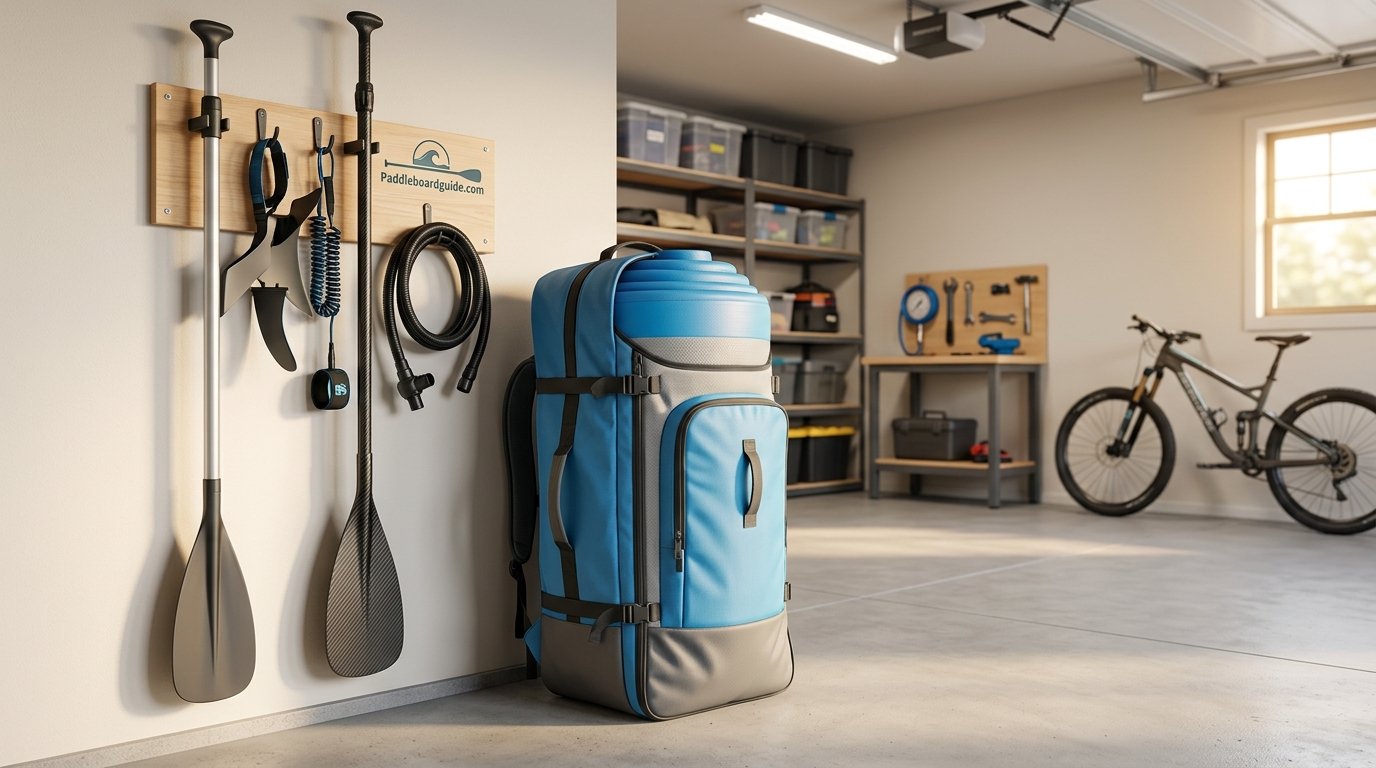
Inflatable Paddle Board Storage Ideas: The Complete Guide to Keeping Your iSUP Safe, Dry, and Ready to Ride
From tiny apartments to two-car garages, here’s every practical way to store an inflatable paddle board so it lasts longer, stays mold-free, and is always five minutes from the water.
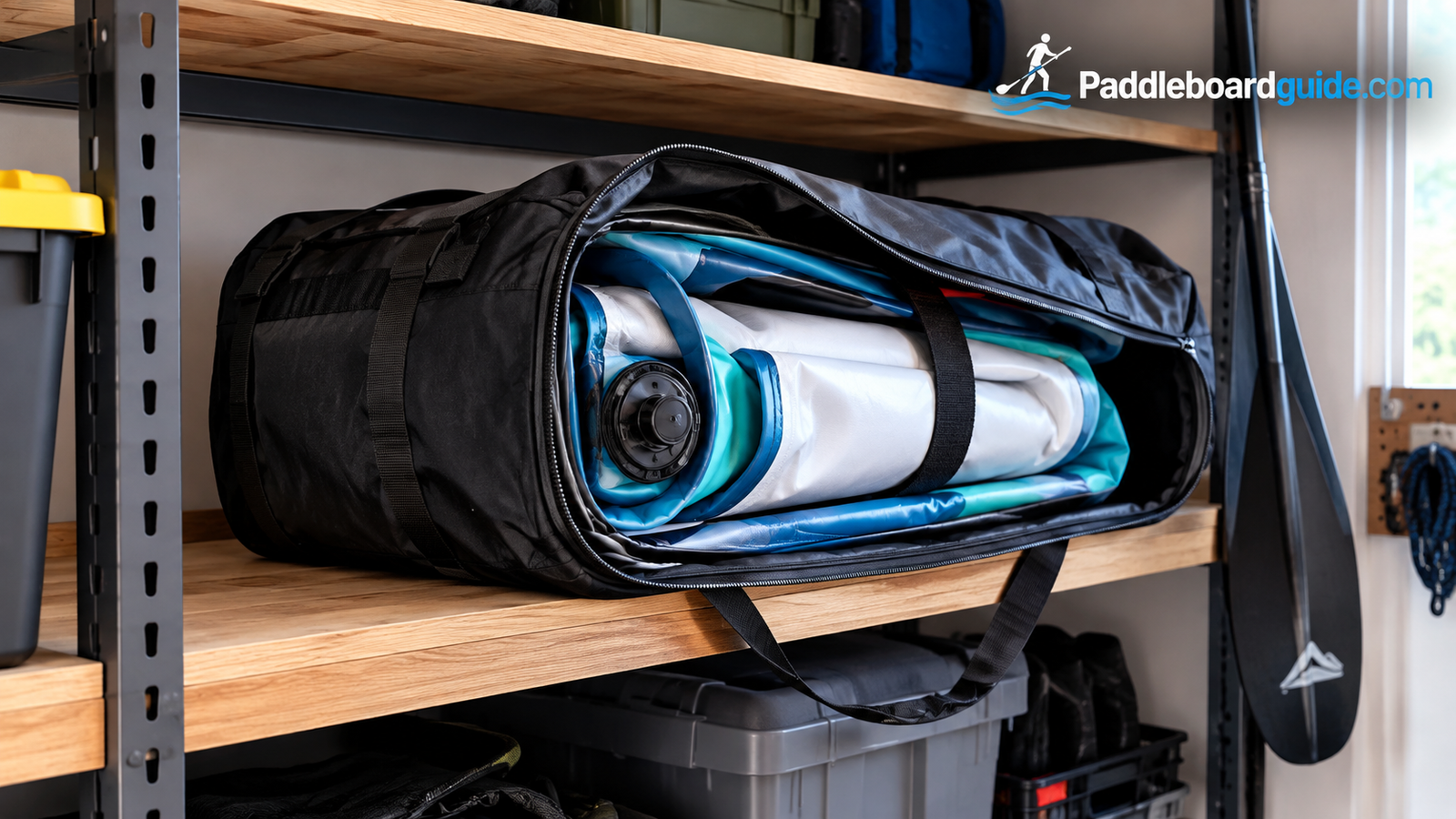
If you’ve ever tripped over a half-deflated paddle board in the hallway, or unrolled yours after winter to find a faint smell of mildew, you already know that storage is just as important as the board itself. An inflatable paddle board (iSUP) is a serious investment, often several hundred dollars, and how you store it between sessions determines whether it lasts three seasons or ten. The good news is that you don’t need a boathouse to do this right. Whether you’re working with a two-car garage, a cramped apartment closet, or a shed at the edge of your yard, there’s a storage method here that fits your space, your budget, and your board.
This guide walks through every realistic storage option for inflatable paddle boards — indoor and outdoor, DIY and store-bought, rolled and inflated — along with the mistakes that quietly shorten a board’s lifespan. If you’re new to the sport entirely, it’s worth reading up on whether inflatable paddle boards are good for beginners first, since the way you store your board often depends on how often you plan to use it.
1. Why Proper iSUP Storage Matters
Inflatable paddle boards are built from military-grade PVC layers fused around a drop-stitch core, which makes them remarkably tough on the water but surprisingly sensitive to how they’re kept when they’re not in use. Three enemies do almost all the damage over time: UV exposure, moisture, and pressure stress. Leave a board inflated and sitting in direct sun for a summer and the PVC coating can start to chalk and fade within a season. Roll it up wet and stuff it in a bag, and you’re creating a dark, damp environment that mold and mildew love. Store it folded at a sharp crease for months at a time, and you risk permanently weakening the seams along that fold line.
None of these problems show up immediately, which is exactly why they catch so many owners off guard. A board that looks fine in October can develop a slow leak by spring because moisture worked its way into a seam over the winter. Good storage isn’t about babying your gear — it’s about controlling three variables (heat, humidity, and pressure) so the materials age the way the manufacturer intended.
There’s also a practical, everyday reason storage matters: convenience. A board that’s awkward to get to is a board that stops getting used. Paddlers who set up a genuinely easy storage system — one that takes less than sixty seconds to access — report paddling far more often than those who have to dig a bag out from behind lawn furniture every time. If you’re trying to build a regular habit, understanding the best time to paddle board only helps if your gear is actually ready to grab when that window opens.
Finally, storage affects resale value. iSUPs hold their value reasonably well on the used market, but only if the deck pad hasn’t yellowed, the PVC hasn’t chalked from UV damage, and the valve and seams show no signs of past leaks. A board that’s spent three years properly stored will look — and inflate — like new. One that’s been left in a hot garage window or a damp basement corner will show it the moment a buyer unrolls it.
It helps to think about storage the same way you’d think about storing a bicycle or a tent — the gear is designed to be used hard and put away wet on occasion, but it’s not designed to live in harsh conditions permanently. The PVC and drop-stitch construction that makes an iSUP light enough to carry and rigid enough to stand on is a compromise between flexibility and strength. That compromise only holds up over years if the material isn’t constantly fighting UV breakdown, temperature extremes, or trapped moisture at the same time it’s absorbing the everyday bumps of transport and use. Owners who treat storage as a five-minute habit rather than an afterthought consistently get more seasons out of the same board.
It’s also worth separating “storage” from “transport,” since the two get confused. Transport is short-term — a few hours in a hot car trunk on the way to the lake won’t meaningfully harm a board. Storage is what happens for the days, weeks, or months in between trips, and it’s the cumulative effect of dozens of these storage periods, not any single afternoon, that determines how a board ages. That distinction is why a rack or bag that takes thirty extra seconds to use properly is worth the trade — it’s not solving a one-time problem, it’s protecting the board across hundreds of storage cycles over its lifetime.

Shop Storage Racks on Amazon →
2. Deflated vs. Inflated Storage: Which Is Better?
This is the single most common storage question new iSUP owners ask, and the honest answer is: it depends on how much space and time you have. Both approaches work when done correctly, but they come with very different tradeoffs.
| Factor | Deflated Storage | Inflated Storage |
|---|---|---|
| Space required | Small (fits in a closet or bin) | Large (needs a wall or ceiling area) |
| Setup time before paddling | 10–15 minutes to inflate | Ready in under a minute |
| Long-term seam stress | Very low if rolled correctly | Slightly higher if left fully inflated for months |
| Risk of UV/heat damage | Minimal (stored in a bag, out of light) | Higher if exposed to direct sun |
| Best for | Infrequent paddlers, renters, small homes | Frequent paddlers, garage/shed owners |
If you paddle a few times a month, deflated storage in a roll-top bag is usually the better call — it protects the board fully and takes up almost no room. If you paddle several times a week and have a garage wall to spare, keeping the board partially or fully inflated on a rack saves you the daily pump session and the wear that comes from repeatedly rolling and unrolling the PVC.
✔ Deflated Storage Pros
- Fits almost anywhere, including small apartments
- Fully protected from sun and weather
- Easy to transport or travel with
✘ Deflated Storage Cons
- Requires inflating/deflating every session
- Must be bone-dry before rolling to avoid mildew
- Repeated tight folds can stress seams over years
Some paddlers land on a hybrid approach: keep the board mostly inflated (70–80% pressure) on an indoor wall rack during the active season, then fully deflate, dry, and bag it for winter storage. This gets you the convenience of grab-and-go access most of the year while still giving the material a real rest during the months it isn’t used.
There’s a middle-ground technique worth mentioning for anyone torn between the two extremes: partial deflation storage. Dropping a board to around 8–10 PSI (instead of the usual 12–15 PSI riding pressure) for storage between sessions keeps it rigid enough to hang on a rack without sagging, while relieving a meaningful amount of the internal pressure that contributes to long-term seam fatigue. This isn’t necessary for boards used every few days, but for boards that sit for a week or two between outings, it’s a simple habit that costs nothing and adds a genuine buffer against stress-related wear.
Climate also tips the scale between these two approaches. In consistently mild, dry regions, inflated wall storage is close to risk-free year-round. In climates with big seasonal swings — hot, humid summers followed by freezing winters — deflated storage during the shoulder seasons (and especially winter) is the safer default, since it removes the board from the environment’s temperature swings almost entirely by tucking it away in a bag.
3. Indoor Storage Ideas
Indoor storage is almost always the better long-term choice for iSUPs because it removes temperature swings, UV exposure, and moisture from the equation entirely. The challenge is finding indoor space that doesn’t turn into an obstacle course.
Closet Storage (Deflated)
A rolled, bagged board slides neatly into the back of a coat closet, under a bed, or on a top shelf. Most 10–11 foot boards roll down to roughly 15 inches by 30 inches, about the size of a duffel bag. This is the go-to option for apartment dwellers and anyone without a garage.
Spare Room or Hallway Wall
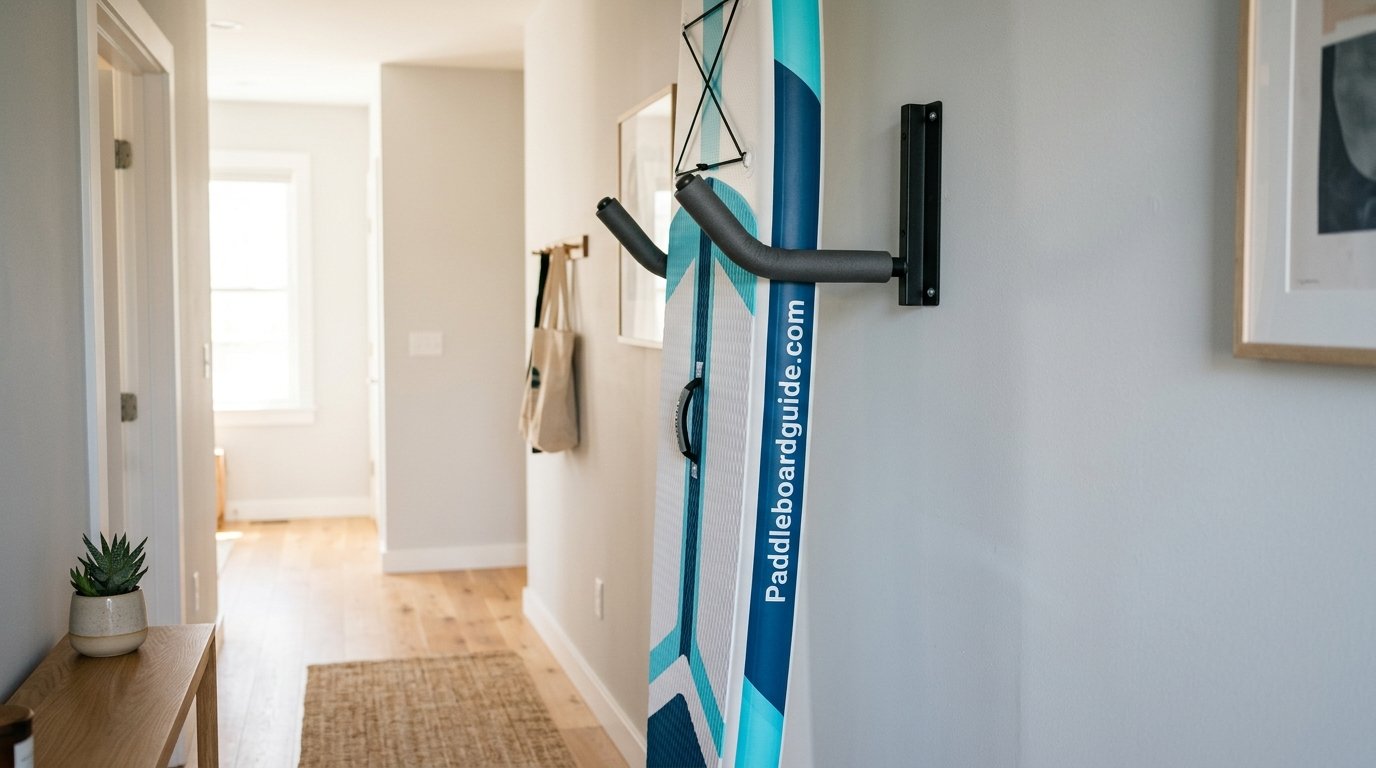
If you have even two feet of unused wall space in a spare bedroom, mudroom, or hallway, a slim wall rack lets you display the board vertically, almost like art, while keeping the floor completely clear.
Under-Stairs Storage
The triangular dead space under a staircase is often ignored, but it’s frequently large enough to fit a rolled board plus a paddle and pump. A simple shelf or bracket keeps everything organized instead of loose on the floor.
Basement Storage
Basements work well for deflated, bagged storage as long as humidity is controlled — a cheap hygrometer and a small dehumidifier go a long way in preventing the musty smell that develops in damp basements over a season.
Whichever indoor spot you choose, keep the board away from furnaces, water heaters, and radiators. Sustained heat above roughly 90°F (32°C) can soften PVC adhesive over time, even when the board is deflated and bagged.
Utility or Laundry Room
Utility rooms are often overlooked, but a wall or ceiling corner above a washer and dryer setup can hold a compact vertical rack. Just be mindful of dryer vent heat and humidity from a washing machine, both of which push this option slightly below a true climate-controlled closet in terms of long-term suitability.
Mudroom Bench Storage
Many mudrooms have bench seating with storage underneath, originally designed for boots and shoes. A rolled, bagged board fits well in this kind of low, wide cubby, especially in households where the paddle board is grabbed on the way out the door alongside other outdoor gear.
One advantage of indoor storage that’s easy to underestimate is pest control. Garages and sheds, even well-sealed ones, are far more likely to attract mice or insects looking for a dark, undisturbed space than a hallway closet inside a living area. A single mouse nesting inside a rolled board bag over a winter can chew through fabric layers in ways that are expensive, or impossible, to repair.

Check Prices on Amazon →
4. Outdoor Storage Ideas
Outdoor storage is sometimes unavoidable — not everyone has garage or closet space — but it requires more discipline about weatherproofing. The two biggest threats outdoors are UV rays and standing moisture, both of which can be managed with the right setup.
Covered Patio or Porch
A shaded, covered porch keeps direct sun off the board while still allowing airflow, which is important if the board is stored deflated but slightly damp from a rinse. Never store a board outdoors fully sealed in a non-breathable bag if there’s any chance moisture is trapped inside.
Storage Shed
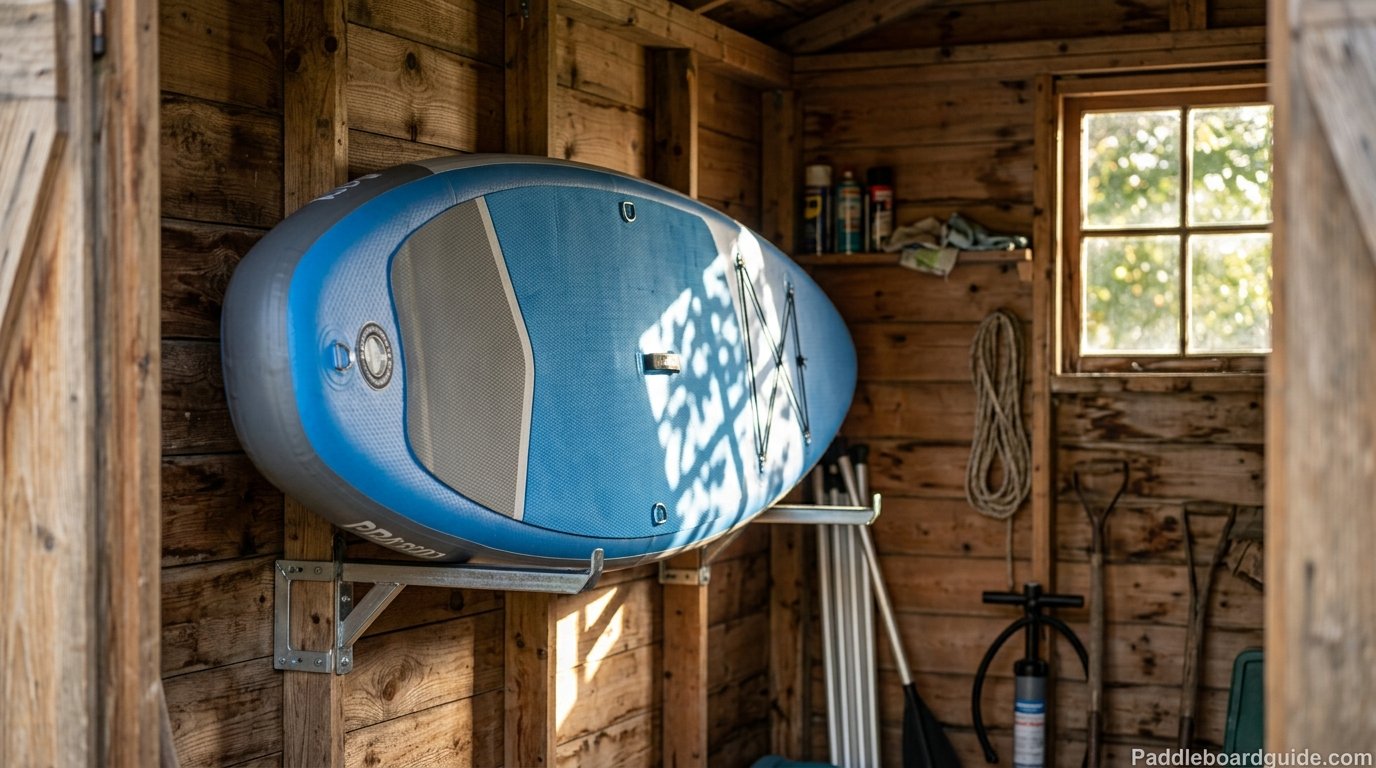
A dedicated shed is one of the best outdoor solutions because it combines shelter from UV and rain with dedicated wall or shelf space for a rack. Add a small vent or leave the door cracked on dry days to prevent humidity buildup.
Under a Deck or Eave
If a shed isn’t an option, the space under a raised deck or a wide roof eave offers reasonable protection from rain and direct sun. A tarp or fitted cover adds an extra layer of defense against blown-in moisture and dust.
Fence-Mounted or Exterior Wall Racks
Weatherproof exterior racks exist specifically for this scenario — UV-resistant padding cradles the board against a fence or exterior wall. These work best in climates without extreme freeze-thaw cycles, since repeated freezing can make PVC more brittle over time.
| Outdoor Spot | UV Protection | Moisture Risk | Best For |
|---|---|---|---|
| Covered Patio | Good | Low–Medium | Mild climates |
| Storage Shed | Excellent | Low (if vented) | Most climates |
| Under Deck/Eave | Medium | Medium | Occasional storms only |
| Fence-Mounted Rack | Medium (needs cover) | Medium–High | Dry climates |
If outdoor storage is your only realistic option, a few extra habits go a long way toward closing the gap with indoor storage. First, elevate the board or rack off the ground — even a few inches of clearance prevents splashback moisture and reduces the chance of ground insects or rodents finding their way in. Second, invest in a genuinely UV-rated cover rather than a generic tarp; cheap tarps trap heat and moisture underneath almost as effectively as they block rain, which can do more harm than leaving the board uncovered in shade. Third, check the storage spot after any major storm — wind-driven rain can reach areas that seem sheltered under normal conditions, and a board that sits in a puddle of water for days is at real risk of moisture working into the valve or seams.
Outdoor storage duration matters too. A board that’s outside for a weekend between Friday and Sunday paddles faces essentially no risk. The same spot used as the board’s only home for six months of winter is a very different situation. If outdoor storage is genuinely your only long-term option, it’s worth budgeting for a proper shed or at minimum a lockable, insulated deck box sized for a rolled board — the upfront cost is usually smaller than the cost of replacing a board that failed early from years of unprotected outdoor exposure.
5. Wall-Mounted Racks & Systems
Wall-mounted storage is the single most popular solution for a reason: it uses vertical space that’s otherwise wasted, keeps boards off the floor, and takes seconds to load or unload. Most wall systems fall into three categories.
Padded J-Hook or Cradle Racks
These mount horizontally and cradle the board on padded arms, similar to a kayak rack. They work well for boards stored partially inflated and support boards up to roughly 35–40 lbs comfortably without stressing the mounting hardware.
Vertical Slot Racks
Vertical racks hold the board on its rail (edge), taking up a narrow footprint — often under 12 inches of wall width — which makes them ideal for garages that already have bikes, tools, and other gear competing for space.
Freestanding Wall-Leaning Brackets
Simple rubber-coated hooks or brackets let the board lean against the wall at an angle. This is the cheapest option and works for boards stored fully deflated and rolled, or lightly inflated.
When installing any wall rack, always anchor into studs rather than drywall alone — a loaded rack plus board can weigh 25–40 lbs, and drywall anchors alone aren’t rated for that kind of sustained, slightly swinging load. If you’re also storing paddles nearby, it’s worth reviewing the best paddle board paddles guide, since many paddle racks mount using the same stud-anchored hardware.
Height placement matters as much as the rack style itself. Mounting a rack too high forces you to lift a bulky, awkward board over your head every time you load or unload it, which is both a strain risk and a common cause of accidental wall dings. A comfortable mounting height puts the bottom of the board roughly at shoulder level for the primary user, so it can be lifted on and off with a controlled, straight-arm motion rather than an overhead push. If more than one household member will be handling the board, split the difference and test the height with each person before committing to permanent mounting holes.
Spacing also deserves a moment of planning if you expect to add a second board down the line. Most padded J-hook and vertical slot racks are sold as single or double-board units, but even a single-board rack can usually be paired with a second unit mounted 14–18 inches away, leaving enough clearance for two boards to hang without their rails touching. Planning this out before drilling saves you from an awkward, uneven second installation later.

View on Amazon →
6. Ceiling Storage & Hoist Systems
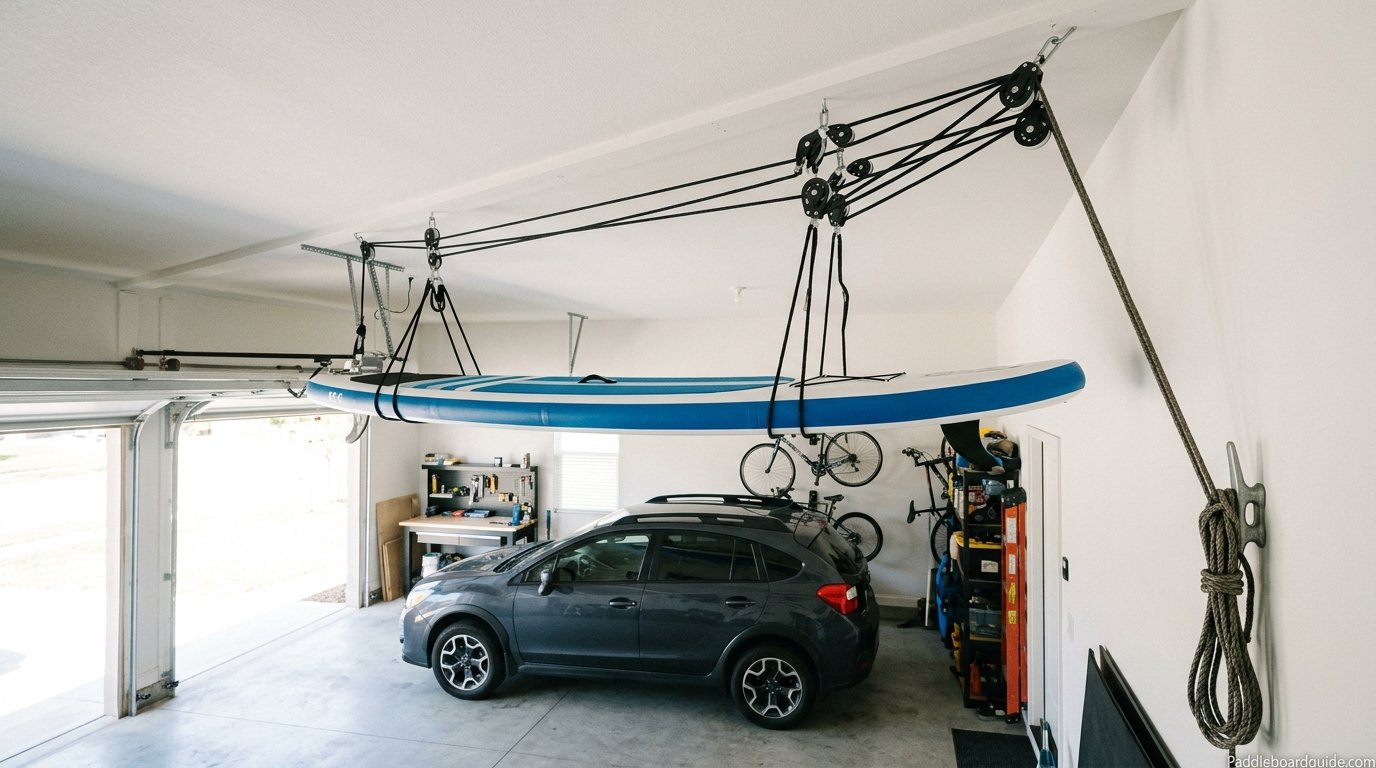
When wall space is at a premium — think a garage shared with two cars, a workbench, and a lawnmower — the ceiling becomes the most valuable real estate in the room. Ceiling storage keeps the board completely out of the way while still being accessible.
Pulley Hoist Systems
A hoist uses a rope-and-pulley system to lift the board (usually still in its bag) up to the ceiling and lower it down on demand. These systems typically support 50–100 lbs, far more than needed for a single board, and can often lift multiple pieces of gear at once, like a bag, pump, and paddle together.
Fixed Ceiling Straps or Slings
Padded straps or slings bolt into ceiling joists and cradle a deflated, rolled board flat against the ceiling. This is a lower-cost, no-moving-parts alternative to a hoist, though it requires a step stool for access.
Overhead Storage Platforms
A small overhead platform (the kind often used for holiday decorations) can double as board storage when a rolled iSUP is placed in a bin or wrapped bag on top. This works particularly well for households storing multiple boards.
As with wall racks, always anchor ceiling hardware into joists, never drywall or ceiling tile alone, and check the manufacturer’s weight rating before adding a second or third board to the same system.
Ceiling hoists are especially popular in households that also store bikes, kayaks, or seasonal decorations overhead, since a single garage ceiling can often accommodate two or three separate hoist points without any of them interfering with each other. The tradeoff is accessibility: lowering and raising a board takes slightly longer than grabbing it off a wall rack, and anyone with mobility limitations may find repeated pulley operation more physically demanding than a straightforward wall-mounted cradle. For garages where floor and wall space are simply nonexistent — a common problem in homes with two vehicles, a workbench, and yard equipment all competing for the same footprint — the extra thirty seconds of hoist operation is usually a worthwhile trade for reclaiming that space entirely.
One detail that’s easy to miss with ceiling storage is garage door clearance. A hoisted board needs to sit high enough that it never intersects with the travel path of an automatic garage door opener or the door itself as it opens. Before finalizing hoist placement, run the garage door through a full open-close cycle with the board lowered to its lowest resting point to confirm there’s no risk of contact.
7. Freestanding & Vertical Storage Racks
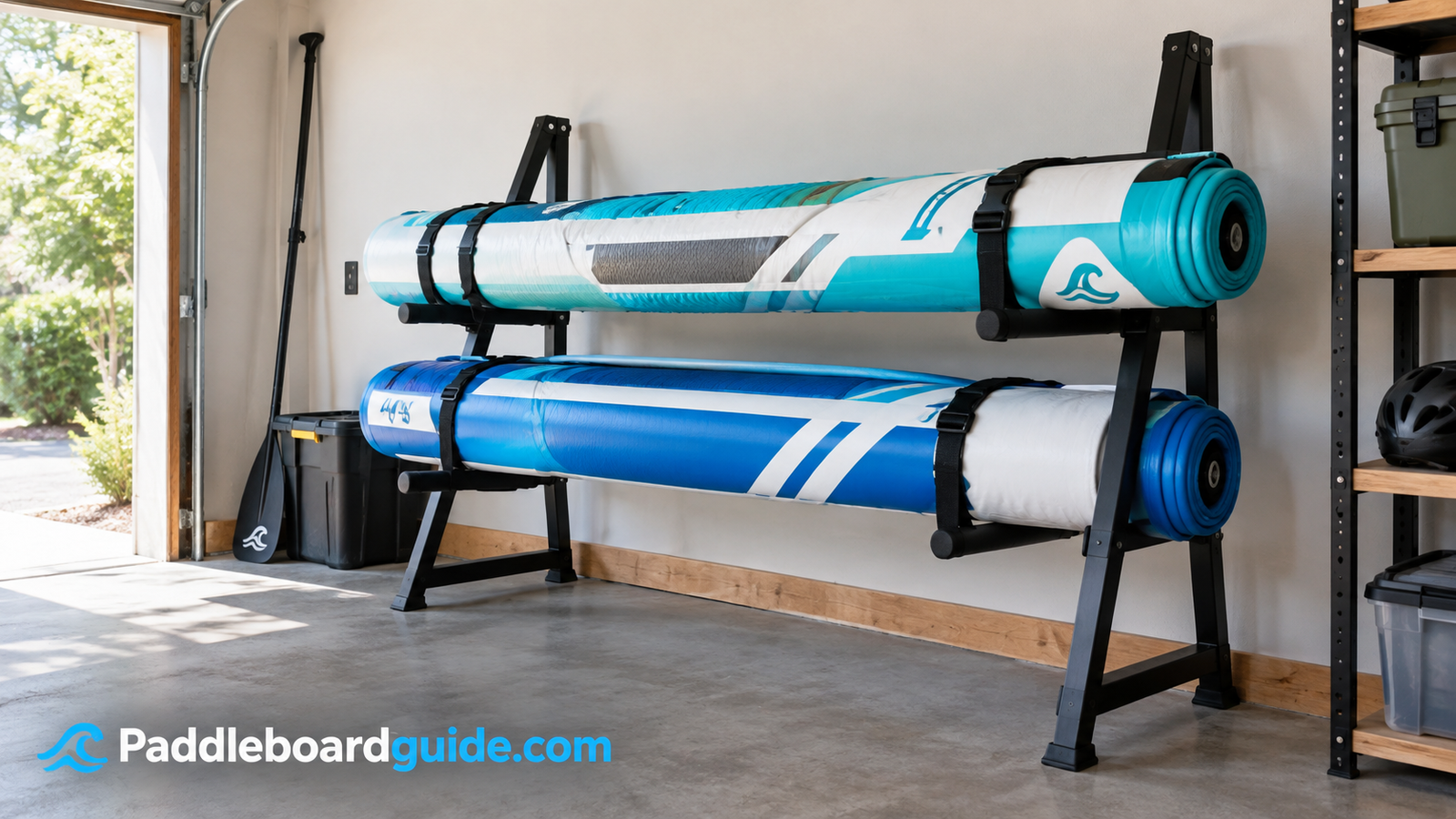
Not everyone wants to drill into a wall or ceiling, especially renters. Freestanding racks solve this by standing independently on the floor, similar to a coat rack or bookshelf.
A-Frame Freestanding Racks
These fold-out racks hold one or several boards leaning against a central frame, distributing weight evenly and taking up roughly a 2×2 foot floor footprint. They’re popular in shared garages, rental spaces, and paddle shops.
Multi-Board Vertical Stands
For families or paddling groups with two or more boards, a multi-slot vertical stand keeps everything upright, separated, and easy to grab without boards leaning on top of each other and scuffing the deck pads.
Portable Rolling Racks
A rack on locking casters can be wheeled out of the way when not in use, which is especially useful in a garage that doubles as a workshop or parking space during the week and gear storage on weekends.
✔ Freestanding Rack Pros
- No drilling or wall damage — renter-friendly
- Can be relocated or removed entirely
- Often holds multiple boards at once
✘ Freestanding Rack Cons
- Larger floor footprint than wall or ceiling options
- Can tip if not weighted or braced properly
- Generally costs more than a simple wall bracket

Shop on Amazon →
8. Garage Storage Solutions
The garage is where most iSUP owners end up storing their gear, and for good reason: it’s typically climate-buffered, has generous wall and ceiling space, and keeps the board close to the car for quick trips to the water. But garages also swing in temperature more than a climate-controlled room, so a few extra precautions matter here.
Park the rack or hoist away from the garage door’s direct sun line — even a closed garage door lets in significant heat and occasional light through gaps and windows. If your garage regularly hits above 100°F (38°C) in summer, consider deflating the board partially (dropping 3–5 PSI) during the hottest stretch, since trapped air expands with heat and can add unnecessary stress to the seams.
Garages are also where most storage-related accidents happen — a board knocked over by a car door, or scraped against a lawnmower blade. Dedicating a specific zone (using a rack, not just leaning it in a corner) prevents the slow accumulation of scuffs and dings that come from a board being shuffled around to make room for other things.
If you’re setting up a garage specifically for paddling gear, it’s worth thinking about the whole kit at once — board, paddle, and pump — rather than storing each piece separately. Understanding how much weight a paddle board can hold is also useful context when deciding whether your garage rack setup needs to support additional gear stacked on or near the board.
| Garage Zone | Recommended Setup | Notes |
|---|---|---|
| Side wall (away from door) | Padded J-hook rack | Best all-around option |
| Ceiling near workbench | Pulley hoist | Frees up floor and wall space |
| Back corner | Freestanding A-frame rack | Good for multiple boards |
| Near garage door | Avoid — UV/heat exposure | Not recommended for inflated storage |
9. Apartment & Small-Space Storage Ideas
Living without a garage doesn’t mean giving up on owning a paddle board — it just means storage has to be deliberate. Most inflatable boards roll down small enough to fit standard apartment storage spots without much trouble.
Behind-the-Door Storage
An over-the-door hook or bracket can hold a rolled, bagged board flat against an interior door, using space that’s otherwise completely wasted.
Under-Bed Storage
Most rolled 10–12 foot boards fit under a standard bed frame with 7+ inches of clearance. A flat, low-profile storage bag or slim duffel keeps things tidy and dust-free.
Balcony Storage (With Caution)
A covered balcony can work for short-term storage, but direct sun and rain exposure make it a poor choice for anything beyond a few days between sessions. If a balcony is your only option, a UV-resistant cover is non-negotiable.
Compact Corner Racks
Slim, corner-fit racks — some as narrow as 8 inches deep — let apartment dwellers store a board upright in an unused corner without eating into usable floor space.
Small-space living is also a good reason to consider whether an inflatable board makes more sense than a hard board in the first place; the comparison in SUP board vs. paddle board covers exactly this tradeoff for space-constrained paddlers.

See Options on Amazon →
10. Storage Bag Best Practices
If you’re storing your board deflated — which most owners do at least part of the year — the storage bag itself matters more than people expect. A good bag does three jobs: blocks UV light, allows some airflow, and cushions the board from friction and impact during handling.
Dry It Completely First
This is the single most important step and the one most often skipped. Even a board that looks dry can hold moisture in the textured deck pad or along seam channels. Wipe it down, then let it air-dry fully — ideally overnight — before rolling it up. Rolling a damp board into a sealed bag is the number one cause of mildew smell and mold spotting on iSUPs.
Roll, Don’t Fold
Always roll from the tail toward the nose (or according to the manufacturer’s instructions) rather than folding flat. Rolling distributes stress evenly across the drop-stitch fibers, while sharp folds concentrate pressure along a single crease line that weakens over repeated storage cycles.
Use Moisture-Absorbing Packets
Dropping a few silica gel packets into the bag before storing for an extended period (like winter) helps absorb residual humidity in the air trapped inside, even from a board that was properly dried.
Don’t Stack Heavy Items on Top
A bagged, rolled board can handle being stored under light items, but stacking heavy boxes, tools, or furniture on top over months can create permanent compression marks in the PVC material.
| Storage Bag Feature | Why It Matters |
|---|---|
| UV-blocking exterior | Prevents fading/chalking if stored near a window |
| Padded shoulder straps | Reduces strain when carrying to/from storage |
| Ventilated liner or mesh panel | Lets residual moisture escape rather than trap it |
| Reinforced base | Protects against abrasion when set on concrete/gravel |
11. Seasonal & Off-Season Storage
How you store a board for a week between weekend trips is very different from how you should store it for four or five months over winter. Off-season storage calls for extra preparation because the board won’t be checked on or handled regularly.
Deflate Fully
Never leave a board fully inflated for an extended off-season. Release all the air, since sustained internal pressure over months — combined with any temperature swings in the storage space — puts unnecessary long-term stress on seams and the valve.
Clean Before You Store
Rinse off salt, sand, sunscreen residue, and any organic buildup (algae, in particular, can degrade PVC coatings over time) before the board goes into hibernation for the season.
Check the Valve
Inspect the one-way valve for grit or debris before storing, and leave it open rather than sealed shut — this allows any trapped air or moisture to equalize rather than building pressure inside a fully sealed, rolled board.
Pick a Stable Temperature Spot
A space that doesn’t swing between freezing and very hot is ideal. Repeated freeze-thaw cycles can make PVC more brittle over years of storage, so an insulated closet or interior room beats an uninsulated shed in cold climates.
Before pulling the board back out in spring, it’s worth reviewing how to patch a paddle board just in case months of storage revealed a small pinhole leak you didn’t know about — catching it before the first trip of the season saves a ruined outing.

Shop Repair Kits →
12. Storage Mistakes to Avoid
Most iSUP damage isn’t dramatic — it’s the slow result of a handful of common storage habits repeated over dozens of cycles. Here’s what to watch for.
- Storing fully inflated in direct sun: Even a few hours a week adds up to significant UV exposure over a season, accelerating fading and material fatigue.
- Rolling a damp board: The fastest way to grow mildew inside a sealed bag — always dry completely first.
- Leaving the valve sealed during long-term storage: Trapped moisture has nowhere to go and condensation can build inside the board.
- Storing near sharp tools or gardening equipment: A single snag against a rake or hedge trimmer can puncture the outer layer.
- Using non-stud wall anchors for racks: A loaded rack can pull loose from drywall over time, especially with any swinging motion.
- Ignoring extreme temperatures: Both very hot garages and unheated, freezing sheds accelerate material breakdown over years.
- Stacking heavy objects on a bagged board: Creates permanent compression creases in the PVC.
- Never rotating the roll direction: Rolling the exact same way every single time can, over years, create a slight memory crease — occasionally reversing the roll direction helps distribute stress more evenly.
Most of these mistakes are easy to fix once you know to look for them, and none require spending more money — just a bit more intention about where and how the board sits when it’s not on the water. For paddlers comparing specific boards before buying, it also helps to know how storage habits affect long-term durability; the breakdown in how long inflatable paddle boards last ties directly back to the storage practices covered in this guide.
Frequently Asked Questions
Can I store my inflatable paddle board fully inflated year-round?
You can for short stretches in a shaded, temperature-stable spot, but it’s not ideal for months at a time. Sustained pressure combined with temperature swings adds unnecessary stress to seams. A partial deflate (dropping a few PSI) during extended storage is a safer middle ground.
Is it bad to store an iSUP in a hot garage?
Occasional heat is fine, but consistently hot garages (above roughly 100°F/38°C) can soften adhesives and accelerate PVC aging over years. If your garage runs hot in summer, consider a shaded wall spot away from the door, or deflate partially during the hottest weeks.
How do I stop my paddle board from smelling musty in storage?
Musty smells almost always trace back to moisture trapped during storage. Make sure the board is completely dry before rolling it, leave the valve open, and consider adding silica gel packets to the bag for extended storage periods.
Do I need to deflate my board every time I’m done paddling?
Not necessarily. If you paddle frequently and have wall or ceiling rack space, keeping the board inflated between sessions saves setup time. If you paddle occasionally or lack storage space, deflating and bagging protects the board better long-term.
Can I hang my paddle board vertically for storage?
Yes — vertical storage on a rail-mounted rack is a popular, space-saving option and doesn’t harm the board as long as weight is distributed evenly along the rack’s padded supports.
What temperature is unsafe for storing an inflatable paddle board?
Extended exposure above roughly 100°F (38°C) or below freezing for long periods can both accelerate material aging. A stable, moderate indoor temperature is ideal for long-term storage.
Should I store my paddle board with the fins attached?
Most paddlers remove detachable fins before storage to prevent them from snapping if the board shifts or is bumped. Fixed fins should be padded or covered if the board is leaned against a hard surface.
Is a wall rack or a freestanding rack better for a garage?
Wall racks save floor space and are typically more secure once anchored into studs, while freestanding racks are better for renters or anyone who doesn’t want to drill into walls. Both work well when properly weighted or anchored.
Can I store my paddle board outside without a shed?
You can, but it requires more care — use a UV-resistant cover, choose a shaded spot, and avoid areas where rain can pool underneath the board. A shed or covered porch is always the safer choice when available.
How often should I check on a board in long-term storage?
Checking every four to six weeks during off-season storage is a reasonable habit — it lets you catch early signs of moisture, pests, or pressure issues before they become bigger problems.
What’s the best bag for long-term paddle board storage?
Look for a UV-resistant exterior, a ventilated or mesh liner, padded straps for handling, and a reinforced base. These features protect against the three biggest long-term threats: sun, trapped moisture, and abrasion.
Does storage affect how much weight my paddle board can hold?
Improper storage — especially repeated sharp folds or prolonged heat exposure — can weaken seams over time, which may reduce a board’s effective weight capacity. Proper storage helps the board perform at its full rated capacity for longer.
Conclusion: Pick the Storage Method That Fits Your Space
There’s no single “correct” way to store an inflatable paddle board — the right method is the one that matches your space, your paddling frequency, and how much time you’re willing to spend setting up before each session. A renter in a studio apartment and a homeowner with a two-car garage will land on completely different solutions, and both can be equally effective if the fundamentals are respected: keep it dry, keep it out of extreme heat, keep it out of direct sun for long stretches, and don’t let it sit under unnecessary weight or pressure.
Get the storage right, and your board will reward you with years of reliable use, a clean deck pad, and a valve that holds air exactly the way it did on day one.
Browse Top-Rated SUP Storage Racks on Amazon →