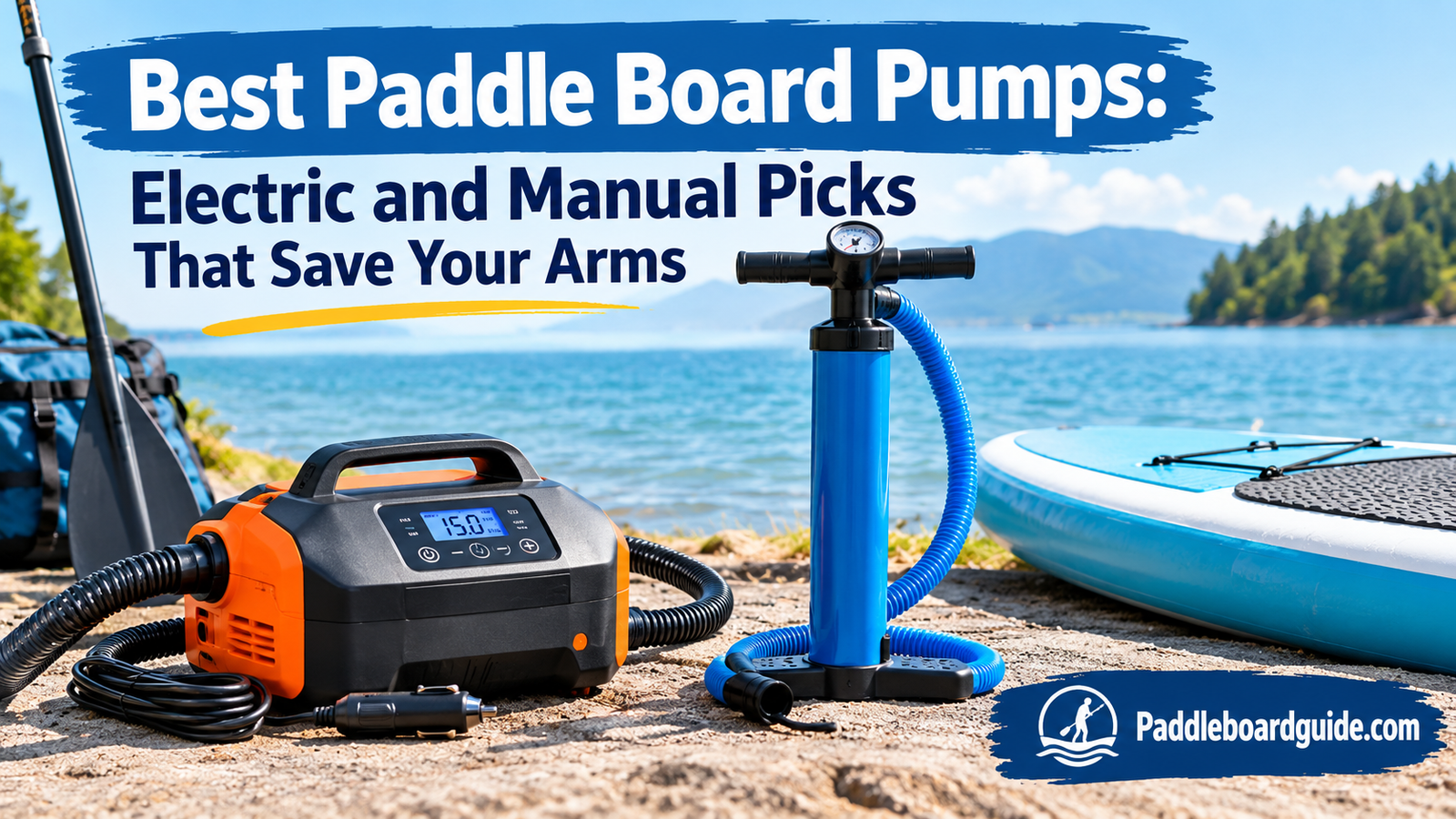
Best Paddle Board Pumps: Electric and Manual Picks That Save Your Arms
Inflating a board by hand is a workout nobody signed up for. We compared the top electric pumps and one standout manual option so you can get on the water faster.

Not sure where to begin? The short version: choose an electric pump for everyday convenience, keep a manual pump as a backup, and always match your pump to your board’s rated pressure. The rest of this guide explains why, and shows you the best options.
Why Your Pump Matters More Than You Think
Most people spend weeks researching a board and about thirty seconds choosing the pump. That is backwards. An inflatable board only performs when it is firm, and a weak or underpowered pump leaves you with a soft, wobbly ride that tracks poorly and tires you out before you even leave the shore.
If you are still choosing a board, start with our guide to the best inflatable paddle boards, then come back here to match it with the right pump. New to the sport? Our post on whether inflatable paddle boards are good for beginners covers what to expect.
What a firm board actually changes
Pressure is the difference between a board that glides and one that folds in the middle. When an inflatable sits below its rated PSI, the hull flexes under your feet, nose and tail sag, and every stroke wastes energy pushing water instead of moving you forward. A properly inflated board feels almost rigid: it tracks straight, handles chop with less wobble, and supports heavier loads. If you are curious about load limits, our guide on how much weight a paddle board can hold explains why pressure and capacity are closely linked.
The hidden cost of the bundled hand pump
Most inflatable packages include a basic hand pump. It works, but reaching full pressure on a larger board can take a long, sweaty stretch of pumping, and the last few PSI are the hardest. Many paddlers stop early, then wonder why the board feels soft. An upgrade pays for itself in the first few sessions, because you are far more likely to paddle when setup does not feel like a chore.
Who should upgrade first
Anyone paddling more than a couple of times a month, anyone with a long touring or all-around board, and anyone with a bad shoulder, back, or knees. Families inflating several boards at once benefit most of all.
A short history of the SUP pump
Inflatable paddle boards changed the sport by making it accessible: a board that fits in a bag, travels in a car trunk, and stores in a closet. But that convenience always came with one catch, and that catch was inflation. Early hand pumps were basic, and paddlers simply accepted the workout. As electric pumps became more common, expectations shifted, and today a good pump is considered part of a proper setup rather than a luxury.
What this guide covers
We walk through how pumps work, which features matter, and how each of the eleven pumps on our list fits different kinds of paddlers. Along the way we cover inflation technique, safety, power, troubleshooting, and care. Read it straight through, or use the table of contents to jump to the section you need.
How to use our picks
Start with your board and your habits. Where do you launch? How often do you paddle? How much do you want to spend? Those three answers narrow the list quickly, and the summary table near the top lets you compare at a glance before you dive into the detailed notes.
Common questions paddlers ask before buying
Readers often wonder whether a pump is worth the money at all, whether any pump will fit any board, and whether electric pumps are reliable enough to depend on. The short answers: yes for most regular paddlers, usually but not always, and yes when you choose a quality model and look after it. The sections below unpack each answer so you can make a confident decision instead of guessing.
What a pump will not fix
A pump cannot rescue a damaged board or a faulty valve. If a board keeps losing air even after proper inflation, the problem is probably a leak, not the pump. Inspect the board, test the valve, and repair small punctures before blaming your equipment.

Our top electric pick
Check Price on AmazonElectric vs Manual: Which Should You Buy?
Electric pumps do the heavy lifting. You press a button, walk away, and the pump stops at your target pressure. Manual pumps are lighter, need no battery, and never fail because you forgot to charge them. Many paddlers carry both: electric for convenience, manual as a backup.
Quick rule of thumb
- Choose electric if you paddle often, have a bigger board, or have shoulder or back concerns.
- Choose manual if you hike in to remote lakes or want a zero-failure backup.
How electric pumps work
Electric SUP pumps are built around a small motor and, on most models, a two-stage design. The first stage moves a large volume of air quickly to fill the board, then the second stage switches to higher pressure to top it off. You set your target PSI, press start, and the pump shuts itself off when it gets there. This is the main reason they feel so effortless compared with a hand pump.
Where manual pumps still win
A manual pump has no battery to forget, no motor to overheat, and no electronics to fail with a splash of water. For multi-day trips, remote shorelines, and travel where charging is unreliable, many experienced paddlers carry one anyway. The tradeoff is simple: it costs you time and effort every single session.
The two-pump strategy
If your budget allows, buy an electric pump for daily use and keep a manual one in the trunk. A flat battery should never end a paddle day. This also protects you if a motor ever stops working mid-trip.
Other things worth weighing
- Storage space: compact pumps tuck into a bag, larger ones need their own space.
- Noise: some motors are loud, which matters at quiet campsites or early launches.
- Heat: hot motors are a common failure point, so look for models with cooling or sensible run-time guidance.
Choosing by board type
Different boards place different demands on a pump. All-around boards are forgiving and work with most pumps on this list. Touring boards are longer and often need more pressure, which favours stronger pumps. Fishing and yoga boards are wide and stable, often with higher volume, so inflation takes longer and a faster pump saves time. For a refresher on how designs differ, see our overview of paddle board types.
Choosing by body and comfort
Hand pumping is repetitive and physical. If you have a sensitive back, shoulders, or knees, or if you are simply not looking for a workout before paddling, electric is the kinder choice. Manual inflation is also tough in hot weather, and sweaty hands make for a poor grip.
Electric pumps vs other inflation methods
| Method | Effort | Pressure | Verdict |
|---|---|---|---|
| Dedicated electric SUP pump | Low | Designed for SUP needs | Best everyday choice |
| Dedicated manual SUP pump | High | Designed for SUP needs | Great backup |
| Standard car tire inflator | Low | May struggle with volume | Not recommended |
| Bundled basic hand pump | High | Often limited | Fine for starting out |
Dedicated SUP pumps are built to move large volumes of air at the pressures inflatable boards need. General-purpose inflators are designed for tires, which need a smaller volume, so they often overheat or stall when used on a board.
Prefer manual?
View the Titan II on AmazonPSI, Inflation Speed and Power: What to Look For
Most inflatable boards want somewhere around 12 to 20 PSI, so check your board’s rated pressure and make sure the pump can reach it. Higher-rated pumps leave headroom, which is where they tend to run cooler and last longer.
- Max PSI: Should exceed your board’s rating.
- Auto shut-off: Stops at your preset pressure so you never overfill.
- Power source: Built-in rechargeable battery, 12V car plug, or both.
- Valve adapters: Make sure it fits your board’s valve.
- Noise and weight: Matters if you carry it a long way.
Match the pump to the board, not the other way round
Start by finding the recommended pressure printed near the valve or in the manual. Touring boards and stiffer all-around designs often call for higher pressure than casual recreational boards. A pump that tops out right at your target can struggle and run hot, while one with a comfortable margin finishes the job without strain.
Why a digital display helps
Pump gauges on cheap models can drift. A digital readout with a preset makes it simple to inflate to the same pressure every time, which keeps handling consistent. It also helps you adjust for temperature: air expands in the sun, so a board inflated in a cool garage may read higher once it is sitting on a hot beach.
Valve compatibility
Nearly all inflatable boards use a standard-style valve, but adapters vary. Check that the pump includes the right nozzle, and keep a spare in your gear bag. A missing adapter is a frustrating reason to turn around.
Power source options
Built-in rechargeable batteries give you freedom at the shoreline. 12V car-powered pumps never run out as long as the engine or car battery is healthy, but need a vehicle nearby. Models that offer both are the most flexible, though they tend to cost more. Think about where you launch most: a car park beside the ramp, or a hike-in cove?
Step-by-step: how to inflate your board properly
- Unroll the board on a flat, clean surface such as a mat or grass, free of sharp objects.
- Open the valve to the inflate position and attach the correct adapter.
- Connect the hose securely and make sure the connection is tight.
- Set your target pressure based on your board’s rating.
- Start the pump and keep an eye on it until it shuts off.
- Disconnect quickly to avoid losing air, then close the valve.
- Check firmness by pressing on the deck and use a gauge to confirm.
- Adjust if needed after the board has sat in the sun for a few minutes.
Take a moment to inspect seams and the valve for any signs of damage. Ready to hit the water? Our guide on how to paddle board covers technique from your first stroke.
Quick glossary
- PSI: pounds per square inch, the standard measure of board pressure.
- Auto shut-off: a feature that stops the pump at your preset pressure.
- Two-stage inflation: a method that moves high volume first, then builds pressure.
- 12V: the car power outlet standard used by many pumps.
- Valve adapter: the nozzle that connects the pump hose to your board valve.

High-pressure option
Check Price on AmazonOur Top Paddle Board Pump Picks at a Glance
| Pump | Type | Best For |
|---|---|---|
| OutdoorMaster Shark 3 | Electric | Best overall |
| OutdoorMaster Shark 2 | Electric, high pressure | Firm, rigid boards |
| Hydrohero Rechargeable | Electric, cordless | Grab-and-go simplicity |
| AIRBANK Puffer Pro | Electric | Compact travel |
| AIRBANK Whale Shark Pro | Electric | Power users |
| Cycplus Volcano | Smart electric | Digital control |
| Flextail Evo Pro | Electric, portable | Backpacking |
| FBSPORT 20PSI | Electric | Budget-friendly |
| Swonder 20PSI Digital | Electric, digital | Easy presets |
| SereneLife Electric | Electric | Casual paddlers |
| Red Paddle Co Titan II | Manual | Best manual |
How we grouped these pumps
Rather than rank eleven products on a single scale, we sorted them by the kind of paddler they suit. The Shark 3 and Shark 2 are the dependable core. The Hydrohero, Puffer Pro, and Flextail Evo lean toward portability. The Whale Shark Pro and Volcano are the feature-rich options. The FBSPORT, Swonder, and SereneLife make electric inflation affordable, and the Titan II covers anyone who prefers to pump by hand.
Quick picks by situation
- Best overall: OutdoorMaster Shark 3
- Best for firm boards: OutdoorMaster Shark 2
- Best cordless convenience: Hydrohero
- Best for travel: AIRBANK Puffer Pro or Flextail Evo
- Best for frequent use: AIRBANK Whale Shark Pro
- Best digital control: Cycplus Volcano or Swonder
- Best value: FBSPORT or SereneLife
- Best manual: Red Paddle Co Titan II
Specs change between versions and listings, so always confirm pressure rating, power source, and included adapters on the product page before you buy.
Usage scenarios: which pump wins where
The solo weekend paddler. You have one board, one car, and a favourite launch. A reliable mid-range electric pump such as the Shark 3 is ideal. You want set-and-forget convenience and a pump that lasts.
The traveller. You fly or take trains with your board. Compact pumps like the Puffer Pro or Flextail Evo save space and weight, and a lightweight manual option may serve as a backup.
The family. Several boards, several people, and impatient kids. Durability and speed matter, so look at more robust options and carry a spare pump in case of trouble.
The adventurer. You hike or paddle to remote spots. A cordless pump plus a manual backup is the safest combination.
The budget starter. You want to stop hand-pumping without spending much. The FBSPORT, Swonder, and SereneLife are all worth comparing.
The enthusiast. You like gear that performs. Consider the Whale Shark Pro or Volcano for control and build.
Who should skip which pump
Choosing well also means knowing what not to buy. If you travel light, skip bulky models. If you paddle often, avoid the cheapest options unless you accept the tradeoffs. If you never leave the car park, cordless is a nice-to-have, not a must. If you have a high-pressure board, make sure the pump you choose can reach that target comfortably. Matching strengths to your needs saves money and frustration.
A word on prices and availability
Prices change, listings update, and new versions appear. Treat our summary as a guide and check each product page for the latest price, features, and included accessories. Reading recent buyer feedback is also a good habit, since it tells you how a pump performs after months of real-world use.
Start with the top pick
See Latest PriceOutdoorMaster Shark 3 and Shark 2
OutdoorMaster is a familiar name in the SUP world, and the Shark line shows why. The Shark 3 is our favorite all-rounder: dependable, easy to use, and built around a simple set-and-forget workflow. The Shark 2 is aimed at paddlers who want strong high-pressure performance for stiffer, higher-PSI boards.
- Trusted brand and straightforward controls
- Auto shut-off convenience
- Well suited to regular use
- Bulkier than ultra-compact travel pumps
- Check your board’s valve adapter fit
Shark 3: the dependable all-rounder
The Shark 3 is the pump we would suggest to most readers. It focuses on what matters: simple operation, a preset pressure with automatic shut-off, and a build that tolerates regular use. You do not need to babysit it, which makes it ideal for solo paddlers who want to rig up while they finish getting dressed or loading gear.
It suits all-around boards, family boards, and most touring models. As with any electric pump, check the listing for the exact power options, accessories, and maximum pressure before ordering so you can match it to your board.
Shark 2: for higher-pressure boards
The Shark 2 is the one to consider if your board calls for a firmer finish. Stiffer inflatables benefit from a pump that does not run out of steam near the top of the pressure range. If you paddle in rougher water or carry heavy gear, the extra firmness is easy to appreciate.
Which one should you choose?
- Pick the Shark 3 if you want a straightforward, reliable option for everyday use.
- Pick the Shark 2 if your board needs a higher pressure target and you want that headroom.
Either way, you are buying from a brand paddlers recognise, which matters when you want accessories, spare parts, and a track record you can read about in buyer feedback. If you are shopping for a complete setup, pair your pump with a quality blade from our best paddle board paddles list.
Real-world use: a typical session
Picture a Saturday morning. You arrive at the launch, unroll the board, attach the hose, set the target pressure, and press start. While the pump works, you apply sunscreen, load your dry bag, and check the forecast. By the time you are ready, the board is firm and the pump has stopped on its own. That small gain in time and effort is the entire reason people buy an electric pump, and the Shark line is designed around exactly that routine.
What to watch for
Larger pumps take up more room in a small car. Read the listing for the power options and any included accessories so you know whether you need a separate adapter. And as with any motorised pump, let it cool between boards if you are inflating several in a row.
Who should skip it
If you only paddle once or twice a year, a more affordable pump or a manual option may be enough. If you travel by plane and need the smallest possible footprint, a compact model could suit you better.
In depth: OutdoorMaster Shark 3
Think of the Shark 3 as the pump you stop thinking about. You plug in, set your pressure, and it does what it should. That predictability is rare and valuable. In reader-style scenarios, such as a weekend lake trip with friends, a pump like this means everyone gets on the water sooner, and nobody ends up sore before they even start paddling. It is a strong match for inflatable all-around boards, which are the most common type among recreational paddlers.
- Best for: everyday paddlers who want reliability
- Ideal setup: A mid-sized board, a car park launch, and a routine you repeat every weekend.
- Keep in mind: Confirm the listing details for power options and included accessories.
In depth: OutdoorMaster Shark 2
The Shark 2 is the pump for people who care about that final firmness. Stiffer boards feel noticeably better when they reach their rated pressure, and a pump built with higher pressure in mind makes that last stretch easier. If you paddle touring boards, carry gear, or want crisp tracking, this model deserves a look. It also makes sense for heavier paddlers who need every PSI the board can safely hold.
- Best for: paddlers with higher-pressure boards
- Ideal setup: A touring or performance board and longer outings.
- Keep in mind: Check that your board’s rating and the pump’s capability line up.
Tips for getting the best from your Shark pump
- Lay out the board on a clean surface before connecting anything.
- Check the valve is fully seated so air does not leak back out.
- Keep the hose uncoiled during use to avoid kinks.
- Let the pump cool between boards if you are inflating more than one.
- Wipe it clean and store it dry after each session.
Pairing your pump with a good paddle improves the whole experience. Browse our best paddle board paddles and learn whether paddle board paddles float before you head out.
Hydrohero Rechargeable and AIRBANK Puffer Pro
The Hydrohero appeals to anyone who hates cords: a rechargeable pump you can use at a remote launch with no car nearby. The AIRBANK Puffer Pro leans compact, making it an easy fit in a board bag or kayak hatch.
Both pair nicely with a lightweight setup. If portability is your priority, our tips on how to transport a paddle board and inflatable paddle board storage ideas will help you pack smart.
Hydrohero: grab-and-go convenience
The Hydrohero is built for simplicity. A rechargeable design means you can inflate anywhere, whether that is a gravel pull-off, a campsite, or a quiet lakeside launch. It is a smart pick for paddlers who dislike cables and want a single device that handles the entire job. Remember to charge it the night before, and keep it warm in cold weather since low temperatures can reduce battery performance.
AIRBANK Puffer Pro: compact and travel-friendly
The Puffer Pro is aimed at people who care about packing space. If you fly with your board, ride a bike to the lake, or keep gear in a small apartment, a compact pump removes one more bulky item from the pile. Smaller pumps may take longer or have less headroom than full-size models, so read the listing details and match them to your board size.
Which fits you?
Choose the Hydrohero if freedom from cords is your priority. Choose the Puffer Pro if every inch of packing space counts. Both pair nicely with the tips in our guide to paddle board types, which helps you understand how different board styles affect your pump needs.
- Easy to carry and store
- Quick setup at the water
- Battery management is on you
- Compact designs can trade away some power
Thinking about the way you travel
Your launch style should drive this decision. If you drive to a boat ramp and park ten steps from the water, power source and size matter little. If you walk a kilometre along a trail, weight and battery life matter a lot. Cordless and compact pumps shine in the second scenario, while the first leaves you free to prioritise power and price.
Battery habits that save trips
Charge fully before every outing, even if the pump seems to have enough left from last time. Keep a cable in the car. If you share a pump with friends, agree who charges it. And if you expect to inflate more than one board, consider a backup option so the group is not stuck waiting.
Final verdict
Both pumps make sense for casual and regular paddlers who value mobility. They are not the answer for heavy-duty rental use, but for personal paddling they remove the biggest hassle of owning an inflatable board.
In depth: Hydrohero Rechargeable Electric SUP Pump
The Hydrohero fits into the lifestyle of paddlers who explore. Remote beaches, hidden coves, and roadside access points rarely come with a power outlet, and a rechargeable pump turns those spots into easy launches. It is simple enough for beginners and handy enough for veterans, particularly as a backup to a car-powered unit.
- Best for: paddlers who value freedom from cables
- Ideal setup: Spontaneous paddles and camping trips.
- Keep in mind: Battery discipline: charge it before every trip.
In depth: AIRBANK Puffer Pro
The Puffer Pro addresses a real problem: inflatable boards are supposed to be portable, but the accessories often are not. A pump that tucks neatly into a bag helps you travel light, whether you are flying, cycling, or living in a small space. It suits paddlers who value tidy gear.
- Best for: packing-conscious paddlers
- Ideal setup: Travel boards and small vehicles.
- Keep in mind: Compact pumps may offer less headroom, so compare the listing with your board’s needs.
Tips for portable pump users
- Pack the charging cable with the pump, not separately.
- Keep spare adapters in a small pouch.
- Store the pump inside your board bag so it never gets left behind.
- Test the pump at home before a big trip so there are no surprises.

AIRBANK Whale Shark Pro and Cycplus Smart Volcano
The Whale Shark Pro is AIRBANK’s step-up model for paddlers who want extra power and a more serious build. The Cycplus Smart Volcano brings a digital, tech-forward feel, handy if you like precise pressure control and a clear display.
- More capable, feature-rich designs
- Good for frequent inflating
- Typically cost more than basic models
Whale Shark Pro: built for heavy use
If you inflate boards often, whether you run a rental setup, paddle with a group, or simply have a quiver at home, the Whale Shark Pro is aimed squarely at you. Pumps in this category are designed for repeated cycles and for boards that need more pressure. Expect a higher price, a bit more size, and a feature set that rewards frequent use.
Cycplus Volcano: the smart option
Cycplus has a cycling background, and the Volcano brings that attention to precision. A smart interface makes it easy to dial in exact pressure, which is helpful for anyone who likes consistency. If you enjoy knowing exactly what is happening inside your board, this one is satisfying to use.
Choosing between them
- Whale Shark Pro: best for power users who inflate often.
- Volcano: best for paddlers who appreciate digital control and clear readouts.
Both cost more than entry-level models, so decide whether the extras genuinely match how you paddle. A casual weekend paddler may not need them, while a daily user will. Before you buy, review our SUP board vs paddle board breakdown if you are still sorting out terminology and board choices.
Do you really need a premium pump?
Honest answer: often not. A mid-range electric pump will inflate most boards perfectly well. Premium models earn their price through durability under heavy use, faster workflow, more precise control, and comfort features. If you value those things, or inflate boards many times each season, the extra cost can make sense. If you paddle a few times a month, you may be happier spending the difference on a better paddle or a life jacket.
Ownership over time
The cost of a pump is spread across every session. A premium pump used for several seasons can work out cheaper per use than a budget model replaced after a short time, but only if you actually use it often. Think in terms of how many times a year you inflate your board.
Safety first
Whatever pump you choose, the most important gear remains a properly fitted life jacket. See our guide to the best paddle board life jackets before your next outing.
In depth: AIRBANK Whale Shark Pro
The Whale Shark Pro is aimed at people for whom pumping is a regular part of life. Paddling clubs, families with several boards, and instructors benefit from a pump built to cope with repeated use. The appeal here is confidence: you expect it to start every time and finish the job.
- Best for: frequent inflators
- Ideal setup: Multi-board households and group outings.
- Keep in mind: Higher cost and size than basic pumps.
In depth: Cycplus Smart SUP Pump Volcano
The Volcano is the pump for people who like to see numbers and trust them. Smart controls mean you can set a pressure and repeat it consistently, which is useful when you tune your board for different water conditions. It feels modern, and that matters if you enjoy well-designed gear.
- Best for: tech-minded paddlers
- Ideal setup: Paddlers who adjust pressure for conditions.
- Keep in mind: Digital features are only valuable if you use them.
Making a premium pump pay off
If you spend more, use the features. Set presets for different boards. Keep a log of your preferred pressures for different conditions. Use the pump consistently so you notice any change in performance early. And protect your investment with clean storage and sensible handling.

Flextail Evo Pro and FBSPORT 20PSI
The Flextail Evo SUP Pump Pro targets adventurers who count every ounce. The FBSPORT 20PSI is a sensible entry point: it reaches a pressure suitable for most inflatable boards without a premium price tag.
Whichever you choose, a firm board is safer. Review our paddle board safety requirements before heading out.
Flextail Evo Pro: for the lightweight crowd
Backpackers, bikepackers, and kayak-camping paddlers all share one goal: carry less. The Flextail Evo SUP Pump Pro leans into that idea with a portable approach. It makes the most sense when you hike or bike to your launch and every ounce matters. Check the details for pressure capability so you know it fits your board before buying.
FBSPORT 20PSI: the value pick
Not everyone wants to spend a lot on a pump. The FBSPORT offers a 20PSI rating and electric convenience at a more approachable price. For a beginner who just wants to stop hand pumping, it is a sensible way to start. You may give up some refinement compared with premium models, but for many recreational paddlers, that is a fair trade.
A word on safety
An underinflated board is more than an annoyance: it can sag, flex, and feel unstable, which increases the chance of falling in. Wear a life jacket, check conditions, and follow local rules. Our posts on paddle board safety requirements and how to paddle board are good next reads.
- Flextail: portable and adventure-friendly
- FBSPORT: affordable electric upgrade
- Lighter or cheaper designs may be slower or less refined
Weighing portability against power
Ultra-portable pumps are impressive, but every design involves tradeoffs. Smaller motors and batteries usually mean longer inflation times or less pressure headroom. Before buying, confirm that the pump can reach your board’s rated PSI, not merely come close. A pump that only reaches 90 percent of the target will leave you with a soft board all day.
Budget does not mean bad
Entry-level electric pumps have improved a lot. For recreational paddling on calm water, a straightforward pump with a reliable shut-off is all you need. Where cheaper pumps tend to compromise is build quality, noise, and long-term durability, so treat them as a sensible starting point and read recent buyer feedback.
In depth: Flextail Evo SUP Pump Pro
For overnight trips, kayak-and-SUP combinations, and hike-in launches, the Evo makes sense. It answers the question many paddlers eventually ask: why am I carrying so much? A portable pump reduces the load without forcing you back to hand pumping.
- Best for: minimalist adventurers
- Ideal setup: Hike-in launches and multi-day adventures.
- Keep in mind: Always verify pressure capability against your board.
In depth: FBSPORT 20PSI Electric Paddleboard Pump
The FBSPORT is a gateway pump. It gives you the key benefit of electric inflation, a button instead of a workout, without a big financial commitment. For recreational paddlers on a budget, that is a solid proposition, and it frees up money for a good paddle or life jacket.
- Best for: first-time electric pump buyers
- Ideal setup: Weekend paddlers on calm water.
- Keep in mind: Expect a simpler build than premium models.
Tips for lightweight and budget setups
- Read the listing for run-time and cooling guidance.
- Do not push a small pump to its limit repeatedly.
- Carry a simple backup, even a basic manual pump.
- Keep all adapters together in one bag.

Swonder 20PSI Digital and SereneLife Electric
The Swonder offers digital presets that take the guesswork out of pressure. The SereneLife is a no-fuss option for occasional paddlers who want an easy upgrade from hand pumping.
Swonder 20PSI Digital: easy presets
The Swonder is a good example of how digital control has trickled down into more affordable pumps. You set a target, it handles the rest, and you can focus on loading the car or applying sunscreen. The digital display removes much of the guesswork that comes with analog gauges.
SereneLife Electric: no-nonsense convenience
The SereneLife suits paddlers who only go out occasionally and want something simple. It is not trying to be the fanciest option, just a pump that replaces arm-wrecking effort with a button. If you paddle a handful of times each season, that is exactly the job you need done.
How they compare
| Feature | Swonder | SereneLife |
|---|---|---|
| Control | Digital preset | Straightforward |
| Best for | Regular paddlers | Occasional paddlers |
| Priority | Precision | Simplicity |
If you are on a budget, either one beats pumping by hand. Choose based on whether you value presets or simply want the cheapest route to effortless inflation.
Who benefits most from simple pumps
Families and casual paddlers are the sweet spot. If you share a board with friends, take the occasional lake weekend, or just want to avoid the arm workout, a simple electric pump solves the problem without overcomplicating things. You can always upgrade later if you start paddling more.
Tips for getting the most out of an affordable pump
- Follow the manual for run times and cool-down breaks.
- Keep connections clean and dry.
- Use the preset feature and confirm the final pressure with a gauge.
- Store the hose and adapters together so nothing goes missing.
In depth: Swonder 20PSI Digital SUP Pump
The Swonder shows that you do not need to pay premium prices to get digital convenience. Set your pressure, start the pump, and walk away. It is a satisfying upgrade for anyone tired of squinting at an analog dial.
- Best for: paddlers who like presets
- Ideal setup: Regular paddlers who want repeatable results.
- Keep in mind: Verify what is included in the box.
In depth: SereneLife Electric Paddle Board Pump
The SereneLife is about accessibility. If your paddling season is short or your outings are occasional, there is little reason to overspend. A straightforward electric pump saves effort, and that alone can make the sport feel more welcoming for beginners and families.
- Best for: occasional paddlers
- Ideal setup: Casual use and shared family boards.
- Keep in mind: Do not expect premium refinement.
What to expect over time
Affordable pumps can serve you well for casual use, but heavy use may reveal their limits. If you find yourself paddling more, you can promote your old pump to backup duty and upgrade to something stronger. That way nothing is wasted, and you build a flexible kit over time.

Best Manual Pump: Red Paddle Co Titan II
If you prefer pumping by hand, the Titan II is the one to beat. Its design is built to move a lot of air per stroke, which makes the job far less punishing. It is also the perfect backup when a battery runs out.
- No battery or charging
- Reliable backup
- Still requires effort, especially on large boards
Why the Titan II earns its spot
Red Paddle Co is well known in the inflatable world, and the Titan II reflects that experience. A large-volume, high-pressure design means each stroke moves plenty of air, and the ergonomics are meant to keep the effort manageable. When you are dealing with a board that needs real pressure, a well-designed hand pump makes a big difference.
Technique matters
Even with the best manual pump, how you pump matters. Plant your feet, keep your back straight, use your legs and body weight rather than just your arms, and keep a steady rhythm. Take short breaks rather than sprinting; the last PSI are the hardest.
Who should buy it
- Paddlers who want a dependable backup.
- Adventurers who go far from power sources.
- Anyone who prefers gear with fewer things that can break.
If you already own an electric pump, the Titan II is a fine second pump. If you do not, expect a workout, and be honest about whether you will be happy doing it every time.
Manual vs electric: an honest comparison
| Factor | Manual | Electric |
|---|---|---|
| Effort | High | Minimal |
| Reliability | Excellent | Depends on battery |
| Speed | Slower | Faster |
| Weight | Light | Varies |
| Best use | Backup, remote trips | Everyday paddling |
For many paddlers, the right answer is not either/or. The Titan II complements any electric pump on this list.
In depth: Red Paddle Co Titan II Manual SUP Pump
There is a quiet confidence in owning a manual pump. No battery to check, no cable to forget, and nothing to overheat. For paddlers who value simplicity, or those who like having a plan B, the Titan II is a reassuring piece of kit. It rewards good technique, and with a steady rhythm the work becomes manageable.
- Best for: dependable backup and off-grid trips
- Ideal setup: A second pump kept in the car or board bag.
- Keep in mind: Larger boards will still need real effort.
Tips to pump by hand with less effort
- Inflate in the shade if possible, since heat makes the job tiring.
- Use a steady rhythm and breathe naturally.
- Alternate hands or take brief pauses.
- Use your legs and body weight, not just your arms.
- Stop at the rated pressure and confirm with a gauge.
Batteries, Car Power and Staying Charged
Charge your pump the night before, and keep a 12V adapter in the car if your model supports it. Cold weather shortens battery performance, so keep the pump warm until you need it. Planning a long day? Check our guide on the best time to paddle board to pick conditions that suit your schedule.
Build a pre-trip habit
The simplest way to avoid pump trouble is a routine. Charge the pump the night before, check the adapter is in your bag, and put the pump on the passenger seat rather than the bottom of a pile. If you paddle early, do this the evening before so you are not hunting for a charging cable in the dark.
Temperature and battery life
Batteries dislike cold. If you paddle in cool conditions, keep the pump inside the car or a jacket until you need it. In hot weather, avoid leaving it on the dashboard or in direct sun, which can damage the battery and stress the motor.
Using a car outlet
If your pump supports a 12V connection, make sure your vehicle can handle it. Some outlets only provide power when the ignition is on, so test it at home first. Running the engine briefly while inflating can protect your car battery.
A simple packing list
- Pump and charged battery or 12V cable
- Valve adapters and a spare
- Manual backup pump if possible
- Pressure gauge for double-checking
- Dry bag to keep electronics clean
Extending the life of your pump battery
Lithium batteries last longer when they are not left empty for months. If you paddle seasonally, charge the pump partially before storing it for winter and top it up occasionally. Keep it somewhere cool and dry, and avoid leaving it in a hot garage.
Troubleshooting common power problems
- Pump will not start: check charge level, connections, and any safety switches.
- Stops early: it may be overheating or reaching its limit; let it cool and try again.
- Slower than before: battery capacity may have dropped, or the intake may be blocked.
Troubleshooting guide
| Problem | Likely cause | What to try |
|---|---|---|
| Board stays soft | Loose connection or valve not seated | Reattach hose, check valve position |
| Air leaks at valve | Dirt or damaged seal | Clean valve and inspect carefully |
| Pump overheats | Continuous use | Let it cool before continuing |
| Pump will not turn on | Low battery | Recharge or use a 12V source |
| Pressure drops overnight | Temperature change or small leak | Top up and test for leaks |
If a problem keeps happening, contact the seller, check the warranty, and avoid trying risky repairs on the pump yourself.
Cold-weather and hot-weather tips
In cold weather, expect lower air pressure after you launch because cold water cools the air inside the board. Inflate slightly firmer on the beach, within the rated limit. In heat, avoid overfilling, because the sun warms the air and raises pressure. Shade the board when you can, and check pressure before you head out.
What to pack with your pump
- The pump and charging cable or 12V lead
- Valve adapters and spare O-rings if applicable
- A pressure gauge
- A small repair kit (see how to patch a paddle board)
- A towel or mat to protect the board while inflating
- A dry bag for electronics
- Your life jacket, leash, paddle, and sun protection
Make a checklist and keep it in your board bag. Having everything in one place makes setup faster and avoids the “I forgot the cable” moment.

Pump Care and Common Mistakes
- Never overinflate beyond your board’s rated PSI.
- Keep sand and water out of the intake.
- Store the pump dry, with hoses coiled loosely.
- Inspect your board for leaks if pressure drops; see how to patch a paddle board.
- Know your board’s lifespan: how long inflatable paddle boards last.
Keep it clean and dry
Sand is the enemy of intakes and valves. Set the pump on a towel or board bag rather than on loose ground, and wipe it down afterwards. Let it dry fully before storing. Salt and moisture shorten the life of any electronics.
Avoid the classic mistakes
- Overinflating: exceeding your board’s rating can stress seams and valves.
- Running the pump nonstop: give it rest if it gets hot.
- Ignoring slow leaks: if your board loses pressure, find the cause early. Our guide on how to patch a paddle board helps.
- Forgetting to deflate properly: follow the manufacturer’s guidance to protect the board.
Storage matters too
Coil hoses loosely, avoid kinks, and store the pump somewhere dry and temperature-stable. Our inflatable paddle board storage ideas cover your board, and the same principles apply to your gear.
A little care keeps a good pump working for many seasons, which makes it a better value than replacing a neglected one.
Seven buying mistakes to avoid
- Ignoring your board’s pressure rating. Always start with the board, then choose the pump.
- Buying on price alone. The cheapest pump is not always the best value if it fails early.
- Overlooking valve adapters. Confirm the pump fits your board.
- Forgetting the power source. Think about where you launch.
- Skipping a backup. Even a basic manual pump can save a day.
- Neglecting maintenance. Clean, dry storage extends life.
- Not reading recent feedback. Product versions change, so look at current reviews and details.
Matching your pump to how you paddle
- Beginners: start simple with an affordable electric pump and learn the basics in our guide on inflatable paddle boards for beginners.
- Families: choose a reliable mid-range pump that can handle several boards.
- Tourers and adventurers: prioritise portability and pressure capability.
- Frequent paddlers: invest in durability and a backup.
A simple maintenance calendar
| When | What to do |
|---|---|
| After every use | Wipe the pump and hose, let them dry, and check for sand or debris. |
| Before every trip | Charge the battery, check adapters, and inspect the hose. |
| Monthly in season | Test run the pump, check connections, and look for wear. |
| End of season | Clean thoroughly, partly charge the battery, and store in a cool, dry place. |
| Start of season | Recharge, test, and replace anything worn before your first outing. |
Extra safety notes
Never leave a charging pump unattended, keep electronics away from water while charging, and avoid using a damaged cable. Respect weather and water conditions, and always paddle with the right safety gear. Our post on paddle board safety requirements is a good reference.
When to replace your pump
Signs it may be time include noticeably slower inflation, a failure to reach your usual pressure, persistent overheating, a damaged hose or connector, or a battery that no longer holds a charge. If a repair costs nearly as much as a replacement, upgrading usually makes more sense. Keep your old pump as a spare if it still works, since backups are always handy.
Sustainability and long-term value
The most eco-friendly pump is the one you keep for years. Look after it, repair it when sensible, and pass it on or recycle it responsibly when it reaches the end of its life.

Frequently Asked Questions
What is the best paddle board pump overall?
The OutdoorMaster Shark 3 is our top electric pick for its balance of ease, reliability, and a brand paddlers trust. If you want a manual option instead, the Red Paddle Co Titan II is the one we recommend. It earns that spot by being easy to use, consistent, and suitable for most everyday paddlers.
If you want a second opinion, compare it with the Hydrohero for cordless freedom or the Shark 2 for higher pressure. The best pump is the one that matches your board, your launch spot, and your habits, so use our summary table to see which category fits you. Whatever you pick, confirm compatibility with your board valve before you order.
Are electric pumps worth it?
For frequent paddlers, yes. They save time and energy, reduce strain on your back and shoulders, and make it far more likely you will actually get on the water. Occasional paddlers may be fine with a manual pump. Consider how often you inflate: the more often, the more value you get from each session.
Think of the cost per outing. If you inflate your board dozens of times each season, even a mid-priced pump quickly becomes cheap per use. If you paddle only a few times a year, a manual pump or the one that came with your board may be enough. Many paddlers start with an affordable electric model, then upgrade as their paddling habit grows.
What PSI do I need?
Check the pressure printed near your board’s valve or in the manual. Many inflatable boards sit roughly in the 12 to 20 PSI range, with stiffer touring and performance boards often needing more. Choose a pump that reaches your target comfortably rather than just barely, since a pump working at its limit runs hotter and slower.
Never guess. The recommended pressure is printed on the board, usually near the valve, and sometimes on the box or in the manual. If you carry heavy gear or paddle with a passenger, stay within the rated range but towards the firmer end for better support. Use a gauge to double-check the final reading.
Can I use a car pump?
Only with caution. Many car tire inflators are not designed for the high volume a paddle board needs and may overheat. They may also not reach your board’s PSI or fit the valve. A dedicated SUP pump is safer and works far better.
Some paddlers get away with it, but it is a gamble. Tire inflators are made for small volumes of air at high pressure, while paddle boards need big volumes. The result can be a hot, struggling pump and a half-inflated board. A dedicated SUP pump is built for the job and is the more reliable choice.
What is the best manual pump?
The Red Paddle Co Titan II is our pick. It is designed to move a lot of air per stroke, which makes hand inflation more manageable. Pair good technique with steady pacing for best results.
If you plan to pump by hand regularly, prioritise a comfortable handle, a stable base, and a pump designed for high volume. Practise on a calm day at home so your first outing is not a struggle. Many paddlers keep the Titan II as a second pump even after buying an electric model.
How long does an electric pump take?
It depends on the model, board size, and target pressure. Most electric pumps are far faster than hand pumping, but times vary, so check the product listing and buyer feedback for realistic expectations. Larger boards naturally take longer.
Several factors shape inflation time: board size and volume, target pressure, ambient temperature, and the pump’s power. Larger boards take longer than small ones, and the last few PSI usually go slower than the first. Plan a few extra minutes in your routine, and do other setup tasks while the pump runs.
Do pumps come with boards?
Many inflatable boards include a basic manual hand pump. These work, but they can be slow and tiring, especially on larger boards. Upgrading to an electric pump or a better manual pump is one of the most worthwhile improvements you can make.
Included pumps vary in quality, so read the board listing before assuming. If the pump supplied is a basic one, treat it as a backup and invest in something better. Also check the valve adapters supplied, which can matter more than you expect.
Can I overinflate my board?
Yes. Use the auto shut-off feature, set your target to your board’s rated PSI, and never exceed it. Overinflation can strain seams and valves. Check pressure again after the board warms up in the sun, and release a little air if necessary.
Overinflation is a genuine risk, especially in hot weather. The board can become too tight, stressing seams and valves, and in extreme cases may fail. Use auto shut-off where available, stay within the rated range, and avoid leaving a fully inflated board in direct sun for long periods.
Do I need a life jacket?
Yes. Wear a properly fitted life jacket every time you paddle, and follow local rules. See our guide to the best paddle board life jackets for suggestions. Safety gear is non-negotiable, whether you paddle in calm lakes or open water.
Wearing one is a habit worth building from the start. Choose a comfortable, properly fitted model that allows free movement of your arms, and make sure it suits your local requirements. Our guide to the best paddle board life jackets covers the options.
How do I charge a cordless pump?
Use the supplied cable, charge fully before each trip, and keep it away from heat and water while charging. Avoid leaving the battery fully drained for long periods, which can shorten its lifespan.
Plug in using the cable supplied with the pump, ideally from a wall outlet. Avoid leaving it charging for days, and do not charge in damp conditions. If the battery seems to lose capacity quickly, contact the seller and check the warranty.
Should I buy a pump with a built-in battery or a 12V plug?
It depends on where you launch. A built-in battery gives freedom at remote spots, while a 12V pump works well when you park near the water. Models that support both are the most flexible. Whichever you pick, a manual backup is a smart safeguard.
Many paddlers end up wanting both: a battery for remote trips and a 12V option for convenience. If you launch from the same spot near your car every time, 12V is fine. If you often wander, battery power is worth the extra cost.
How do I know if my pump is working properly?
A healthy pump starts smoothly, builds pressure steadily, and shuts off at your target. Signs of trouble include unusual noise, excessive heat, or a board that never reaches full firmness. Check connections first, then consult the manual or seller.
Keep notes on how long your pump usually takes to reach your usual pressure. If that time grows, or the pump becomes noisy or hot, something may be wrong. Early attention can prevent a failure on the water-side morning you least expect it.
Final Thoughts
A good pump turns setup from a chore into a two-minute task. For most paddlers, the OutdoorMaster Shark 3 is the easy recommendation, and the Red Paddle Co Titan II is the best manual companion. Pick the one that matches your board and routine, and spend your energy paddling.
How to choose in one minute
Ask three questions. First, how often do you paddle? Frequent paddlers should invest in a stronger, more durable pump. Second, how far do you carry your gear? Long carries favour compact, cordless models. Third, what is your budget? You can find a good electric pump at several price points, and a manual pump remains a smart backup.
If you are still building your kit, explore our guide to the best inflatable paddle boards and our tips on how to transport a paddle board, then head out and enjoy the water.
Our final recommendations
- Best overall: OutdoorMaster Shark 3 for its dependable everyday performance.
- Best for high pressure: OutdoorMaster Shark 2.
- Best portable: Hydrohero, AIRBANK Puffer Pro, or Flextail Evo.
- Best premium: AIRBANK Whale Shark Pro or Cycplus Volcano.
- Best budget: FBSPORT, Swonder, or SereneLife.
- Best manual: Red Paddle Co Titan II.
A pump will never be the most exciting thing you buy for paddling, but it is one of the most used. Get the right one, and every outing begins with less effort and more time on the water. Happy paddling.
Before you buy
Check the current listing for each pump to confirm price, availability, included accessories, and compatibility with your board. Compare the points that matter most to you, whether that is portability, power, control, or cost. Then choose with confidence and enjoy your next paddle.
Setting expectations for your first season
Your first few inflations will teach you more than any review. Note how long your pump takes, how warm it gets, and how firm the board feels at your chosen pressure. Adjust slightly based on your weight, your gear, and the water conditions. Within a few outings you will have a routine that takes minutes, and you will wonder how you ever managed with a basic hand pump.
Building a kit that grows with you
Start with the essentials: a board, a paddle, a life jacket, a leash, and a pump you can rely on. Add a backup pump, a repair kit, and a storage solution as you go. Our inflatable board guide and storage ideas will help you build a setup that fits your space and budget.
Wrapping up the pump decision
There is no single perfect pump, but there is a perfect pump for you. Think about your board, your launch spots, how often you paddle, and what you are willing to spend. Use the picks above as a shortlist, check the current details on each listing, and choose the one that makes setup the least stressful part of your day.
One last practical tip: keep a small note in your phone with your board’s rated pressure, your usual inflation time, and the model of your pump. When something feels off, that quick reference makes it easy to spot a problem early. It also helps if you ever need to contact a seller or compare a replacement, because you will know exactly what you are working with.
If you paddle with friends, share what you learn. Showing a newer paddler how to inflate, check, and care for a board is one of the nicest ways to help them stick with the sport, and it keeps everyone safer on the water.