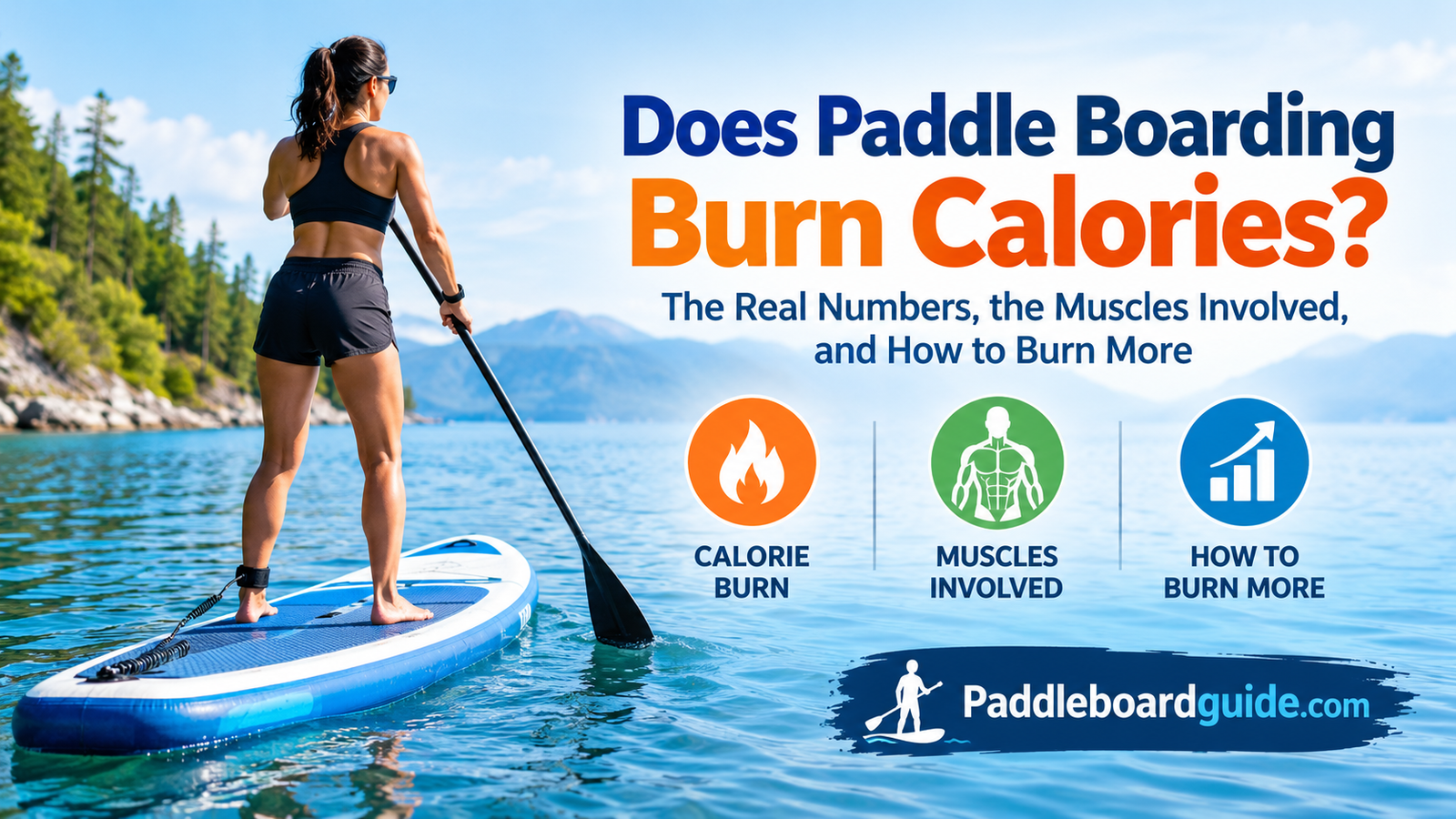
Does Paddle Boarding Burn Calories? The Real Numbers, the Muscles Involved, and How to Burn More
Yes, it does, and often more than people expect. Here is exactly how much, why it varies so much, and how to turn a relaxed day on the water into a genuinely effective workout.
Picture a calm morning on a lake. The water is flat, the air is cool, and you are standing on a board, dipping a paddle in a steady rhythm. It feels more like a stroll than a workout. Then, about forty minutes in, you notice your shoulders are warm, your core is working harder than you realized, and your heart rate is higher than your mood would suggest. That quiet little surprise is the reason so many people ask whether paddle boarding actually burns calories.
The short answer is yes. Stand up paddle boarding (SUP) combines balance, rhythmic upper-body pulling, constant core engagement, and leg stabilization, all while you are standing on an unstable surface. The exact calorie burn depends on who you are, how hard you paddle, and what the water is doing, but for most adults a steady hour on a board lands in a respectable moderate-exercise range, with harder sessions climbing well above that.
In this guide you will find realistic calorie estimates by body weight and intensity, a breakdown of the muscles you use, side-by-side comparisons with walking, kayaking, swimming, running, and cycling, and practical ways to raise your burn without wearing yourself out. You will also see sample workouts, honest thoughts on weight loss, and safety and recovery advice. If you are brand new to the sport, our overview of what a paddle board is and how it works is a handy companion read.
One quick note before we dive in: every calorie figure you will see here is an estimate. Bodies, boards, and conditions vary, and fitness trackers can disagree with each other by a wide margin. Treat the numbers as useful ballparks rather than guarantees, and let the trends in how you feel, sleep, and perform guide you.
1. The Quick Answer: Does Paddle Boarding Burn Calories?
Paddle boarding burns calories in the same way any sustained physical activity does: your muscles use energy to move you and keep you upright, and that energy comes from the food you eat and the fuel your body has stored. What makes SUP interesting is how many muscles contribute at once and how hard your body works to stay balanced, even when you do not feel like you are working hard.
Most exercise scientists classify casual paddle boarding as light to moderate activity, comparable to a brisk walk or an easy bike ride. Push the pace, paddle into a headwind, or add interval efforts and it moves into vigorous territory. That range is wide on purpose. A leisurely sunset float and a fast fitness session are technically the same sport, but they are not the same workout.
Key Takeaways
- A relaxed hour on calm water burns a modest amount, similar to a steady walk.
- A purposeful hour with a strong, consistent stroke lands in moderate-intensity territory for most adults.
- Interval-style or racing-style efforts can push the burn into a vigorous range.
- Body weight, wind, current, board type, and technique all change the final number.
- The workout is full-body, with the core, legs, back, and shoulders sharing the load.
Why SUP Feels Easier Than It Is
Water has a cooling, calming effect. You are outdoors, there is scenery, and there is no pounding impact like you get from running. All of that lowers your perceived effort. Researchers call this the gap between how hard exercise feels and how hard your body is actually working, and outdoor water activities tend to widen that gap in a good way. You can end up doing meaningful exercise without the sense of grinding through a workout.
There is another reason it sneaks up on you: stabilization work is invisible. When you stand on a board, hundreds of small adjustments happen in your ankles, knees, hips, and trunk every second. None of them feels like a big effort individually, but together they add up to a steady background burn that you would not get standing on a gym floor.
Is It Real Exercise?
Absolutely. If you want a deeper look at the cardiovascular, strength, and mental benefits, we cover them in our guide on whether paddle boarding is good exercise. For this article, the key idea is simple: you do not need to turn the sport into a race to get a worthwhile calorie burn. You just need to be intentional about how you paddle.
A Quick Word on Terminology
You will see the terms SUP, stand up paddle board, and paddle board used interchangeably. If you have ever wondered whether there is a real difference, our explainer on SUP board vs paddle board clears it up. For calorie purposes, they all describe the same activity: standing on a board and moving yourself with a long paddle.
Ready to get on the water and start burning? A stable, beginner-friendly inflatable board is the easiest way in.
Shop Inflatable Paddle Boards2. How Many Calories Does Paddle Boarding Burn?
Let us put actual numbers on it. The most common way to estimate calorie burn for any activity is to use metabolic equivalents, usually shortened to METs. One MET is roughly the energy you use sitting quietly. An activity rated at 6 METs burns about six times that. Published activity compendiums list paddle boarding in the neighborhood of 6 METs for general recreational paddling, with gentle paddling lower and fast, effortful paddling considerably higher.
The Simple Formula
If you weigh 160 pounds, that is about 72.6 kilograms. At a moderate 6 METs, you get roughly 436 calories for a full hour. At an easy 3.5 METs, you get about 254. At a vigorous 8 METs, you get around 581. Those are estimates for the time you spend actively paddling, not the time you spend adjusting your leash, taking photos, or floating while you chat.
Estimated Hourly Burn by Body Weight and Intensity
The table below uses the formula above with three representative intensity levels. Think of it as a map rather than a measurement.
| Body Weight | Easy Cruising | Steady Fitness Pace | Hard Effort / Intervals |
|---|---|---|---|
| 130 lb (59 kg) | about 200 cal | about 350 cal | about 470 cal |
| 160 lb (73 kg) | about 250 cal | about 435 cal | about 580 cal |
| 190 lb (86 kg) | about 300 cal | about 515 cal | about 690 cal |
| 220 lb (100 kg) | about 350 cal | about 600 cal | about 800 cal |
Why Your Tracker May Say Something Different
Wrist-based trackers estimate calorie burn using heart rate, movement, and personal data. On a board, your wrist movement is limited and your heart rate may respond differently than it does on land because of heat, hydration, and the way upper-body exercise affects heart rate. Some watches overestimate, some underestimate, and many handle the upright arm swing of paddling poorly. If you track your sessions, use the number to compare one session with another rather than as an absolute truth. A chest strap tends to be more reliable for heart rate than a watch during paddling.
If you would like a waterproof device, a fitness watch with a dedicated paddle or water sports mode makes logging easier. Just remember to rinse it with fresh water after saltwater sessions.
What Is a Realistic Weekly Number?
Say you paddle for an hour, three times a week, at a steady fitness pace, and you weigh around 160 pounds. That is roughly 1,300 calories of additional activity across the week, plus all the other benefits that come with regular movement. For someone who is otherwise sedentary, that is a meaningful jump. For someone who already trains hard, it is a fun and lower-impact addition.
Pro tip: Do not compare a calm-lake float with a published race figure. Pick the row in the table that matches how you really paddle, then try to nudge yourself up one level on a few sessions each week.
Heart Rate Zones: A Better Guide Than Calories
Calories are a handy headline number, but heart rate zones tell you how your body is responding in real time. Many fitness guides suggest that moderate exercise falls somewhere around the middle of your estimated maximum heart rate, while vigorous exercise sits higher. A simple alternative is the talk test. If you can speak in full sentences, you are in an easy to moderate zone. If you can manage only a few words at a time, you are working hard. If you cannot speak at all, you are at an all-out effort that should be saved for very short bursts.
On a paddle board, the talk test works especially well because you are usually outdoors with a friend or can simply talk to yourself. Use it to keep easy days easy and hard days purposeful. Many paddlers make the mistake of living in the middle, going just hard enough to feel tired but never hard enough to improve or easy enough to recover. Planning your zones keeps your sessions varied and your progress steady.
The Afterburn Question
You may have heard that intense exercise keeps your metabolism elevated after you finish. That effect is real, but it is modest. After a hard interval session, your body uses a little extra energy to recover, restore oxygen levels, and repair tissue. For most recreational paddlers this adds a small bonus rather than a dramatic one, so do not plan your eating around it. The calories you burn while actually paddling are the main event.
Want to track your sessions properly? A waterproof fitness watch makes comparing workouts simple.
Browse Waterproof Fitness Watches3. What Changes Your Calorie Burn on a Paddle Board?
Two people can paddle for the same amount of time and walk away with very different numbers. That is not a flaw in the sport. It is a reflection of how many variables are in play. Understanding them lets you pull the right levers.
Body Weight and Composition
Moving a heavier body costs more energy, which is why the table above climbs from left to right and from top to bottom. A heavier paddler also stabilizes more mass on the board. Muscle tissue burns more energy than fat tissue at rest and during activity, so two people at the same weight but with different body compositions may also see slightly different results. If you are curious about how much weight a board can safely carry, our guide on how much weight a paddle board can hold explains capacity ratings and why they matter for stability and performance.
Paddling Speed and Cadence
Speed is the biggest lever you control. Resistance from water rises sharply as you go faster, so moving at four miles per hour takes far more effort than moving at two. The same goes for stroke rate. A relaxed cadence of around 30 strokes per minute feels very different from a brisk cadence of 50 or more. Even a modest speed increase raises your heart rate noticeably.
Wind
Wind is the great equalizer. Paddling into a steady breeze is like climbing a hill: your speed drops, your effort rises, and the calorie burn jumps. A paddler who rides home with a tailwind gets an easy return, while the outbound leg into the wind earns the real workout. A smart strategy is to start into the wind when you are fresh and finish with the wind at your back.
Current, Waves, and Chop
Flat water is relaxing. Chop makes your stabilizing muscles work harder, and waves or boat wakes add balance challenges. Moving water, like a river with a mild current, can make an upstream paddle feel like a treadmill with the incline turned up. These conditions are good for calorie burn but require more skill and more caution.
Board Type, Length, and Width
Long, narrow touring boards glide efficiently, so you can go faster with less effort. Wide, short all-around boards are more stable but slower and a bit draggier. Neither is better for calories per se. A stable board lets you stay upright and paddle consistently, which can mean a better workout for a beginner than a fast board they keep falling off. To understand how different boards behave, read our overview of paddle board types.
Technique
Efficient technique can actually reduce effort at a given speed, while energetic technique raises both speed and calorie burn. A paddler who uses only the arms tires quickly and burns fewer calories than one who rotates the torso and drives from the hips. The most effective approach is to learn good form first and then add power. If you are still working on basics, our walkthrough on how to paddle board is a solid place to start.
Duration and Consistency
Because calories scale with time, a ninety-minute session at a moderate pace burns as much as a sixty-minute session at a harder one. For beginners, longer and easier tends to be more sustainable. For people with limited time, shorter and harder fits better.
Temperature and Conditions
Cold water can raise energy use slightly because your body works to stay warm, while hot weather raises heart rate because of heat stress. Neither is a recommended way to burn extra calories. Dress and hydrate appropriately for the conditions rather than trying to exploit them.
Quick Reference: Factors at a Glance
| Factor | Effect on Burn | How You Can Use It |
|---|---|---|
| Speed | Very high | Add short bursts or longer fast segments |
| Headwind | High | Paddle into the wind first, finish with it behind you |
| Body weight | High | Use the table in Section 2 as your baseline |
| Duration | High | Add 10 minutes at a time as fitness grows |
| Chop and current | Moderate | Choose conditions that match your skill level |
| Technique | Moderate | Rotate the torso and keep a steady cadence |
| Board shape | Low to moderate | Pick stability first, speed second |
Fitness Level and Efficiency
Here is a twist that surprises many beginners: as you get fitter and more skilled, you may burn slightly fewer calories at the same pace, because your body becomes more efficient. The upside is that you can now go faster, farther, or longer for the same perceived effort, which more than makes up for it. To keep progressing, you need to nudge up the challenge over time with more minutes, more intervals, tougher conditions, or a stronger technical focus.
This is also why beginners sometimes feel exhausted after what looks like an easy paddle. Their bodies are working hard on balance and coordination that experienced paddlers handle automatically. That extra effort is real, and it is a good reason to be patient with yourself in the early weeks.
A lighter, better-fitting paddle makes every stroke more efficient and every session more enjoyable.
Shop SUP Paddles4. The Muscles Worked on a Paddle Board
One reason paddle boarding burns a worthwhile amount of energy is that it recruits many large and small muscle groups together. Whole-body movements that involve big muscles tend to use more energy than isolated movements, and SUP checks that box.
Core: The Engine Room
Your abdominals, obliques, lower back, and deep stabilizers are active the entire time you stand. Each stroke adds a rotational demand as you twist and then unwind. You will not usually feel a burning sensation like you would doing crunches, but many paddlers notice a pleasant tightness through the midsection the next day. The deep stabilizers around the spine do much of this quiet work, helping you stay upright as the board shifts underneath you.
Legs and Glutes: The Foundation
Your quads, hamstrings, calves, and glutes keep you balanced and absorb movement from the water. Soft knees and a slightly bent stance mean your thighs and glutes stay engaged. In your feet and ankles, dozens of small muscles make constant micro-corrections. This is a big reason paddling can feel more tiring than expected for beginners: the legs are working continuously, just without looking like it.
Back and Lats: The Pulling Power
Each stroke pulls the paddle through the water, and your latissimus dorsi, rhomboids, and mid-back muscles provide a lot of that pull. Good technique routes power through the big muscles of the back instead of relying solely on the arms. A strong posture also engages the muscles along your spine that keep you tall.
Shoulders, Arms, and Chest
Shoulders, triceps, and biceps help guide and drive the paddle. The top arm pushes while the lower arm pulls, so both sides contribute. If you rely too heavily on your arms, your shoulders will fatigue early and you will burn fewer calories than you could, because you will have to slow down. Using the torso fixes that.
Hips and Inner Thighs
Rotating the hips with each stroke and balancing laterally engages the hip flexors, adductors, and abductors. These are often neglected muscle groups in everyday life, so paddling can be a nice complement to a routine that is dominated by forward and backward movement.
Balance and Proprioception
The nervous system is a big part of the workout too. Staying upright on a moving surface trains your brain to coordinate muscles quickly, which improves balance and body awareness. That training benefit carries over to daily life and to other sports.
What Paddling Does Well
- Works the core continuously
- Low-impact on joints
- Trains balance and coordination
- Builds muscular endurance in back and shoulders
- Adapts easily from gentle to demanding
What It Does Less Well
- Does not build maximum strength on its own
- Provides little bone-loading impact
- Is weather and location dependent
- Needs gear and a place to paddle
- Overuse of arms can strain shoulders
Pairing paddling with a few strength sessions each week, especially for the legs, hips, and upper back, fills in the gaps and gives you a well-rounded routine. Even simple bodyweight moves or resistance band work are enough.
Support your paddling with simple strength work. A resistance band set is a cheap, portable cross-training tool.
Shop Resistance Bands5. Paddle Boarding vs Other Workouts
How does an hour of paddle boarding stack up against other popular activities? The table below uses approximate MET values for a 160-pound person. Use it for rough comparison, not exact ranking, since every activity has a wide range depending on effort.
| Activity (1 hour) | Approx. Calories (160 lb) | Impact on Joints | Notes |
|---|---|---|---|
| Gentle yoga | about 180 | Very low | Focus on flexibility and calm |
| Easy paddle boarding | about 250 | Very low | Social, scenic, relaxed |
| Brisk walking | about 310 | Low | Easy to start anywhere |
| Recreational kayaking | about 360 | Very low | Seated, more upper-body dominant |
| Steady paddle boarding | about 435 | Very low | Full-body with balance demand |
| Swimming (moderate) | about 435 | Very low | Technique-dependent |
| Hard paddle boarding | about 580 | Very low | Intervals or racing pace |
| Cycling (moderate) | about 580 | Low | Leg dominant |
| Running (about 5 mph) | about 600 | High | Highest impact, efficient burn |
Paddle Boarding vs Walking
An easy paddle is similar to a walk in terms of calories, but it adds balance, upper-body, and core work that walking does not. A steady paddle moves clearly beyond a walk. Walking wins on convenience and cost; paddling wins on variety and enjoyment for many people.
Paddle Boarding vs Kayaking
Kayaking is seated and braced, so your core and legs work less on stability. Paddle boarding adds the standing component and more full-body involvement. Kayaking can be faster and easier on longer trips, though, and a hard kayak session can match or beat a moderate paddle board session.
Paddle Boarding vs Swimming
Swimming is excellent exercise but depends heavily on technique. A skilled swimmer burns a lot, while a beginner may tire quickly and not sustain intensity. Paddling is far more accessible for many people because you are on top of the water and can keep moving comfortably for an hour or more.
Paddle Boarding vs Running and Cycling
Running and cycling have the edge in raw calorie burn per hour at similar effort levels, with running being the most calorie-dense because it is weight-bearing. The trade-off is joint impact for running and a more limited muscle group for cycling. Paddle boarding sits in a sweet spot: lower impact than running, more full-body than cycling, and enjoyable enough that people tend to do it longer and more regularly.
The best workout is the one you will repeat. If you love being on the water, a slightly lower hourly burn that you do three times a week beats a higher-burning activity that you dread and skip.
Choosing the Right Activity for Your Goals
If your main goal is the highest possible calorie burn in the shortest time, running or hard cycling will usually beat paddle boarding. If your main goal is a full-body, low-impact workout that you enjoy and can sustain, paddle boarding is hard to beat. If you want strength, add resistance training. If you want mobility, add yoga. Many people end up combining several of these and treating paddle boarding as the fun anchor of their week.
It is also worth considering joint health and injury history. Runners often turn to paddling for a gentler cross-training day, while people with sore knees or hips frequently find that the water-based, low-impact motion feels far kinder than pounding pavement. Whatever your starting point, the right choice is the one that fits your body, your schedule, and your sense of fun.
Long sessions are easier when you stay hydrated. A comfortable hydration pack keeps water within reach.
Shop Hydration Packs6. Different Styles of Paddling and Their Calorie Burn
Paddle boarding is not one activity. It is a family of them, and each branch has its own calorie profile. Here is a tour of the most common styles.
Recreational Cruising
This is what most people picture: a wide board, calm water, a relaxed pace, and plenty of stops to enjoy the view. Expect the lower end of the burn range, roughly in the easy cruising column of our table. It is wonderfully accessible, and it is also the best way to build comfort and balance when you are new.
Touring and Distance Paddling
Touring boards are longer and narrower, designed to glide. Because you are covering ground at a steady pace for a long time, the calorie burn can add up significantly over a half or full day. A three-hour tour at a moderate pace can burn more total calories than a hard thirty-minute session, even though it feels gentler in the moment.
Fitness and Interval Paddling
Here you treat the board like a gym. You warm up, then alternate hard efforts with easy recovery paddling, much like running or cycling intervals. This is the highest-intensity form for most people and produces the largest hourly burn. It also trains your cardiovascular system more effectively. Keep it to a few sessions per week and add easy days between them.
Racing
Racers use long, narrow boards and precise technique to cover distance quickly. The effort is sustained and demanding, with calorie burns well above recreational levels. You do not have to race to benefit from racing techniques, though. Borrowing a focus on rotation, reach, and stroke rate makes any paddler faster and fitter.
SUP Yoga and Pilates
On a stable board anchored in calm water, yoga poses become a balance and core challenge. Burn is modest compared with fast paddling, closer to a land-based yoga session with a boost from the instability. The real payoff is strength, flexibility, and mindfulness. Many people use it as a complement to a more active paddling routine.
Surf SUP
Paddling out through waves, positioning for a swell, and riding it demands bursts of intense effort, followed by recovery. It is a skilled, advanced form of the sport and carries more risk. Calorie burn is hard to estimate because it comes in unpredictable bursts, but it can be substantial.
Whitewater and River Paddling
Moving water adds a constant balance challenge and can require strong, quick efforts. It is not a beginner activity and demands training, appropriate equipment, and respect for conditions.
Style Comparison
| Style | Typical Intensity | Best For | Skill Level |
|---|---|---|---|
| Recreational cruising | Light | Relaxation, learning | Beginner |
| Touring | Light to moderate | Long, scenic outings | Beginner to intermediate |
| Fitness intervals | Moderate to vigorous | Cardio and calorie burn | Intermediate |
| Racing | Vigorous | Speed and competition | Advanced |
| SUP yoga | Light | Balance, flexibility, calm | Beginner to intermediate |
| Surf SUP | Variable, bursts | Thrill and skill | Advanced |
Curious about on-the-water yoga? A wide, stable board with a cushioned deck is the right place to begin.
Shop SUP Yoga Boards7. Standing, Kneeling, Sitting, and Board Type: Do They Change the Burn?
Not every paddler stays upright the whole time, and not every board feels the same underfoot. Here is how those choices affect your workout.
Standing
Standing is the full-experience position and the most demanding for the core and legs. Your body weight is carried over a small base of support, and every ripple asks for a correction. If your goal is to burn calories and build stability, standing is the position to aim for. It also gives you a better view and a better paddling angle for powerful strokes.
Kneeling
Kneeling lowers your center of gravity and gives you a much wider base. It is a great starting point for nervous beginners, for windy conditions, and for a rest during a long outing. You will still use your core, back, and shoulders, but the leg and balance demand drops. Calorie burn is lower than standing at the same pace, though the difference narrows if you paddle hard.
Sitting
Sitting is best for rest breaks, for paddling with a dog or a child, or for recovering after a fall. It engages the upper body but removes most of the stabilizing work. Consider it an active rest rather than an exercise position.
Does a Hard Board Burn More Than an Inflatable?
Not in a way that matters for most people. Hard boards usually glide faster and feel more rigid, which can mean a higher speed for the same effort. Inflatables are stable, forgiving, and easy to transport and store, and quality models are very rigid when fully pumped. The best board for burning calories is the one you will actually take out regularly. For a roundup of options, see our guide to the best inflatable paddle boards, and if you are still deciding whether an inflatable suits a new paddler, read are inflatable paddle boards good for beginners.
Board Width and Stability
A wider board is more stable, which allows a newer paddler to keep a steady pace. A narrower board rewards good balance and technique with speed. If you are heavy or new, choose stability first. Being able to paddle for an hour without falling in creates more calorie burn than a fast board that makes you nervous.
Fins and Tracking
Fins help the board track straight. A board that tracks well lets you take more consecutive strokes on one side, which is more efficient. A board that wobbles forces extra corrections. If your board seems to wander, check that the fins are seated correctly and that your stance is centered.
Position Comparison
| Position | Core Demand | Leg Demand | Calorie Burn | Best Use |
|---|---|---|---|---|
| Standing | High | High | Highest | Fitness and full experience |
| Kneeling | Moderate | Low | Moderate | Wind, beginners, rest |
| Sitting | Low | Very low | Lowest | Breaks and passengers |
Smart mix: If you are building up, alternate five minutes standing with a minute kneeling. You will keep moving longer, which matters more than sticking rigidly to one position.
Looking for a stable, durable board for long fitness sessions? Compare touring-style boards that glide with less effort.
Shop Touring Paddle Boards8. The Gear That Shapes Your Workout
You do not need a garage full of equipment to burn calories on a paddle board, but a few smart choices make sessions safer, smoother, and more productive.
The Board
For most people, an all-around inflatable between ten and eleven feet is the easiest starting point. It handles calm water and light chop, rolls up for storage, and is forgiving when you fall. If your goal is fitness and distance, a touring shape adds glide. Check the weight capacity so your board floats at the right level. A board that is overloaded sits low in the water and drags, which slows you down and makes stability worse.
The Paddle
The paddle is your engine, and a poor one makes every session harder than it needs to be. Look for an adjustable length so you can set it to roughly six to ten inches above your head for general paddling. A lighter paddle reduces fatigue over time, which means you can paddle longer and burn more. Our guide to the best paddle board paddles compares materials and designs, and it is worth a look before you upgrade.
The Leash
A leash keeps the board attached to you if you fall, which matters because a drifting board can be hard to catch, especially in wind. Choose a leash that suits your water type, with a coiled leash typical for flat water and a straight leash for surf. It is a small piece of safety gear with a large payoff.
The Life Jacket
A personal flotation device is one of the most important items you can bring, and in many places it is a legal requirement. Modern inflatable and low-profile options are comfortable enough to wear all day. We cover the details in our guide to the best paddle board life jackets, and the rules in our overview of paddle board safety requirements.
The Pump
If you paddle an inflatable board, an efficient pump saves energy before you even hit the water. An electric pump is a nice upgrade if you want to save your shoulders for paddling. A fully inflated board is stiffer and faster, so do not skimp on pressure.
Clothing and Sun Protection
Dress for the water temperature, not just the air temperature. Quick-dry fabrics, a rash guard, and a hat keep you comfortable. Sunscreen is essential because reflection off the water increases exposure. Polarized sunglasses with a retainer reduce glare and make it easier to read the water.
Hydration and Fuel
Bring water for any session over thirty minutes, and more in warm weather. A small dry bag with a snack covers longer outings. Sweating is less noticeable on the water because the breeze cools you, so it is easy to underdrink.
Phone and Valuables
A waterproof phone pouch lets you carry a phone for safety and for tracking your session. Put it on a lanyard or in a dry bag attached to the board.
Essential Gear Checklist
- Stable board matched to your weight and skill level
- Adjustable, lightweight paddle set to the correct height
- Leash suited to your water conditions
- Properly fitted personal flotation device
- Pump with a reliable pressure gauge for inflatables
- Sun protection, water, and a small snack
- Whistle and waterproof phone pouch for safety
Not sure what else you need? A complete accessory kit covers most of the basics in one purchase.
Shop Paddle Board Accessories9. Technique Tweaks to Burn More Without Burning Out
Good technique makes you faster, more efficient, and more powerful, and those three things together produce a bigger, safer calorie burn. These tweaks are simple to learn and practice.
Start with Your Stance
Stand in the center of the board with your feet about hip-width apart, parallel, and roughly midway between the nose and the tail. Keep your knees soft and your back tall, with your head up and eyes on the horizon rather than your feet. A good stance gives you balance and a strong base to push from.
Rotate Your Torso
This is the most important tip for both power and calorie burn. Instead of pulling with your arms, wind your torso forward, reach, plant the paddle, and unwind. Your core and back drive the stroke, and your arms act as connectors. Practicing rotation also protects your shoulders from overuse.
Reach and Plant
Reach forward to catch the water near your toes and bury the blade fully before you pull. A half-buried blade wastes effort. A full catch grabs more water and moves the board more with each stroke.
Pull Past Your Feet, Not Past Your Hips
The most effective part of the stroke happens between your front foot and your hip. Pulling the paddle far behind you lifts the water and slows the board down. Exit the blade at your ankle or just behind it.
Keep the Shaft Vertical
A vertical paddle shaft pulls straight back instead of pushing the board sideways. The top hand pushes down over the blade, and the bottom hand pulls. Think of it as climbing a ladder with the paddle rather than rowing a boat.
Use a Steady Cadence
Aim for a rhythm you can maintain. A faster cadence with a lighter pull can be more efficient than a slow cadence with a heavy pull, and it keeps your heart rate in the zone you choose. Use a count in your head, like in for three, out for three, to keep rhythm.
Switch Sides Smartly
Paddle three to six strokes on one side, then switch. Switching too often wastes time and energy, while switching too rarely causes the board to turn. Balanced use of both sides also keeps your muscles evenly worked.
Add Intensity in a Controlled Way
- Use short bursts of twenty to thirty hard strokes followed by an easy minute
- Paddle into the wind or against a current on purpose for a set period
- Try pyramid intervals, building from thirty seconds hard to two minutes hard and back down
- Hold a lower stance with deeper knee bend for a minute to challenge your legs
- Use a smaller blade or a lower stroke rate for a strength-endurance feel
Take It Easy on Your Body
Intensity should rise gradually. Add no more than about ten percent to your weekly time or effort, and listen for warning signs like sharp shoulder pain, numb hands, or lower back strain. If you are curious about how demanding the sport can be for newcomers, our look at how hard paddle boarding is offers realistic expectations. And for a step-by-step walkthrough of form, see our guide on how to paddle board.
Efficient Technique
- Uses big muscles like back, core, and legs
- Protects shoulders and elbows
- Allows longer sessions
- Produces higher speed for the same effort
Arm-Only Paddling
- Tires shoulders early
- Lowers total session burn
- Raises the risk of overuse strain
- Makes the board zigzag
Common Mistakes That Waste Energy
- Looking down at your feet instead of ahead, which rounds the back and throws off balance
- Standing too far toward the nose or tail, which makes the board plow or wobble
- Gripping the paddle too tightly, which tires your forearms and hands
- Using a paddle that is too short, which forces you to hunch over
- Taking short, choppy strokes instead of long, full ones
- Holding your breath during hard efforts instead of breathing steadily
Fixing even two or three of these can make a visible difference to speed and comfort. Film yourself from the shore or ask a friend to watch. Seeing your own stroke is one of the quickest ways to improve it.
Breathing and Mindset
Steady breathing keeps your muscles supplied with oxygen and your mind calm. Try exhaling as you pull the paddle through the water and inhaling on the recovery. Over time this rhythm becomes automatic and gives your session a meditative quality. Paddling is one of the few workouts where the environment itself, with the light on the water, the birds, and the quiet, can help you stay relaxed even while your heart rate rises.
The right paddle height and an adjustable shaft make good technique much easier to learn.
Shop Adjustable SUP Paddles10. Sample Paddle Board Workouts for Every Level
Structure helps. If you have ever wondered what a calorie-focused session looks like, here are practical plans you can adapt. Always start with a warm-up and finish with a cool-down. Adjust for your fitness level and conditions, and stop if you feel unwell.
Workout 1: The Easy Starter (30 to 40 minutes)
- 5 minutes of easy paddling to warm up, kneeling if you need to
- 20 minutes of steady paddling at a pace where you can chat comfortably
- 5 minutes of easy paddling to cool down, plus a short stretch on the shore
This session fits first-timers and anyone coming back after a break. The goal is to enjoy the water and build confidence.
Workout 2: The Steady Fitness Hour
- 10 minutes easy warm-up with a few rotation drills
- 40 minutes at a pace where talking takes some effort, focusing on torso rotation
- 10 minutes easy cool-down
This is the bread-and-butter session for regular paddlers and the one most closely matched to the middle column of our calorie table.
Workout 3: Interval Builder (45 minutes)
- 10 minutes easy warm-up
- 8 rounds of 1 minute hard, 2 minutes easy
- 10 minutes steady cool-down paddling at a relaxed pace
Intervals raise your heart rate more than steady paddling and can increase your hourly burn. The hard minutes should feel strong but controlled, not frantic.
Workout 4: The Wind Challenge
- Paddle out into a headwind for 20 minutes at a strong, steady effort
- Turn around and paddle back with the wind, focusing on technique and recovery
- Finish with a few minutes of easy paddling and stretching
Let the wind do the work of making it harder. Only do this when you are confident, you are wearing a leash and flotation, and you know you can get back.
Workout 5: Endurance Tour (90 to 120 minutes)
- Plan a route with a safe turnaround point
- Paddle at a conversational pace with a short break every 30 to 40 minutes
- Drink water regularly and bring a snack
Long, moderate outings are among the best ways to rack up total calories without feeling beaten up. Picking the right time of day makes a real difference, and our guide to the best time to paddle board can help you choose.
Workout 6: SUP Yoga Flow (45 minutes)
- 10 minutes of easy paddling to a calm, sheltered spot
- 25 minutes of gentle poses, such as cat-cow, plank, downward dog, and warrior, on a stable board
- 10 minutes of easy paddling back
A Sample Weekly Plan
| Day | Plan | Intensity |
|---|---|---|
| Monday | Steady fitness hour | Moderate |
| Tuesday | Strength work or rest | Light |
| Wednesday | Interval builder | Hard |
| Thursday | Rest or stretching | Light |
| Friday | Easy cruise or SUP yoga | Light |
| Saturday | Endurance tour | Moderate |
| Sunday | Rest, walk, or gentle stretching | Light |
Beginner reminder: If this looks like too much, start with two sessions per week and add a third after a month. Consistency beats ambition.
An Eight-Week Progression Idea
If you want a simple path from beginner to confident fitness paddler, here is one way to build gradually. In weeks one and two, paddle twice per week for 30 minutes at an easy pace, kneeling whenever you need a break. In weeks three and four, extend those sessions to 40 minutes and add a third outing. In weeks five and six, make one session a steady 50 to 60 minutes and add a few short pickups of 20 strokes each. In weeks seven and eight, introduce a proper interval session once a week and a longer, easier tour on the weekend.
This approach respects the body’s need for adaptation. Tendons, joints, and connective tissue strengthen more slowly than muscles, so building volume gradually is the best protection against overuse. If you miss a week because of weather or life, simply repeat the previous week rather than jumping ahead. Progress on the water is rarely a straight line, and that is perfectly normal.
Keep your phone dry and your session on track with a waterproof pouch for timing intervals.
Shop Waterproof Phone Pouches11. Can Paddle Boarding Help You Lose Weight?
Paddle boarding can be a helpful part of a weight-management plan, but it is not a magic solution on its own. Body weight depends on the balance between the energy you take in and the energy you use over time, along with sleep, stress, hormones, and genetics. Exercise matters, but food habits usually matter more.
The Calorie Math, Kept Honest
You may have heard that a pound of body fat equals about 3,500 calories. That rule of thumb is a rough guide, and real bodies adapt, so progress is rarely perfectly linear. Still, the idea is useful: sustained activity that adds up over weeks can contribute to a calorie deficit. If you add three steady paddling sessions per week, you may be adding well over a thousand calories of activity, which can support gradual weight change when combined with sensible eating.
The Compensation Trap
Many people finish an enjoyable activity and feel they have earned a large treat. A single post-paddle snack or drink can easily cancel out a good portion of what you burned. This is not a reason to avoid treats. It is a reason to be realistic about how much exercise offsets, and to focus on how you feel and perform rather than treating every session as currency to spend.
Appetite and Fueling
Exercise can raise appetite for some people and not others. Eating a balanced meal with protein, whole grains, fruits, and vegetables after a session helps you recover and keeps cravings in check. Skipping meals before long paddles can leave you tired and cranky, so fuel appropriately for the session length.
Strength and Body Composition
The scale does not tell the whole story. Paddling builds muscular endurance, and adding strength training can improve body composition even when the weight does not change much. Pay attention to how your clothes fit, your energy levels, your sleep, and your performance on the water.
Sustainability Is the Secret
The best weight-related benefit of paddling may be that it feels like play. Activities people enjoy are the ones they keep doing for years, which matters far more than a short burst of extreme effort. Combining regular paddling with daily walking, sensible nutrition, and good sleep gives you a strong foundation.
Helpful Habits
- Paddle two to four times each week
- Add daily walking on non-paddling days
- Include a couple of strength sessions
- Eat balanced meals and stay hydrated
- Track trends over weeks, not days
Common Pitfalls
- Expecting rapid results from exercise alone
- Rewarding every session with a large meal
- Skipping rest and risking overuse
- Comparing tracker numbers to other people
- Fasting before long sessions in the heat
Talk to a professional: If you have a medical condition, take medication, are pregnant, or are returning from an injury, check with your doctor before starting a new exercise routine. A registered dietitian can help with personalized eating guidance, and nothing in this article replaces individual medical advice.
A Realistic Timeline
People often expect quick changes, but sustainable progress takes time. In the first few weeks, you are likely to notice better balance, more energy, and a calmer mood long before any change on the scale. Over two to three months of regular paddling combined with sensible eating, many people see clearer changes in how their clothes fit and how strong they feel. Keeping a simple log of your sessions, sleep, and energy gives you evidence of progress that does not depend on a single number.
Fueling Around Your Sessions
For short, easy outings, you may not need anything special beyond water. For longer or harder sessions, a light snack containing carbohydrates an hour or two beforehand, such as a banana or toast with nut butter, can keep your energy steady. Afterward, a meal that includes protein and carbohydrates supports recovery. Individual needs vary widely, so experiment during easy sessions rather than trying something new before a big outing.
Planning ahead makes healthy eating easier. Good meal prep containers keep post-paddle meals simple.
Shop Meal Prep Containers12. Safety, Recovery, and Staying Consistent
A great workout is one you can repeat safely. This final section covers the practical habits that keep you healthy and motivated so the calories you burn today turn into progress over months.
Check Conditions Before You Go
Look at wind speed, wind direction, weather, tides, and currents. Offshore winds can push you away from the shore faster than you can paddle back. Thunderstorms are a clear reason to stay off the water. If conditions look marginal, wait for a better day. Paddle with a friend when you can, and tell someone your plan.
Always Wear Flotation and a Leash
Even strong swimmers can tire, get cold, or get hurt. Wearing flotation and a leash is the simplest way to improve your odds in an emergency. Review your local rules on flotation and lighting requirements, and carry a whistle. Our safety requirements guide goes through what to bring and why.
Warm Up and Cool Down
A five to ten minute warm-up of easy paddling and gentle rotation prepares your joints and muscles. After you finish, take a few minutes to stretch your shoulders, chest, hips, hamstrings, and lower back. These small habits reduce stiffness the next day.
Hydrate and Refuel
Drink before, during, and after longer sessions. After your outing, a mix of carbohydrates and protein supports recovery. If you have been paddling for more than an hour in warm weather, consider adding electrolytes.
Protect Your Skin and Eyes
Apply water-resistant sunscreen and reapply as directed. Wear a hat, long-sleeve sun shirt, and sunglasses. Reflection from the water increases exposure, even on cloudy days.
Listen to Your Body
- Sharp or persistent shoulder pain is a signal to rest and revise technique
- Dizziness, headache, or nausea can indicate heat illness or dehydration
- Numbness or tingling in your hands may mean a grip that is too tight
- Lower back soreness often points to arm-dominant paddling or poor posture
Care for Your Equipment
Rinse your board and paddle after saltwater sessions, dry them before storage, and keep your board out of prolonged direct sun when you are not using it. Good care makes your gear last, and it keeps you confident that it will perform.
Stay Motivated
Pick a regular day and time, find a paddling friend, and set simple goals like paddling a certain distance or exploring a new shoreline. Keep a simple log of date, time, and how you felt. Celebrating small improvements, like holding a pace longer or standing through chop, builds momentum.
Weekly Recovery Checklist
- At least one or two lighter days between harder sessions
- Seven or more hours of sleep when possible
- Gentle stretching or a short walk on rest days
- Enough protein and overall food to support recovery
Seasonal and Cold-Water Paddling
As the weather cools, the stakes rise. Cold water can cause a dangerous shock response and rapidly reduce your ability to swim or climb back on a board. If you paddle in cool conditions, dress for the temperature of the water rather than the air, which often means a wetsuit or drysuit, a flotation device, and a plan for what to do if you fall in. Stay close to shore, paddle with others, and keep your phone in a waterproof case.
Warm-weather paddling brings its own challenges, including heat, sun, and dehydration. Schedule sessions for cooler parts of the day, take more frequent water breaks, and know the signs of heat illness. Adjusting to the season is part of being a thoughtful paddler, and it lets you keep your routine going all year without taking unnecessary risks.
When to Skip a Session
Strong winds, lightning, poor visibility, illness, and unusual pain are all valid reasons to stay home. Skipping a session is not a failure. It is a decision that protects your long-term consistency. A rest day or a land-based workout keeps your routine going while the water recovers its manners.
A comfortable, well-fitting life jacket is the most important piece of safety gear you can own.
Shop Life JacketsFrequently Asked Questions About Paddle Boarding and Calories
Does paddle boarding burn calories?
Yes. Paddle boarding is a full-body activity that uses your core, legs, back, shoulders, and arms while you balance on the water. A relaxed hour burns a modest amount, a steady fitness pace burns a moderate amount, and interval or racing-style paddling can reach a vigorous level.
How many calories does paddle boarding burn in an hour?
For a 160-pound person, a rough estimate is about 250 calories at an easy pace, about 435 at a steady fitness pace, and about 580 or more with hard efforts. Heavier paddlers burn more, and lighter paddlers burn less. Wind, current, and technique also change the figure.
Is paddle boarding a good workout for weight loss?
It can be a helpful part of a weight-management plan, especially because it is enjoyable and easy on the joints, which makes it easier to repeat. Results depend on your overall eating habits, sleep, and consistency, so combine regular paddling with balanced nutrition and daily movement.
Does paddle boarding work your abs?
Yes. Your abdominals, obliques, and deep stabilizing muscles work constantly to keep you upright and to transfer power from the torso to the paddle. Rotating through the torso with each stroke makes it even more effective.
Is paddle boarding better than walking for calorie burn?
An easy paddle is similar to a brisk walk, while a steady or hard paddle burns more per hour. Paddling also adds balance and upper-body work. Walking is more convenient, so many people benefit from doing both.
Does standing burn more calories than kneeling on a paddle board?
Yes. Standing engages your legs and core more and raises the balance demand. Kneeling is great for beginners and windy conditions, but it burns fewer calories at the same pace.
Do inflatable boards burn fewer calories than hard boards?
Not meaningfully. Hard boards may glide a bit faster, but a fully inflated quality board performs well for most paddlers. Choose the board you will use most often. For help, see our guide to the best inflatable paddle boards.
How can I burn more calories while paddle boarding?
Paddle faster, add intervals, paddle into the wind, rotate your torso, and extend your session time gradually. Improving technique also lets you sustain a higher intensity without fatiguing your arms early.
How long should I paddle board to see fitness benefits?
Many beginners benefit from thirty to sixty minutes, two to three times per week. As your fitness grows, you can extend time or add intensity. Regular, comfortable sessions are better than occasional exhausting ones.
Is paddle boarding hard on your body?
It is low-impact and easy on joints, but overuse can strain shoulders or the lower back if technique is poor. Learning to rotate your torso and building up gradually helps. Our article on how hard paddle boarding is covers what beginners can expect.
Can beginners get a good workout on a paddle board?
Yes. Even a calm, slow paddle works the core and legs, and a stable board lets you stay upright and keep moving. As your balance improves, you can raise the intensity.
What is the best time of day to paddle for exercise?
Early morning and evening usually offer calmer winds, cooler temperatures, and fewer boats. Choose a time that fits your schedule and conditions. For more help, read our guide to the best time to paddle board.
How accurate are fitness trackers for paddle boarding?
They can be a useful guide for comparing sessions but may over or underestimate the actual burn. Wrist-based heart rate can be affected by arm movement and conditions. Use trends over time rather than a single number.
Conclusion: So, Does Paddle Boarding Burn Calories?
It does, and it does so in a way that rarely feels like work. A relaxed paddle gives you a gentle burn, a steady fitness session lands in a solid moderate range, and interval or distance outings can push you into serious territory. Along the way you build core stability, back and shoulder endurance, leg strength, and balance, all with very little impact on your joints.
The most important takeaway is that the best calorie-burning activity is the one you enjoy enough to keep doing. Start where you are, choose a stable board, learn good technique, and add time or intensity gradually. Use the estimates here as a map, track how you feel, and keep a mix of easy and challenging days. Combine regular paddling with sensible nutrition, good sleep, and a bit of strength work, and the results will take care of themselves.
The water is waiting. Grab a board, pick a calm morning, and give your body a workout that feels like an adventure.
Ready to start your paddling routine? Explore beginner-friendly inflatable boards and starter kits.
Find Your Paddle BoardYou May Also Like
Keep exploring our paddle board guides, reviews, and how-tos.