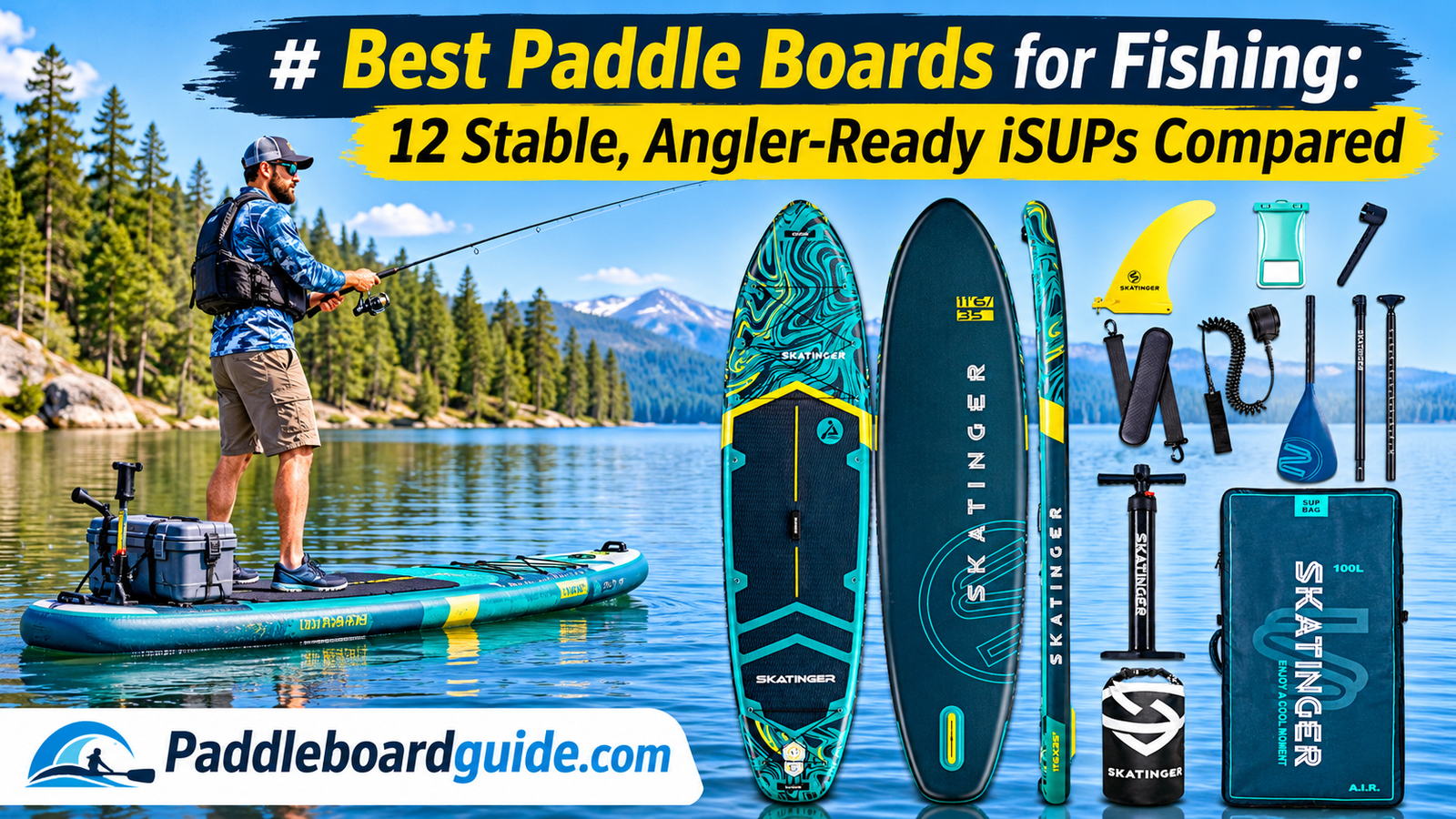
Best Paddle Boards for Fishing: 12 Stable, Angler-Ready iSUPs Compared
Standing to cast changes everything. These are the fishing paddle boards that give you the balance, deck space, and load capacity to actually land fish from a board.
Fishing from a paddle board sounds absurd until the first time you do it. Then you wonder how you ever cast from a seated position in a boat for all those years.
There is a reason stand-up paddle board fishing has moved from novelty to mainstream. When you are standing eight to ten feet above the waterline, you can read structure, spot shadows, see weed lines, and place a cast with a level of precision that no seated angler can match. Fish that spook at the silhouette of a hull often ignore a quiet board drifting overhead. You are stealthy, you are mobile, and you can go where a boat with a propeller simply cannot.
What makes it possible is the equipment. A modern inflatable fishing paddle board is not a surfboard with a leash and good intentions. It is a wide, rigid, drop-stitched platform engineered to hold a paddler, a cooler, a tackle bag, a rod or three, and the fish you land — all without flexing like a waterbed. The boards in this guide range from compact, budget-friendly all-rounders to super-wide fishing platforms rated for serious loads, and each one has been selected against the same set of questions: Is it stable enough to stand and cast from? Is there room to rig it? Will it hold you and your gear without wallowing? And is it something you will actually take out often, or a board that ends up gathering dust in a garage?
We compared twelve boards in total, looking closely at platform width, deck layout, weight capacity, rigging potential, portability, and value for money. Where a specification is published in the product name, we use it. Where it is not, we describe the board’s character honestly instead of guessing at numbers. If you are completely new to the sport, our paddle board guide covers the fundamentals first, and the difference between the two terms people throw around is explained in SUP board vs paddle board.
How this guide is built. Sections one through nine walk through the buying knowledge that separates a great fishing board from a frustrating one. Sections ten through twelve are the board-by-board reviews, grouped by what each board does best. Skim the comparison table if you want answers now; read the deep dives if you want to buy once and buy right.
Ready to Start SUP Fishing?
Browse the full range of fishing-ready paddle boards on Amazon.
Check Fishing SUPs on AmazonQuick Comparison: Our Top Picks
Every board we reviewed appears below, ranked by how well it serves an angler rather than by price alone. The first row is the board we would put under a first-time fishing SUP buyer without hesitation.
| # | Image | Product | Key Specs | Verdict | Check Price |
|---|---|---|---|---|---|
| 1 |  |
Skatinger 11’6″ x 35″ Super Wide iSUPTop Pick Best Overall Stability |
|
Room to stand, cast, and land fish with confidence. | Check Price on Amazon |
| 2 | 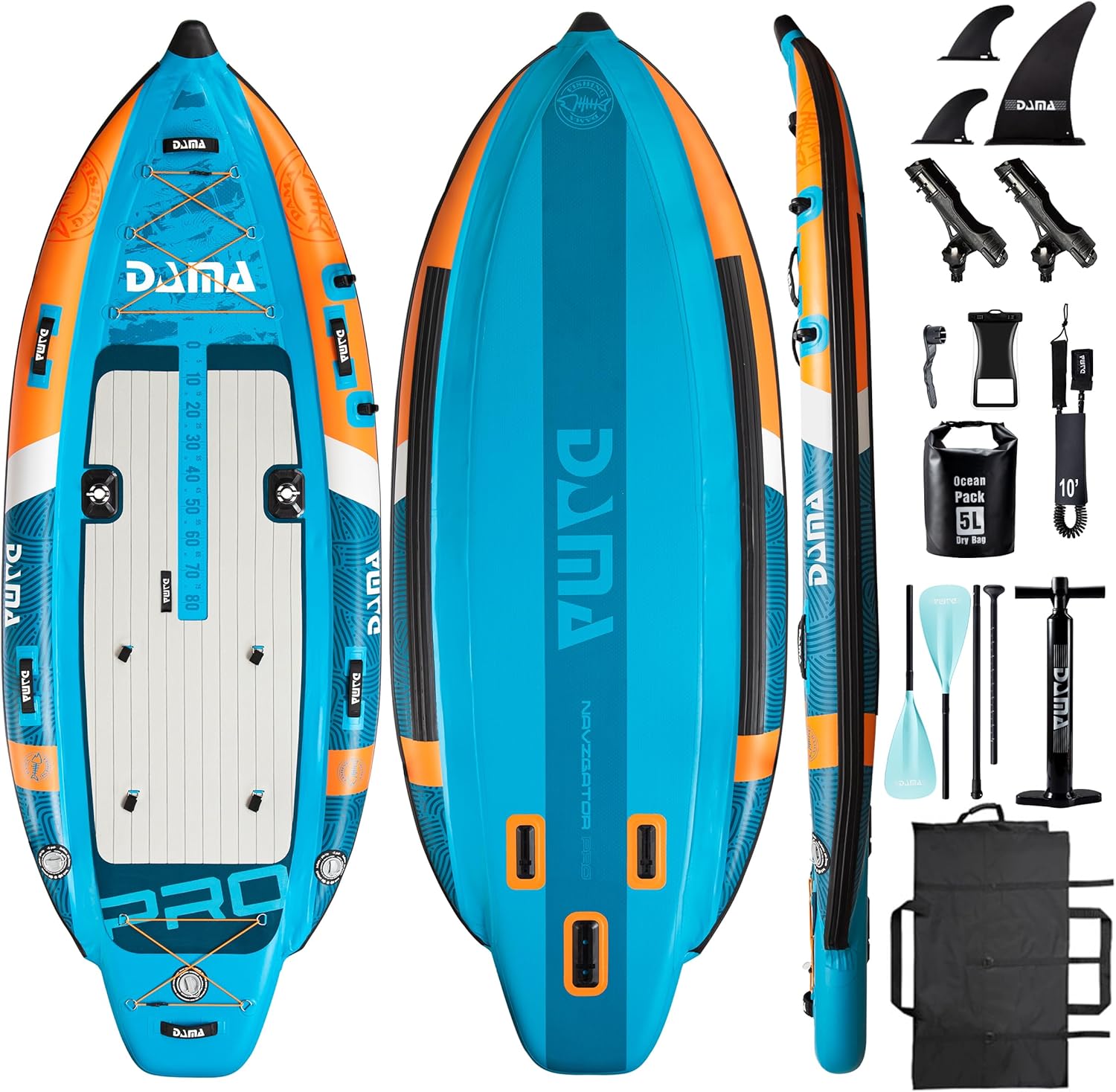 |
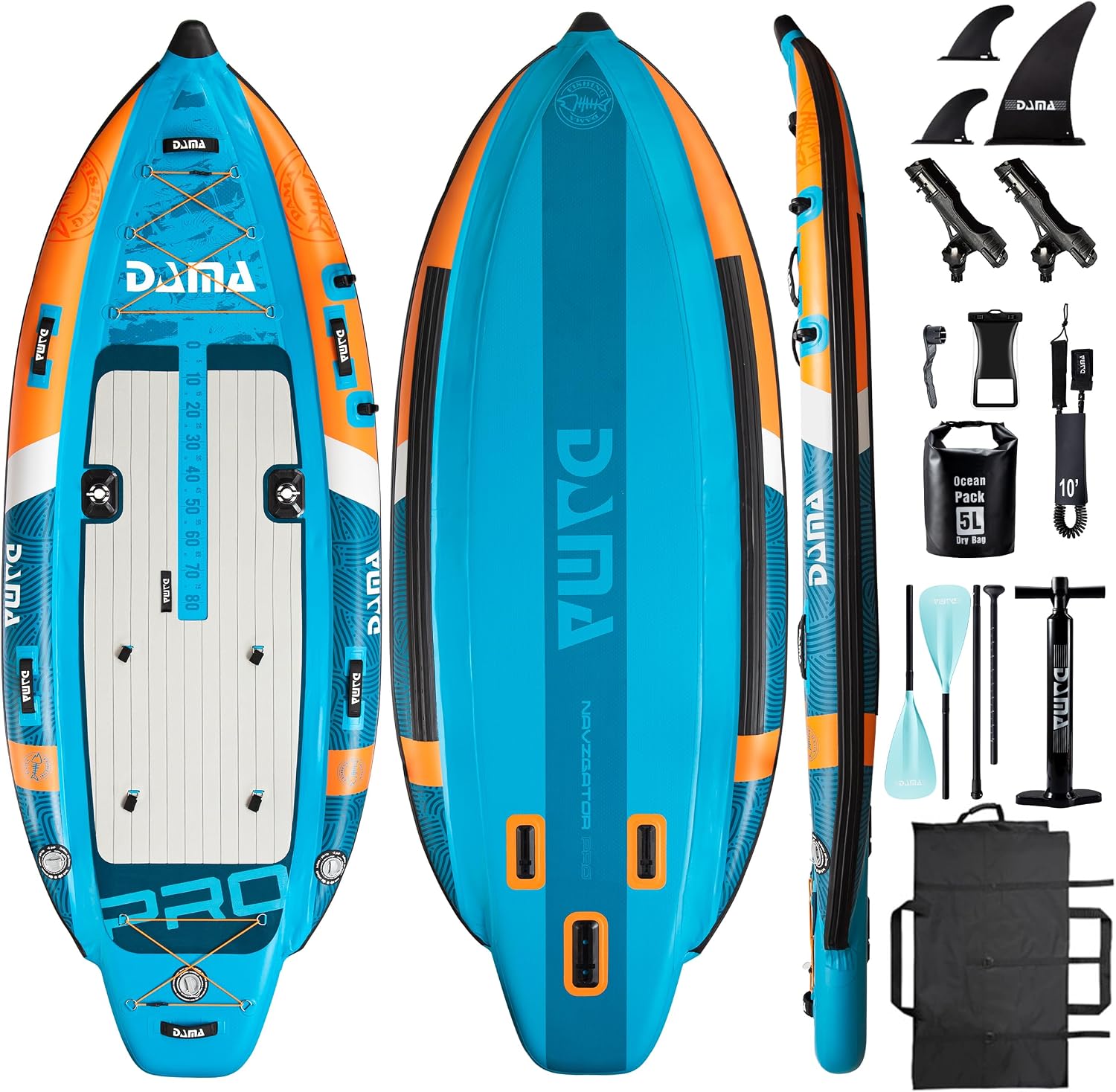
DAMA Triple Chamber SUPBest Heavy-Duty Capacity |
|
Serious load rating and rod holders built right in. | Check Price on Amazon |
| 3 |  |
NACATIN 12′ Convertible SUP-to-KayakBest Convertible Design |
|
Wide, long, and convertible for all-day fishing. | Check Price on Amazon |
| 4 |  |
FLYPARK 10’8″ x 35″ Fishing & Family SUPBest for Family + Fishing |
|
One board for family paddles and fishing missions. | Check Price on Amazon |
| 5 |  |
MYBOAT 11’6″ Inflatable Fishing SUPBest Dedicated Fishing Deck |
|
Purpose-built platform with an angler-first deck. | Check Price on Amazon |
| 6 |  |
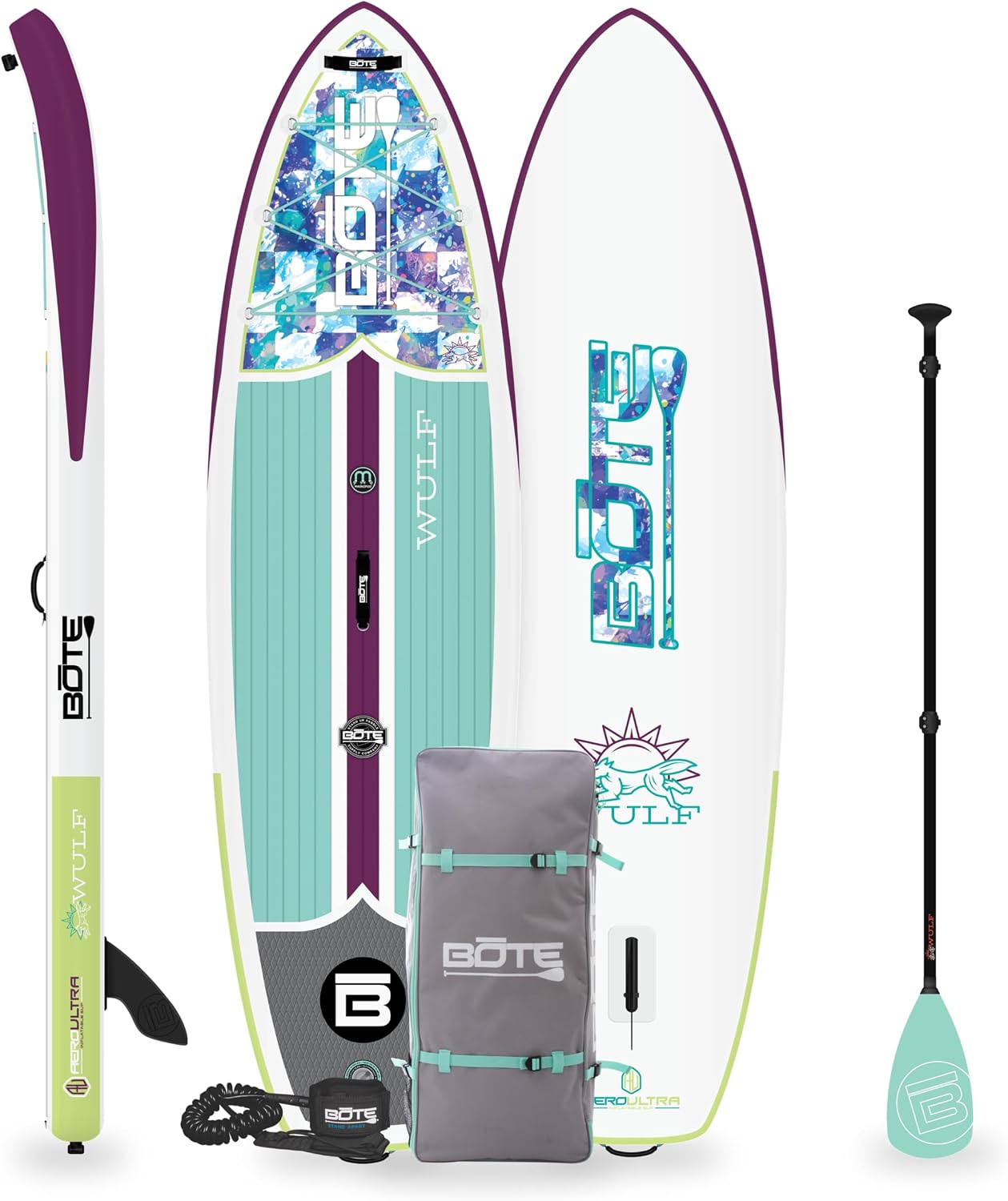
BOTE HD Aero Inflatable SUPBest Premium Build |
|
Premium feel and finish for anglers who want the best. | Check Price on Amazon |
| 7 |  |
Roc Inflatable SUP 10’6″Best Budget |
|
Affordable, easy to carry, steady enough for casual casts. | Check Price on Amazon |
| 8 |  |
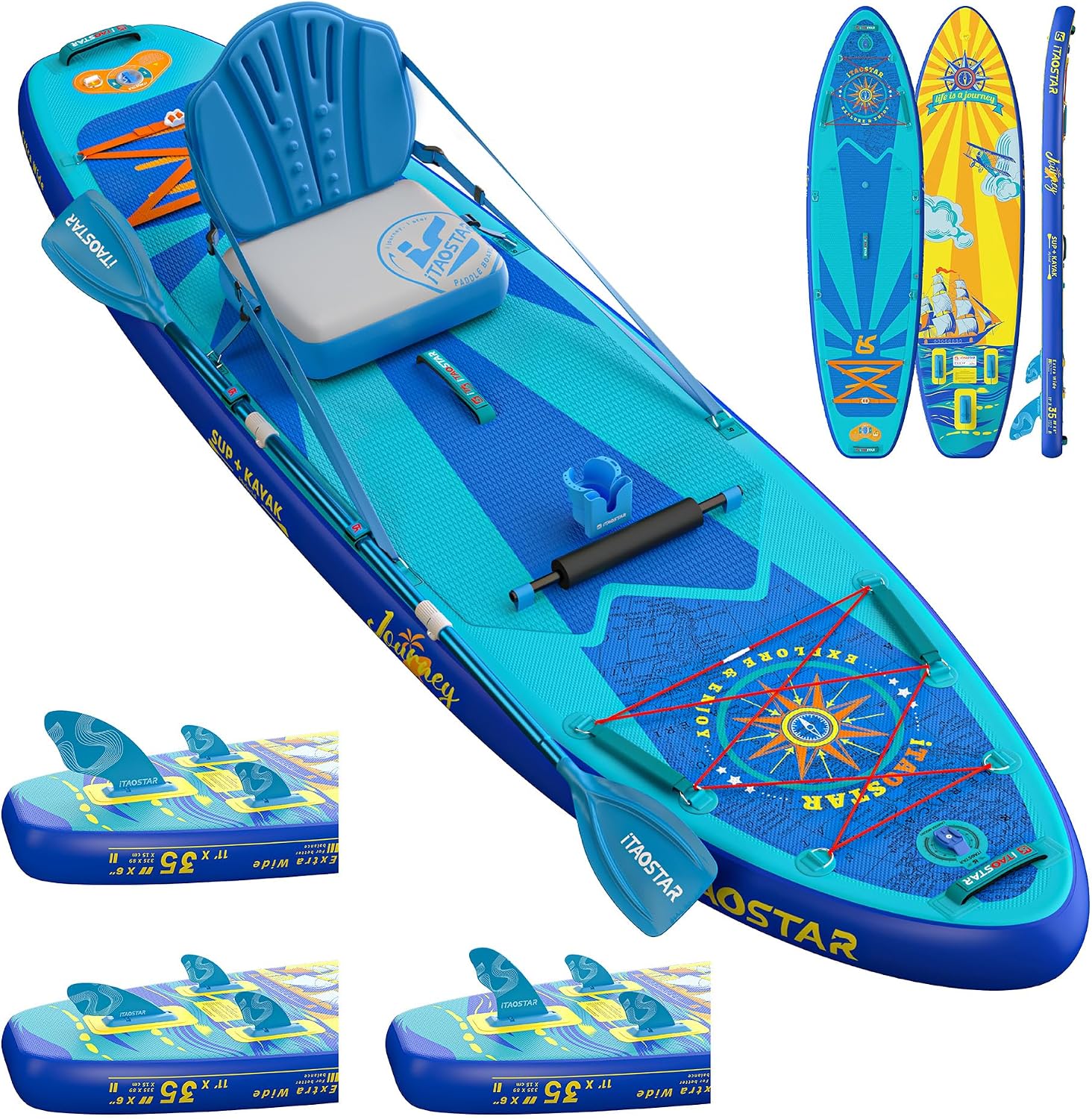
iTAOSTAR Journey 11’6″ Value PackBest Value Bundle |
|
A big bundle that covers fishing trips and family days. | Check Price on Amazon |
| 9 |  |
Niphean Inflatable Paddle BoardBest Stiff High-Pressure Deck |
|
High-pressure deck delivers a firm, hard-board-like ride. | Check Price on Amazon |
| 10 | 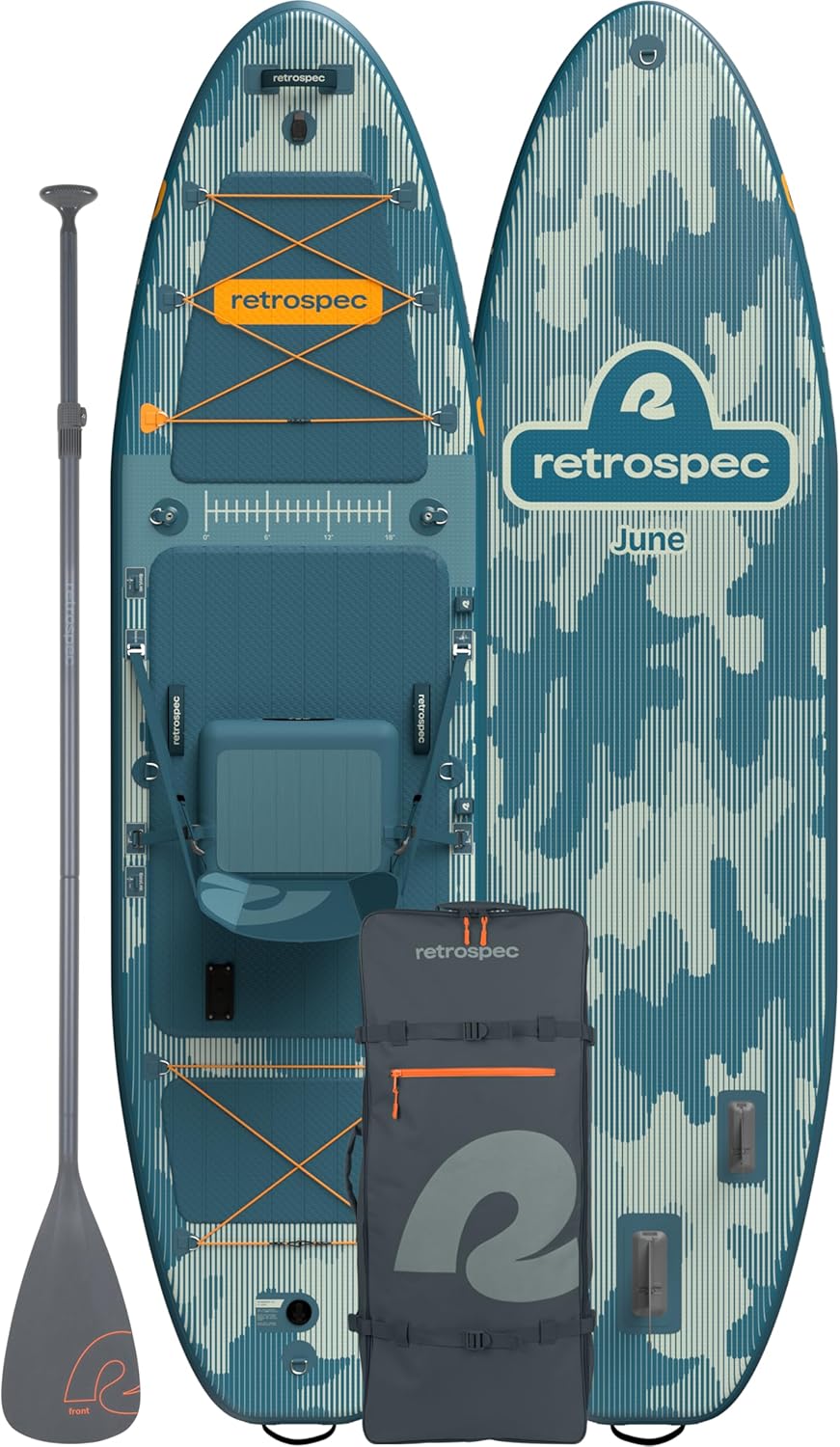 |
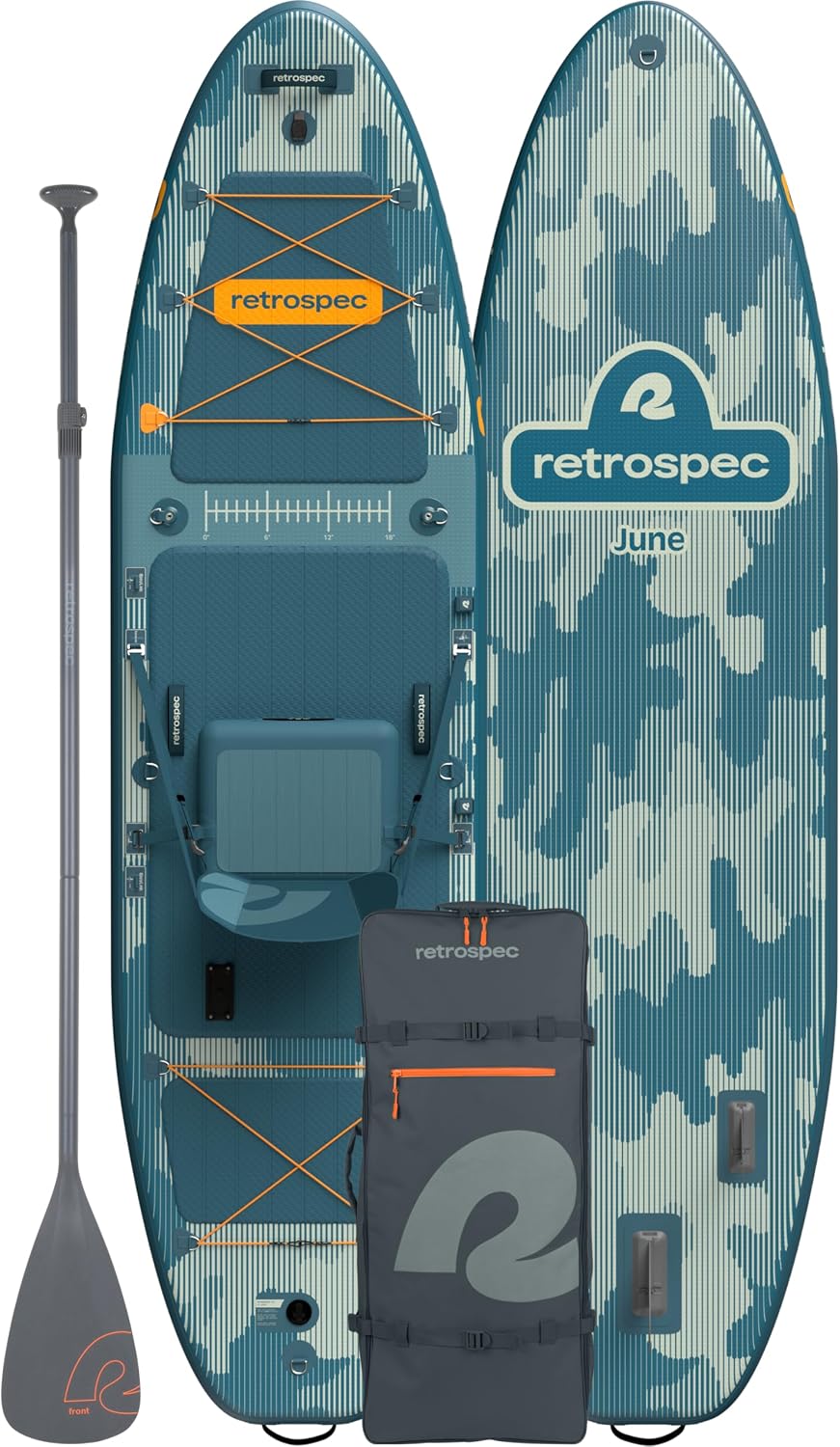
Retrospec June Fishing Paddle BoardBest Style-Led Angler Board |
|
Good-looking fishing board that paddles well all season. | Check Price on Amazon |
| 11 |  |
Hydro Force Oceana Inflatable SUPBest SUP / Kayak Hybrid |
|
Kayak seat included for relaxed, seated fishing sessions. | Check Price on Amazon |
| 12 |  |
BEYOND MARINA Inflatable SUPBest Lightweight Option |
|
Light enough to haul alone and forgiving for new anglers. | Check Price on Amazon |
See Today’s Availability
Stock and bundle contents shift through the season. Check current listings before you decide.
Check Price on AmazonWhat Makes a Paddle Board Good for Fishing?
Any board floats. Very few boards let you stand still, hold a rod, and fight a fish without falling in.
The gap between a general-purpose paddle board and a fishing paddle board comes down to three things: platform, payload, and rigging. Get those right and the rest of the experience takes care of itself. Get them wrong and you will spend the day kneeling, chasing gear that has slid to the nose, and paddling home with wet feet.
Platform is the physical footprint you stand on. Fishing boards are typically wider than their all-round cousins, because width is the single biggest contributor to lateral stability. When you shift your weight to cast, reach behind you for a tackle box, or lean over to net a fish, a wide board resists the roll that would send a narrow board sideways. Width also gives you usable deck area: room for a cooler between your feet, a crate behind you, and a rod lying flat without it poking over the rail.
Payload is the capacity the board can carry before it starts riding low and flexing. This is where fishing diverges sharply from fitness paddling or yoga. A recreational paddler is carrying a human and a water bottle. An angler is carrying a human, a cooler with ice, tackle trays, rods, a net, an anchor, a dry bag with keys and a phone, and often a landing net and a fish. That is easily forty to eighty pounds of equipment on top of body weight, which is why several boards on this list are rated well into the four- to six-hundred-pound range. If you want to understand how those ratings are reached and what they actually mean on the water, we break it down in how much weight can a paddle board hold.
Rigging is what turns a floating platform into a fishing tool. It includes attachment points for rod holders, tie-down rings for securing a cooler or crate, deck coverage that stays grippy when wet, and enough open space that you can re-rig a lure without stepping on your own equipment. Some boards arrive fishing-ready with holders and mounts already accounted for. Others are blank canvases that become excellent fishing boards with a few bolt-on accessories and an afternoon of setup.
There is also a fourth factor that never appears on a spec sheet: how often you will actually use it. The most stable fishing board in the world is worthless if it takes two people and a hand truck to get from the car to the water. This is where inflatables have quietly taken over the fishing category. A rolled-up board in a backpack fits in a closet, rides in any vehicle, and can be checked on a plane. When the barrier to getting on the water drops, you fish more, and you get better.
Finally, consider the type of fishing you plan to do. Sight-fishing shallow flats rewards a stable, quiet platform you can stand on for hours. Casting lures into cover rewards maneuverability and a board that turns quickly. Sitting and soaking bait rewards a comfortable seat and a board that tracks straight. The best fishing paddle board for you is the one that matches the way you actually fish, which is why the reviews further down are grouped by use case rather than by price.
Build Your First Fishing Setup
Start with a wide, high-capacity board and add rod holders as you go.
Browse Fishing Paddle BoardsStability and Deck Design: Why 35 Inches Matters
Width gets the headlines. But the way a deck is shaped and covered matters just as much once you are standing with a rod in your hand.
Look down the width column in the comparison table and you will see a pattern. The boards that are purpose-built for fishing cluster between thirty-three and thirty-six inches wide. The Roc sits at 33 inches and is the narrowest of the group; the Skatinger and FLYPARK both open up to 35 inches; the NACATIN pushes to 36 inches. That two- or three-inch difference sounds trivial on paper and feels enormous underfoot, especially in chop, boat wake, or current.
Stability is not one number, though. Engineers and paddlers talk about primary stability — how the board feels when it is flat and level — and secondary stability — how it behaves when it tips and you need to recover. A very wide, flat board has outstanding primary stability and feels reassuring the moment you step on. A narrower board with a rounded hull can feel twitchy at rest but forgiving once it leans. For fishing, primary stability wins almost every time, because most of your time is spent standing still or moving slowly rather than carving.
Board thickness contributes too. A thicker inflatable displaces more water and resists flex, which matters when you are standing near the tail and the board wants to taco under you. High-pressure decks take this further: the Niphean’s 20 PSI deck rating is the kind of specification that translates directly into a firmer, more responsive platform. A stiffer board flexes less as you walk, which means less energy wasted balancing and more attention on the water.
Deck pad coverage is the underrated detail. Fishing means standing for long stretches, shifting constantly, and frequently getting the deck wet from a landing net or a flopping fish. A full-length, deeply textured traction pad keeps your feet planted when things get slippery. Boards with a small, narrow pad look tidy in photos and punish you in practice, because at some point you will be standing near the nose or tail while handling gear.
Length plays its own role. Longer boards track straighter and carry speed better, which matters when you are covering water to reach a fishing spot. Shorter boards turn more easily and are simpler to manage in tight cover, around docks, and in wind. The 11’6″ boards on this list hit a useful middle ground: long enough to glide between spots, short enough to spin around a fallen tree. The 12-foot NACATIN leans toward covering distance, and the 10’6″ Roc leans toward agility and easy handling.
One honest trade-off deserves a mention. All that width and stability costs you speed and efficiency. A wide fishing board will not glide as effortlessly as a narrow touring shape, and paddling into a headwind takes more strokes. For most anglers this is a non-issue, because fishing involves short bursts of paddling and long stretches of standing or drifting. If you also want a board for fitness paddling or long distances, look at the more streamlined options and consider a stable board designed for balance work, since yoga and fishing prize many of the same traits.
Quick rule of thumb. If your main goal is standing while you fish, choose the widest board you can comfortably carry and store. Thirty-five inches is the sweet spot for most adult anglers. Go wider if you plan to bring heavy gear or fish in open, choppy water; go narrower if you value easy handling and paddling efficiency.
Shop by Stability
Filter for wide-deck fishing boards and compare platform sizes side by side.
Check Price on AmazonWeight Capacity: Boards, Gear, and the Fish You Land
The capacity number on the listing is not the number you should plan around. Plan around what it feels like to be near it.
Scan the capacities in our comparison and the spread is striking. The Roc is rated at 350 lb, the FLYPARK at 430 lb, the Skatinger at 450 lb, and both the DAMA and NACATIN at 661 lb. Those are large, confident numbers, and they are one of the main reasons inflatable boards have become legitimate fishing platforms. A board that can carry a big adult plus a full load of gear without riding low gives you a dry, stable, predictable deck.
But capacity ratings describe a limit, not a target. A board loaded to its maximum will sit lower in the water, flex more underfoot, and respond sluggishly to every paddle stroke. In practice, the best experience comes from staying comfortably within the board’s rating with a healthy margin for the unexpected — the cooler you forgot to account for, the friend who hops on for a photo, the fish that turns out to be heavier than expected. If you want the full explanation of how these figures are derived and how to use them, we cover it in how much weight can a paddle board hold.
Add It Up Honestly
Before you buy, do the arithmetic with real numbers, not guesses. Start with your body weight in the clothes you will actually wear. Add a cooler with ice, which is heavier than people expect. Add a tackle bag or crate, a landing net, two or three rods, an anchor or drift sock, a dry bag, a water bottle, and a personal flotation device. If you are fishing in cooler months, add the weight of a jacket and layers. For many adult anglers the total gear load lands somewhere between thirty and seventy pounds before a single fish is caught.
Now add a buffer. That is your real target capacity, and it is why boards rated in the four-hundred-pound range and above are so popular in this category. They let a two-hundred-pound angler carry a full kit and still float high and dry. Higher-capacity boards like the 661 lb-rated DAMA and NACATIN open the door to heavier anglers, extra gear, a dog riding along, or a second person for short stretches.
What Overloading Actually Looks Like
Exceed a board’s comfortable range and the symptoms are unmistakable. The deck sits nearer the waterline, small waves wash over the rails, the board flexes when you step toward the middle, and every paddle stroke feels like dragging a bucket. Worse, an overloaded board loses the crisp, stable feel that makes standing and casting possible in the first place. It becomes bouncy and vague, which is exactly the wrong sensation when you are concentrating on a cast or reaching for a net.
There is also a safety dimension. A heavily loaded board is slower to respond and harder to remount if you do go in. In wind or current, that margin matters. Capacity is not only about comfort; it is about control.
Capacity and Fishing Style
The right capacity depends on how you fish. A minimalist angler with a rod, a small bag, and a water bottle can be perfectly happy on a 350 lb board if the arithmetic works. A family angler who brings a big cooler, a seat, and a child for part of the day needs the higher ratings. A tournament-minded angler carrying multiple rods, electronics, and a crate wants maximum margin, full stop.
And remember that capacity is closely tied to width and length, which is why the biggest load ratings on this list belong to the widest, longest boards. More volume in the hull means more buoyancy, more deck room, and more forgiveness when you are loaded down.
Compare High-Capacity Boards
Look for ratings that leave real room for you, your gear, and the day’s catch.
Check Price on AmazonInflatable vs Hard Boards for Fishing
The old argument assumed inflatables were the compromise. For fishing specifically, the compromise has quietly flipped.
Most of the boards on this list are inflatables, and that is not an accident. The inflatable fishing category has grown because the technology has caught up with the use case. Drop-stitch construction — thousands of fine threads connecting the top and bottom layers so the board inflates into a rigid slab rather than a balloon — combined with reinforced rails and high-pressure valves, produces a platform that feels remarkably solid underfoot. The Niphean’s 20 PSI deck rating is a good illustration of where the engineering has landed: modern boards are designed to be pumped to pressures that would have split older inflatables.
For a full technical breakdown of construction, our guide to how paddle boards are made explains the layers, the stitching, and why some boards cost far more than others. The short version is that materials and construction quality matter enormously, and the price spread in the fishing category reflects that.
Where Inflatables Win
Portability is the obvious advantage, and for most people it is the deciding one. A deflated fishing SUP rolls into a bag that fits in a closet, a trunk, or an overhead bin. There is no roof rack required, no garage wall to clear, and no worry about a stray shopping cart in a parking lot. If you live in an apartment, or you fish remote ponds reached by a long walk down a trail, or you travel to coastal destinations a few times a year, an inflatable is not the compromise — it is the only realistic option.
Durability is the second advantage, and it surprises people. An inflatable bounces off rocks, dock pilings, and gravel launches. A hard board chips, dings, and cracks, and every repair costs money. If your fishing takes you to rocky shorelines and unimproved put-ins, an inflatable shrugs off abuse that would ruin a composite board.
Comfort is a third point rarely discussed. An inflatable deck pad is softer underfoot during long days of standing, which matters when you are sight-fishing for hours. And if you fall in — which you will, eventually — landing on an inflatable is considerably friendlier than landing on fiberglass.
Where Hard Boards Still Lead
Glide and speed. A hard board accelerates faster, carries momentum better, and cuts through chop with less effort. If you routinely paddle long distances to reach your spots, or you fish open water with a lot of wind, a rigid board will tire you out less. Hard boards also tend to be a touch more responsive to subtle weight shifts, which experienced paddlers notice.
The trade-offs are storage, transport, fragility, and cost. For a fishing board that will be loaded with gear, dragged over sand, and used by the whole family, most anglers conclude that inflatables win.
Beginners and Longevity
Inflatables are also forgiving for newcomers. They are stable, soft, and resistant to damage while you learn, which is a genuine advantage when you are still figuring out balance and paddle technique. If you are just starting out, read are inflatable paddle boards good for beginners and our roundup of the best inflatable paddle boards. And if you want to know how many seasons of fishing you can expect from a board before it needs attention, see how long do inflatable paddle boards last. The answer depends heavily on how you store it, which we cover later in this guide.
Shop Inflatable Fishing Boards
Roll it up, throw it in the trunk, and fish anywhere you can walk to.
Check Price on AmazonSUP Fishing vs Kayak Fishing: Which One Suits You?
Both get you on the water quietly. Only one of them gives you a casting platform at standing height.
Kayak fishing earned its reputation honestly. A fishing kayak is stable, carries a mountain of gear, keeps you dry and comfortable for a full day, and can be fitted with pedal drives, electronics, and rod storage that would make a small boat jealous. If your fishing involves long sessions, heavy tackle, cold weather, or big water, a kayak is a genuinely strong tool.
But the core advantage of a paddle board is elevation. Standing on a SUP puts your eyes several feet higher than a seated kayak angler’s, and that changes what you can see. Weed edges, submerged structure, cruising fish, drop-offs, and the subtle color changes that signal depth all become visible from a standing position. For sight-fishing in shallow water — flats, estuaries, ponds, and clear rivers — this is a decisive edge. You also cast farther and more accurately standing up, because you can use your whole body and rotate freely.
There is a stealth argument too. A paddle board has almost no hull below the waterline, no propeller, and no slap of a paddle against a gunwale. Drifted quietly, a SUP can approach fish that would scatter at the sound of a kayak. Many anglers describe it as the closest thing to wading without getting wet.
Where the Kayak Holds Its Ground
Comfort over long durations, storage capacity, and foul-weather protection. A kayak keeps your legs dry and lets you sit, stretch, and stow gear out of the way. In wind and current, a kayak’s low profile and hull shape give it better directional control than a SUP, which can act like a sail when you are standing. In cold conditions, sitting low and enclosed is warmer and safer.
Handling a big fish is also more controlled from a kayak in many cases, since you are seated with a low center of gravity and both hands free. On a SUP you are managing balance and the fight at the same time, which is part of the fun and part of the challenge.
The Middle Ground: Convertible Boards
You do not have to choose. Several boards on this list are designed to work in both modes. The NACATIN is explicitly a convertible SUP-to-kayak design with a 36-inch-wide platform and a 661 lb capacity, which makes it a genuinely credible fishing kayak when you clip in a seat. The Hydro Force Oceana comes with a kayak seat, so you can paddle standing for the sight-fishing portion of the day and drop into a seated position when the wind picks up or your legs need a break. Even on boards without a dedicated seat, an add-on seat turns a SUP into a serviceable kayak for a modest outlay.
For more detail on the trade-offs, read paddle board vs kayak, and if you are leaning toward a seated setup, our guide to the best paddle board seats covers what to look for.
Explore Convertible Fishing Boards
Stand to sight-fish, sit to cover distance. Two styles, one board.
Check Price on AmazonRigging Your Board: Rod Holders, Coolers, and Deck Layout
A bare board catches nothing. A well-rigged board is a fishing platform that happens to float.
Rigging is where fishing SUPs get personal, and it is the part of the process most anglers enjoy. The goal is a deck layout that keeps everything you need within arm’s reach, keeps weight balanced, and leaves you room to stand, cast, and move without tripping over your own equipment.
Start With Rod Management
At minimum you want a secure way to carry two rods: one in your hand and one rigged and ready. Rod holders can be mounted through accessory tracks, strapped to D-rings, or built into a crate behind you. The DAMA is notable for coming with two rod holders as part of its design, which removes the first hurdle for a new fishing SUP owner. On other boards, holders are added after purchase, and the mounting options on the deck determine how clean that install looks.
Think about angle and placement. A holder mounted behind you and angled outward keeps a rod out of your paddling stroke and away from your legs. A holder angled forward within reach lets you grab a rod quickly when you see a fish. Most experienced SUP anglers end up with at least one of each.
Coolers, Crates, and Tackle
A cooler serves double duty on a fishing SUP: it keeps bait and drinks cold, and it becomes a seat when you want to sit for a while. The trick is placement. Weight directly under or slightly behind your standing position is ideal; weight far forward or far aft changes the way the board rides and makes it nose-heavy or tail-heavy. Secure everything with the deck’s tie-down points and bungee systems. Nothing should be able to slide when you lean.
A milk crate with rod holders bolted to the corners remains one of the most effective fishing SUP setups ever devised, and it costs almost nothing. Tackle trays fit inside it, a small net straps to the outside, and it sits neatly behind you on the tail.
Anchoring and Positioning
Fishing from a drifting board is productive right up until the moment you want to stay on a spot. That is when an anchor earns its place. A small folding anchor with a length of rope, or a simple drag chain, lets you hold position over structure. In shallow water, a stake-out pole pushed into the bottom is lighter and quieter. A drift sock slows you down in wind so you can work a shoreline at a usable pace.
Whatever you choose, make sure it is quick to deploy and quick to release. Anchoring in current with a rope wrapped around your ankle is a genuine hazard; use a quick-release system and never tie off to your body in moving water.
Seats, Electronics, and Comfort
A clip-in seat converts a SUP to a kayak-style setup for long sessions or windy days. It is one of the highest-value accessories you can add, and it is covered in detail in our paddle board seat guide. For electronics, a small fish finder with a transducer mounted through the deck or clipped to the rail turns a simple board into a serious tool — just be mindful of battery weight and waterproofing.
Finally, rig for the trip, not for the catalogue. Every accessory you add is weight and clutter. The best deck layouts are the ones you have refined over a few outings, which is a good excuse to get on the water more often. When you are ready to plan those outings, our guide to the best time to paddle board covers conditions, seasons, and timing.
Finish Your Rig
Rod holders, crates, anchors, and tie-downs to complete your fishing deck.
Check Fishing Rigging on AmazonChoosing the Right Paddle and Safety Gear
The paddle is your engine. The safety gear is what makes a bad day survivable.
Fishing changes what you want from a paddle. You are standing more, which means you want a longer paddle than a seated kayaker would use. You are also putting the paddle down constantly to cast, so weight and hand comfort matter more than racing-grade stiffness. A paddle that is too heavy turns a pleasant afternoon into shoulder fatigue by the second hour.
Length is the first fit decision. Standing paddlers generally want a paddle that clears the top of the head by a comfortable margin when the blade is on the ground; paddling from a seated position with a seat installed calls for a shorter setup. Adjustable paddles solve this neatly, and they are the sensible choice for a board that gets used in both standing and seated modes. Blade shape matters too: a wider blade moves more water per stroke and suits the short, powerful strokes used around structure, while a narrower blade is kinder over long distances.
Material is where the money goes. Aluminum-and-plastic paddles are affordable and durable but heavy. Composite shafts and lightweight blades cost more and feel dramatically better over a full day. If you fish often, this is one of the upgrades you will never regret. Our full breakdown of the best paddle board paddles covers materials, sizing, and blade design in depth. And yes, a good paddle floats — the details are in do paddle board paddles float — but you should still treat it like any other piece of gear and secure it when you are not using it.
Personal Flotation Is Not Optional
Wear a life jacket. Not stowed under the bungees, not in the crate — worn. Fishing from a SUP means standing, twisting, leaning, and occasionally losing balance while your hands are full of rod and fish. The moment you go in unexpectedly is the moment you need flotation already on your body. Modern inflatable belt packs and low-profile vests are comfortable enough that there is no excuse, and many are designed specifically for paddlers who need unrestricted arm movement for casting.
Requirements vary by location and by vessel classification, so check the rules where you paddle. Our overview of paddle board safety requirements is a solid starting point, and our roundup of the best paddle board life jackets covers the styles that anglers actually wear all day.
Leash, Whistle, Light, and Common Sense
A leash keeps you connected to your board, which is your largest flotation device. Coiled leashes are the standard for flat water because they stay on the deck rather than dragging in weeds. In moving water, a quick-release leash worn at the waist is the safer choice, because a leash snagged on a submerged branch can hold a paddler under.
Beyond that, carry a sound-signalling device, a light if you are out near dawn or dusk, and a phone in a waterproof pouch secured to the board. Tell someone where you are going and when you expect to be back. Check the forecast and take wind seriously — a light offshore breeze in the morning can become a hard paddle home in the afternoon.
Cold water adds another layer of risk. Dress for immersion, not for the air temperature, and understand your limits. If you are new to the sport entirely, our guide on how to paddle board is the right place to build fundamentals before you add a rod to the mix.
Don’t Skip Safety Gear
Life jacket, leash, whistle, and a light for early and late sessions.
Check Safety Gear on AmazonTransport, Storage, and Maintenance
The fastest way to stop using a paddle board is to make getting it to the water a chore.
Fishing adds logistics. You are carrying more gear, often launching from less convenient places, and sometimes driving long distances to reach good water. The setup you use to get a board from your closet to the shoreline determines how often you actually fish, so it deserves real thought before you buy.
Getting There
Inflatable boards win this category outright. Deflated and rolled, a fishing SUP fits in a bag that lives in a closet and travels in any vehicle. Inflation takes a few minutes with a decent pump. If you are walking any distance to your launch — down a beach, along a trail, across a field to a farm pond — a rolled board on your back or in a cart is easy. For vehicle transport options, from soft racks to full systems, see our guide to the best paddle board roof racks, and for the complete picture of moving boards of every kind, read how to transport a paddle board.
A good carry bag deserves a mention here. Fishing means extra gear, and a well-designed board bag with shoulder straps, storage pockets, and rugged fabric turns transport from a nuisance into a non-event. We cover the options in best paddle board bags.
Inflation and Pressure
Use a proper high-pressure pump and inflate to the manufacturer’s recommended pressure. Under-inflation is the most common mistake new owners make: the board looks full, feels acceptable, and flexes under load, costing you stability and speed. A board that is stiff and properly pressurized is a different machine. If you fish often, an electric pump is a worthwhile accessory; our guide to the best paddle board pumps covers manual and electric options.
Storage: The Silent Longevity Factor
How you store an inflatable between trips determines how many seasons it gives you. Rinse it with fresh water after every outing, especially after salt or muddy water, and dry it thoroughly before rolling it up. Store it loosely rolled or partially inflated, out of direct sunlight and away from extreme heat — a hot attic or a car trunk in summer is hard on any inflatable. UV and heat are the enemies; moisture left in a rolled board is the other one.
For practical setups that work in apartments, garages, and small closets, see inflatable paddle board storage ideas, and for realistic expectations about service life, how long do inflatable paddle boards last.
Repairs and Care
Fishing is hard on equipment. Rocks, hooks, knives, and fish spines all find their way to the deck eventually. Keep a small repair kit with your gear, learn the basics of locating and patching a leak, and fix small issues before they become big ones. Sharp hooks and braided line are the enemies of inflatable surfaces, so use a small mat or keep pointy items contained. When the inevitable happens, our walkthrough on how to patch a paddle board will get you back on the water.
Gear Up for Transport & Care
Pumps, bags, and repair kits that keep a fishing SUP in service for years.
Check Price on AmazonBudget vs Premium: Where Your Money Actually Goes
Price differences in this category are real, but they are not random. Here is what you are paying for.
Stand a budget fishing SUP next to a premium one and the difference is not obvious from a photo. Inflated, side by side, on the water, the differences appear quickly — and most of them come down to materials, construction, rigging, and accessories.
Construction and Materials
Premium boards use denser drop-stitch, reinforced rails, multiple PVC layers, and higher-grade deck pads. The result is a board that stays stiff over time, resists flex under load, and shrugs off contact with rocks and docks. Budget boards often use lighter constructions that are perfectly adequate for casual use but may flex more when loaded heavily and may show wear sooner. This does not make them bad boards — it makes them boards with a defined job.
Accessories and Bundles
Value bundles are one of the most compelling parts of this market. The iTAOSTAR Journey value pack is a good example: a generous package that gives a new owner almost everything needed to get on the water at once. Buying a premium board and then adding a paddle, pump, leash, bag, seat, and repair kit separately can easily cost more than it appears at first glance. Our guides to the best paddles, best pumps, and best bags help you judge whether a bundle’s accessories are worth having or whether you would replace them anyway.
Rigging and Design Intent
Boards designed for fishing from the outset — with attachment points, rod holders, stable decks, and thoughtful deck layouts — save you the cost and hassle of aftermarket rigging. The DAMA’s included rod holders and the MYBOAT’s angler-focused deck are examples of design intent you can feel on the water. Premium boards such as the BOTE HD Aero tend to offer refined details: cleaner finishes, better hardware, layouts that have been thought through.
Where to Spend and Where to Save
If your budget is tight, buy the board that fits your size and fishing style and put the savings into a comfortable life jacket and a decent paddle. Those two items affect every single minute you spend on the water. Save money on accessories you can add later — a second rod holder, a fish finder, an anchor system. Do not save money on safety gear.
And keep expectations grounded. Fishing from a SUP is genuinely excellent exercise in addition to being a great way to catch fish. If you are curious about the fitness side, see is paddle boarding good exercise and does paddle boarding burn calories. If you are worried the sport sounds harder than it is, read how hard is paddle boarding and are paddle boards hard to use. The honest answer: most people are standing confidently within their first session.
Get the Most for Your Money
Compare bundles and standalone boards before you commit.
Check Price on AmazonWide, Stable Fishing Platforms: Our Dedicated Angler Picks
These are the boards that were designed with a standing angler in mind — wide, high-capacity, and rigged for fishing from day one.
If fishing is the primary reason you are buying a paddle board, this is your shortlist. Every board below prioritizes a stable, spacious platform and enough capacity to carry a real load of gear. They are not the lightest or the cheapest options on this list, and they are not trying to be. They are trying to keep you standing while you cast.
| # | Image | Board | Best For | Check Price |
|---|---|---|---|---|
| 1 | |
Skatinger 11’6″ x 35″Top Pick | Anglers who want maximum standing stability and 450 lb capacity. | Check Price on Amazon |
| 2 | |
MYBOAT 11’6″ Fishing SUP | Dedicated anglers who want an angler-first deck layout. | Check Price on Amazon |
| 3 | |
FLYPARK 10’8″ x 35″ | Households that want one board for fishing and family days. | Check Price on Amazon |
| 4 | |
NACATIN 12′ Convertible | Anglers who want the widest platform and a kayak option. | Check Price on Amazon |
Skatinger 11’6″ x 35″ Super Wide iSUP (450 lb)
Best Overall Stability for Anglers
If there is one board on this list that makes the case for fishing from a paddle board all by itself, it is the Skatinger. The specification that matters is right there in the name: 11’6″ long and 35 inches wide, with a 450 lb capacity. That is a genuinely wide platform with real load margin, which is exactly the combination a standing angler needs. Step onto it and the immediate impression is calm. The board does not twitch when you shift your weight to reach behind you, and it does not roll when you plant your feet wide to cast. That confidence translates directly into better fishing, because you stop thinking about balance and start thinking about where the fish are.
The 11’6″ length is a smart compromise. It is long enough to track reasonably well between spots, so paddling out to a promising point or covering a weed line is not a chore, yet short enough that turning the board around a dock or a fallen tree is manageable. For anglers who split their time between paddling to the fish and standing on top of them, this is the sizing that works.
Key Features
- 35-inch-wide platform: among the widest here, designed for standing casts and long sessions on your feet.
- 450 lb capacity: generous headroom for an adult angler plus cooler, tackle, rods, and the day’s catch.
- 11’6″ length: balances glide between spots with easy handling in tight cover.
- Roomy deck layout: space to stage a cooler or crate within reach without crowding your stance.
- Inflatable convenience: rolls into a bag for storage, transport, and travel to remote water.
What We Like
- Exceptionally stable platform for standing and casting
- Capacity leaves real room for gear and a catch
- Length suits both paddling out and fishing in place
- Wide deck is forgiving for newer anglers
Worth Knowing
- A 35-inch-wide board takes more effort to paddle than a narrow one
- Wide boards need adequate storage space when inflated
Best for: Anglers who plan to stand for most of the session and want the most stable, confidence-inspiring fishing platform in the group.
Skatinger 11’6″ Super Wide iSUP
Our top pick for stability-first fishing.
Check today’s price and bundle details.
MYBOAT 11’6″ Inflatable Fishing SUP
Best Dedicated Fishing Deck
The MYBOAT is built around one idea: give an angler a platform that works. The 11’6″ length matches the Skatinger, and the deck is organized with fishing in mind rather than general recreation. That shows up in the details — a standing area that leaves room for gear, tie-down points where you actually want them, and a layout that accommodates a cooler or crate without turning the deck into an obstacle course. It is the kind of board that rewards rigging, because the foundation underneath your accessories is sensible.
On the water it behaves like a dedicated fishing platform should: stable when you are standing still, predictable when you move around the deck, and unbothered by the weight of a full kit. It is a strong choice for someone who already knows they are buying a fishing board first and a paddle board second, and who wants a deck that reflects that priority from the first outing.
Key Features
- 11’6″ angler platform: a proven length for reaching fishing water without sacrificing handling.
- Stable standing deck: designed for long sessions on your feet with a rod in hand.
- Fishing-ready layout: attachment points and open deck space for rod holders, crates, and coolers.
- Inflatable build: easy to transport to remote launches and simple to store between trips.
What We Like
- Deck design clearly made with anglers in mind
- Stable and predictable when loaded with gear
- Easy to customize with aftermarket rod holders
Worth Knowing
- As a fishing-first design, it is less of an all-rounder for pure fitness paddling
- You will want to add your own rod holders and crate setup
Best for: Anglers who want a purpose-built fishing deck and intend to rig it properly with holders, a cooler, and a crate.
MYBOAT 11’6″ Fishing SUP
A dedicated fishing platform that is ready to rig.
See what comes in the current package.
FLYPARK 10’8″ x 35″ Fishing & Family SUP (430 lb)
Best for Family and Fishing
Most households do not need a single-purpose fishing board. They need one board that can be a fishing platform on Saturday morning and a family cruiser on Sunday afternoon, and the FLYPARK is designed for exactly that. The 35-inch width and 430 lb capacity give it the stability and headroom to work as a fishing board, while the shorter 10’8″ length keeps it nimble and manageable for lighter paddlers, teenagers, and anyone who finds a longer board intimidating.
That shorter length is a real feature rather than a compromise. A 10’8″ board turns more easily, is simpler to carry to the water, and feels less unwieldy in wind. It also fits more easily in smaller vehicles and storage spaces. For a family that wants one board to cover a lot of ground — fishing, casual paddling, maybe a passenger for short stretches — this is a very practical choice.
Key Features
- 10’8″ x 35″ platform: wide and stable, but shorter and easier to handle than long fishing boards.
- 430 lb capacity: plenty of margin for an adult, gear, and a child or a dog along for the ride.
- Family-friendly handling: easier to carry, turn, and manage for mixed-experience paddlers.
- Fishing-capable deck: wide enough to stand, cast, and stage a cooler comfortably.
What We Like
- Genuinely works as both a fishing board and a family board
- Shorter length is easy for lighter paddlers to control
- Strong capacity for its size
Worth Knowing
- Tracks less efficiently over long distances than a 12-foot board
- Deck space tightens up quickly with a full fishing load
Best for: Households that want a single board to cover fishing trips, family paddles, and everything in between.
FLYPARK 10’8″ Fishing & Family SUP
One board for fishing mornings and family afternoons.
Check the current package.
Still Deciding Between These Four?
Compare current prices and included accessories side by side.
Check Price on AmazonBest Value and Everyday Boards for Mixed Use
You do not need the most expensive board on the rack to catch fish. These five deliver real capability per dollar.
Value in this category is not about buying the cheapest board available. It is about getting a platform that is stable enough to fish from, tough enough to use often, and complete enough that you are not spending a fortune on accessories afterwards. Each board below earns its place by doing one thing especially well — affordability, rigidity, hybrid versatility, low weight, or sheer quantity of included gear.
| # | Image | Board | Best For | Check Price |
|---|---|---|---|---|
| 1 | |
Roc Inflatable SUP 10’6″ | Budget-minded anglers who want an easy-to-carry board. | Check Price on Amazon |
| 2 | |
Niphean Inflatable SUP | Paddlers who want a stiff, hard-board-like platform. | Check Price on Amazon |
| 3 | |
Hydro Force Oceana | Anglers who want a kayak seat included from day one. | Check Price on Amazon |
| 4 | |
BEYOND MARINA Inflatable SUP | Paddlers who want to carry and handle the board solo. | Check Price on Amazon |
| 5 | |
iTAOSTAR Journey 11’6″ | Buyers who want the fullest accessory bundle for the money. | Check Price on Amazon |
Roc Inflatable SUP 10’6″ (33″ Wide, 350 lb)
Best Budget Entry Into SUP Fishing
The Roc is the board to buy when you want to find out whether SUP fishing is for you without making a heavy financial commitment — and it is good enough that many owners never feel the need to upgrade. At 10’6″ long and 33 inches wide with a 350 lb capacity, it is the most compact board in our comparison, and that has real advantages. It is easier to carry to the water, easier to turn, easier to store, and easier for a lighter paddler or a beginner to feel confident on.
For fishing, the honest assessment is this: a 33-inch-wide board is stable enough for standing casts in calm water for most paddlers, and the 350 lb capacity covers an average adult with a moderate gear load. It is not the platform for a two-hundred-fifty-pound angler carrying a big cooler and three rods. It is a genuinely capable platform for a lighter or minimalist angler, or for someone who fishes ponds, calm lakes, and sheltered water.
Key Features
- 10’6″ length: compact, agile, and easy for one person to handle.
- 33″ width: stable for calm-water fishing while staying efficient to paddle.
- 350 lb capacity: suits lighter anglers and moderate gear loads comfortably.
- Lightweight and portable: easy to roll, carry, and store in a small space.
What We Like
- Accessible price makes SUP fishing easy to try
- Compact size is simple to carry and turn
- Efficient to paddle for its class
Worth Knowing
- Narrower and lower-capacity than dedicated fishing boards
- Less deck room for a full fishing rig
Best for: Budget-conscious buyers, lighter paddlers, and anyone testing the waters of SUP fishing on calm lakes and ponds.
Roc Inflatable SUP 10’6″
An affordable way into fishing from a paddle board.
See the current price and included gear.
Niphean Inflatable Paddle Board (20 PSI Deck)
Best Stiff, Hard-Board-Like Platform
Rigidity is the quality that separates a great inflatable from a frustrating one, and the Niphean leans hard into it. Its deck is rated to 20 PSI, which is a meaningful figure: higher pressure means less flex underfoot, a crisper response to weight shifts, and a platform that behaves much more like a hard board than like a balloon. For fishing, that stiffness is exactly what you want. A firm deck keeps you balanced when you lean to cast, when you walk toward the nose, and when you set your feet to fight a fish.
What makes this board interesting in a value context is that it delivers a premium-quality ride characteristic — the sense of standing on something solid — at a price point well below boards positioned as luxury items. It is a strong pick for anglers who have tried a soft, bouncy inflatable and did not enjoy the experience.
Key Features
- 20 PSI deck rating: designed to be inflated firmly for a rigid, responsive platform.
- Minimal flex: stays composed under load when you move around the deck.
- Inflatable convenience: rolls up for transport and storage like any other iSUP.
- Stable fishing platform: a firm deck makes standing casts far more comfortable.
What We Like
- Feels noticeably stiffer than typical entry-level inflatables
- Great stability for its class while standing
- Firm deck improves paddling efficiency
Worth Knowing
- Requires a pump capable of reaching higher pressures
- Higher pressure means a firmer deck underfoot, which some paddlers need to adjust to
Best for: Anglers who want the transportability of an inflatable without the soft, flexy ride that comes with lower pressures.
Niphean Inflatable Paddle Board
A high-pressure deck for anglers who want a rigid feel.
Check what is included.
Hydro Force Oceana Inflatable SUP (Kayak Seat)
Best SUP and Kayak Hybrid for the Price
The Hydro Force Oceana solves a problem most fishing SUP buyers eventually run into: standing is fantastic until your legs get tired, the wind picks up, or you want to soak bait for an hour. Because it comes with a kayak seat, you can switch modes without buying anything else. Stand to sight-fish and cover water; clip in the seat when you want to settle in, stay low in the wind, or give your legs a rest.
Its Amazon listing shows a 4.6 rating, which speaks to how well this formula lands with owners. The board is positioned as a versatile, family-friendly option rather than a hardcore fishing machine, and that is exactly its appeal. It is a comfortable, forgiving board that is easy to enjoy and flexible enough to cover a wide range of days on the water, from fishing trips to casual paddles with the kids.
Key Features
- Kayak seat included: convert from stand-up paddling to seated paddling in moments.
- Two paddling modes: stand to sight-fish, sit to cover distance or fish relaxed.
- Versatile, family-friendly design: works for fishing, cruising, and casual outings.
- Strong customer feedback: its listing shows a 4.6 rating from buyers.
What We Like
- Seat included, no extra purchase needed for hybrid use
- Seated mode is a real advantage in wind and on long days
- Forgiving and approachable for newer paddlers
Worth Knowing
- Less fishing-specific rigging than dedicated angler boards
- Seats and accessories add clutter to the deck when installed
Best for: Anglers who want to alternate between standing and sitting and prefer a versatile, well-reviewed all-rounder.
Hydro Force Oceana Inflatable SUP
Stand-up sight fishing and seated paddling in one package.
Check the current listing.
BEYOND MARINA Inflatable SUP
Best Lightweight Option for Easy Handling
Weight matters more than most buyers expect. A board you can carry comfortably from the car to the water by yourself is a board you will use on weekday evenings, not just on carefully planned weekend expeditions. The BEYOND MARINA is highlighted as a lightweight option, and that single characteristic shapes the entire ownership experience: easier loading, easier inflation, easier handling at the launch, and less fatigue before you have even started fishing.
Its listing shows a 4.3 rating, and the appeal is easy to understand. This is a board aimed at paddlers who want something approachable and pleasant rather than maximum capacity. It suits solo anglers who travel light, beginners who are still building confidence, and anyone who has been put off by heavier boards that are a chore to manage alone.
Key Features
- Lightweight build: easier to carry, load, and maneuver on your own.
- Approachable handling: forgiving on the water for newer paddlers.
- Portable package: rolls up for compact storage and easy transport.
- Well-received by buyers: its listing shows a 4.3 rating.
What We Like
- Easy for one person to handle end to end
- Forgiving and confidence-building for beginners
- Great for light-tackle, minimalist fishing trips
Worth Knowing
- Lighter construction is not aimed at maximum load capacity
- Less suited to heavy gear hauls than wide fishing platforms
Best for: Solo anglers, beginners, and anyone who values a board that is easy to carry and easy to live with.
BEYOND MARINA Inflatable SUP
Lightweight, easy to handle, and ready for casual fishing.
See the current offer.
iTAOSTAR Journey 11’6″ Value Pack (34″ Wide)
Best Value Bundle for New Owners
Buying a board is only the beginning. By the time you have added a paddle, a pump, a leash, a bag, a fin, and a repair kit, the real cost of getting on the water is considerably higher than the price tag on the board. The iTAOSTAR Journey value pack addresses that head-on by bundling a generous set of accessories with an 11’6″, 34-inch-wide board, which is a very sensible starting platform for fishing and general paddling alike.
The board itself sits comfortably in the middle of our sizing recommendations. Thirty-four inches wide is stable enough for standing casts in most conditions, and 11’6″ is a length that paddles well and handles predictably. This is the package to look at if you are equipping yourself from scratch and want to be on the water quickly without shopping for a dozen separate accessories.
Key Features
- 11’6″ x 34″ platform: a versatile size that balances stability and paddling efficiency.
- Generous value pack: accessories included so you are not starting from zero.
- All-round capability: suited to fishing, cruising, and family use.
- Inflatable portability: stores compactly and travels easily.
What We Like
- Bundle approach saves money and guesswork for new owners
- Board sizing works well for fishing and general use
- Good foundation to build a fishing rig on
Worth Knowing
- Bundled accessories may be upgraded over time as your needs sharpen
- Not a purpose-built fishing deck like the angler-specific boards
Best for: First-time buyers who want a complete, ready-to-go package without assembling gear piece by piece.
iTAOSTAR Journey 11’6″ Value Pack
A complete starter package for fishing and family paddling.
See everything included.
Compare Value Packs Side by Side
Check which bundles include the accessories you would buy anyway.
Check Price on AmazonHeavy-Duty, Convertible, and Premium Angler Rigs
For serious loads, serious fishing, and buyers who want the details done properly.
This final group is for anglers who need more: more capacity, more rigging, more refinement, or the flexibility to paddle in more than one style. The boards here are not compromises. Each one is a strong answer to a specific question — how much can it carry, how well is it made, how good does it look and feel on the water.
| # | Image | Board | Best For | Check Price |
|---|---|---|---|---|
| 1 | |
DAMA Triple Chamber SUPCapacity King | Heavy loads, big anglers, and built-in rod holders. | Check Price on Amazon |
| 2 | |
BOTE HD Aero Inflatable SUP | Buyers who want premium build and finish. | Check Price on Amazon |
| 3 | |
Retrospec June Fishing SUP | Anglers who want style and everyday usability. | Check Price on Amazon |
| 4 | |
NACATIN 12′ Convertible SUP-to-Kayak | Maximum width, capacity, and two-in-one versatility. | Check Price on Amazon |
DAMA Triple Chamber SUP (661 lb, 2 Rod Holders)
Best Heavy-Duty Capacity and Built-In Rigging
Some fishing days demand more board: a heavier load, a bigger cooler, extra rods, a second person for a while, or simply the confidence of floating high no matter what you bring. The DAMA is built for exactly that, with a 661 lb capacity and a triple-chamber construction that gives the platform additional structure and a reassuring sense of security. Triple-chamber designs are worth appreciating on their own terms — the added chambers contribute to rigidity and give the board a more composed feel under load.
What makes the DAMA genuinely fishing-ready is that it comes with two rod holders. That is a real head start. Most anglers end up buying and fitting holders anyway, so having them accounted for from the start means less setup time and a cleaner deck. Combine that with the high load rating and you have a board that can carry a serious amount of equipment and still behave like a fishing platform rather than a barge.
Key Features
- 661 lb capacity: among the highest here, ideal for heavy loads and larger paddlers.
- Triple-chamber construction: added structure and rigidity under load.
- Two rod holders included: fishing-ready rigging straight out of the package.
- High-buoyancy platform: rides high and dry with a full kit of gear.
What We Like
- Exceptional capacity headroom for gear-heavy fishing
- Rod holders included, no extra purchase required
- Triple-chamber build feels solid and secure
Worth Knowing
- More chambers can mean a bit more inflation time
- High-capacity boards are physically larger to store and carry
Best for: Larger anglers, gear-heavy fishing trips, and anyone who wants rod holders and maximum capacity in one board.
DAMA Triple Chamber SUP
High capacity with two rod holders already on board.
Check today’s price.
BOTE HD Aero Inflatable Paddle Board
Best Premium Build and Finish
BOTE has built a strong reputation among anglers for boards that are designed rather than simply produced, and the HD Aero is a good example of that philosophy in inflatable form. This is the board for buyers who care about the details: the quality of the deck, the finish of the hardware, the thoughtfulness of the layout, and the sense that the board has been refined through real use rather than assembled from a catalogue.
On the water, premium construction shows up as stiffness, clean tracking, and a deck that stays composed as you move around it. For fishing, that refinement means a platform you can trust when you are concentrating on something other than your balance. It is a board that will still feel good after many seasons of use, which is the real argument for spending more. If you want the full picture of how this brand’s inflatables compare, read our BOTE inflatable paddle board review.
Key Features
- HD inflatable construction: built for stiffness, durability, and long service life.
- Premium finish and hardware: details that show up every time you use the board.
- Angler-friendly layout: a deck that supports rigging and standing casts.
- Portable performance: inflatable convenience without giving up ride quality.
What We Like
- Excellent build quality and refined ride
- Strong platform for rigging fishing accessories
- Retains its feel and value over time
Worth Knowing
- Premium boards sit at the higher end of the price range
- More capability than a casual paddler may need
Best for: Experienced anglers and quality-focused buyers who want a board that feels right every time they use it.
BOTE HD Aero Inflatable SUP
Premium build for anglers who value refinement.
Check current availability.
Retrospec June Fishing Paddle Board
Best Style-Led Fishing Board
The Retrospec June is the board on this list that looks as good leaning against a wall as it does on the water, and there is nothing wrong with caring about that. What matters more is that the design intent is genuinely fishing-oriented: a stable deck that suits standing casts, a layout that works for carrying gear, and a complete package approach that makes it easy to get started.
It is a board for the angler who wants one setup that does a lot of things well. Take it fishing in the morning, take the family out in the afternoon, and enjoy the fact that it is pleasant to use in both roles. Retrospec has a wide lineup, and if you are still weighing your options within the brand, our Retrospec Weekender paddle board review covers how their boards tend to perform.
Key Features
- Fishing-focused design: deck and layout suited to standing and casting.
- Stable platform: confident underfoot for anglers of mixed experience levels.
- Complete package approach: geared toward getting on the water without extra shopping.
- Everyday versatility: equally at home on a casual paddle as on a fishing trip.
What We Like
- Looks great and paddles well
- Fishing-friendly without being single-purpose
- Approachable for newer anglers
Worth Knowing
- You may want to add specialized rod holders for a dedicated rig
- Not positioned as a maximum-capacity board
Best for: Anglers who want a good-looking, capable board that covers fishing and everyday paddling with equal ease.
Retrospec June Fishing SUP
Style and substance for everyday fishing.
See the current listing.
NACATIN 12′ Convertible SUP-to-Kayak (36″ Wide, 661 lb)
Best Convertible Design With Maximum Width
The NACATIN makes the strongest versatility argument in this group. It is 12 feet long, 36 inches wide — the widest platform in our comparison — rated to 661 lb, and explicitly designed to convert between a stand-up paddle board and a kayak. That combination is compelling for fishing, because it means one board covers the two most useful modes an angler can have: standing to sight-fish and cast, and sitting down with a paddle when you want to cover distance, ride out wind, or simply relax.
The 36-inch width deserves emphasis. That is a genuinely wide platform, and combined with the high capacity rating, it produces a board that feels planted underfoot with a full load of gear. The 12-foot length helps it track efficiently between fishing spots, so the extra width does not turn paddling into hard work. For anglers who fish big water or long days and want the option to sit, this is one of the most practical boards on the list.
Key Features
- 36″ width: the widest platform here, built for outstanding standing stability.
- 661 lb capacity: room for a heavy load of gear, or a passenger for short stretches.
- 12′ length: efficient tracking between spots and solid glide.
- Converts to a kayak: stand to sight-fish, sit to travel or rest.
What We Like
- Exceptional width and capacity for stability
- Two paddling modes in one board
- Long enough to cover real distance efficiently
Worth Knowing
- A 12-foot, 36-inch board needs adequate storage and transport space
- Larger boards take more effort to carry to the launch
Best for: Anglers who want the widest, highest-capacity platform and the flexibility to paddle standing or seated.
NACATIN 12′ Convertible SUP-to-Kayak
Maximum width and capacity with two-in-one versatility.
Check the current price.
Ready to Commit to a Serious Rig?
Compare premium and heavy-duty fishing boards before you buy.
Check Price on AmazonFrequently Asked Questions About Fishing Paddle Boards
These are the questions we hear most often from people moving from shore fishing or boat fishing to a paddle board. Tap any question to see the answer.
Are inflatable paddle boards actually good for fishing?
Yes, and for most anglers they are the best option available. Modern inflatable fishing boards use drop-stitch construction and high-pressure decks that produce a rigid, stable platform, while rolling up small enough to store in a closet and carry in any vehicle. They also handle contact with rocks, docks, and gravel launches better than hard boards. The main trade-off is paddling efficiency in wind and chop, which matters far less for fishing than for touring.
How wide should a fishing paddle board be?
Thirty-five inches is the sweet spot for most adult anglers, and the boards on this list cluster between 33 and 36 inches wide. Wider boards give you more lateral stability for standing casts and more deck room for gear, at the cost of some speed and paddling effort. If you plan to carry a heavy load, fish in choppy water, or are new to standing on a board, lean wider. If you value easy handling and efficiency, the narrower end of that range works well.
How much weight can a fishing paddle board hold?
It depends entirely on the board. In our comparison, capacities range from 350 lb on the compact Roc to 661 lb on the DAMA and NACATIN. The key is to add up your body weight, cooler with ice, tackle, rods, anchor, and safety gear, then choose a board with comfortable margin beyond that total. Staying well within the rating keeps the board riding high and feeling stable. For a deeper explanation, see how much weight can a paddle board hold.
Do I need rod holders on a fishing paddle board?
You need a reliable way to carry more than one rod, but that does not have to mean built-in holders. Some boards, like the DAMA, include rod holders as part of the package. Others rely on accessory tracks, D-rings, or a crate with holders bolted to it. What matters is that your rods are secure, out of your paddling stroke, and easy to reach when a fish appears.
Is SUP fishing harder than kayak fishing?
It is different rather than harder. Standing requires balance and takes a session or two to feel natural, but most people are comfortable quickly. In exchange you get a far better view of the water, longer and more accurate casts, and access to shallow water that a kayak cannot reach. Seated fishing is easier on the legs over very long days, which is why convertible boards with a kayak seat are so popular.
What size paddle board is best for fishing?
For most adults, a board in the 11- to 12-foot range and 34 to 36 inches wide hits the balance between stability, deck space, and paddling efficiency. Shorter boards around 10’6″ are easier to handle and better for lighter paddlers and tight water. Longer boards like the 12-foot NACATIN cover distance more efficiently and carry more gear.
Can I use a regular paddle board for fishing?
You can, especially in calm water with light gear. The limitations show up when you add weight and rigging: a standard all-round board may flex under a cooler and a full tackle load, and it may lack attachment points for rod holders and tie-downs. If you fish regularly, a board designed with a wide deck and generous capacity will serve you much better. Our guide to the types of paddle boards explains the differences.
Do I need to wear a life jacket on a paddle board?
Yes, and you should wear it rather than stow it. Fishing from a SUP means standing, twisting, leaning, and handling gear and fish, which is exactly when unexpected falls happen. Modern inflatable belt packs and low-profile paddling vests are comfortable enough to wear all day. Requirements vary by location, so check local rules — our overview of paddle board safety requirements is a good starting point.
What accessories do I need to start SUP fishing?
At minimum: a paddle sized for standing, a personal flotation device, a leash, a rod holder or crate, a cooler or dry bag, and a way to secure everything to the deck. From there, an anchor or stake-out pole, a landing net, and a seat are the upgrades most anglers add first. Buying a bundle like the iTAOSTAR value pack can cover the basics in one purchase.
How do I keep my balance while casting?
Keep your feet roughly shoulder-width apart with one foot slightly forward, keep your knees soft, and cast with your core rather than your arm. Look where you want the lure to land rather than down at your feet. A wide, stiff board does most of the work for you, which is exactly why platform width and deck rigidity matter so much in this category. Balance improves quickly with time on the water.
Can I bring a dog or a child on a fishing paddle board?
On many boards, yes — provided the capacity rating allows for it with room to spare and you plan for it. High-capacity boards like the DAMA and NACATIN at 661 lb, or the Skatinger at 450 lb, are the natural choices. Make sure the passenger wears flotation, keep them clear of your casting area, and remember that a second moving body changes the board’s balance significantly.
How do I store and transport a fishing paddle board?
Inflatable boards roll into a bag that fits in a closet or a vehicle, which is their greatest advantage. Rinse with fresh water after every outing, dry thoroughly before rolling, and store out of direct sunlight and away from heat. For vehicle transport, soft racks or dedicated systems work well — see best paddle board roof racks and inflatable paddle board storage ideas.
Have More Questions?
Browse fishing paddle boards and compare specs directly on Amazon.
Check Price on AmazonConclusion: Which Fishing Paddle Board Should You Buy?
Twelve boards, one honest answer: the best fishing paddle board is the one that matches how you actually fish — and gets you on the water often.
Stand-up paddle board fishing rewards a small number of decisions made well. Get the platform wide enough to stand confidently. Get the capacity high enough that you never have to think about what you brought. Get the rigging right for the way you fish. Do those three things and the rest of the experience — the sight-fishing, the quiet approach, the casting accuracy, the sheer enjoyment of standing on the water — takes care of itself.
If you want a single recommendation, the Skatinger 11’6″ x 35″ Super Wide iSUP is the board we would hand to most buyers. Its 35-inch width and 450 lb capacity create the stable, high-margin platform that fishing demands, and the 11’6″ length keeps it pleasant to paddle between spots. For heavier loads and built-in rigging, the DAMA Triple Chamber SUP brings 661 lb of capacity and two rod holders already in place. For maximum width and two-in-one versatility, the NACATIN 12′ Convertible is hard to argue with. And for buyers who want to start without stretching the budget, the Roc Inflatable SUP 10’6″ proves you do not need to spend a fortune to catch fish from a board.
Whichever board you choose, invest in the two items that affect every minute on the water: a comfortable life jacket you will actually wear and a paddle that does not tire you out. Add rod holders and a cooler next, then refine your setup trip by trip. Fishing from a paddle board gets better the more you do it, and the season is always shorter than you think.
Get on the Water This Season
Check current prices and bundles on fishing paddle boards now.
Check Price on AmazonYou May Also Like
More paddle board guides, reviews, and head-to-head comparisons from our library.
iROCKER Nautical Review
A closer look at one of the most popular entry-level inflatable paddle boards and what it is like to live with.
Read the reviewiROCKER Paddle Board Review
How iROCKER’s inflatable boards perform across stability, build quality, and everyday usability.
Read the reviewISLE Paddle Board Review
An honest look at ISLE’s lineup and where these boards fit among premium inflatable options.
Read the reviewTower Paddle Board Review
What Tower boards are like on the water, and who they suit best.
Read the reviewGILI Paddle Board Review
Our take on GILI’s inflatable boards, their build quality, and their value for money.
Read the reviewiROCKER vs BOTE
Two of the biggest names in inflatable paddle boards compared side by side.
Read the comparisonISLE vs iROCKER
Which popular inflatable brand is the better fit for your paddling style and budget?
Read the comparisonAtoll vs iROCKER
A head-to-head look at two well-liked inflatable paddle board brands.
Read the comparison