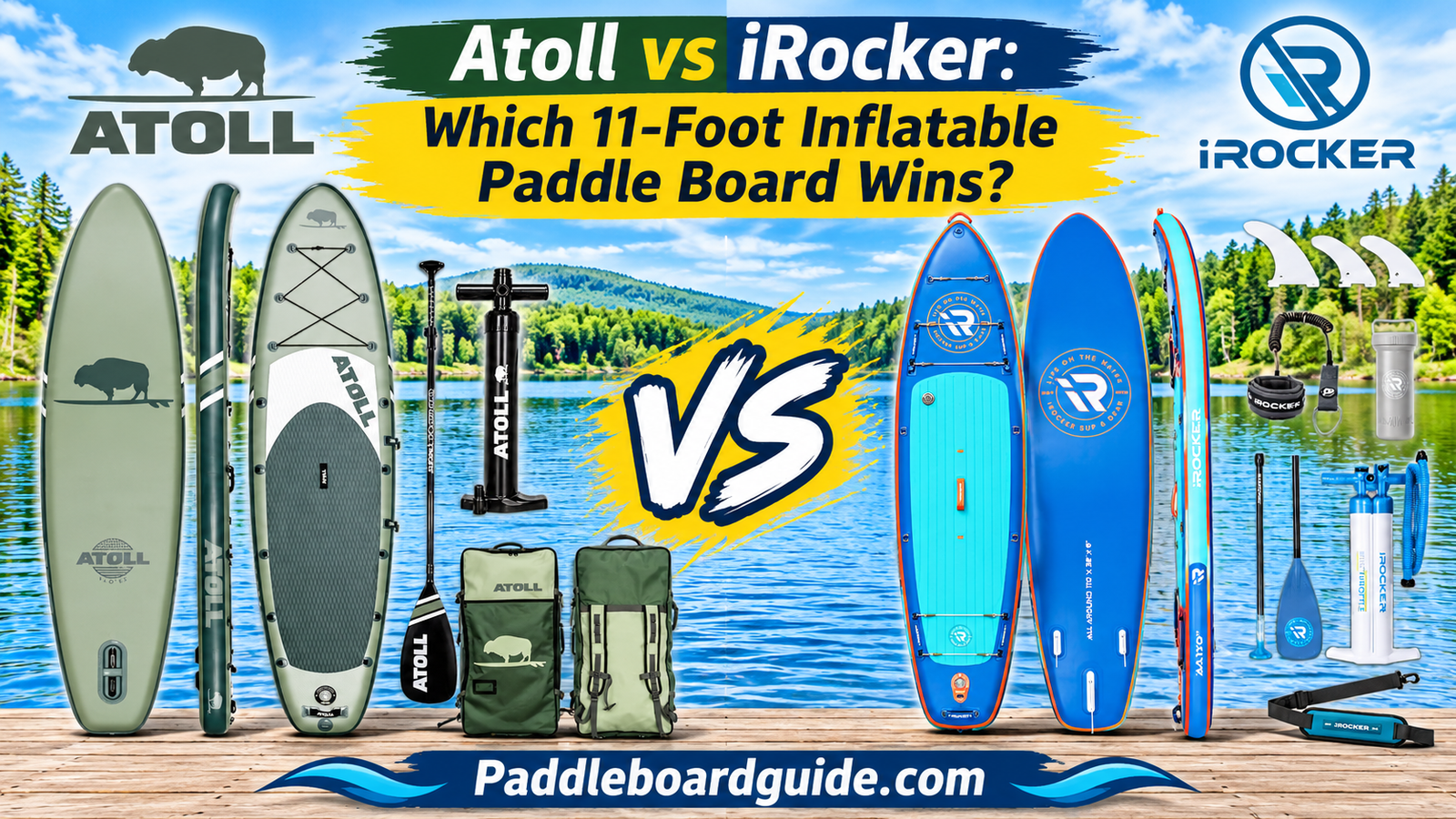
Eleven feet is the sweet spot for a lot of paddle board buyers. Long enough to glide well and track straight, short enough to steer without wrestling it around a dock, and forgiving enough that a beginner can stand up on the first outing. It is no surprise, then, that Atoll vs iRocker is one of the most searched inflatable paddle board comparisons on the web.
Both brands make an eleven-foot all-around inflatable that looks almost identical in a product photograph: a wide, rounded nose, a full-length traction pad, a single fin setup, and a bundle that is supposed to get you on the water the day it arrives. The differences, though, are real and they show up in places product listings tend to gloss over.
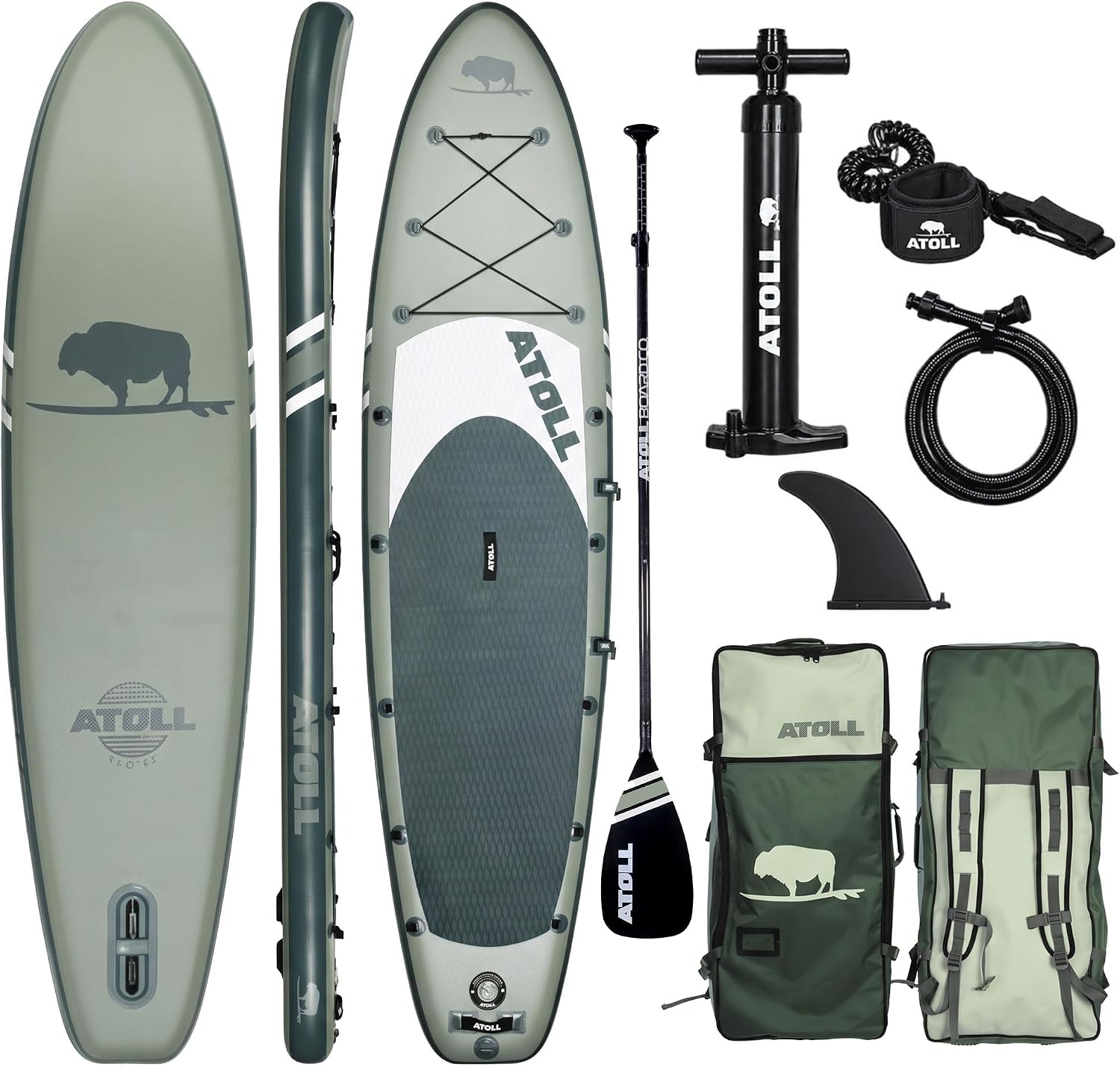
The Atoll 11′ Inflatable Paddle Board measures 11′ x 32″ x 6″ and ships as a package with a carbon-hybrid paddle and a pump. It is the board that gets recommended in enthusiast groups by people who care about the paddle as much as the board. The iROCKER All-Around 11′ Inflatable Paddle Board is 11′ x 32″, weighs 26 lb, and carries a rated capacity of 400 lb. It is the board built around carrying more, more confidently.
Over the next twelve sections we compare the two across construction, stability, rider fit, paddles, portability, accessories, on-water behaviour, durability, and total cost of ownership. Where a number appears on the product label we quote it. Where it does not, we describe the board in plain language instead of inventing a figure, because a fabricated spec is worse than an honest omission.
The Short Answer
Buy the Atoll 11′ if you want a complete package that feels like an upgrade from day one. The inclusion of a carbon-hybrid paddle and a pump makes it one of the most complete setups in this class, and the board itself is an easy, comfortable all-rounder.
Buy the iROCKER All-Around 11′ if capacity and load confidence matter most. With a 400 lb rating and a 26 lb build, it is the better fit for heavier riders, families sharing a board, and anyone who paddles with a dog or a pile of gear.
Everything below explains where each one wins, where each compromises, and which paddler should own which.
How We Compared These Two Boards
A spec sheet tells you what a board weighs and how much it is rated to carry. It does not tell you whether you will still enjoy carrying it after a summer, or whether the paddle in the box will end up in a closet by July. So we looked at both boards through the lens of real ownership.
- Handling and carry weight. How the board feels between the car and the water, and how much effort it takes to live with.
- Stability and usable capacity. Not just the headline rating, but how much room you actually have for rider, gear, and passengers.
- Construction and stiffness. How the board resists flex and how the deck feels underfoot after an hour.
- The paddle. The single most-used piece of equipment, and the one most bundles get wrong.
- Accessories and portability. Pump quality, fin setup, bag design, and how quickly you can get going.
- Versatility and long-term value. Whether the board grows with your paddling instead of forcing a replacement next season.
If you are brand new to the sport and still sorting out the vocabulary, our introduction to the paddle board and our guide to the main types of paddle boards will give you the grounding you need before reading the detail below.
Ready to Start Shopping?
Compare current inflatable paddle board listings and bundle options.
Check Price on AmazonQuick Comparison: Our Top Picks
Here is the whole comparison in one table. Both boards are eleven-foot all-around inflatables with a 32″ width, so the decision comes down to what you get in the box and what the board is built to carry.
| # | Image | Product | Key Specs | Verdict | Check Price |
|---|---|---|---|---|---|
| 1 Top Pick |
|
Atoll 11′ Inflatable Paddle BoardBest Complete Package |
|
A finished kit that feels upgraded from day one. | Check Price on Amazon |
| 2 |  |
iROCKER All-Around 11′ Inflatable Paddle BoardBest for Capacity |
|
Load confidence for big riders, pets, and gear. | Check Price on Amazon |
See Both Boards Side by Side
Check current listings, bundles, and availability for eleven-foot inflatables.
Check Price on AmazonTwo Brands, Two Different Bets
Atoll and iRocker are not chasing the same customer, even though their boards end up in the same comparison charts. Understanding what each brand is optimizing for makes the rest of this guide much easier to read, because almost every difference in these two boards traces back to a decision made at the brand level.
Atoll has built its reputation on a simple pitch: give paddlers a complete, well-thought-out package and let the board speak for itself. There is no sprawling model range to decode, no dizzying matrix of sizes and variants. You get an eleven-foot all-around board with the accessories that matter already in the box, including a carbon-hybrid paddle that would normally be an aftermarket upgrade. That approach appeals to people who want to buy once and start paddling.
iRocker goes wide. The brand covers everything from budget-friendly entry boards to compact travel designs to premium heavy-duty platforms, and the All-Around 11′ sits right in the middle of that range as the everyday workhorse. Capacity and load tolerance are consistent themes across the lineup, and the 400 lb rating on this board is very much in keeping with that. Our full iROCKER paddle board review covers the wider range in detail.
What That Means When You Are Standing on the Deck
In practice, the brand philosophies show up in two places: what is in the box, and how much the board is comfortable carrying. Atoll bets that you will value a better paddle and a ready-to-go kit. iROcker bets that you will value capacity, a sturdier build, and the ability to add accessories over time. Neither bet is wrong. They simply serve paddlers with different priorities.
Where Atoll Leans
- Complete, upgrade-ready packages
- Quality paddle included from the start
- Simple lineup, easy decision
- Comfortable everyday all-around performance
Where iRocker Leans
- High rated load capacity
- Reinforced, load-tolerant construction
- Deep accessory and upgrade ecosystem
- Consistent design language across models
The Broader Market Context
It is worth remembering that these two boards are not the only options. The inflatable market is deep, and brands like ISLE, BOTE, Tower, GILI, and Retrospec all compete hard in this size class. If you want the widest possible view before committing, our roundup of the best inflatable paddle boards covers the full field. For now, though, the question is narrower: given these two specific boards, which one suits you?
One last framing point. Neither board is a niche specialist. They are both designed to be the only board a casual paddler owns, which means the comparison is less about peak performance and more about daily pleasure. That is a much better way to evaluate them than chasing numbers.
Shop Inflatable Paddle Boards
Browse eleven-foot all-around inflatables from leading brands.
Check Price on AmazonMeet the Boards: Full Reviews
Before the deep dive into construction and performance, here is each board on its own terms. Both are eleven-foot, thirty-two-inch-wide all-around inflatables, and both are designed for the paddler who wants one board that does most things well. The character of each, though, is distinctly different.
| Feature | Atoll 11′ | iROCKER All-Around 11′ |
|---|---|---|
| Dimensions | 11′ x 32″ x 6″ | 11′ x 32″ |
| Rated Capacity | Not listed here | 400 lb |
| Board Weight | Not listed here | 26 lb |
| Included Paddle | Carbon-hybrid paddle included | See listing for current bundle |
| Included Pump | Yes | See listing for current bundle |
| Design Priority | Complete, upgrade-ready package | Capacity, stability, and durability |
Atoll 11′ Inflatable Paddle Board
The Atoll 11′ is one of those rare products where the package feels like it was designed by people who actually paddle. At 11′ x 32″ x 6″, the board itself is a proven all-around shape: long enough to glide, wide enough to balance on, and thick enough to stay rigid under load. What sets it apart is what arrives with it — a carbon-hybrid paddle and a pump included, so there is no second shopping trip before your first session.
Key Features
- 11′ x 32″ x 6″ all-around platform suited to flat water and light chop
- Carbon-hybrid paddle included, a genuine upgrade over standard bundle paddles
- Pump included so the board is ready to use straight from the box
- Six-inch thickness for a rigid, confident feel underfoot
- Comfortable deck layout designed for relaxed cruising and longer sessions
Pros
- Excellent complete package
- Quality paddle from day one
- Easy, forgiving all-around shape
- Strong value for the whole kit
Cons
- Capacity not listed here
- Not a dedicated speed or race board
- Single-shape lineup limits options
Who it is best for: Paddlers who want a single purchase that gets them on the water properly equipped. It suits beginners who do not want to research accessories, intermediate paddlers tired of upgrading bundle paddles, and anyone who values a clean, uncomplicated setup over a long feature list.
Atoll 11′ Inflatable Paddle Board
Check the current price and what is included today.
Check Price on Amazon
iROCKER All-Around 11′ Inflatable Paddle Board
The iROCKER All-Around 11′ is built to carry more and worry less. With a 400 lb rating and a 26 lb build, it sits at the sturdy end of the all-around category, and you can feel that in the way the board stays composed when you load it up. This is a board for paddlers who want headroom — for gear, for a dog, for a child, or simply for the peace of mind of never being near the limit.
Key Features
- 11′ x 32″ all-around platform with a stable, confidence-building outline
- Rated capacity of 400 lb for riders, gear, and passengers
- 26 lb build with a reinforced, load-tolerant construction
- Attachment points for seats, bags, coolers, and other accessories
- Consistent design language shared with the wider iROCKER range
Pros
- Excellent rated capacity
- Very reassuring under load
- Strong accessory compatibility
- Built for heavy, regular use
Cons
- Heavier to carry at 26 lb
- More board to pack away
- Overkill for small, light solo paddlers
Who it is best for: Heavier paddlers, families sharing a board, dog owners, anglers carrying gear, and anyone who has ever felt an inflatable sag under them. If your priority is stability and capacity over saving a few pounds on the carry, this is the one to shortlist.
Both boards are forgiving enough for a first-time buyer and capable enough to keep for years. If you are still weighing up whether an inflatable is right for you at all, our comparison of inflatable versus hard paddle boards covers the storage, transport, and on-water trade-offs in more depth.
Compare Inflatable Paddle Boards
See what is available in the eleven-foot all-around class.
Check Price on AmazonConstruction and Build Quality: What Sits Under the Deck Pad
Every inflatable paddle board looks impressive when it is inflated and standing upright on the lawn. The interesting question is what is inside it, because that determines how stiff the board feels, how it handles a heavy load, and how long it survives regular use.
Drop-Stitch: The Foundation
Both boards are built on drop-stitch cores. Inside an inflatable board are thousands of fine threads connecting the top and bottom surfaces, so that when you pump it up the board pulls flat instead of bulging into a round tube. It is the single most important piece of engineering in the entire category, and it is why an inflatable can feel genuinely rigid underfoot rather than like a pool toy.
Around that core, brands add layers of reinforced material and finish the edges with rail bands. Those rails matter more than most people realize: they are what stops the board from twisting when you step toward the tail or when a wave rolls under you. For a fuller explanation of how these layers come together, our article on how paddle boards are made walks through the whole process.
Weight, Stiffness, and the Trade-Off Between Them
Here is the engineering tension at the heart of every inflatable design. More material generally means more stiffness and more durability, but it also means more weight on your shoulder. Lighter boards are easier to carry and quicker to pack, but they have to work harder to stay rigid at higher loads.
The iROCKER All-Around 11′ is listed at 26 lb, which places it at the reinforced end of the scale. That is a deliberate choice: extra material for a board rated to 400 lb is exactly what keeps it composed when it is loaded. The Atoll 11′ focuses instead on delivering a well-balanced package, pairing its 11′ x 32″ x 6″ platform with a paddle good enough that you will not immediately want to replace it.
- Rail reinforcement resists twisting under load and when turning.
- Deck pad quality determines comfort on long sessions and grip when wet.
- Valve and seam quality decides how well the board holds pressure over time.
- Fin box design affects tracking and how quickly setup takes.
- Grab handles matter far more than they look, especially on hot sand.
Stiffness Is a Feeling
Two boards can both be described as rigid and still feel quite different. A slightly more forgiving flex is comfortable in chop and smooth on joints but can feel bouncy at higher loads. A very stiff board feels precise and efficient but transmits more of the water’s movement to your ankles. Neither is objectively better; they suit different paddlers and different water.
Deck Comfort: The Part You Actually Touch
Do not underestimate the deck pad. It is the only part of the board in contact with your feet for an entire session, and its texture, thickness, and coverage decide how comfortable the board feels when you shift stance, kneel, sit, or stretch. Boards aimed at relaxed cruising and light fitness tend to prioritize generous padding, and that quiet detail often decides which board people reach for on a Saturday morning.
Looking for a Well-Built Inflatable?
Browse reinforced inflatable paddle boards with quality rails and deck pads.
Check Price on AmazonShape, Width, and Stability: The 32-Inch Question
Both of these boards are 11′ x 32″, which makes this the most directly comparable part of the whole comparison. Same length, same width, same target paddler. And yet the two boards do not feel identical on the water, for reasons that go beyond the outline printed on the listing.
Width Is the Stability Shortcut
Board width is the single biggest predictor of how stable a paddle board feels to a beginner, and 32″ is a sensible all-around width. It is wide enough to inspire confidence and narrow enough to glide well and turn without a fight. It sits slightly below the very widest beginner boards, which means it gives up a fraction of raw stability in exchange for noticeably better efficiency and handling.
If you are comparing this width against wider boards in the 33″ to 35″ range, the difference is real but manageable. Wider boards are easier for nervous beginners and better for yoga or fishing; 32″ boards reward you with better glide and a livelier feel. Our explainer on SUP boards versus paddle boards covers how the terminology and shapes differ.
Length and Tracking
At eleven feet, both boards track well. Tracking is the board’s ability to hold a straight line between strokes, and length is its biggest ally. Compared with a ten-foot-six board, an eleven-foot board requires fewer corrective strokes, which means less wasted energy and a much easier time looking around instead of staring at the nose. It also means the board carries momentum better between strokes, which is quietly satisfying on a long paddle.
Where They Feel Different
With identical headline dimensions, the differences come from construction and load behaviour. A board built with more reinforcement and rated for higher loads will feel more planted when you add gear or a passenger. A board tuned around a lighter, more complete package tends to feel a little more agile for a solo paddler of average build.
| Handling Trait | Atoll 11′ | iROCKER All-Around 11′ |
|---|---|---|
| Platform Size | 11′ x 32″ x 6″ | 11′ x 32″ |
| Stability Character | Balanced and easy for everyday cruising | Planted and composed, especially when loaded |
| Best Water | Flat water, sheltered bays, light chop | Flat water, light chop, gear-heavy outings |
| Trade-Off | Less headroom for very heavy loads | More weight to carry and pack |
For most paddlers on calm water, the difference will be subtle. It becomes obvious the moment you load the deck up with a cooler, a dog, or a child, where the board built for capacity has the advantage.
Find Your Ideal Board Width
Compare inflatable paddle boards by size, width, and stability.
Check Price on AmazonWeight Capacity and Rider Fit: Reading the Ratings Properly
This is where the two boards part company most clearly. The iROCKER All-Around 11′ carries a rated capacity of 400 lb, a substantial figure for an eleven-foot all-around inflatable. The Atoll’s capacity is not listed in the notes we are working from, so we will not guess at it. Instead, let us talk about what capacity ratings actually mean, because that is more useful than a single number anyway.
Capacity Is a Boundary, Not a Target
A weight rating tells you the upper limit a board is designed to handle. It does not tell you the point at which it performs best. As a rider approaches the maximum, the board sits lower in the water, picks up more drag, feels less lively, and becomes harder to correct when it starts to tip. The comfortable zone is always well below the ceiling, and the more headroom you leave yourself, the better the board feels.
Think of it like luggage allowance. Just because a bag can be packed to the zipper does not mean you will enjoy carrying it through an airport.
Everything Counts Toward the Number
One of the most common mistakes new buyers make is treating capacity as body weight alone. It is not. Everything on the board counts.
- Body weight, plus anything you are wearing.
- Gear and accessories, including the paddle if you set it down on the deck.
- Passengers, whether a child, a friend, or a large dog.
- Water, food, and safety equipment, which add up quickly on longer outings.
- Wet gear, which weighs considerably more than dry gear.
| Scenario | Atoll 11′ | iROCKER All-Around 11′ |
|---|---|---|
| Solo paddler, light gear | Comfortable, well within its design intent | Comfortable with plenty of headroom |
| Solo paddler plus cooler and bag | Suits typical recreational loads | Handles it with room to spare |
| Heavier paddler | Check the current listing for capacity | Strong choice with a 400 lb rating |
| Paddler plus dog or child | Workable for smaller passengers | The more reassuring option |
| Fishing or photography gear | Lighter setups | Better suited to heavier kits |
If you want to understand how these ratings are calculated and where the practical limits sit, our guide to how much weight a paddle board can hold goes into the detail.
Who Should Prioritize Capacity?
Capacity deserves extra weight in your decision if you are a heavier rider, if you regularly paddle with a passenger, if you carry a lot of gear, or if you simply want a board that never feels close to its limit. For lighter solo paddlers on calm water, capacity beyond your needs mostly translates into extra bulk to carry.
Find the Right Board for Your Weight
Shop inflatable paddle boards with generous capacity ratings.
Check Price on AmazonThe Paddle Difference: Carbon-Hybrid vs Standard Bundle Kit
If there is one detail in this comparison that deserves more attention than it usually gets, it is the paddle. The paddle is the only piece of equipment you touch for every single second you are moving. It determines how tired your shoulders get, how efficiently you move, and how much you enjoy the session. And yet it is the accessory most bundles treat as an afterthought.
What a Better Paddle Actually Does
Three things separate a good paddle from a basic one: weight, stiffness, and balance. A lighter paddle means less effort per stroke and less fatigue over an hour. A stiffer blade transfers more of your energy into the water instead of flexing uselessly. And a well-balanced paddle feels like an extension of your arm rather than a lever you are fighting.
Carbon-hybrid construction sits in the sweet spot here. Full carbon paddles are wonderful and expensive; aluminium paddles are cheap and heavy. A carbon-hybrid blends the stiffness and low weight of carbon with the durability and cost control of other materials, which is why experienced paddlers often recommend it as the first upgrade anyone should make.
Why the Atoll Bundle Stands Out
The Atoll 11′ includes a carbon-hybrid paddle in the box. That is genuinely unusual at this level, and it changes the economics of the purchase. Normally you buy the board, use the bundle paddle for a season, then spend again on an upgrade. Starting with a carbon-hybrid paddle skips that cycle entirely and means your very first stroke is with equipment you would have bought anyway.
Sizing the Paddle Correctly
Whichever board you choose, take two minutes to size the paddle properly. Too long and you will overreach, hunch your shoulders, and tire quickly. Too short and you will crouch and lose power. The right length depends on your height, your stance, and the kind of paddling you do. Our guide to the best paddle board paddles covers sizing and materials in depth.
One question that comes up constantly, usually right after someone drops a paddle overboard: do paddle board paddles float? The answer matters more than you think, and it is worth knowing before your first deep-water outing.
- Weight — the single biggest factor in long-session comfort.
- Stiffness — how much of your effort actually propels the board.
- Blade shape — affects cadence and how the paddle feels in the water.
- Adjustability — useful if more than one person shares the board.
- Grip comfort — matters enormously on a hot day.
Portability, Weight, and Getting the Board to the Water
Every paddle board is easy to use once it is floating. The difference between a board you love and a board you sell is what happens in the fifteen minutes on either side of the session. Carry weight, bag design, and pack-down behaviour quietly determine how often you actually go.
Carry Weight Is a Lifestyle Decision
The iROCKER All-Around 11′ is listed at 26 lb. That is a substantial but sensible figure for a board rated to 400 lb, and it reflects the reinforcement built into the deck and rails. If you have a short walk from the car to the launch, you will never think about it. If you have a long carry across hot sand, or you are loading the board alone, those extra pounds announce themselves.
This is why being honest about your routine matters so much. A lighter board that gets used three times a week is a better purchase than a heavier board that gets used twice a season. Our guide to how to transport a paddle board covers practical solutions for every situation, from apartment stairwells to trailhead parking.
Car, Roof, or Foot
The beauty of an inflatable is that it lives in a bag. Both boards fold down into something that fits in a trunk, a back seat, or a closet, which removes the single biggest barrier to owning a paddle board. If you do carry boards on a roof regularly, a proper rack protects your vehicle and your sanity. Our recommendations for the best paddle board roof racks cover both inflatable and hard board setups.
The Bag and the Pump
Two accessories shape the start and end of every session. A well-designed carry bag with proper backpack straps turns transport into a non-event. A good pump with a pressure gauge gets the board to proper stiffness without exhausting you before you even reach the water. Both boards here come with a pump, which is the right call; the quality of that pump and the bag around it are worth checking in the current listing.
If you want to compare options, our guide to the best paddle board pumps covers hand and electric styles, and our pick of the best paddle board bags covers what makes a bag genuinely good rather than merely present.
- Inflate out of direct sun — heat raises internal pressure quickly.
- Use the pressure gauge — stiffness is what makes the board feel right.
- Rinse and dry before packing — sand and salt are hard on zips and valves.
- Roll from nose to tail — pushes air out and makes repacking easier.
- Store loosely — long-term tight storage is hard on the material.
Storage at Home
Finally, think about where the board will live. Inflatables are forgiving, but a cool, dry, out-of-the-sun spot will extend their life considerably compared with a hot garage corner. Our collection of inflatable paddle board storage ideas has solutions for very small spaces.
Make Transport Effortless
Shop paddle board bags, pumps, and roof rack accessories.
Check Price on AmazonWhat’s in the Box: Accessories, Fins, and the Extras That Matter
Bundle contents are the most persuasive part of a product listing and one of the least reliable indicators of value. A long list of included accessories does not automatically mean a better deal, because the quality and usefulness of those accessories vary enormously. Here is how to read the box.
The Non-Negotiables
Some items are essential. Without them you either cannot use the board safely or you will be back online ordering within a week.
| Accessory | Why It Matters | What to Look For |
|---|---|---|
| Paddle | Used on every single stroke of every session | Light weight, stiff blade, comfortable grip |
| Pump | Determines how stiff and safe the board feels | Built-in pressure gauge and stable base |
| Leash | Keeps the board with you when you fall in | Correct style for your water and a comfortable cuff |
| Fin | Controls tracking and how straight the board travels | Tool-free fitting and durable construction |
| Flotation | Required in many regions and always recommended | Proper fit and freedom to paddle comfortably |
| Carry bag | Decides how painful transport is | Backpack straps, sturdy zips, room for the pump |
Where the Two Packages Differ
The clearest distinction in these bundles is the paddle. The Atoll 11′ includes a carbon-hybrid paddle and a pump, which makes it one of the more complete setups in this class. Everything you need to start is there, and the paddle is good enough that you are unlikely to replace it immediately. For the iROCKER All-Around 11′, check the current listing for what the bundle includes, as package contents shift over time.
Safety Gear: Not Optional
Whichever board you choose, budget for safety equipment from day one. A properly fitted personal flotation device, an appropriate leash, sun protection, and a way to call for help form the baseline for any paddle board outing. Requirements vary by location, so check the rules that apply to your waterways. Our overview of paddle board safety requirements is a good starting point, and our picks for the best paddle board life jackets will help you find one you will actually wear.
The Nice-to-Haves
After the essentials, the accessory list becomes personal. A kayak seat turns an all-around board into a second boat for windy days. A deck bag keeps water and snacks within reach. A waterproof phone pouch, an anchor for yoga sessions, or a rod holder for fishing all expand what the board can do. Our guide to the best paddle board seats covers the convertible options if that appeals.
Round Out Your Kit
Shop paddle board paddles, pumps, leashes, and safety gear.
Check Price on AmazonOn-Water Performance: Tracking, Glide, Turning, and Chop
Specifications describe what a board is. They do not describe how it feels two hours into a paddle when the wind has picked up and your technique is getting sloppy. This section is about feel, and about how the design decisions in the previous sections show up once you are moving.
Tracking and Glide
At eleven feet, both boards track well. The long waterline means fewer corrective strokes and a more relaxing paddle, especially for beginners who are still finding their rhythm. Glide is good too: eleven-foot boards carry momentum between strokes noticeably better than shorter all-around designs, which rewards a smooth, unhurried cadence rather than a frantic one.
Where the boards differ is in how that glide feels when loaded. A board built for higher capacity keeps its composure as you add weight, maintaining tracking and efficiency. That is the practical benefit of the reinforcement we discussed earlier, and it is the reason capacity matters even if you never approach the maximum rating.
Turning and Maneuverability
Thirty-two inches of width and eleven feet of length make these boards easy to steer without being twitchy. Tight turns take a bit more effort than on a shorter board, which is the trade-off for stability and glide. Standing back toward the tail and sinking the rail is the technique that makes any of these boards turn quickly when you need it to.
Wind, Chop, and Changing Conditions
Wind is the great equalifier of paddle boarding. A wider board catches more breeze and gets pushed off course faster, which is why beginners often find windy days disproportionately difficult regardless of which board they own. Choosing your conditions matters as much as choosing your board. Our guide to the best time to paddle board covers the window when the water is usually calmest.
Both boards handle light chop comfortably. A stiff, well-built inflatable absorbs small waves without feeling vague, and the six-inch thickness on these platforms keeps the nose riding high rather than diving. For rougher water, a shorter board with more rocker would be a better tool, but that is not what either of these is designed for.
Learning Curve and Technique
If you are new to the sport, be patient with yourself. Most people are surprised by how quickly balance clicks into place and equally surprised by how tiring the first few sessions are. Our guides on how to paddle board, how hard paddle boarding is, and whether paddle boards are hard to use set expectations accurately and give you a few techniques to work on.
Comfort Is Performance
Finally, remember that comfort is a performance metric. A board with a soft deck pad, forgiving flex, and a shape that does not punish small balance errors will keep you on the water longer than a faster board that exhausts you. For the paddler buying in this category, that is almost always the right trade.
Get On the Water
Browse inflatable paddle boards built for calm water and light chop.
Check Price on AmazonWho Should Buy Which: Matching the Board to the Paddler
After all the analysis, the decision usually comes down to a handful of personal details that no spec sheet can capture. This section turns everything above into a simple matching exercise. Find the description closest to your situation and you have your answer.
| If You Are… | Choose | Why |
|---|---|---|
| A first-time buyer who wants everything at once | Atoll 11′ | Carbon-hybrid paddle and pump included, no second shopping trip |
| A heavier rider | iROCKER All-Around 11′ | 400 lb rated capacity and a 26 lb build designed for load |
| Tired of upgrading bundle paddles | Atoll 11′ | Carbon-hybrid paddle in the box from the start |
| Paddling with a dog or child | iROCKER All-Around 11′ | Capacity headroom and a planted, composed feel |
| An intermediate wanting a clean, simple setup | Atoll 11′ | Straightforward package that performs without fuss |
| Carrying gear for fishing or long days | iROCKER All-Around 11′ | Load tolerance and accessory attachment points |
By Paddling Goal
Fitness and exercise. Either board will give you a genuine workout. Standing on an unstable surface engages your core and stabilizers in a way that feels far more like play than training. If that is your motivation, read our take on whether paddle boarding is good exercise and how many calories paddle boarding burns.
Yoga and stretching. Both boards work, though a wider platform gives you more room for poses and transitions. Our roundup of the best paddle boards for yoga covers what makes a board suited to practice on the water.
Fishing. Capacity and attachment points win here, which points toward the iROCKER. Our guide to the best paddle boards for fishing covers the wider field.
Learning the basics. Both are excellent choices. Our picks for the best paddle boards for beginners and our answer to whether inflatable paddle boards are good for beginners will help you set expectations for those first few sessions.
By Practical Constraint
Sometimes the deciding factor is not on the water at all. If you live up several flights of stairs with no elevator, weight matters enormously. If you paddle somewhere with a long walk from the parking area, weight matters again. If you have plenty of space and a short carry, capacity and features can take priority. Be realistic about these constraints, because they will shape your experience more than any difference in fin design.
Find Your Match
Browse inflatable paddle boards sized for your paddling style.
Check Price on AmazonDurability, Care, and Long-Term Value
A paddle board is not a disposable purchase. Treated well, either of these boards will serve you for many seasons. Treated carelessly, even the best-built inflatable will disappoint. The good news is that the difference comes down to a handful of habits, and those habits are the same regardless of which brand you choose.
What Actually Damages an Inflatable
Inflatables are remarkably tough against impacts and abrasion. What they dislike is sustained neglect. The three biggest enemies are heat, ultraviolet light, and being stored wet or under-inflated for long stretches.
| Risk | What Happens | How to Avoid It |
|---|---|---|
| Heat | Internal pressure rises and stresses seams and valves | Never leave a fully inflated board in a hot car or direct sun |
| UV exposure | Materials fade and weaken over prolonged exposure | Store in shade or indoors; rinse and dry after use |
| Sharp objects | Punctures from shells, rocks, hooks, and thorns | Scan the launch area and avoid shallow, rocky entries |
| Wet storage | Odor, mildew, and material degradation | Dry fully before rolling; air the bag out afterwards |
| Over-inflation | Seam stress, especially on warm days | Use the gauge and stay within the recommended range |
A Simple Care Routine
- Rinse with fresh water after every session, especially in salt water.
- Dry completely before rolling, including under the deck pad and around the valve.
- Store loosely in a cool, dry place away from direct sunlight.
- Check the valve occasionally and tighten the insert if you notice slow air loss.
- Inspect the hull before each outing, particularly along the rails and tail.
When Something Goes Wrong
Punctures happen, and they are rarely catastrophic. Most inflatable boards can be patched at home with a standard repair kit and a little patience. The keys are finding the leak properly, cleaning and drying the area, and giving the patch full cure time before re-inflating. Our walkthrough on how to patch a paddle board takes you through it step by step.
Realistic Lifespan
How long an inflatable lasts depends far more on care and storage than on which brand you chose. Boards that are rinsed, dried, and stored out of the sun outlast those left inflated in a sunny yard by a wide margin. Our article on how long inflatable paddle boards last covers realistic expectations and the warning signs that a board is nearing the end of its life.
Total Cost of Ownership
Finally, think about cost beyond the purchase price. A board that arrives with a paddle you would have had to buy anyway represents real savings. So does a board that is stiff and comfortable enough that you do not start shopping for a replacement next season. Add in the safety gear you need regardless, and the picture becomes clearer: the cheapest board on the page is often not the cheapest board to own.
Protect Your Investment
Shop repair kits, storage straps, and paddle board care accessories.
Check Price on AmazonMistakes to Avoid When Choosing Between Atoll and iRocker
Most paddle board disappointment traces back to a handful of predictable errors. None of them are about brand loyalty, and all of them are avoidable once you know what to look for.
1. Buying on the Headline Number Alone
A high capacity rating is a good thing, but it is not automatically a better board. If you paddle solo on calm lakes and want an easy, enjoyable board, buying for maximum capacity can leave you with more bulk than you need. Match the board to your realistic load rather than your worst-case scenario.
2. Ignoring Carry Weight
The opposite mistake is just as common. People buy the most capable board they can find and then discover they hate carrying it. If you have a long walk to the water, or you load and unload alone, think carefully about those extra pounds before committing.
3. Treating the Bundle as Free Money
Focus on the quality of the three items you will use constantly: the paddle, the pump, and the bag. Everything else is a bonus. If a bundle paddle is poor, you will replace it anyway, which means the bundle saved you nothing.
4. Forgetting Where the Board Will Live
Measure your storage space before you buy. A board that has to live in a hallway becomes an obstacle, and an obstacle makes you resent the purchase. Our inflatable paddle board storage ideas article has solutions for very small homes.
5. Skipping Safety Gear
Budget for a properly fitted flotation device and a suitable leash from the start. It is not an upgrade, it is part of the board. Requirements vary by region, so read our summary of paddle board safety requirements before your first outing.
6. Buying for the Paddler You Might Become
It is tempting to buy the board you imagine using once you are fit and skilled. Buy the board that suits how you paddle this season. A board you enjoy today gets you to that future faster than a board you find intimidating.
7. Ignoring the Rest of the Market
Both of these boards are strong choices, but it is worth looking sideways before you commit. Budget boards have improved enormously, and our review of the iROCKER Nautical shows how much value exists at the entry level if you are working within a tighter budget.
8. Getting Lost in Terminology
You will see “SUP board,” “stand-up paddle board,” and “paddle board” used interchangeably across listings, and effectively they are. Our explainer on SUP boards versus paddle boards clears up any confusion, and our overview of paddle board types covers the wider category.
Shop Smarter
Compare inflatable paddle boards and accessories before you commit.
Check Price on AmazonAtoll vs iRocker: Frequently Asked Questions
Which board is better for a complete beginner?
Both are excellent beginner boards. The Atoll 11′ is arguably the easier first purchase because it arrives with a carbon-hybrid paddle and a pump, so there is nothing else to research or buy. The iROCKER All-Around 11′ is equally forgiving on the water and adds capacity headroom if you are a heavier rider or plan to carry gear. For more on learning, see our picks for the best paddle boards for beginners.
What size are these boards?
Both are eleven feet long and thirty-two inches wide. The Atoll is listed as 11′ x 32″ x 6″, giving it a six-inch thickness, and the iROCKER is listed as 11′ x 32″. Identical headline dimensions make this one of the most directly comparable pairs in the inflatable market.
How much weight can the iROCKER All-Around 11′ hold?
It carries a rated capacity of 400 lb. Remember that a capacity rating is an upper boundary rather than a target: the board performs best well below the maximum. Our guide to how much weight a paddle board can hold explains how to think about these figures in practice.
Does the Atoll come with a paddle?
Yes. The Atoll 11′ package includes a carbon-hybrid paddle and a pump. That is a meaningful inclusion, since a carbon-hybrid paddle is normally an aftermarket upgrade and makes a noticeable difference to comfort and efficiency over a long session.
How heavy is the iROCKER All-Around 11′?
It is listed at 26 lb. That places it at the sturdier end of the all-around category and reflects the reinforcement that supports its capacity rating. It is a manageable weight for most paddlers, though it is worth thinking about if you have a long carry to the water.
Can I take a dog or a child on these boards?
Yes, on the right board and within the capacity rating. The iROCKER’s 400 lb rating makes it the more reassuring choice for passengers and gear. Always account for combined weight, keep children in properly fitted flotation, and let pets get used to the deck in shallow water first.
Are these boards good for yoga or fitness?
Both work well. A stable thirty-two-inch platform is comfortable for stretching and light yoga, and paddle boarding in general is an excellent core workout. If yoga is your main focus, our guide to the best paddle boards for yoga covers what to prioritize.
Do I need to buy a separate pump?
No. The Atoll 11′ includes a pump, and both boards can be inflated with any quality high-pressure pump that has a built-in gauge. If you want to upgrade to an electric pump for easier setup, our guide to the best paddle board pumps covers the options.
How long do these inflatable boards last?
Longevity depends far more on care than on brand. Boards that are rinsed after use, dried before storage, and kept out of direct sun and extreme heat last dramatically longer than those left inflated in a hot yard. See our article on how long inflatable paddle boards last for realistic expectations.
Which is better for fishing or carrying gear?
The iROCKER All-Around 11′ is the stronger choice here, thanks to its 400 lb rating and load-tolerant construction. If fishing is your main use, our guide to the best paddle boards for fishing covers the wider field of options.
Should I choose an inflatable or a hard board?
For most recreational paddlers, an inflatable wins on storage, transport, and durability against knocks. Hard boards have an edge in glide and rigidity for performance paddling. Our comparison of inflatable versus hard paddle boards lays out the trade-offs in detail.
Is paddle boarding harder than it looks?
It is easier than most people expect to get standing, and harder than most people expect to do for a long time. Balance clicks quickly for most beginners; fitness takes a few sessions. Our articles on how hard paddle boarding is and whether paddle boards are hard to use set realistic expectations.
Still Have Questions?
Browse inflatable paddle board listings to compare specs directly.
Check Price on AmazonConclusion: Atoll or iRocker?
Both of these boards do exactly what an eleven-foot all-around inflatable should do: they are stable without being boring, capable without being intimidating, and forgiving enough that a first-time paddler can enjoy them from the first session. The choice between them comes down to what you value most.
The Atoll 11′ is the better buy for most people. The board itself is a comfortable, proven all-around platform at 11′ x 32″ x 6″, and the inclusion of a carbon-hybrid paddle and a pump makes it one of the most complete packages in this class. You are not buying a board and then immediately shopping for upgrades. You are buying a finished kit that feels like an upgrade from the moment you unwrap it.
The iROCKER All-Around 11′ is the better buy if capacity matters. With a 400 lb rating and a 26 lb build, it is designed to carry more and stay composed while doing it. Heavier paddlers, families sharing one board, dog owners, and anyone who paddles with a pile of gear will appreciate that headroom every single outing.
Whichever you choose, buy your safety gear at the same time, pick a calm morning for your first session, and give yourself a few outings to find your balance. Everything else comes with time on the water.
Ready to Pick Your Board?
Check current listings, bundles, and availability before you decide.
Check Price on AmazonYou May Also Like
More paddle board comparisons, brand reviews, and buying guides from our library.