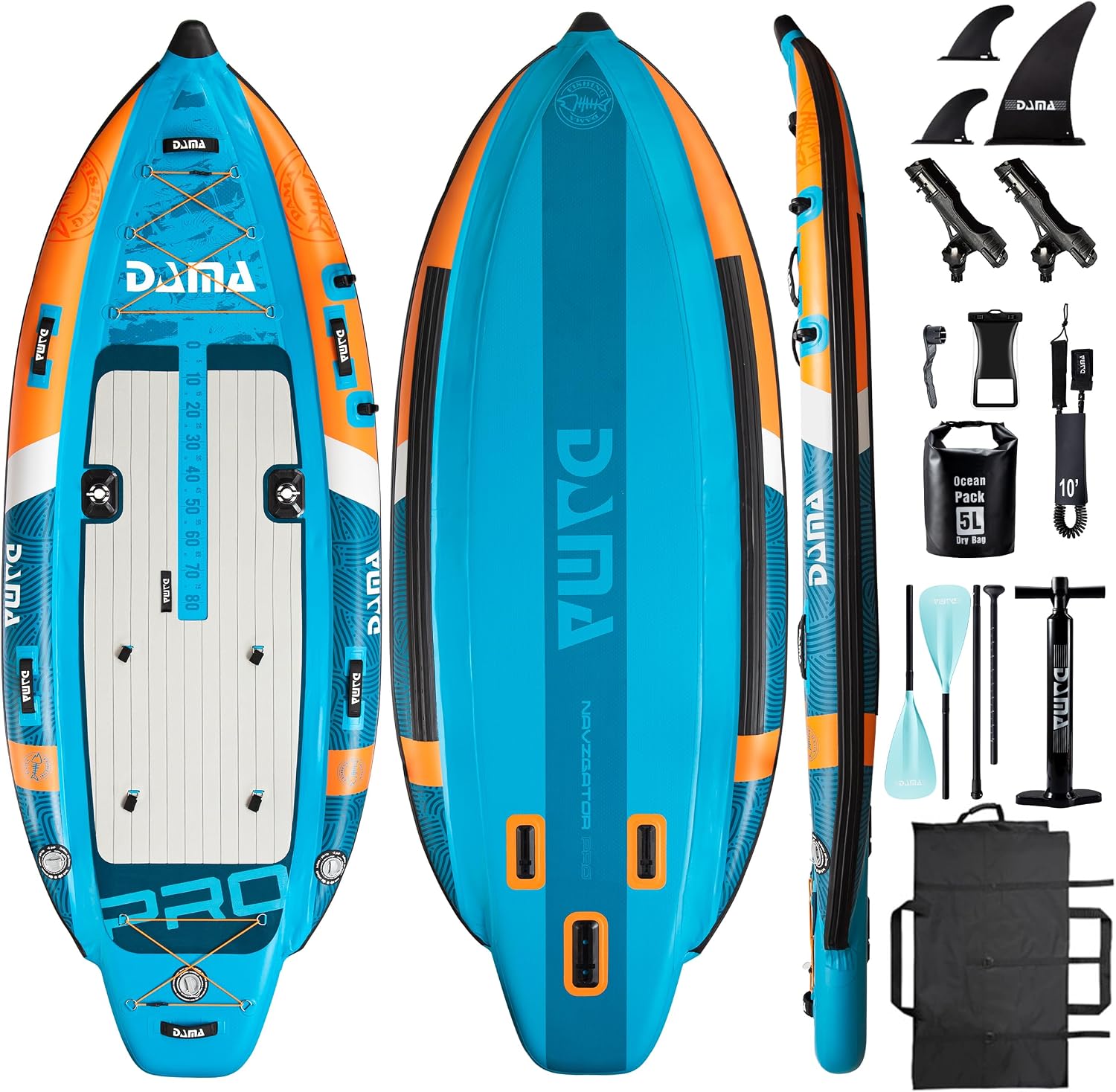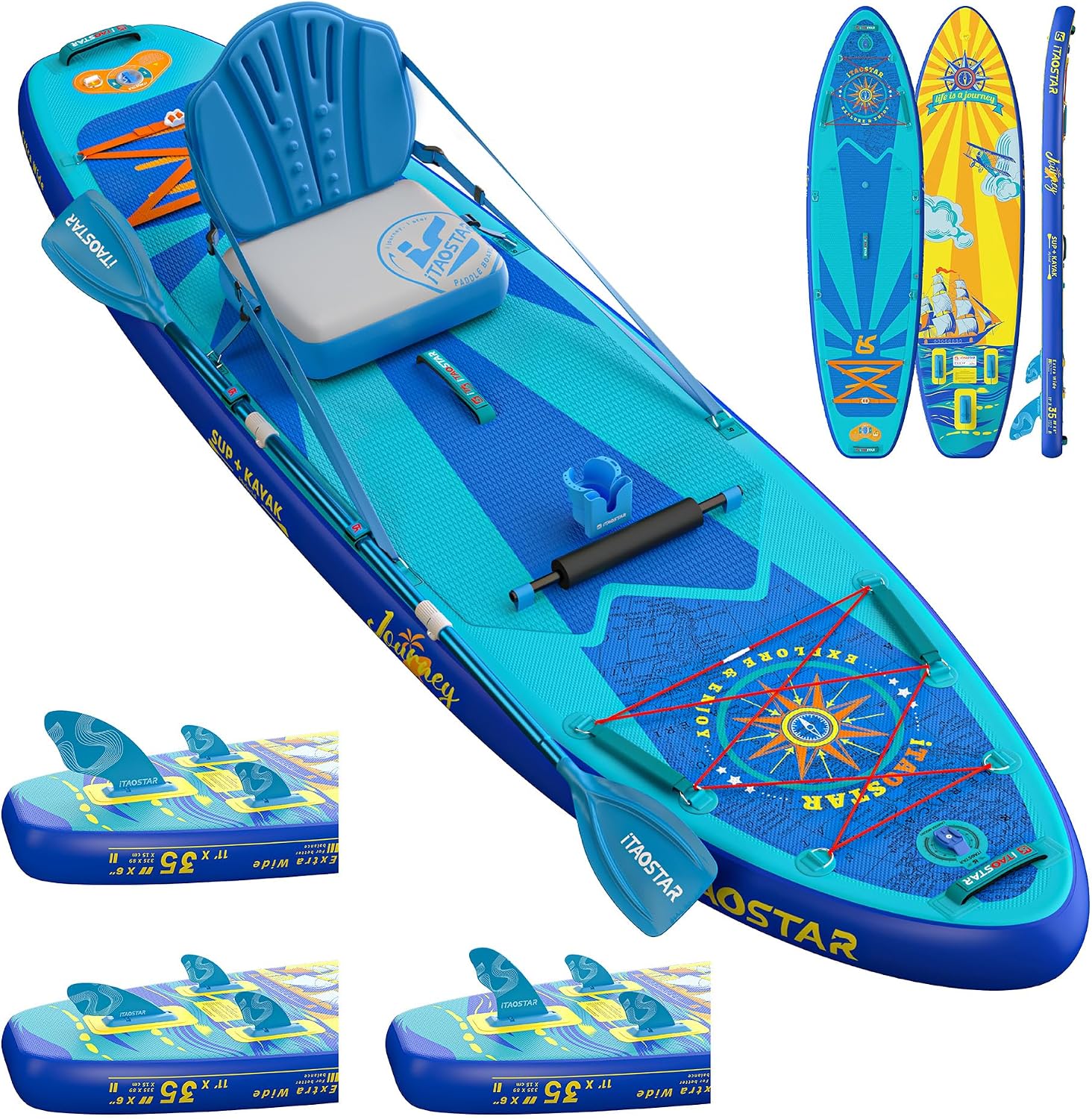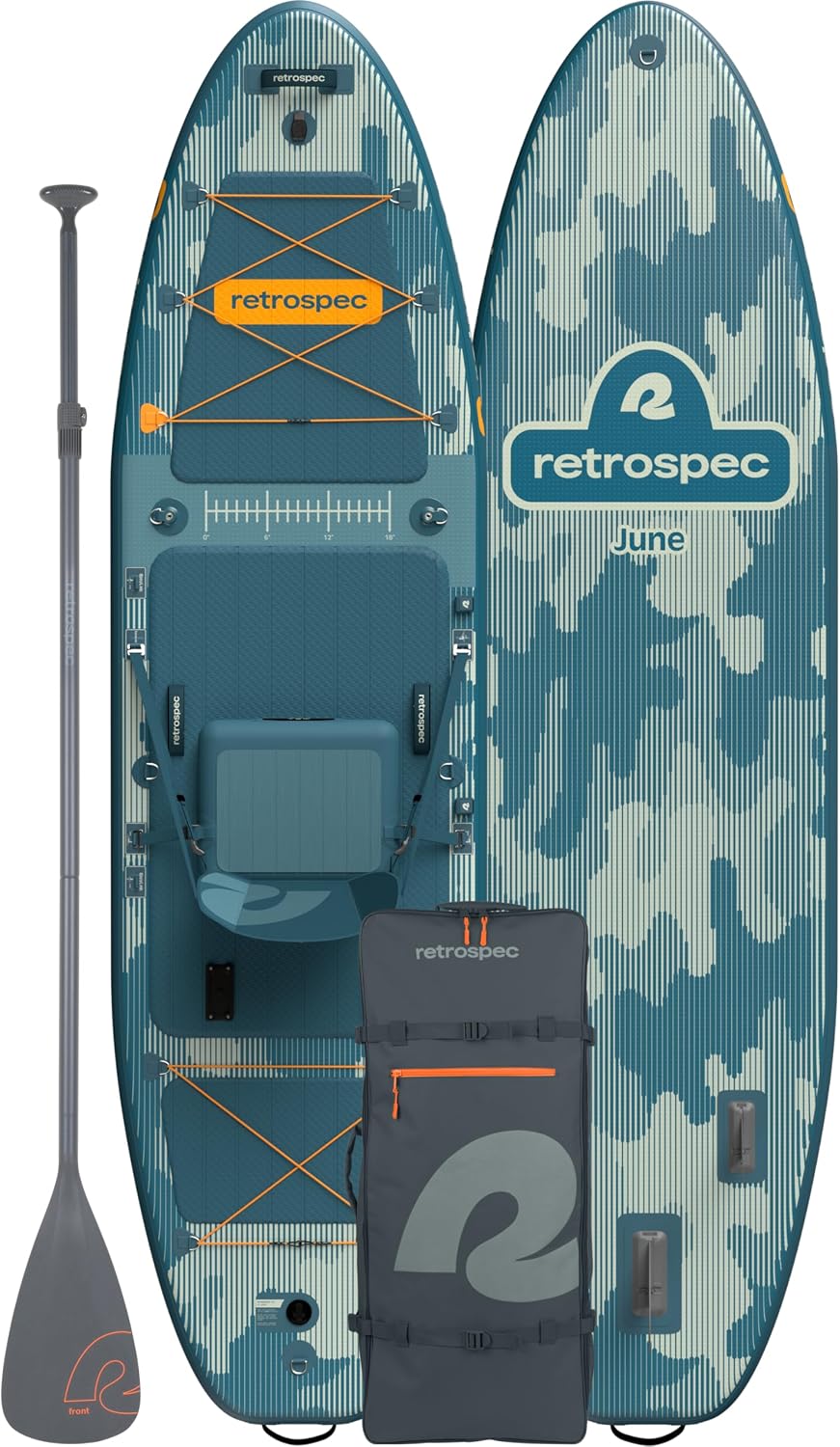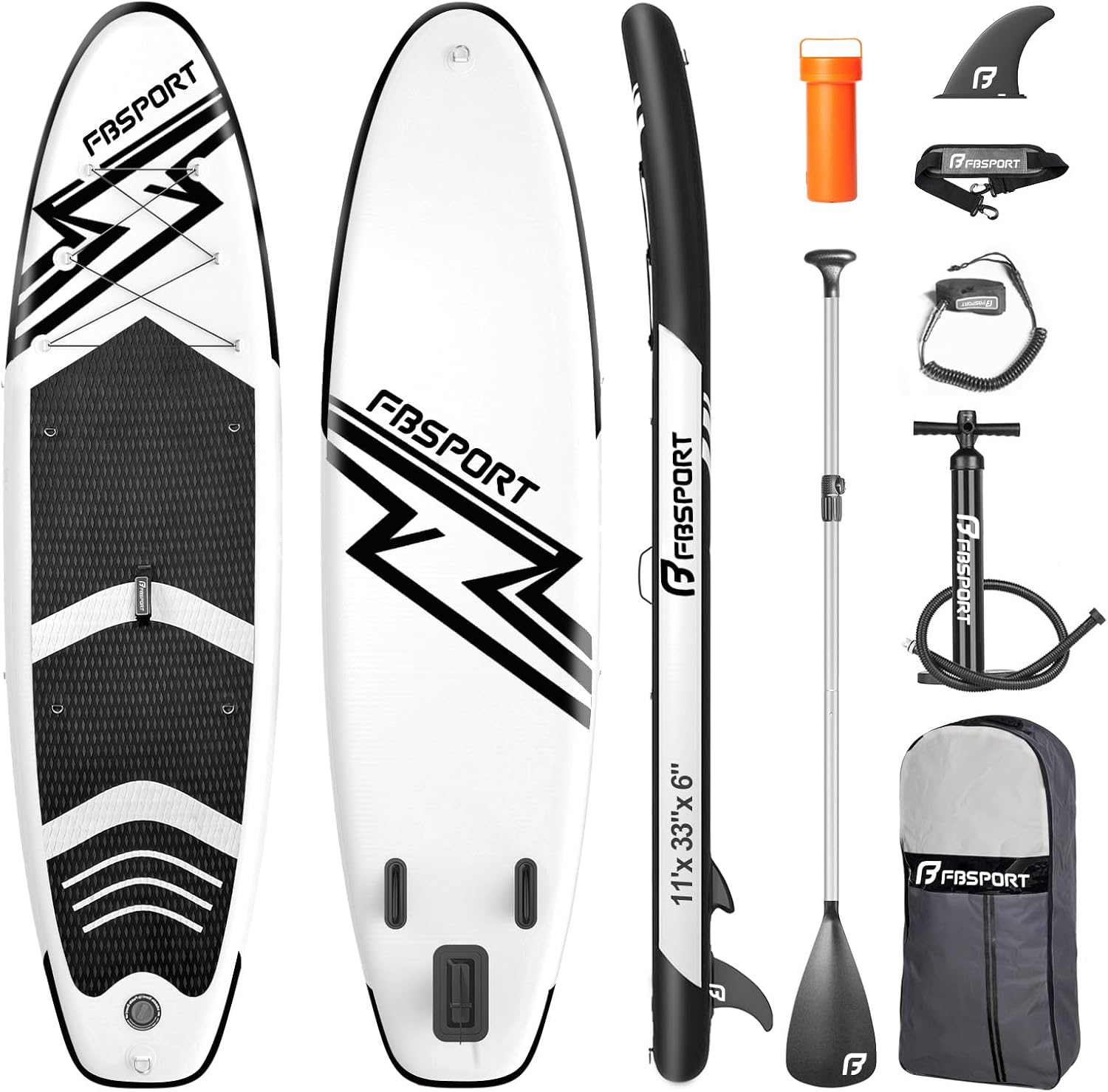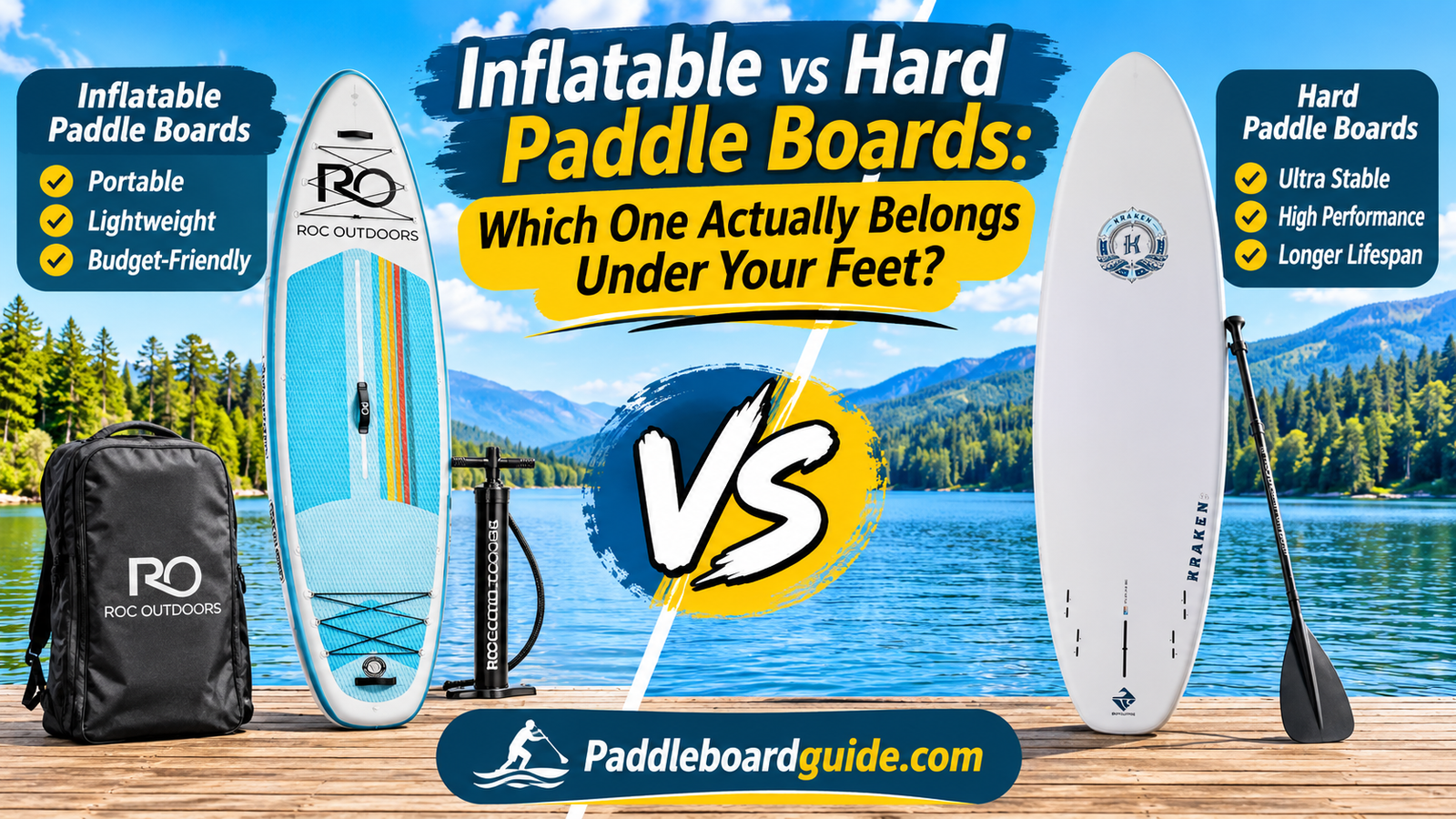
Buyer’s Guide & Head-to-Head Comparison
Inflatable vs Hard Paddle Boards: Which One Actually Belongs Under Your Feet?
One folds down into a backpack and lives in a closet. The other is rigid, quick, and glides like it was shaped for the water. We break down construction, performance, portability, durability, price, and real-world use — then look at twelve boards that argue both sides of the case.
Before We Dive In
The Only Paddle Board Argument That Actually Matters
Search any paddling forum and you will find the same argument playing out on repeat: someone asks whether an inflatable paddle board is a real board or a glorified pool toy, and a dozen people answer with more confidence than evidence. The truth is less dramatic and far more useful. Inflatable and hard paddle boards are both legitimate tools, built differently, and better at different jobs.
This guide is built to end that argument with specifics. We look at what each construction actually does on the water, what it costs you in time and effort, how it handles the bumps and scrapes of real life, and which type of paddler ends up happy with which board. Then we put the theory to work by reviewing twelve boards — six inflatables and six hard-shell and soft-top models — so you can see how the differences show up in real products rather than abstract categories.
If you are brand new to the sport, it helps to step back first and understand the wider landscape of paddle board types, because “paddle board” covers everything from inflatable all-rounders to racing displacement hulls to hybrid kayak-SUP designs. And if you have been using the terms interchangeably, our explainer on SUP board vs paddle board clears up the vocabulary quickly. For everyone else, the short version is this: the right paddle board is the one that matches where you paddle, how you get there, and where you keep it when you are done.
Bottom Line Up Front
- Choose an inflatable if you live in an apartment, drive a small car, travel, hike to alpine lakes, paddle casually, or want one board the whole family can handle without stress.
- Choose a hard board if you keep a board on a rack near the water, chase performance and glide, paddle frequently, surf, or simply prefer the locked-in feel of a rigid platform.
- Choose a hybrid — either a soft-top hard board or a wider inflatable with a kayak seat — if versatility matters more to you than pure speed.
Everything that follows supports that summary with detail. Take the section that matches your situation most closely if you are short on time, or read straight through if you want the full picture before spending money.
Ready to Start Shopping?
See the current range of stand up paddle boards in one place.
Compare shapes, sizes, and packages side by side.
At a Glance
Quick Comparison: Our Top Picks
Every board in this guide appears below, ranked by how well it serves the paddler it was designed for. The list mixes inflatables and hard boards on purpose — this is a comparison, not a popularity contest. The “Key Specs” column only lists details we can confirm, and the verdict column keeps things short enough to scan in a parking lot.
| # | Image | Product | Key Specs | Verdict | Check Price |
|---|---|---|---|---|---|
| 1 |  |
Top PickRoc Inflatable SUP 10’6″Best Overall for Most Paddlers |
|
The balanced all-rounder that suits almost everyone. | Check Price on Amazon |
| 2 |  |
Boardworks Kraken 9’9″Best Hard Board for All-Water Use |
|
A genuine all-water shape with real glide and polish. | Check Price on Amazon |
| 3 |  |
Skatinger 11’6″ Super WideBest for Heavier Paddlers & Gear |
|
Huge, planted, and unbothered by extra passengers. | Check Price on Amazon |
| 4 | 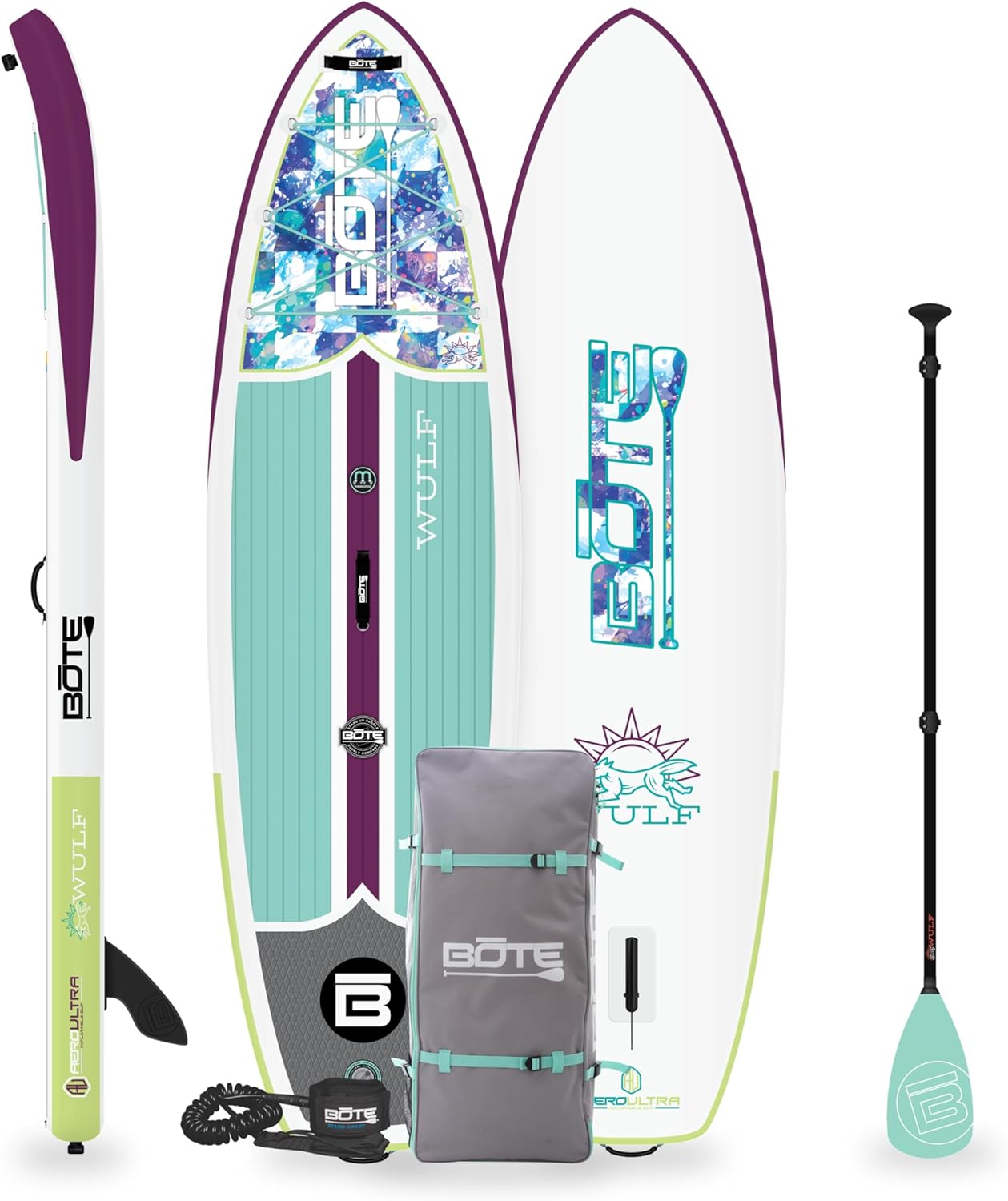 |
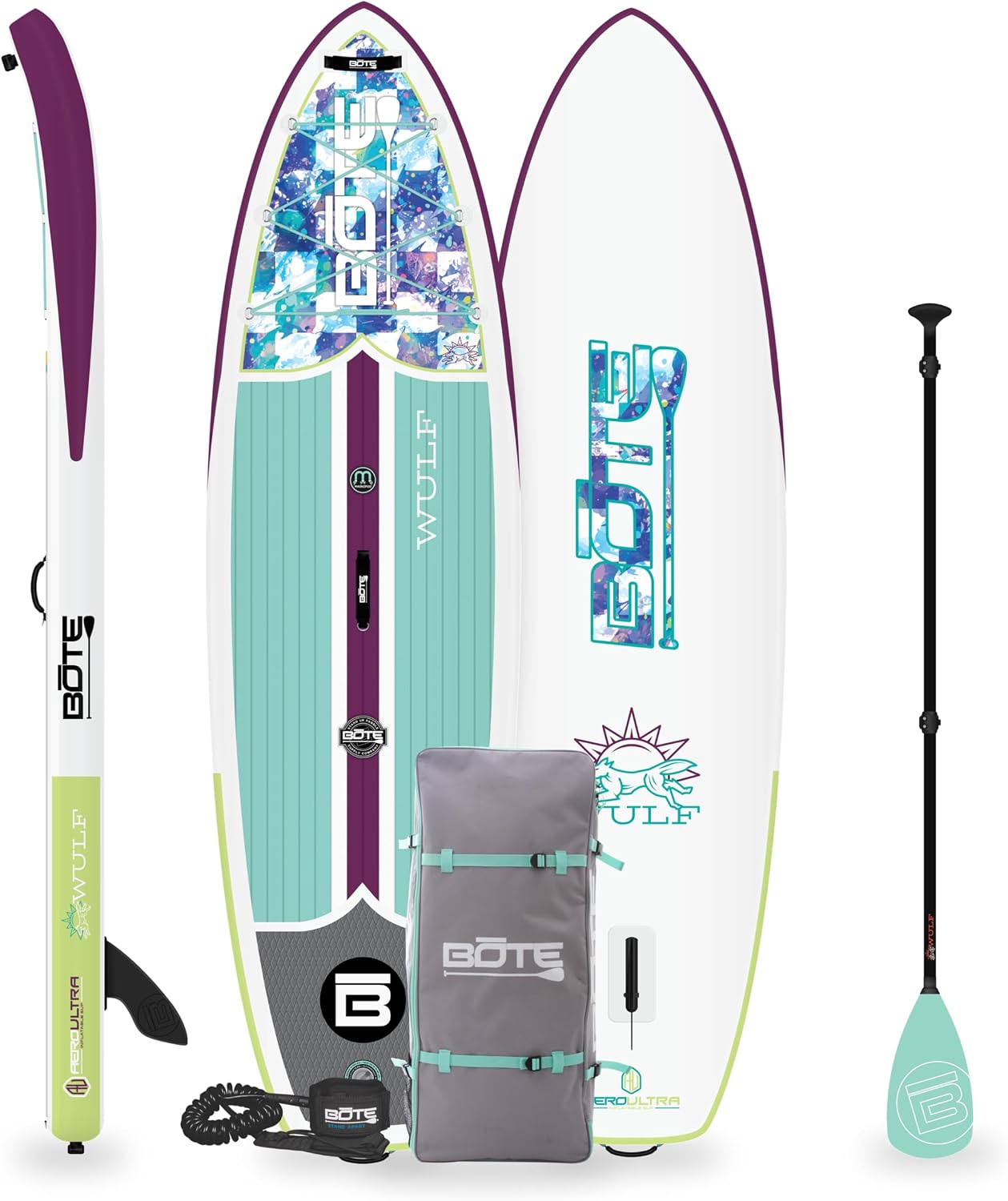
BOTE Wulf AeroBest Feature-Rich Inflatable |
|
Thoughtful hardware that makes days on the water easier. | Check Price on Amazon |
| 5 |  |
Lifetime Amped 11′Best Budget Hard Board |
|
Tough, simple, and ready to paddle out of the box. | Check Price on Amazon |
| 6 | 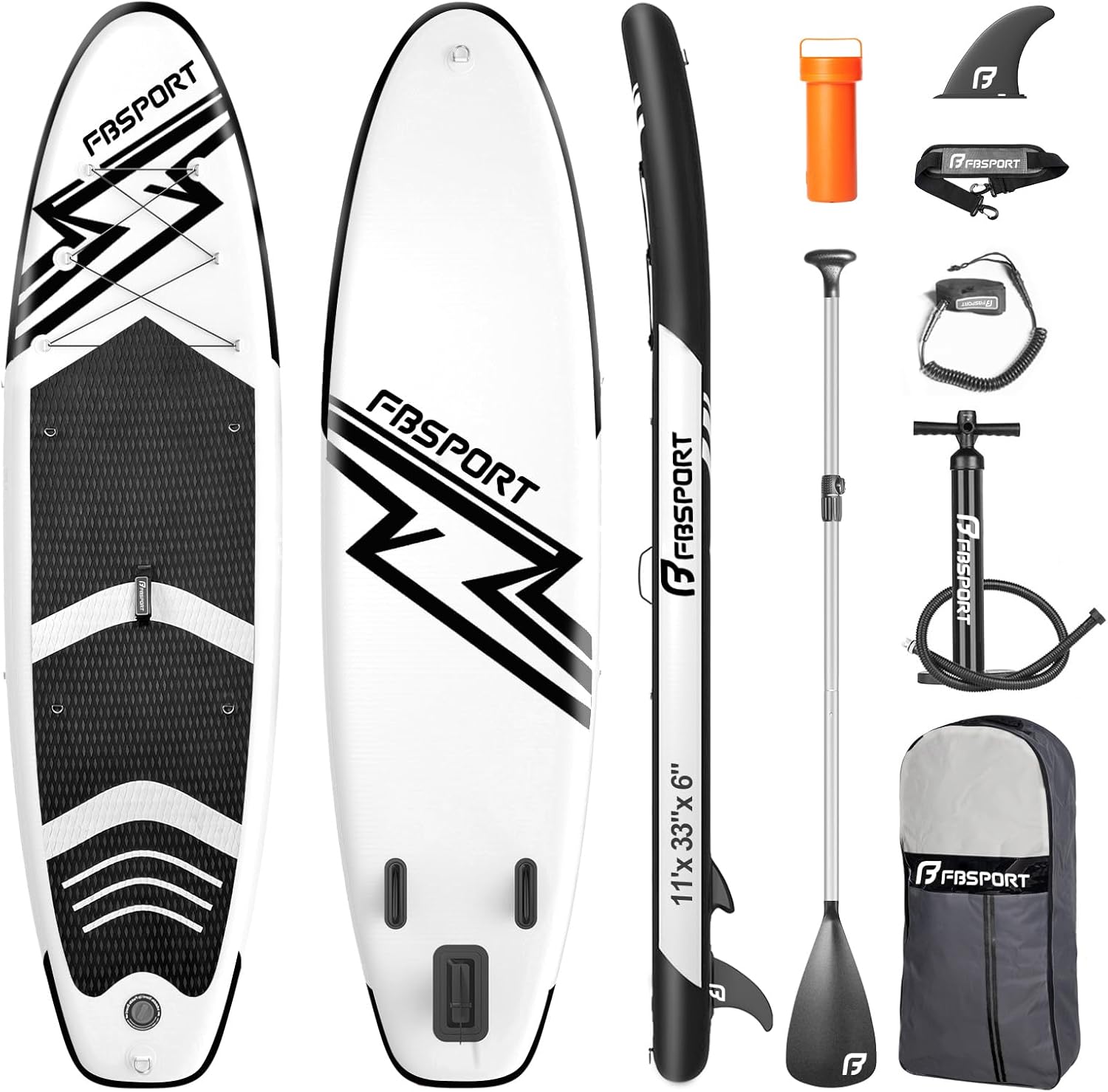 |
FBSPORT 11′ PremiumBest Value Inflatable |
|
Extra waterline for paddlers who want to cover ground. | Check Price on Amazon |
| 7 |  |
Pelican Flow 106Best Stable Hard Board |
|
A steady, confidence-building hard board for everyday use. | Check Price on Amazon |
| 8 |  |
Niphean Inflatable SUPBest for New Paddlers |
|
Friendly proportions that forgive wobbly first strokes. | Check Price on Amazon |
| 9 |  |
WAVESTORM 9’6″ HybridBest SUP / Kayak Hybrid |
|
Two ways to paddle, one forgiving soft deck. | Check Price on Amazon |
| 10 |  |
SereneLife 10’6″Best Entry-Level Inflatable |
|
A light, easy way to test whether SUP is for you. | Check Price on Amazon |
| 11 |  |
Perception Hi LifeBest Family Hybrid |
|
A tough do-everything platform for shared family days. | Check Price on Amazon |
| 12 |  |
Liquid Shredder 10’6″ Soft-TopBest Soft-Top for Shared Use |
|
Comfort underfoot and calm handling in traffic. | Check Price on Amazon |
See the Full Lineup
Browse inflatable and hard paddle boards together.
Filter by size, style, and paddling environment.
Section 01
What “Inflatable vs Hard Paddle Board” Really Means
The phrase gets used as shorthand for a dozen different arguments at once. Some people mean quality. Some mean performance. Some are really asking whether an inflatable is a legitimate piece of sporting equipment or an inflatable pool accessory with ambitions. Set the opinions aside and the difference is genuinely simple to describe.
An inflatable paddle board gets its shape from pressurized air held inside a fabric structure. Pump it up, it becomes a firm platform; let the air out, and it rolls down to roughly the size of a sleeping bag. A hard paddle board gets its shape from a solid core wrapped in a shell — foam, epoxy, fiberglass, plastic, or some combination. Its form is permanent. You do not build it each time you use it, and you cannot fold it away when you are finished.
That single structural difference is the source of everything else. Rigidity, weight, glide, storage, durability, price, repairability, and even how a board feels underfoot at the end of a long paddle all trace back to whether the board is a pressurized air chamber or a solid object. Once you internalize that, the rest of the debate stops being confusing and starts being predictable.
Three Questions That Decide This for You
Before comparing individual models, answer these honestly, because they matter more than any spec sheet.
- Where will the board live? A garage wall, a rooftop rack, or a closet in a small apartment? Storage is the single biggest practical differentiator between the two categories.
- How will you get it to the water? If you drive a compact car, carry gear upstairs, or walk to your launch spot, portability is not a nice-to-have — it is the whole decision.
- What do you want from the session? A relaxed cruise with the dog feels different from chasing fitness miles, surfing a beach break, or paddling a long solo route. Boards are shaped around intentions.
| Category | Inflatable Paddle Board | Hard Paddle Board |
|---|---|---|
| Shape source | Pressurized air inside a fabric chamber | Solid core wrapped in a rigid shell |
| Storage footprint | Folds into a backpack or duffel | Needs wall, ceiling, or rack space |
| On-water feel | Slightly dampened, very forgiving | Crisp, direct, immediate feedback |
| Setup effort | Inflate before, deflate and dry after | Grab and go |
| Typical damage | Punctures and seam issues, usually patchable | Dings, scratches, and pressure dents |
| Best fit | Apartment dwellers, travelers, casual and family use | Frequent paddlers with storage and transport sorted |
Notice that neither column is described as “better.” That is deliberate. A hard board that sits unused because it will not fit in your car is a worse purchase than an inflatable you actually use three times a week. Enthusiasm matters more than engineering, and the board that gets you on the water wins by default.
It is also worth knowing how each of these objects comes to exist in the first place. Our walkthrough of how paddle boards are made shows the layering and molding behind both constructions, which explains a lot about why they behave so differently once they leave the beach.
Not Sure Where You Land Yet?
Compare both constructions in a single search.
See which boards fit your space and your style.
Section 02
Construction Compared: Air Chambers vs Foam Cores and Shells
Marketing language in this category is famously confusing. Terms like “military grade,” “dual layer,” “thermoformed,” and “unibody” get thrown around until they stop meaning anything. Strip the vocabulary away and there are really two families of construction, each with a few variations.
How Inflatable Boards Are Built
At the center of every inflatable is drop-stitch material: two layers of fabric connected by thousands of fine threads. When you inflate the board, those threads pull the top and bottom surfaces taut, so instead of ballooning into a sausage, the board flattens into a stiff slab. Around that core, manufacturers laminate protective outer layers, add rails along the sides, and attach deck pads, D-rings, handles, and fin boxes.
The variables that actually change how a board feels are the thickness of that core, how many outer layers are bonded to it, the quality of the seams along the rails, and how stiff the resulting platform is at working pressure. A thicker, wider inflatable feels planted and stable. A narrower, thinner inflatable feels livelier but less reassuring. Cheaply bonded seams and thin outer skins are the usual failure points on budget boards, which is why a well-made inflatable can cost meaningfully more than an entry-level one even when the dimensions look identical.
How Hard Boards Are Built
Hard boards start with a foam core. Around that core goes a shell. The shell determines almost everything about the board’s personality and price.
- Epoxy and fiberglass. Lightweight, stiff, and responsive. This is the classic performance construction, and it is also the one that dings most easily if you knock it against rocks.
- Thermoformed and composite variants. Manufacturers layer materials to balance stiffness, weight, and impact resistance. The Boardworks Kraken’s EPX-V construction is a good example of a modern composite approach aimed at all-water use.
- Rotomolded plastic. A single-piece polyethylene shell that is extremely impact resistant and heavier as a result. The Lifetime Amped and Pelican Flow 106 use this approach, and so does the Perception Hi Life.
- Foam soft tops. A soft foam deck over a rigid structure. WAVESTORM’s design with multiple stringers and Liquid Shredder’s soft-top build both belong here. They are comfortable, forgiving, and popular in rental fleets and family households.
Why Rigidity Is Not the Whole Story
It is tempting to assume that a rigid board must always outperform an inflatable because rigid is rigid. On pure glide and acceleration, a well-shaped hard board does have an edge: the hull holds its designed curve precisely under load, so the board slices through chop instead of flexing over it. But stiffness is only one ingredient. Outline, rocker, volume distribution, rail shape, and fin setup all influence how a board moves, and a thoughtfully designed inflatable can easily out-handle a cheaply shaped hard board.
Modern inflatables have narrowed the gap considerably. Pumped to their recommended pressure, quality models feel firm enough that most recreational paddlers cannot tell the difference in casual use. Where the difference remains noticeable is in sustained speed, upwind chop, surf maneuvering, and the subtle feedback a rigid hull gives through your feet.
If the manufacturing side interests you, the deeper story of core materials, glassing schedules, and lamination is covered in our guide to how paddle boards are made, and the practical lifespan of each construction shows up in the next few sections.
Compare Constructions Yourself
Look at composite, plastic, and inflatable builds side by side.
See which construction matches your paddling.
Section 03
On-the-Water Performance: Stability, Speed, Tracking, and Feel
This is the section most people scroll to first, and it is also the one where generalizations fail fastest. Two boards with the same length and width can behave completely differently depending on hull shape, rocker, and volume placement. Still, some reliable patterns hold across the categories.
Stability
Stability comes from width, thickness, and where the volume sits. Wider boards resist tipping; boards with volume spread evenly along the length feel steady whether you are standing at the center or walking toward the nose. Inflatables tend to be generous with width and thickness, which is why beginners so often find them confidence-inspiring. A board like the Skatinger at 35 inches wide is built around that idea, as is the 34-inch BOTE Wulf Aero.
Hard boards can be extremely stable too — the Pelican Flow 106 at 32 inches wide is a good example — but their stability often feels different. A rigid hull gives you immediate feedback about balance, which can feel twitchy at first and precise once you adjust. Inflatables tend to mute that feedback, giving you more time to correct before anything happens.
If you are still developing balance, our look at how hard paddle boarding really is and whether paddle boards are hard to use covers the learning curve honestly.
Speed and Glide
Longer waterlines generally carry speed better, and rigid hulls hold their line with less effort. If your idea of a good session is covering distance efficiently, a hard board — or a longer, narrower inflatable — will reward you. The FBSPORT’s 11-foot format leans this direction among the inflatables in this guide, while the Boardworks Kraken represents the rigid side with its composite build and considered outline.
For casual paddling, the difference matters less than people expect. Most recreational sessions involve sightseeing, drifting, and the occasional burst of effort, and a comfortable board beats a fast one every time. Fitness paddlers will notice the gap more, and that is a legitimate reason to choose hard.
Tracking and Turning
Tracking — how straight the board goes between strokes — improves with length, fin size, and hull shape. Inflatables with a single large center fin track well. Hard boards with refined rails and fin boxes often track more precisely and turn more decisively when you shift your weight back. If you plan to surf, the responsiveness of a rigid board is hard to replicate. If you plan to cruise straight lines on flat water, either construction works.
Paddle technique matters more than most buyers realize. If you are new to stroke mechanics, our guide on how to paddle board is the fastest way to improve your glide regardless of what you are standing on.
Comfort Over Long Sessions
Here is an underrated point: inflatables are often more comfortable. The slight flex absorbs chop, the deck pads tend to be thick and soft, and the platform forgives small balance errors. Rigid boards transmit more of the water to your ankles and knees. On a two-hour paddle, that difference is real. Soft-top hard boards split the difference nicely, which is one reason designs like the WAVESTORM and Liquid Shredder soft-top remain so popular.
Find Your On-Water Match
Shop boards by length, width, and hull style.
Match the board to the water you actually paddle.
Section 04
Portability, Storage, and Transport: Where the Argument Usually Ends
Plenty of buying decisions are settled not on the water but in a stairwell. If you have ever tried to carry a rigid board up three flights of stairs, or watched one overhang the back of a small hatchback, you already understand why this section exists. For a large number of paddlers, portability is not a tiebreaker — it is the decision.
The Inflatable Advantage
An inflatable folds into a bag that fits in a closet, under a bed, in a car trunk, or in the overhead bin of an airplane. That opens doors that rigid boards simply cannot open. You can paddle on vacation without renting. You can keep a board in a city apartment. You can hike a deflated board into a mountain lake. You can store two or three boards without turning your garage into an obstacle course.
The trade-off is that everything happens around the bag. You inflate at the launch, you deflate and dry afterward, and you carry a pump, a fin, and a repair kit. It is a ritual rather than a chore, but it is a ritual every single time.
The Hard Board Reality
A rigid board is grab-and-go in the purest sense. Unstrap it from the rack, drop it on the water, and you are paddling. No pump, no waiting, no rolling. For someone who lives five minutes from a lake and paddles several times a week, that convenience is enormous.
The cost is logistics. Rigid boards need real storage space — a wall rack, ceiling hoist, or yard space with protection from sun and weather. Transport means a roof rack or a bed setup, and an eleven-foot board is a commitment on the highway. Weight matters too: many hard boards sit in the 35 to 55 pound range, and the Perception Hi Life at 55 pounds is genuinely a two-person carry for some households.
Practical Transport Tips
- Use proper rack pads and bow and stern lines for longer drives; a loose board is an unsecured load.
- Store rigid boards out of direct sun and away from extreme heat, which can affect finishes and adhesives over time.
- Dry inflatables thoroughly before packing them away; trapped moisture is the enemy of any fabric-based gear.
- Keep a small grab bag with pump, fin, patch kit, and leash so nothing gets left behind in the rush to the water.
For detail on loading, strapping, and protecting a board in transit, see our guide to how to transport a paddle board. If you drive frequently with a rigid board, a dedicated setup like the options in our best paddle board roof racks roundup removes most of the hassle. And for carrying gear along with the board, best paddle board bags covers both inflatable backpacks and board socks for rigid hulls.
Storage at home deserves its own thought. Inflatables solve it automatically, but if you are working with limited space and want creative ideas, our inflatable paddle board storage ideas has solutions that work in small homes.
Make Transport Easier
Find racks, straps, bags, and carriers built for paddle boards.
Protect your board between the driveway and the water.
Section 05
Durability, Damage, and Repairs: Which Board Survives Real Life?
“Inflatables pop” is the single most persistent myth in paddle boarding, and it survives because people imagine pool floats. Real inflatable paddle boards are not pool toys. They are laminated structures designed to hold serious pressure, and punctures are far less common than most newcomers expect. That said, both constructions can be damaged, and they fail in different ways.
How Inflatables Get Hurt
The realistic risks are sharp objects — oyster shells, barnacle-covered pilings, fish hooks, broken glass, thorns during the carry from the car. Most damage happens on land or in shallow water, not in the middle of a lake. Secondary risks include seam failure from chronic under-inflation, abrasion from dragging across rough surfaces, and heat damage from being left inflated in a hot car.
The good news is that inflatable repairs are usually straightforward. A puncture in the outer layers can be cleaned, glued, and patched at home in an afternoon with a standard repair kit. The board stays usable for years after a well-executed patch. Our step-by-step guide to how to patch a paddle board walks through the process from locating the leak to curing the adhesive.
How Hard Boards Get Hurt
Rigid boards fail through impact and abrasion. Composite boards ding when they hit docks, rocks, or car roofs; plastic rotomolded boards scratch and gouge rather than crack, which is precisely why so many rental fleets and family households prefer them. Soft-top boards dent and scuff but tend to shrug off the kind of contact that would chip a fiberglass rail.
Composite repairs range from a simple resin touch-up to professional structural work. Rotomolded plastic is famously low-maintenance: scrape off the gouge, keep paddling. Soft tops need the least attention of all, which is a genuine quality-of-life benefit for anyone sharing a board with kids or guests.
Longevity: Which Lasts Longer?
There is no universal winner. A rigid composite board kept on a rack under cover can outlast an inflatable stored folded in a damp shed, and a well-cared-for inflatable can serve a family for many seasons. Usage and care dominate construction type. What we can say is that inflatables have a finite relationship with air pressure and adhesives over very long timelines, while rigid boards have a finite relationship with impact damage and sun exposure. If you want the specifics of inflatable aging and what to expect over time, our article on how long inflatable paddle boards last covers the realistic arc.
- Prevent the preventable: rinse with fresh water, dry before storage, avoid prolonged direct sun, and never drag a board across concrete.
- Carry a repair kit: patch material, adhesive, and a valve wrench weigh almost nothing and save entire trips.
- Inspect before launching: thirty seconds of checking seams, fins, and deck fittings prevents most mid-session surprises.
- Respect heat: inflated boards in hot cars and rigid boards on hot rooftops both suffer over time.
Keep Your Board Alive
Find patch kits, adhesives, and maintenance essentials.
Small supplies that protect a big investment.
Section 06
Setup and Everyday Convenience: The Part Nobody Posts About
Social media shows the glide across a glassy lake. It does not show the fifteen minutes of pumping beforehand, or the deflating and drying afterward. It also does not show the person with a rigid board who cannot fit it in their car and simply does not go. Convenience is the quiet factor that determines how often you actually paddle.
The Inflatable Routine
A typical inflatable session looks like this: unload the bag, unfold the board, attach the fin, inflate to the recommended pressure, leash on, launch. Afterward, rinse, deflate, dry, roll, and pack. In practice, most paddlers settle into a rhythm and stop noticing. Manual pumps are simple and reliable; electric pumps exist and turn the setup into a hands-free task while you sort the rest of your gear.
Pressure is the detail people get wrong. An under-inflated board flexes, feels sluggish, and handles poorly — and many “inflatables feel soft” complaints trace back to a gauge nobody read. Pump to the manufacturer’s recommendation and the difference is immediate.
If you want to upgrade the most tedious part of the process, our roundup of the best paddle board pumps covers both manual and electric options.
The Hard Board Routine
Unstrap, carry, launch. That is genuinely it. The convenience is addictive and it is the main reason dedicated paddlers gravitate toward rigid boards despite the storage burden. The only recurring task is transport and keeping the hull clean.
Accessories That Change the Experience
- A paddle that suits you. Length, blade shape, and weight matter more than most buyers expect. See our guide to the best paddle board paddles if yours feels like an afterthought.
- A leash that fits the water. Calm lakes, rivers with current, and surf all call for different leash thinking.
- A seat for hybrid days. Many inflatable and hybrid boards accept a kayak-style seat, which turns a single board into a two-mode platform. Our best paddle board seats explains what to look for.
- Storage for small items. Dry bags, bungee cargo areas, and magnetic mounts all reduce the friction of carrying phone, water, and keys.
And for a small question with a surprisingly practical answer: yes, paddle choice can turn into a safety question if yours goes overboard. Our explanation of whether paddle board paddles float is worth thirty seconds of your time before your next session.
Upgrade Your Setup
Find pumps, paddles, seats, and accessories that save time.
Less fuss at the launch means more time on the water.
Section 07
Cost of Ownership: Upfront Price, Accessories, and Long-Term Value
Comparing sticker prices between inflatables and hard boards is misleading in both directions. Inflatables usually arrive as packages — board, paddle, pump, leash, fin, bag, and sometimes more — while hard boards are often sold as the board alone, with rack, paddle, and transport gear purchased separately. To compare fairly, you have to compare complete setups.
What You Actually Need to Budget
- The board. Your largest single line item by far.
- Transport and storage. Rack pads, straps, a wall mount, or a padded bag. Frequently forgotten, rarely optional.
- Propulsion and safety. Paddle, leash, and a properly fitted personal flotation device.
- Maintenance. Patch materials, wax or deck cleaner, and the occasional replacement fin or fitting.
Safety equipment is not a place to economize. A correctly fitted life jacket matters as much as the board beneath you, and our guide to the best paddle board life jackets covers what to prioritize for paddling specifically rather than boating generally.
Where Each Construction Saves Money
Inflatables tend to save money at the front end because the accessory bundle is included, and they save money on transport because you rarely need a rack. Hard boards tend to save money on accessories over the long run because there are fewer consumables — no pump to replace, no adhesive, no valve service — and a durable rotomolded board shrugs off the kind of damage that costs money on other constructions.
Both categories have wide price bands, so it is more useful to think in tiers than in absolutes. Entry-level boards prioritize affordability and completeness of package. Mid-tier boards improve materials, stiffness, and finish. Premium boards refine hull shape, weight, and hardware. Knowing which tier you are shopping in keeps expectations honest.
The Value Question That Matters Most
Value is not cost per board; it is cost per session. A board that gets used twice a week for years is a bargain at almost any price. A board that sits unused because it is too heavy, too large, or too much trouble is expensive even at a discount. If you are choosing a first board, our guide to the best paddle boards for beginners and our specific look at whether inflatable paddle boards are good for beginners will help you match expectations to reality. And if inflatable is already your direction, the best inflatable paddle boards roundup goes deeper on that side of the market.
Stretch Your Budget Further
Compare complete packages before you compare prices.
Find a board that earns its keep on every outing.
Section 08
Matching the Board to the Mission: Yoga, Fishing, Surf, Touring, and Family Days
The most common buying mistake is shopping for a board instead of shopping for an activity. Boards are shaped around intentions, and the right shape for one mission is often wrong for another. Here is how the two constructions map onto the most popular uses.
Yoga and Fitness
Yoga on the water rewards a wide, flat, stable platform with plenty of deck space and a comfortable pad. Inflatables dominate here. Their width and thickness make poses feel secure, the soft deck is kind to hands and knees during transitions, and the forgiving platform absorbs the small balance shifts that would tip a narrow board. Wider models like the Skatinger at 35 inches or the BOTE at 34 inches illustrate exactly the proportions that work. Our guide to the best paddle boards for yoga goes into the details of deck layout and stability.
Fishing
Fishing demands stability first, then accessory mounting, then quiet. Inflatables do extremely well here: they are stable, they accept rod holders and coolers, and they glide silently. Rigid plastic boards offer toughness and permanent mounting points. Whichever you choose, prioritize width and weight capacity over speed, and think about where your gear will sit. Our guide to the best paddle boards for fishing covers rigging and layout.
Surf and Rough Water
Surf belongs to hard boards. The responsiveness of a rigid hull through turns, the way rails bite in a face, and the immediate feedback underfoot are simply hard to replicate with air. Beginners learning in tiny whitewater can start on an inflatable without issue, but anyone progressing into real waves will eventually want rigidity.
Touring and Distance
Distance rewards waterline length and efficient hulls. Longer inflatables cover ground well and travel beautifully; rigid touring boards glide better over long sessions. If you are building fitness rather than just floating, both categories offer plenty of scope — and paddling genuinely delivers. Our articles on whether paddle boarding is good exercise and how many calories paddle boarding burns set realistic expectations.
Families, Guests, and Shared Boards
For a household board that everyone uses, forgiving beats fast. Soft-top hard boards and stable inflatables both shine here. Soft tops handle careless handling with grace; inflatables handle limited storage with grace. Hybrids that accept a kayak seat add a second mode for kids and older relatives — the WAVESTORM’s built-in seat and the Perception Hi Life’s dual-purpose design both follow this logic, and adding a seat to an inflatable works along the same lines.
Timing also shapes the experience. Calm morning water is a very different proposition from afternoon wind, and our guide to the best time to paddle board is a quick read that improves almost every outing.
Build Your Activity Setup
Shop boards and accessories for yoga, fishing, and family days.
Set up for the paddling you actually plan to do.
Section 09
Six Inflatable Paddle Boards Reviewed
Here is where the theory meets actual hardware. The six inflatables below cover the spectrum from entry-level to oversized and accessory-rich, so whatever your situation, something here will look familiar. Before the individual reviews, the grouped table gives you the fast comparison.
| # | Board | Size / Width | Best For | Check Price |
|---|---|---|---|---|
| 1 | Roc 10’6″ | 10’6″ / 33″ | Best overall all-rounder | Check Price on Amazon |
| 2 | Skatinger 11’6″ | 11’6″ / 35″ | Heavier paddlers and gear | Check Price on Amazon |
| 3 | BOTE Wulf Aero | 34″ wide | Accessory lovers | Check Price on Amazon |
| 4 | FBSPORT 11′ | 11′ length | Covering distance | Check Price on Amazon |
| 5 | Niphean 126″ x 33″ | 10’6″ / 33″ | First-time paddlers | Check Price on Amazon |
| 6 | SereneLife 10’6″ | 10’6″ length | Casual, occasional use | Check Price on Amazon |
Best Overall
Roc Inflatable Stand Up Paddle Board 10’6″
The Roc is the board we hand to people who say “I want one board that does most things well.” Its proportions are the classic all-round formula — a 10’6″ length paired with a 33-inch width — and the published 350 lb capacity gives it genuine headroom for larger paddlers, a pet, or a pile of dry bags. That combination is exactly why this format became the default recommendation across the industry.
- Proven all-round proportions — 10’6″ by 33″ balances stability and maneuverability for mixed water.
- Generous 350 lb capacity — plenty of room for paddler, gear, and a canine first mate.
- Forgiving deck platform — wide enough to build confidence without feeling barge-like.
- Travel-friendly format — deflates and packs away for storage in small spaces.
Pros
- Versatile shape suited to lakes, calm bays, and slow rivers
- Strong weight capacity for the size
- Approachable for new paddlers yet useful for experienced ones
- Packs down small for apartment living and travel
Cons
- Not built for surfing or high-performance racing
- Requires inflation before every session
- Wider platform trades some speed for stability
Best for: paddlers who want one inflatable board that handles casual cruising, fitness laps, family outings, and the odd overnight trip without needing a second board in the garage. If you are cross-shopping entry-level options, our iRocker Nautical review covers another popular all-round inflatable worth comparing on shape and package.
Check Price on Amazon
Best High Capacity
Skatinger 11’6″ Super Wide Inflatable SUP
If your priority is simply not falling in, the Skatinger makes a very persuasive case. At 11’6″ long and 35 inches wide, with a published capacity of 450 lb, it belongs to the “big platform” category that prioritizes planted stability over everything else. This is the board you choose when the paddler is tall or heavy, when a child rides along, when the dog insists on standing at the nose, or when you are stacking cooler, camera, and fishing gear on deck.
- 35-inch width — among the widest platforms in this group, and it shows in the stability.
- 11’6″ waterline — extra length keeps the board tracking steadily despite the width.
- 450 lb capacity — real headroom for tandem outings and heavy gear loads.
- Confidence-building platform — ideal for nervous beginners and yoga practitioners alike.
Pros
- Exceptional stability for larger paddlers and extra load
- Doubles as a floating platform for yoga and lounging
- Still packs down for storage despite its size
- Excellent choice for paddlers carrying camera or fishing gear
Cons
- Wide and long boards take more effort to turn
- Bigger bag and slightly longer inflation time
- Overkill for paddlers who want speed above all
Best for: bigger paddlers, families sharing one board, anglers, and anyone who has decided that stability is the single feature they will not compromise on. For more on matching capacity to body weight and gear, see how much weight a paddle board can hold.
Check Price on Amazon
Best Feature Set
BOTE Wulf Aero Inflatable Paddle Board
BOTE has built its reputation on making boards that behave like platforms for activities, and the Wulf Aero carries that thinking into the inflatable category. The 34-inch width provides the stable base that makes accessory use practical, while the MagnePod magnetic mount gives you a clean, fumble-free way to keep a compatible tumbler or accessory locked in place while you paddle. It sounds like a small detail until you have watched a drink roll across a wet deck mid-session.
- 34-inch wide platform — stable enough for standing casts, stretches, and gear handling.
- MagnePod magnetic mount — a genuinely useful touch for drinks and compatible accessories.
- Accessory-forward deck layout — designed around carrying things, not just paddling.
- Portable inflatable format — all the above folds into a bag afterward.
Pros
- Thoughtful hardware that solves real annoyances
- Stable, activity-oriented platform
- Strong option for fishing, floating, and social paddles
- Packs away despite the accessory-rich deck
Cons
- Accessory focus is less relevant for minimalist paddlers
- Wide platform prioritizes stability over raw speed
- MagnePod usefulness depends on compatible accessories
Best for: paddlers who treat a board as a basecamp — fishing, floating with friends, long lazy afternoons where the gear matters as much as the distance covered. Our BOTE inflatable paddle board review goes deeper into the brand’s inflatable lineup if you want more context.
Check Price on Amazon
Best for Distance
FBSPORT 11′ Premium Stand Up Paddle Board
The FBSPORT sits at the longer end of the recreational inflatable spectrum, and that extra waterline changes the character of the board. Where 10’6″ all-rounders favor quick turns and playful handling, an 11-foot board wants to go somewhere. It carries momentum between strokes and holds a line more willingly, which makes it the natural pick for paddlers whose sessions involve covering distance rather than drifting.
- 11-foot length — more waterline for better tracking and sustained glide.
- Premium inflatable build — aimed at paddlers who want more than an entry-level package.
- Distance-friendly character — ideal for longer explorations and fitness laps.
- Still packable — the touring advantage without the storage commitment.
Pros
- Tracks straight and holds speed well for an inflatable
- Suits fitness paddling and longer routes
- Comfortable cruising platform for intermediate paddlers
- Deflates for travel and small-space storage
Cons
- Longer boards turn more slowly
- Slightly more pump time than shorter models
- Not the most forgiving choice for total beginners
Best for: paddlers who have a season or two behind them and want an inflatable that rewards effort with distance. If you are still exploring the wider inflatable market, our roundup of the best inflatable paddle boards covers a broad range of shapes and budgets.
Check Price on Amazon
Best for Beginners
Niphean Inflatable Paddle Board (126″ x 33″)
At 126 inches by 33 inches — the familiar 10’6″ by 33″ all-round formula — the Niphean sits squarely in the sweet spot for first boards. Those dimensions are not an accident. That width is wide enough to feel steady while you learn, and the length is short enough to turn without a fight. It is the paddling equivalent of learning to drive in a midsize sedan rather than a sports car.
- 10’6″ x 33″ platform — the classic beginner-friendly proportion.
- All-round shape — handles flat water and light chop with equal composure.
- Forgiving stability — builds confidence from the very first session.
- Inflatable convenience — easy to store, carry, and travel with.
Pros
- Very approachable for new paddlers of all sizes
- Stable enough for casual fishing and yoga too
- Packs down small for apartment and trunk storage
- Good springboard for developing technique
Cons
- All-round shapes are not built for racing
- Requires inflation setup each session
- May feel too tame for advanced paddlers
Best for: anyone buying a first board who wants an easy, confidence-building start. If you are weighing inflatable against other beginner routes, our analysis of whether inflatable paddle boards are good for beginners lays out the full picture.
Check Price on Amazon
Best Entry Level
SereneLife 10’6″ Inflatable Stand Up Paddle Board
SereneLife’s 10’6″ inflatable is aimed squarely at the paddler who wants to find out whether stand up paddle boarding is their thing without overcommitting. It is a straightforward, portable, easy-to-handle board in the most popular recreational length, and its appeal lies in simplicity: inflate it, paddle it, decide later whether you want something more specialized.
- 10’6″ all-round length — the industry-standard size for recreational paddling.
- Light and manageable — easier to carry and handle than larger inflatables.
- Compact packed size — fits in a closet or small car without rearranging your life.
- Low barrier to entry — designed for testing the waters, literally.
Pros
- Accessible way to start paddling
- Easy for one person to carry and set up
- Great for occasional use and vacations
- Storage-friendly in small homes
Cons
- Not aimed at high-performance use
- Lighter boards can feel less planted in wind
- You may outgrow it if the sport takes hold
Best for: first-time buyers, vacation paddlers, and anyone who wants a portable board on hand for guests. Our guide to the best paddle boards for beginners places boards like this in context alongside other starter-friendly options.
Check Price on AmazonComparing Inflatable Brands?
Brand-level comparisons can be genuinely useful once you know which shape class you want. If the inflatables above have you curious about the wider market, our head-to-heads on iRocker vs BOTE, ISLE vs iRocker, and Atoll vs iRocker compare packages, construction approaches, and design philosophies in detail. Single-model deep dives are available too, including our iRocker paddle board review, GILI paddle board review, ISLE paddle board review, and Retrospec Weekender paddle board review.
Shop Inflatable Paddle Boards
See today’s inflatable boards and complete packages.
Compare sizes, widths, and included accessories.
Section 10
Six Hard Paddle Boards Reviewed
Hard boards cover a wider range of constructions than most people realize, from composite all-water shapes to indestructible rotomolded plastic to soft-topped hybrids that double as kayaks. The six below show that range clearly, and each makes a different argument for rigidity.
| # | Board | Construction | Best For | Check Price |
|---|---|---|---|---|
| 1 | Boardworks Kraken 9’9″ | EPX-V composite | All-water performance | Check Price on Amazon |
| 2 | Lifetime Amped 11′ | Rotomolded HDPE | Durability and value | Check Price on Amazon |
| 3 | Pelican Flow 106 | Rotomolded plastic | Stable everyday paddling | Check Price on Amazon |
| 4 | WAVESTORM 9’6″ | Foam soft top, 3 stringers | Hybrid SUP and kayak use | Check Price on Amazon |
| 5 | Perception Hi Life | Rotomolded polyethylene | Family versatility | Check Price on Amazon |
| 6 | Liquid Shredder 10’6″ | Soft-top construction | Comfort and shared use | Check Price on Amazon |
Best All-Water Hard Board
Boardworks Kraken 9’9″ All-Water SUP
The Kraken is what most people picture when they imagine a proper hard paddle board. Its EPX-V construction, 180 liters of volume, 35-pound weight, and 260-pound capacity describe a well-rounded all-water shape — substantial enough to feel secure, light enough to carry with one hand, and refined enough to reward paddlers who care about how a hull behaves. This is the board in this guide that most clearly makes the performance case for rigidity.
- EPX-V construction — a modern composite build designed for stiffness and all-water durability.
- 180 L volume — sensible flotation for a wide range of paddler weights.
- 35 lb weight — manageable for transport and car-top loading.
- 260 lb capacity — suits most recreational paddlers comfortably.
Pros
- Genuine glide and responsiveness of a rigid hull
- Light enough for straightforward handling
- All-water versatility from lakes to light surf
- Refined shape for paddlers who value feel
Cons
- Needs real storage and transport space
- Composite surfaces want careful handling
- Capacity is more limited than oversized inflatables
Best for: paddlers with a rack and a garage who want the crisp, immediate feel of a properly shaped hard board across changing conditions. If you enjoy comparing premium designs, our Tower paddle board review covers another performance-oriented option worth reading.
Check Price on Amazon
Best Budget Hard Board
Lifetime Amped 11′ Hardshell Paddleboard with Paddle
The Amped makes the hard board case in the most practical language possible: it is tough, it is straightforward, and it arrives with a paddle so you can go paddling immediately. The rotomolded HDPE shell at 47 pounds is not trying to win weight comparisons — it is trying to survive years of docks, driveways, kids, and general household neglect. On that front, it succeeds.
- Rotomolded HDPE shell — impact-resistant single-piece construction that shrugs off abuse.
- 11-foot length — a stable, tracking-friendly platform for everyday use.
- 47 lb weight — solid and planted, best handled with a plan for transport.
- Paddle included — a complete start without accessory guesswork.
Pros
- Extremely forgiving of knocks and scrapes
- Ready to use out of the box
- Low maintenance over its lifetime
- Confident, stable platform for all skill levels
Cons
- Heavier than composite and inflatable alternatives
- Bulky to store and transport
- Less glide than a refined composite shape
Best for: families, lake houses, rental-style shared use, and anyone who values toughness over grams. If this becomes your first rigid board, our guide to how to transport a paddle board will make the logistics much easier.
Check Price on Amazon
Best Hybrid
WAVESTORM 9’6″ SUP Kayak Hybrid
Two ways to paddle on one platform is the entire pitch here. The WAVESTORM pairs a forgiving foam soft top with a rigid structure supported by three stringers, then adds a built-in kayak seat so the board works standing up or sitting down. For households with mixed ambitions — one person wants to stand and cruise, another wants to sit and relax — that versatility is genuinely valuable.
- Foam soft top — comfortable and forgiving underfoot, ideal for long lazy sessions.
- Three-stringer structure — internal reinforcement for a solid, dependable platform.
- Built-in kayak seat — switch to seated paddling without buying separate gear.
- 9’6″ length — compact, maneuverable, and easy to handle in tight spaces.
Pros
- Two paddling styles on a single board
- Soft deck is comfortable and safety-friendly
- Great for mixed-ability groups and families
- Simple, low-maintenance construction
Cons
- Soft tops are not built for high performance
- Rigid format still needs storage and transport space
- Shorter length favors maneuvering over distance
Best for: households that want maximum versatility and comfort from a single board. If seated paddling appeals, our guide to the best paddle board seats covers what separates a good seat from a frustrating one.
Check Price on Amazon
Most Stable Hard Board
Pelican Flow 106 Hardshell SUP
The Flow 106 is a hard board that behaves like a patient teacher. Its rotomolded plastic shell takes punishment without complaint, the 32-inch width gives the platform reassuring steadiness, and at 46 pounds it sits in the typical range for durable hard boards. This is the board that belongs at a cabin, a dock, or a busy family beach where the equipment has to handle everyone from nervous first-timers to confident regulars.
- Rotomolded plastic shell — impact resistance you can feel confident about near docks and rocks.
- 32-inch wide deck — stable proportions for building balance and confidence.
- 46 lb weight — substantial and planted on the water.
- Low-maintenance build — rinse it, store it, use it again.
Pros
- Excellent stability for learning and casual cruising
- Handles rough handling with minimal fuss
- Straightforward, no-setup convenience
- Great shared board for families and guests
Cons
- Weight makes solo carrying a two-handed job
- Requires storage space at home
- Not oriented toward speed or surf performance
Best for: families and shared-use situations where stability and toughness matter more than anything else. It pairs well with the fundamentals in our best paddle boards for beginners guide.
Check Price on Amazon
Best Family Hybrid
Perception Hi Life Kayak / SUP Hybrid
The Hi Life is built around the same idea as the WAVESTORM but executed in rotomolded polyethylene at a substantial 55 pounds. That weight tells you what the board is: a tough, do-everything platform that will take years of enthusiastic use from everyone in the household. It works as a stand up paddle board and as a kayak, which makes it one of the most versatile single purchases in this entire guide.
- Rotomolded polyethylene — seriously durable shell that handles impact and abrasion.
- 55 lb build — heavy, stable, and planted once on the water.
- SUP and kayak capability — two paddling modes for different moods and different people.
- Family-friendly platform — roomy enough for kids, gear, and long afternoons.
Pros
- Exceptional durability for shared and heavy use
- Genuine two-in-one versatility
- Stable, comfortable platform for long sessions
- Handles rocky launches and rough docks well
Cons
- At 55 lb it needs a transport plan
- Storage footprint is significant
- Heavier build favors comfort over speed
Best for: households that want one rugged board that serves standing and seated paddling alike. The hybrid concept is worth exploring further in our comparison of paddle board vs kayak.
Check Price on Amazon
Best Soft-Top
Liquid Shredder 10’6″ Soft-Top SUP
Soft-top boards occupy a sweet spot that marketing departments rarely highlight: they are comfortable, forgiving, and calm to use in crowded water. The Liquid Shredder’s 10’6″ soft-top format takes that logic and applies it to the most popular recreational length. If you have ever winced watching a rigid board bang against a dock, you already understand the appeal.
- Soft-top construction — cushioned deck that is comfortable and forgiving.
- 10’6″ length — familiar, manageable proportions for mixed conditions.
- Family-friendly handling — lower risk of injury or damage in busy water.
- Low-stress ownership — fewer worries about dings and scratches.
Pros
- Comfortable underfoot for long sessions
- Excellent for beginners and mixed-ability groups
- Handles careless use gracefully
- Simple to maintain over time
Cons
- Soft tops are heavier than equivalent composites
- Not aimed at racing or surf performance
- Still requires proper storage space
Best for: shared boards, calm-water cruising, and anyone who wants a rigid board without the fragility of a composite finish. Our review of the ISLE paddle board range covers more soft-top and stable platform designs if you want to explore this style further.
Check Price on AmazonShop Hard Paddle Boards
Compare composite, rotomolded, and soft-top builds.
Find the rigid board that fits your storage and your water.
Section 11
How to Choose: A Decision Framework for Real Buyers
You now have the full comparison and twelve boards worth of context. What follows is the part that turns all of that into a decision you will not regret. Work through these filters in order and the field narrows quickly.
Filter One: Logistics
Be ruthless here. If you have no wall space, no rack, and no vehicle that can carry a ten-foot board, then hard boards are off the table regardless of how much you admire them. Conversely, if you have a garage with a rack five minutes from a boat launch, inflating a board before every session starts to look like unnecessary work. Logistics narrow the field faster than any performance discussion.
Filter Two: Skill Level and Comfort
New paddlers do best on wide, stable, forgiving platforms — which means either a generous inflatable or a soft-top hard board. Intermediate paddlers start caring about glide and responsiveness. Advanced paddlers know exactly what they want and usually want rigidity. Meeting yourself where you actually are, rather than where you hope to be in two seasons, produces much better outcomes.
Filter Three: Weight Capacity
Board capacity needs to cover your body weight plus gear plus margin. A board loaded near its limit sits low in the water, feels sluggish, and handles poorly. Boards with generous published capacity — like the Roc at 350 lb or the Skatinger at 450 lb — give you real flexibility for pets, children, coolers, and fishing tackle. The deeper math behind this is covered in our article on how much weight a paddle board can hold.
Filter Four: The Activity You Actually Do
Buy for your real weekends, not your aspirational ones. If you paddle calm water with family twice a month, a stable all-rounder is perfect. If you are logging fitness miles, prioritize length and hull efficiency. If you want to surf, choose a rigid board shaped for it. Our guides to the best paddle boards for beginners, fishing, and yoga cover the most common missions in more detail.
| Decision Factor | Inflatable | Hard Board | Edge |
|---|---|---|---|
| Apartment or small-space storage | Folds into a bag | Needs rack or wall space | Inflatable |
| Pure glide and speed | Good, with some flex | Excellent, precise hull | Hard board |
| Beginner confidence | Forgiving and stable | Stable but more feedback | Inflatable |
| Impact toughness | Good; punctures patchable | Excellent in plastic builds | Depends on build |
| Travel and flying | Packs into luggage | Requires freight or roof | Inflatable |
| Surf and quick turns | Usable at a basic level | Responsive and precise | Hard board |
| Comfort on long sessions | Soft, dampened platform | Firm; soft tops help | Inflatable / soft top |
| Setup speed at the launch | Inflate each session | Grab and go | Hard board |
Brand Comparisons Worth Reading
Once you know your construction and shape class, brand comparisons become genuinely useful because they highlight differences in packaging, warranty thinking, design philosophy, and included accessories. Our head-to-heads on iRocker vs BOTE, ISLE vs iRocker, and Atoll vs iRocker are the natural next step if you have narrowed your search to two names.
Make the Final Call
Use the filters above, then compare your shortlist directly.
The right board is the one you will actually paddle.
Section 12
Care, Safety, and Getting the Most From Either Board
Whichever construction wins your decision, the fundamentals of ownership are remarkably similar. Take care of the equipment, take care of yourself on the water, and both inflatable and hard boards will reward you with years of use. This section covers the habits that make the biggest difference.
Care Habits That Pay Off
- Rinse after every session. Fresh water removes grit, salt, and organic material that slowly degrade surfaces and hardware.
- Dry before storing. Especially for inflatables, moisture trapped in a rolled-up board is the fastest route to unpleasant surprises.
- Store out of direct sun. Ultraviolet exposure is unkind to finishes, deck pads, and adhesives over long timelines.
- Respect heat. Never leave an inflated board baking in a closed vehicle, and be careful with rigid boards on hot rooftops.
- Inspect regularly. Check seams, valves, fin boxes, deck fittings, and leash attachment points at the start of each season.
For inflatable-specific maintenance and repair, our guide to how to patch a paddle board covers the essentials, and our article on how long inflatable paddle boards last sets realistic expectations for aging and care.
Safety Fundamentals
Paddle boarding looks serene because it usually is — but water deserves respect, and the paddlers who have the most fun over the long term are the ones who build good habits early.
- Wear a properly fitted life jacket. Not stowed, not strapped to the board — worn. Our guide to the best paddle board life jackets explains the fit and design features that matter specifically for paddling.
- Use a leash appropriate to the conditions. Calm water and moving water call for different thinking.
- Check conditions before launching. Wind, current, and boat traffic change a session dramatically. Our guide to the best time to paddle board covers how to read the day.
- Tell someone your plan. A quick message costs nothing and matters enormously if something goes wrong.
- Learn the rules of the water. Our complete guide to paddle board safety requirements covers equipment, right-of-way, and legal basics.
Keep Improving
Technique is the upgrade that costs nothing and improves everything. A better stroke makes any board faster, straighter, and less tiring. If you are still building fundamentals, our guides to how to paddle board and how hard paddle boarding really is are useful reading between sessions. And if your paddle is letting you down, the best paddle board paddles will help you find one that suits your height and style.
Paddle Safer, Paddle Longer
Find life jackets, leashes, and care essentials.
Small gear choices that make every session better.
Questions Paddlers Ask Most
Frequently Asked Questions
Are inflatable paddle boards as good as hard paddle boards?
For recreational paddling, fitness cruising, travel, and family use, a quality inflatable is genuinely as good as a hard board and often more practical. Where hard boards hold an advantage is in pure glide, precise hull response, and surf performance. “As good” depends entirely on what you are asking the board to do.
Do inflatable paddle boards last as long as hard boards?
Both can last for many seasons with reasonable care. Inflatables are vulnerable to punctures from sharp objects and to heat and moisture when stored improperly. Hard boards are vulnerable to impact damage and sun exposure. Care habits matter more than construction type in most cases.
Which is better for a complete beginner — inflatable or hard?
Inflatables tend to be the easier starting point because they are wide, stable, forgiving, and comfortable underfoot. Soft-top hard boards offer a similar experience. The main thing is to choose a board with enough width and capacity that you feel secure while learning balance and stroke technique.
Can you take an inflatable paddle board in the ocean or in surf?
Inflatables handle calm ocean water, bays, and light chop perfectly well, and many paddlers use them exactly that way. For actual surfing, rigid boards respond far better through turns and in the face of a wave. If surf is your goal, a hard board shaped for it is the right tool.
How long does it take to inflate a paddle board?
With a standard manual pump, most paddlers find it takes a comfortable few minutes of steady effort, longer for larger boards and faster for smaller ones. Electric pumps handle the job hands-free. The bigger factor is reaching the correct pressure, since an under-inflated board performs noticeably worse.
Are hard paddle boards faster than inflatables?
Generally, yes — a rigid hull holds its designed shape under load and glides with less energy loss. The gap narrows considerably with longer, well-designed inflatables, and for casual paddling most people will not notice it at all. Distance and fitness paddlers are the ones who benefit most from rigidity.
Which type is better for yoga and fitness on the water?
Wider inflatables are the popular choice because they offer a stable, cushioned platform with room to move through poses comfortably. Soft-top hard boards work well too. Look for width first, then deck pad quality, then capacity for any gear you want on board.
Can I store an inflatable paddle board in a hot car or garage?
Avoid leaving an inflated board in a closed vehicle on a hot day, as heat builds quickly and can stress seams and adhesives. Let air out if it must stay in a warm space, and store boards in a cool, dry, shaded area whenever possible.
Which is better for fishing — inflatable or hard?
Both work well. Inflatables offer stability, quiet movement, portability, and easy accessory mounting. Rotomolded hard boards offer toughness and permanent mounting points. Choose based on how you reach your fishing spot and where you store the board the rest of the week.
Do hard paddle boards scratch and dent easily?
Composite boards can ding and scratch if knocked against hard surfaces. Rotomolded plastic boards scratch and gouge rather than crack, which makes them far more relaxed to own. Soft tops dent and scuff but handle casual use with remarkable grace.
Is paddle boarding good exercise, and does it burn many calories?
Paddle boarding is a genuine full-body workout that challenges balance, core stability, and endurance. How much you burn depends on pace, conditions, and duration — a brisk fitness paddle is a very different session from a slow scenic float. Our guides to paddle boarding as exercise and calorie burn cover the details.
Which board type holds more weight?
Capacity depends on the individual board rather than the construction. Oversized inflatables are frequently designed with very generous capacity for tandem use and heavy gear, while hard boards vary widely by volume and shape. Always leave margin between your total load and the board’s stated limit.
Still Deciding?
Browse both categories and compare packages directly.
The best answer is usually found in the specs.
Final Word
Conclusion: The Best Board Is the One That Gets You on the Water
The inflatable vs hard paddle board debate sounds like a question about quality. It is really a question about lifestyle. Both constructions are excellent. They simply solve different problems.
If your life involves limited storage, small vehicles, travel, family sharing, or casual sessions on calm water, an inflatable is not a compromise — it is the smarter tool. Boards like the Roc, the Skatinger, and the BOTE Wulf Aero show how much stability, capacity, and thoughtful design can be packed into something that folds into a bag.
If you have the space and the transport sorted, and you care about glide, responsiveness, and the direct feel of a hull cutting through water, then a hard board rewards you every single session. The Boardworks Kraken represents the refined end of that spectrum, while the Lifetime Amped and Pelican Flow 106 show how much toughness and simplicity you get at the practical end.
And if you genuinely cannot decide, the hybrids point at a third answer: a soft-top or dual-purpose board that covers both modes comfortably. The WAVESTORM and Perception Hi Life both make that case convincingly.
Whichever way you go, buy the board that matches your real weekends, take care of it, wear your life jacket, and keep building your technique. Everything else is details — and the details are the fun part.
Ready to Pick Your Board?
Compare today’s inflatable and hard paddle boards side by side.
Find your match and get on the water this week.
Keep Reading
You May Also Like
Best Paddle Boards for Beginners
Stable, forgiving boards that make the first season genuinely enjoyable.
Gear GuideBest Paddle Board Paddles
How length, blade shape, and material change every stroke you take.
How ToHow to Transport a Paddle Board
Loading, strapping, and protecting a board from driveway to dock.
RoundupBest Paddle Board Bags
Backpacks, duffels, and board socks that protect your investment.
Best Paddle Board Roof Racks
Secure, quiet transport setups for rigid boards and long drives.
TipsInflatable Paddle Board Storage Ideas
Clever ways to keep a board handy even in a small home.
RoundupBest Paddle Board Pumps
Manual and electric options that make setup faster and easier.
SafetyBest Paddle Board Life Jackets
Comfortable, paddling-specific flotation you will actually wear.
How ToHow to Patch a Paddle Board
Find the leak, prep the surface, and make a repair that holds.
ComparisonPaddle Board vs Kayak
Two ways to move on water — which suits your style and your water?
FitnessIs Paddle Boarding Good Exercise?
What paddling does for balance, core strength, and endurance.
Quick ReadDo Paddle Board Paddles Float?
A small question with real consequences on a windy day.
AccessoriesBest Paddle Board Seats
Turn any compatible board into a comfortable seated platform.
PlanningBest Time to Paddle Board
Reading wind, water, and light for a better session every time.
SafetyPaddle Board Safety Requirements
Equipment, right-of-way, and the basics every paddler should know.
SkillsHow to Paddle Board
From first standing attempt to a smooth, efficient stroke.