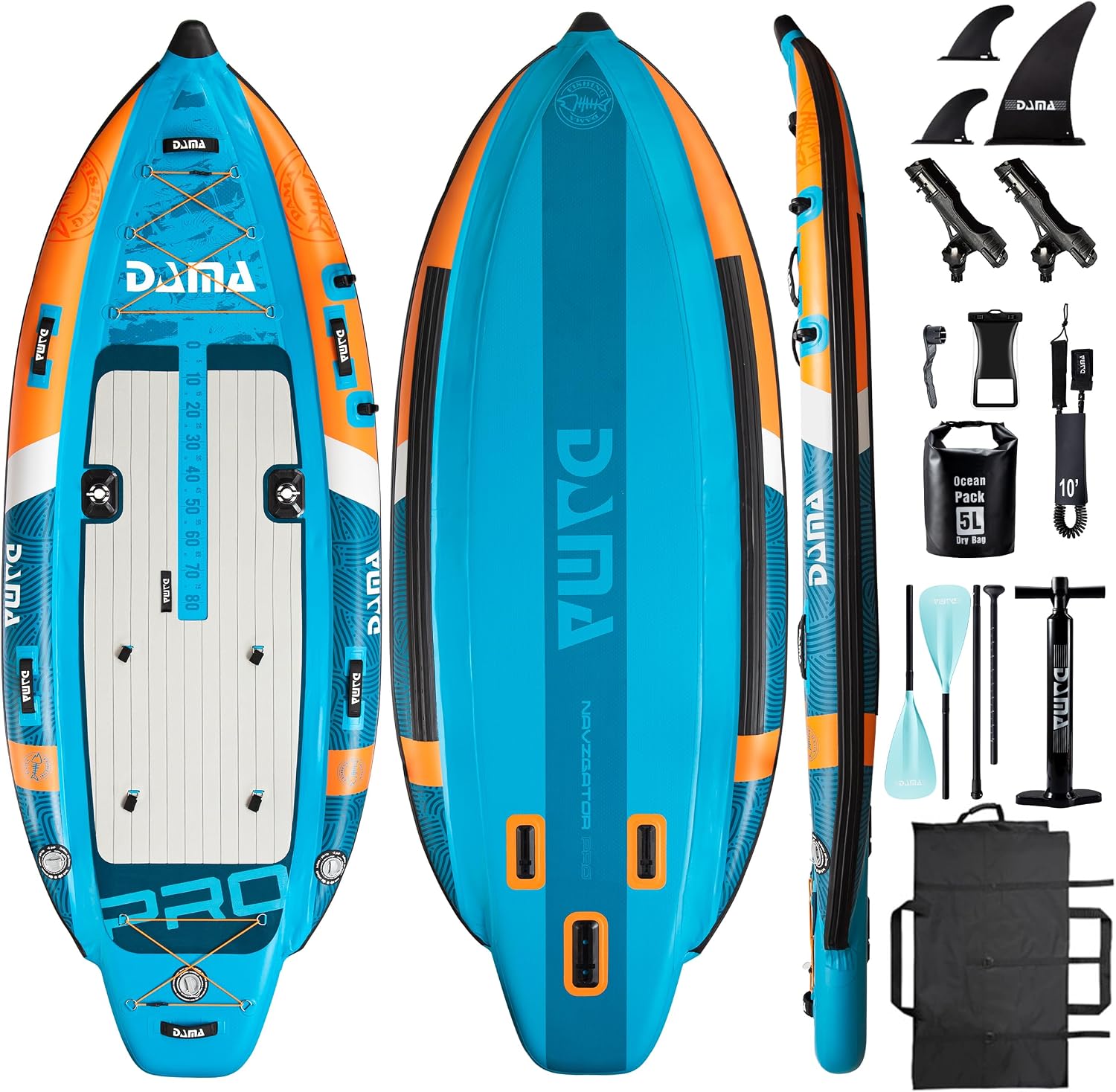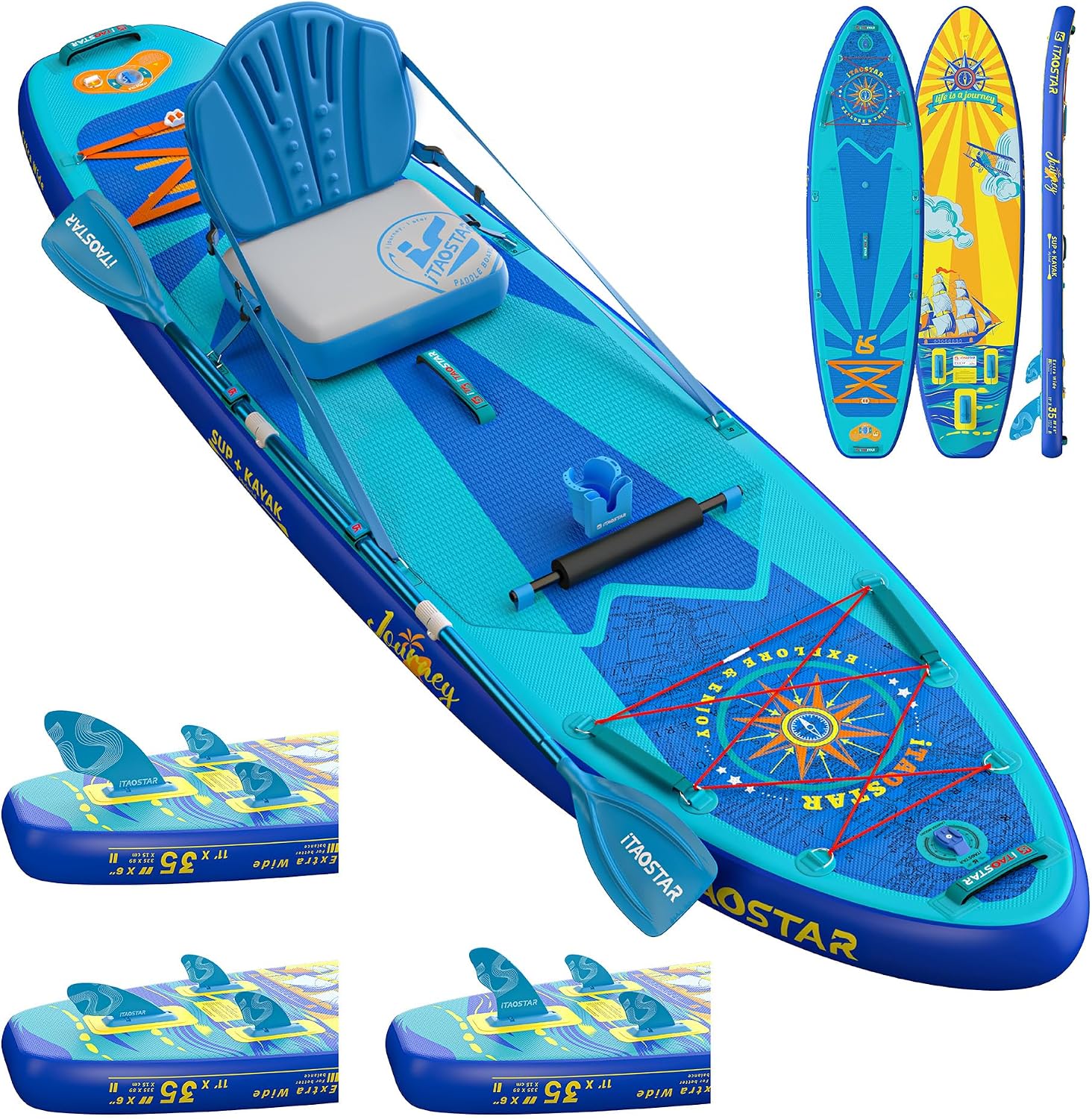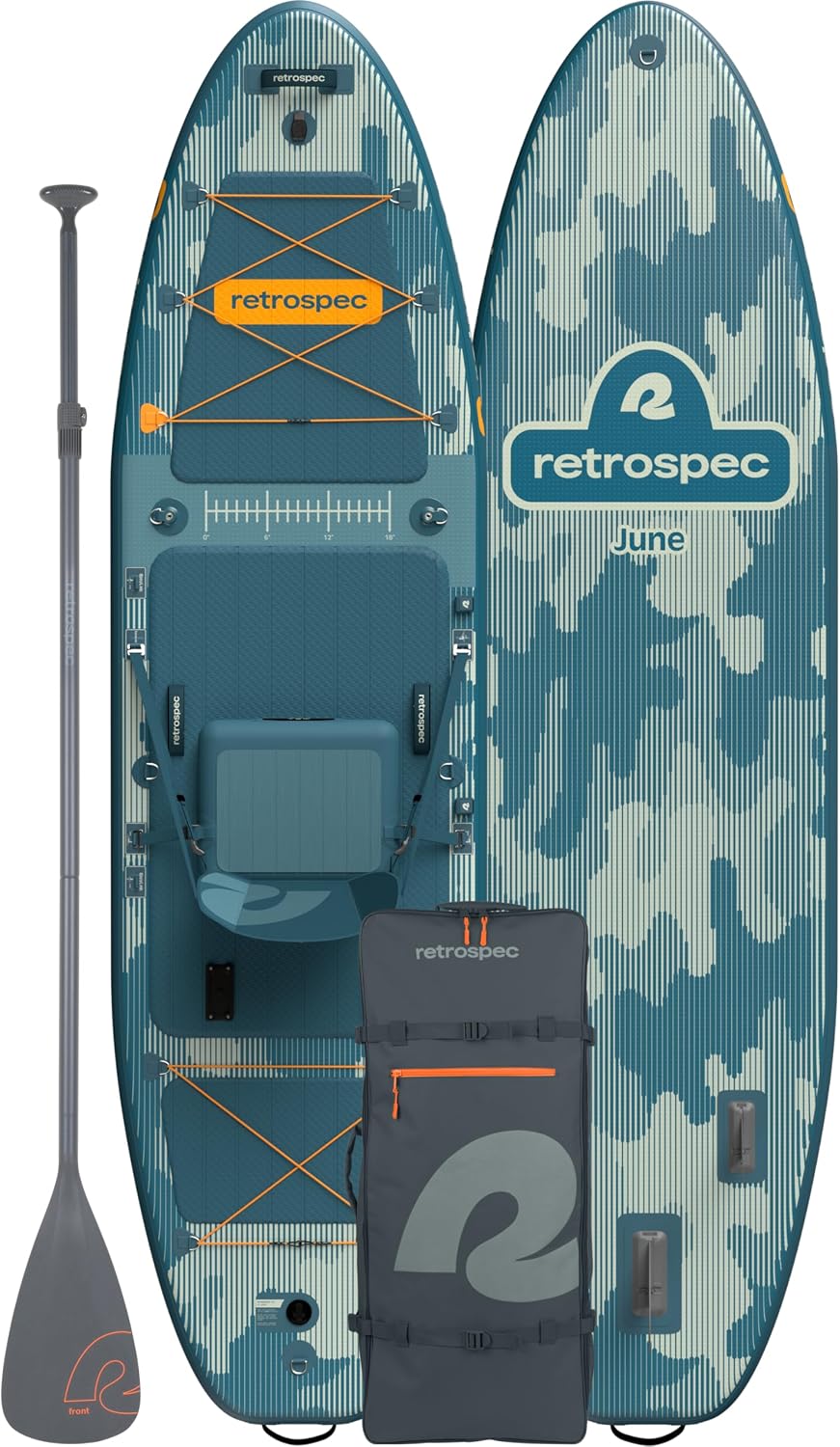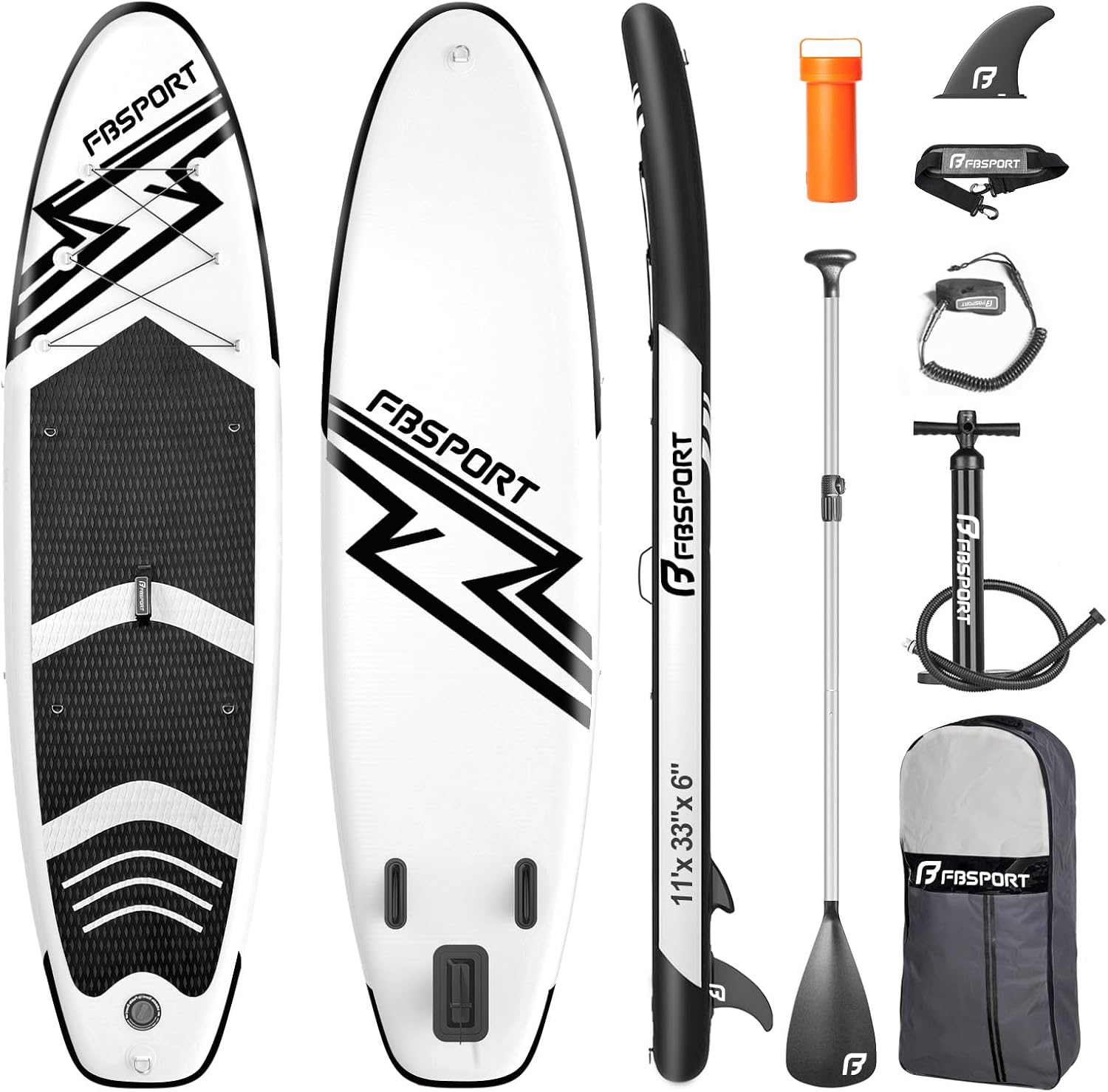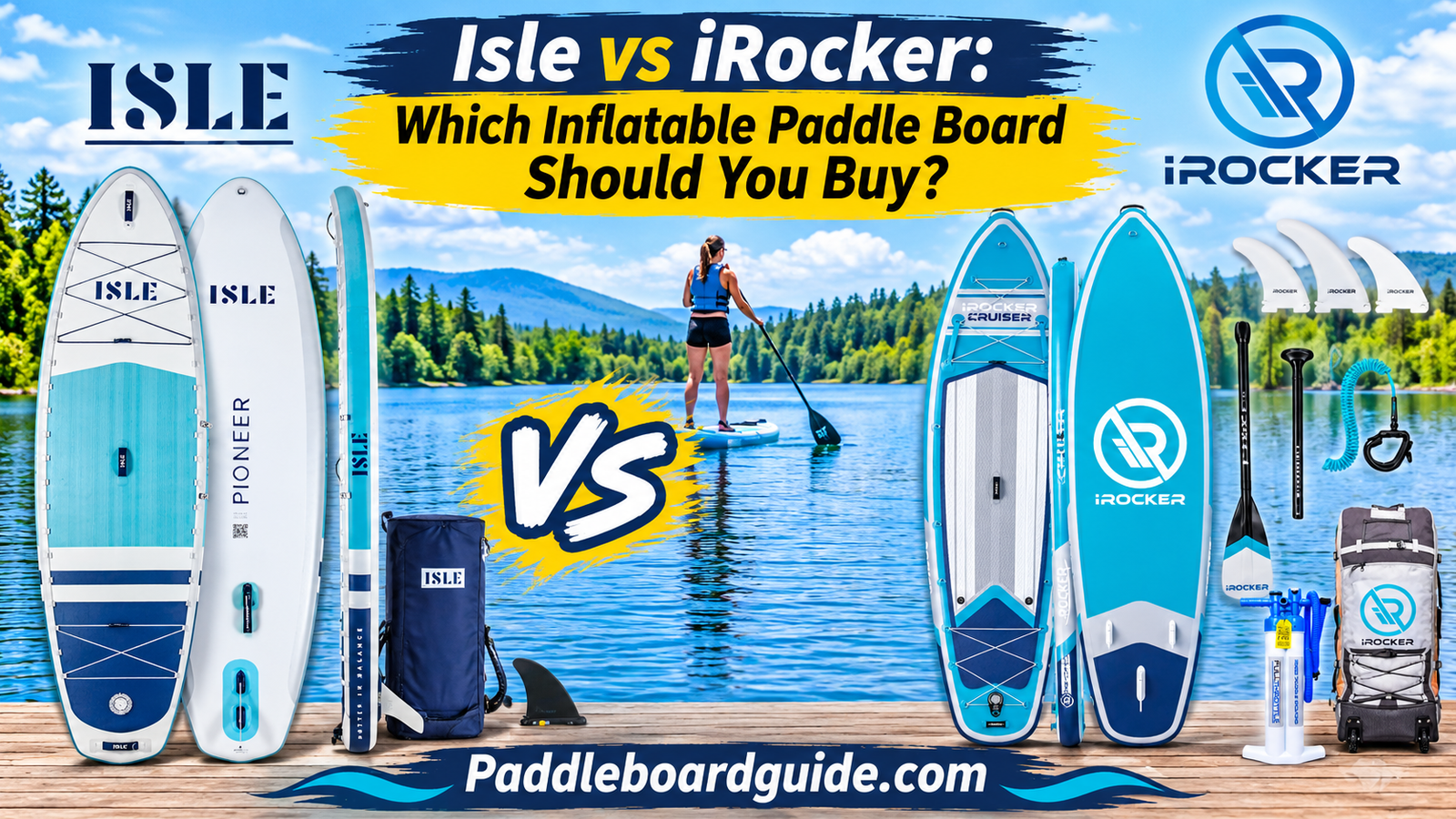
If you have spent any time shopping for an inflatable paddle board, you have already run into the same argument in every forum and comment section: Isle vs iRocker. Both brands are everywhere. Both have loyal followings. Both sell boards that look almost identical in a product photo and then behave very differently once they are inflated and floating.
That is the problem this guide is built to solve. On paper, a 10’6″ all-around inflatable from one brand looks a lot like a 10’6″ all-around inflatable from the other. In practice, the differences show up in the places that actually matter after a few weeks of ownership: how heavy the board feels walking from the car, how much room you have left before the deck sits low in the water, how stable it feels when a boat wake rolls through, and how much of the “bundle” you will actually keep using.
We lined up six boards — three from ISLE and three from iRocker — across the three categories shoppers ask about most. First there is the classic paddle board all-around battle, the 10’6″ class boards that most first-time buyers end up owning. Then there is the compact-focused pair for people who need the board to disappear into a small car, an apartment closet, or checked luggage. Finally there is the hybrid and heavy-rider group, where capacity, stability, and multi-use design take priority over shaving the last pound off a carry bag.
Along the way we look at construction philosophy, deck layout, stability versus weight capacity, portability, accessories, and the ownership realities nobody puts in a product title. Where a number is on the product label, we quote it. Where it is not, we describe the board in plain language rather than guessing, because a made-up spec is worse than no spec at all.
The Short Answer
Choose ISLE if carry weight and easy handling are high on your list. The Pioneer 3 is one of the lightest-feeling boards in this group and the Switch gives you a genuine SUP-and-kayak hybrid without turning into a boat anchor.
Choose iRocker if capacity, stability margin, and a deep accessory ecosystem are what you care about. The Cruiser platform carries more, the Ultra version packs down smaller, and the Blackfin Model XL is built for paddlers who want the most board under their feet.
The rest of this guide breaks down exactly where each brand wins, where each one compromises, and which of the six boards fits the way you actually paddle.
How We Compared These Boards
Every inflatable paddle board review on the market tends to turn into a feature checklist. That is useful, but it misses the point. Boards are not bought for feature lists; they are bought for Saturday mornings on the lake, for a week at the beach, for a first season of learning to balance without falling in every four minutes. So we compared these six boards across the dimensions that show up in real use.
- Handling and carry weight. A board you dread carrying from the car is a board that stays in the garage.
- Stability and usable capacity. Not just the headline number, but how much room you realistically have for rider, gear, dog, or child.
- Construction and stiffness. How the board resists flex, how the rails are finished, and how the deck feels underfoot.
- Portability. Packed size, bag quality, and how much effort it takes to get the board back in the bag at the end of a session.
- Accessories and long-term value. What comes in the box, what you will replace, and what you will wish you had bought separately.
- Versatility. Whether the board can handle flat water, light chop, a passenger, a paddleboard seat, or a fishing setup without feeling out of its depth.
If you are brand new to the sport and still working out what all the terminology means, our overview of the main types of paddle boards is a good place to get your bearings before reading the head-to-head details below. And if you simply want the widest field of options, our roundup of the best inflatable paddle boards covers the broader market beyond these two brands.
Ready to Start Shopping?
Browse current inflatable paddle board listings before the good bundles sell out.
Check Price on AmazonQuick Comparison: Our Top Picks
Six boards, three categories, one table. Every product in this guide appears below with the label specifications that matter most for paddle boards: platform size, weight capacity where it is listed, and how much the board weighs to carry. Use the shortlist to jump straight to the board that fits your paddling, then read the full review blocks further down.
| # | Image | Product | Key Specs | Verdict | Check Price |
|---|---|---|---|---|---|
| 1 Top Pick |
|
ISLE Pioneer 3 10’6″ x 34″Best Overall |
|
Light, stable, and genuinely easy to live with. | Check Price on Amazon |
| 2 |  |
iROCKER Cruiser 10’6″Best for Heavier Riders |
|
Extra capacity for big paddlers, pets, and gear. | Check Price on Amazon |
| 3 | |
ISLE Pioneer Pro 10’6″ x 34″Best Lightweight All-Around |
|
More carrying headroom in a familiar shape. | Check Price on Amazon |
| 4 |  |
iROCKER Cruiser Ultra 10’6″ x 33″ x 6″Best for Travel |
|
Packs down small without giving up deck space. | Check Price on Amazon |
| 5 |  |
ISLE Switch 11’6″ x 35.5″Best Hybrid SUP / Kayak |
|
Two ways to paddle in one light package. | Check Price on Amazon |
| 6 |  |
iROCKER Blackfin Model XLBest Heavy-Duty Platform |
|
Maximum board underfoot for bigger paddlers. | Check Price on Amazon |
Compare the Full Lineup
See current listings and bundle options for inflatable paddle boards.
Check Price on AmazonTwo Brands, Two Philosophies: ISLE and iRocker at a Glance
Before comparing individual boards, it helps to understand what each brand is optimizing for, because that decision trickles down into every board they make. Neither approach is wrong. They simply serve different paddlers.
ISLE has built its reputation around boards that are pleasant to own. That sounds vague until you have carried a heavy inflatable up a boat ramp in a crosswind. ISLE boards in this comparison consistently come in at the lighter end of the scale, and the brand tends to treat clean design, simple deck layouts, and comfort underfoot as core features rather than afterthoughts. The Pioneer line is the everyday all-around workhorse. The Switch takes that same comfort-first thinking and adds a genuinely useful second mode. If you want to read more about the wider range, our ISLE paddle board review covers the brand in detail.
iRocker takes a different angle: more board, more capacity, more features. The Cruiser platform is one of the most recognizable all-around shapes in the sport, and it has earned that reputation by being reassuringly stable and generously rated for load. The Ultra line then answers the “but will it fit in my apartment?” question, and the Blackfin series pushes into premium, maximum-stability territory. Our iROCKER paddle board review goes deeper on the brand’s construction and accessory ecosystem.
What That Means in Practice
Think of it as a trade-off triangle between carry weight, load capacity, and feature depth. ISLE tends to prioritize the first while still delivering solid capacity. iRocker tends to prioritize the second and third while accepting a few extra pounds on your shoulder. Neither brand is chasing a different sport; they are answering different versions of the question “what annoys you most?”
Where ISLE Leans
- Lower carry weight on comparable boards
- Clean, uncluttered deck layouts
- Hybrid designs that serve two purposes well
- Comfort-oriented shapes for relaxed cruising
Where iRocker Leans
- Higher rated weight capacities
- Feature-rich decks with plenty of attachment points
- Compact options for travel-focused paddlers
- A deep accessory and upgrade path
Brand Loyalty Is Real, but Paddling Style Wins
Ask ten paddle board owners which brand is better and you will get a split verdict along with a few very confident opinions. What almost everyone agrees on is this: the board that matches your storage space, your car, your strength, and your local water will make you happier than the board that won a popularity contest. If you are still deciding what kind of paddler you are, our guide to paddle board types is a useful detour before you commit.
One more thing worth saying up front. Both brands make boards that suit complete beginners. The stereotype that one is “for experts” and the other “for casuals” does not survive contact with the water. What separates them is small, specific, and entirely about preference.
Shop by Brand
Compare ISLE and iRocker inflatable paddle board listings side by side.
Check Price on AmazonConstruction and Build Quality: How Each Board Is Put Together
Inflatable paddle boards all look similar when they are rolled up in a bag, but the engineering inside is where the differences live. Understanding the basics makes it much easier to see why two boards with nearly identical dimensions can feel completely different on the water.
Drop-Stitch Cores and Outer Layers
Every inflatable board in this comparison is built on a drop-stitch core: thousands of fine threads connecting the top and bottom layers of the board so that, when inflated, the board holds a flat, rigid shape instead of bulging into a round tube. Around that core, brands add outer layers of reinforced material, and then finish the edges with rail bands that stiffen the board against twisting.
This is the part where brands quietly diverge. More layers generally mean more stiffness and more durability, but also more weight. Lighter builds are easier to carry and easier to roll back into the bag, but they need careful design to avoid feeling soft underfoot. ISLE and iRocker both build boards that are rigid enough for their intended riders, yet they land in different places on that trade-off. The ISLE boards in this lineup are notably light; the iRocker boards lean into reinforcement and load tolerance. For a longer explanation of how these boards are actually assembled, see our breakdown of how paddle boards are made.
Rails, Handles, and Hardware
Look at the rails and the hardware rather than the marketing photos. Reinforced rail bands resist flex when you step back toward the tail. Grab handles that are stitched through the deck rather than glued on will outlast years of dragging the board across sand. D-ring placement matters if you ever want to clip on a kayak seat, a cooler, or a dry bag, and the number and position of those rings vary noticeably between designs.
- Reinforced rails keep the board from twisting under load.
- Quality handles make the walk from car to water far less annoying.
- Deck pad coverage determines how comfortable the board feels when you change stance or sit down.
- Fin box design affects tracking and how quickly you can get on the water.
- Attachment points decide how far the board can grow with your hobbies.
Stiffness Is a Feel, Not Just a Number
Two boards can both be “rigid” and still feel different. A board with a slightly softer flex will feel forgiving and comfortable in chop but can feel bouncy at higher loads. A very stiff board feels precise and fast but transmits more of the water’s movement to your ankles. Neither is objectively better; they suit different paddlers. This is one reason the heavier-rider recommendations later in this guide lean toward boards with more material and more capacity rather than the lightest options.
If you are deciding between an inflatable and a hard board at all, our comparison of inflatable versus hard paddle boards covers the trade-offs in storage, transport, and on-water feel in much more depth.
Deck Comfort and Grip
Do not underestimate the deck pad. It is the only part of the board you touch for the entire session. Textured traction pads with good coverage make standing for an hour comfortable and give you grip when the surface gets wet, sandy, or slimy. Softer, thicker padding is a quiet advantage for anyone doing yoga, stretching, or paddling with kids who will inevitably be crawling around the deck.
Looking for a Well-Built Inflatable?
Browse reinforced inflatable paddle boards with quality rails and deck pads.
Check Price on AmazonAll-Around Showdown: ISLE Pioneer 3 vs iRocker Cruiser
This is the matchup most shoppers actually care about. Both boards sit in the 10’6″ all-around class, the category that has become the default recommendation for first boards, family boards, and do-everything boards. Both are designed to handle flat water, light chop, casual fitness, and the occasional passenger. The difference is in how they get there.
| Feature | ISLE Pioneer 3 | iROCKER Cruiser |
|---|---|---|
| Length & Width | 10’6″ x 34″ | 10’6″ with a 33″ wide deck |
| Rated Capacity | 285 lb | 435 lb |
| Board Weight | 19.6 lb | 25 lb |
| Best Suited To | Paddlers who want an easy, light, confidence-building board | Paddlers who want maximum load room and stability margin |
| Trade-Off | Lower rated capacity on the label | Noticeably heavier to carry and pack |
How They Differ on the Water
Both boards use the wide, rounded outline that makes an all-around board forgiving. The ISLE’s 34″ width gives it a generous, stable platform that flatters a beginner’s balance, and its light weight makes it lively and easy to correct when you drift off balance. The iROCKER’s slightly narrower but far more heavily rated platform feels planted and confident, especially once you start adding gear, a dog, or a child to the deck.
Here is the honest framing. For a paddler of average build who wants a board for calm lakes, slow rivers, and sheltered bays, the Pioneer 3 is the easier board to enjoy. For a paddler who is heavier, who plans to carry a lot of gear, or who wants one board that will still feel stable when loaded up for a long day, the Cruiser is the safer choice.
ISLE Pioneer 3 10’6″ x 34″ Inflatable Paddle Board
The Pioneer 3 is the board most people picture when they imagine an inflatable paddle board done simply and done well. At 19.6 lb it is one of the lightest boards in this comparison, and at 34″ wide it is one of the most forgiving. Rated to 285 lb, it is built for a solo paddler who wants a comfortable, confidence-inspiring board rather than a gear hauler.
Key Features
- 10’6″ x 34″ all-around shape with a wide, stable stance area
- Rated capacity of 285 lb for solo paddlers and light gear
- Light 19.6 lb build that is easy to carry and pack away
- Clean deck layout with generous traction padding
- Comfortable cruising profile suited to calm and sheltered water
Pros
- Very light for its size
- Wide, beginner-friendly platform
- Simple deck that is easy to learn on
- Comfortable for long, relaxed sessions
Cons
- Lower rated capacity than the Cruiser
- Less headroom for heavy gear loads
- Not aimed at speed-focused paddling
Who it is best for: First-time buyers, lighter and average-build paddlers, couples buying one board to share, and anyone who has to carry their board a long way from the car. If you want a board that feels friendly on day one and still feels good on day one hundred, this is the one to shortlist.
iROCKER Cruiser 10’6″ Inflatable Paddle Board
The Cruiser is the board that made the case for inflatable all-arounders in the first place. With a 33″ wide deck and a rated capacity of 435 lb, it is designed to carry a lot without getting twitchy. At 25 lb it asks more of your shoulders than the Pioneer 3, and that is the central trade-off you are accepting.
Key Features
- 10’6″ platform with a 33″ wide, stability-first deck
- Rated capacity of 435 lb for heavier riders, pets, and gear
- 25 lb build with a reinforced, load-tolerant construction
- Plenty of attachment points for accessories and add-ons
- Confident feel when the deck is loaded up for a long day
Pros
- Excellent rated load capacity
- Very reassuring stability
- Great for pets and extra gear
- Strong accessory compatibility
Cons
- Heavier to carry at 25 lb
- Takes more effort to pack down
- Overkill for small, light solo paddlers
Who it is best for: Heavier paddlers, families sharing one board, dog owners, anglers carrying gear, and anyone who would rather have capacity they do not need than wish they had more. If you have ever felt a board sag under you, this is the fix.
Both boards are excellent first purchases, and both are forgiving enough that a complete beginner can be standing and paddling within a session or two. If you are worried about the learning curve, our guides on whether inflatable paddle boards are good for beginners and the best paddle boards for beginners will help you set realistic expectations.
Still Deciding on Your First Board?
Compare popular inflatable paddle boards for new paddlers.
Check Price on AmazonCompact and Travel-Friendly: ISLE Pioneer Pro vs iROCKER Cruiser Ultra
For some paddlers, the best board is the one that fits in the smallest space. Apartment dwellers, frequent travelers, people with small cars, and anyone who has ever fought a rolled-up board back into a bag on a windy beach know exactly what we mean. This is the category where pack-down size starts to matter as much as on-water performance.
The two boards here take different routes to the same goal. The ISLE Pioneer Pro keeps the familiar 10’6″ x 34″ all-around platform and raises the rated capacity to 300 lb, giving you more headroom without changing the shape you already know works. The iROCKER Cruiser Ultra is the compact-focused version of the Cruiser platform at 10’6″ x 33″ x 6″, designed around the idea that the board should be easier to travel with and store.
| Feature | ISLE Pioneer Pro | iROCKER Cruiser Ultra |
|---|---|---|
| Size | 10’6″ x 34″ | 10’6″ x 33″ x 6″ |
| Rated Capacity | 300 lb | Not listed here |
| Design Priority | Familiar all-around shape with more load headroom | Compact pack-down for travel and small storage |
| Best Suited To | Paddlers who want a stable board that still handles well | Travelers and anyone short on storage space |
Why Pack-Down Size Matters More Than You Think
Every inflatable paddle board folds down, but not every board folds down to the same practical size. A board that packs into a genuinely compact bag changes how you use it. It fits in an overhead bin on some flights. It slides under a bed. It disappears into a closet instead of occupying the corner of a room like a piece of furniture you regret buying. If storage is tight, our collection of inflatable paddle board storage ideas is worth a read before you choose.
There is also the bag itself. A well-designed carry bag with proper straps, a decent closure, and room for the pump and paddle turns transport from a chore into a non-event. We go into this more in the accessories section, and our guide to the best paddle board bags covers what to look for if you plan to upgrade later.
ISLE Pioneer Pro 10’6″ x 34″ Inflatable Paddle Board
The Pioneer Pro takes the shape that works and adds capacity headroom. At 10’6″ x 34″ and rated to 300 lb, it gives average and larger paddlers more room before the board starts riding low, while keeping the wide, stable outline that makes an all-around board so easy to enjoy.
Key Features
- 10’6″ x 34″ all-around platform with a wide, forgiving outline
- Rated capacity of 300 lb for extra gear and larger riders
- Comfortable deck design suited to long, relaxed sessions
- Easy-handling build that remains manageable to carry and store
- Versatile enough for cruising, light fitness, and casual touring
Pros
- Generous capacity for an all-around board
- Wide, stable platform underfoot
- Comfortable for longer outings
- Great all-rounder for mixed use
Cons
- Not a dedicated speed board
- Wide shape takes more effort to turn quickly
- Still an inflatable, not a race hull
Who it is best for: Paddlers who want a bit more capacity than a standard all-around board offers without stepping up to a much bigger hybrid. It suits larger riders who still want a manageable board, and anyone who regularly paddles with a cooler, a dry bag, or a four-legged companion.
iROCKER Cruiser Ultra 10’6″ x 33″ x 6″ Inflatable Paddle Board
The Cruiser Ultra answers the question every owner of a full-size inflatable eventually asks: can this be easier to move and store? Built around a 10’6″ x 33″ x 6″ platform, it keeps the Cruiser’s stable, confidence-building shape while putting pack-down and portability at the center of the design.
Key Features
- 10’6″ x 33″ x 6″ proportions with a stable all-around outline
- Compact-focused design aimed at travel and tight storage
- Cruiser-family stability that flatters developing balance
- Manageable size for loading into small cars and closets
- Full-size deck feel once inflated and on the water
Pros
- Easier to store and transport
- Retains a stable, friendly shape
- Ideal for travel and small spaces
- Good fit for urban paddlers
Cons
- Compact design takes a bit more care when packing
- Not the choice for maximum load capacity
- Best suited to sheltered and moderate water
Who it is best for: Travelers, apartment dwellers, boaters who want a tender that stows away, and anyone whose previous board simply took up too much room. If the phrase “it lives in the closet” matters to you, this is the board to look at.
Whichever you choose, the bag and the pump will shape your day more than you expect. A bag with proper backpack straps saves your shoulders at the trailhead or the beach access, and the right pump turns setup from a workout into a two-minute job. Our picks for the best paddle board bags and the storage tips in inflatable paddle board storage ideas cover both topics in detail.
Need a Compact Inflatable?
Shop travel-friendly inflatable paddle boards and carry bags.
Check Price on AmazonHybrid and Heavier Riders: ISLE Switch vs iROCKER Blackfin Model XL
This final pairing is where the comparison stops being about minor differences in feel and starts being about genuinely different design goals. One board is a two-in-one hybrid that doubles as a kayak. The other is a large-format, stability-first platform built for paddlers who want as much board under them as possible.
The ISLE Switch measures 11’6″ x 35.5″, is rated to 425 lb, and weighs in at a surprisingly light 19 lb. It is designed to work as both a stand-up paddle board and a sit-on kayak, which makes it the most versatile single board in this entire comparison. The iROCKER Blackfin Model XL is iROCKER’s premium large-format option, aimed at bigger paddlers and anyone who wants a stable, feature-rich platform that does not get unsettled when loaded up.
| Feature | ISLE Switch | iROCKER Blackfin Model XL |
|---|---|---|
| Size | 11’6″ x 35.5″ | Large-format platform |
| Rated Capacity | 425 lb | Not listed here |
| Board Weight | 19 lb | Not listed here |
| Design Priority | Two paddling modes in one board | Maximum stability and premium construction |
The Case for a Hybrid
Two-in-one boards sound like a gimmick until you use one. Paddling standing up is wonderful on calm mornings, but there are days when the wind picks up, when your legs are tired, when you want to cover distance, or when you simply want to sit back and drift. A hybrid board with a seat option turns those days from “we should have stayed home” into a perfectly good outing. Our comparison of paddle boards versus kayaks explains where each style wins.
Adding a paddle board seat and switching to a seated stroke also opens up the board to people who would never try standing: younger kids, older relatives, nervous first-timers, and anyone recovering from an injury. That versatility is the Switch’s strongest argument.
The Case for Maximum Stability
The Blackfin Model XL goes the other way. It is not trying to be two things; it is trying to be the most reassuring single platform it can be. For heavier paddlers, for anglers loading gear, for photographers standing up to shoot, and for anyone who simply wants to stop thinking about balance, a large-format board is a genuine quality-of-life upgrade. If fishing is your priority, our guide to the best paddle boards for fishing covers what makes a board work well for that use.
ISLE Switch 11’6″ x 35.5″ 2-in-1 Inflatable Paddle Board and Kayak
The Switch is the most interesting board in this comparison, because it solves two problems at once. It is a wide, stable stand-up paddle board at 11’6″ x 35.5″ with a rated capacity of 425 lb, and it also works as a sit-on kayak. At 19 lb it is lighter than you would expect for a board of this size.
Key Features
- 11’6″ x 35.5″ hybrid platform for standing or seated paddling
- Rated capacity of 425 lb for riders, gear, and passengers
- Light 19 lb build for a board in this size class
- 2-in-1 design that works as a SUP and a kayak
- Wide, stable deck suited to families and multi-use paddling
Pros
- Genuine two-in-one versatility
- High rated capacity
- Light for its size
- Excellent stability for new paddlers
Cons
- Longer board needs more storage space
- Wide shape is not built for speed
- More board to steer in tight water
Who it is best for: Families, couples sharing one board, paddlers who want both standing and sitting options, heavier riders who want capacity without a heavy board, and anyone who gets out on water that changes mood through the day.
iROCKER Blackfin Model XL Inflatable Paddle Board
The Blackfin Model XL is the board you buy when stability is non-negotiable. It sits at the premium end of iROCKER’s range as a large-format, stability-first platform built for bigger paddlers, heavy gear loads, and anyone who wants a board that never feels like it is about to roll out from under them.
Key Features
- Large-format platform designed around stability and load
- Premium construction with reinforced rails and robust hardware
- Spacious deck with generous traction coverage
- Attachment points for seats, bags, coolers, and fishing gear
- Built for heavier riders and gear-intensive outings
Pros
- Outstanding stability
- Excellent for heavier paddlers
- Feature-rich deck
- Built to take a lot of use
Cons
- More board to carry and store
- Overkill for small, light paddlers
- Premium build means premium positioning
Who it is best for: Larger and heavier paddlers, anglers, photographers, anyone carrying a lot of gear, and paddlers who have outgrown a standard all-around board and want to feel completely settled on the water.
If you like the hybrid idea, it is worth comparing against other convertible designs before deciding. Our look at paddle boards versus kayaks and the roundup of the best paddle board seats will help you picture exactly how a 2-in-1 setup would work for your household.
Building a Hybrid Setup?
Shop kayak seats and accessories for inflatable paddle boards.
Check Price on AmazonStability, Width, and Rider Weight: What the Numbers Actually Mean
Product listings throw a lot of numbers at you, and two of them matter more than the rest: board width and rated weight capacity. Between them, those two figures explain most of the differences between these six boards. They also explain most of the regret people experience after buying the wrong one.
Width: The Stability Shortcut
Width is the single biggest predictor of how stable a paddle board feels to a beginner. The boards in this comparison range from 33″ to 35.5″, and that difference is far more noticeable than it sounds. A wider platform resists tipping, gives you more room to adjust your stance, and feels dramatically more forgiving when you shift your weight to look at something or reach for a water bottle.
The trade-off is speed and turning. A wider board has more water to push and turns a little more slowly. For casual cruising, that trade is almost always worth taking. For anyone who wants to cover distance efficiently, a narrower board will feel better over a long session. If you are still working out where you sit on that spectrum, our guide to SUP boards versus paddle boards covers the terminology and how the shapes differ.
Weight Capacity: Read It as a Range, Not a Limit
Rated capacity is a useful comparison tool, but it is not the number at which a board performs best. Think of it as an upper boundary. As a rider approaches the maximum rating, the board sits lower in the water, picks up more drag, feels less lively, and becomes harder to correct when it starts to tip. The comfortable zone is well below the maximum, and the more room you leave yourself, the better the board feels.
| Board | Width | Rated Capacity | What That Means |
|---|---|---|---|
| ISLE Pioneer 3 | 34″ | 285 lb | Plenty for most solo paddlers with light gear |
| iROCKER Cruiser | 33″ | 435 lb | Big headroom for riders, pets, and extra load |
| ISLE Pioneer Pro | 34″ | 300 lb | Extra room in a familiar all-around shape |
| iROCKER Cruiser Ultra | 33″ | Not listed here | Stable all-around proportions in a compact design |
| ISLE Switch | 35.5″ | 425 lb | Widest platform here, built for riders plus gear |
| iROCKER Blackfin Model XL | Not listed here | Not listed here | Large-format design aimed at maximum stability |
Account for Everything That Goes on the Board
Here is a mistake that catches people out constantly: capacity is not just about body weight. A paddle, a full water bottle, a dry bag, a cooler, a dog, a child, a fishing crate, a camera bag, and a spare life jacket all add up. Add in a wet deck pad and a soaked towel and you have quietly used another chunk of your headroom.
- Your own weight, plus the weight of anything you wear.
- Gear and accessories, including the paddle if you set it down on the deck.
- Passengers, whether that is a child, a friend, or a large dog.
- Water and food for longer sessions.
- Safety equipment, which is required in many places and always recommended.
For a deeper dive into how these ratings work and what happens at the top end, read our explainer on how much weight a paddle board can hold.
Find the Right Board for Your Weight
Shop inflatable paddle boards with generous capacity ratings.
Check Price on AmazonPortability, Weight, and Pack-Down: Living With Your Board
Every paddle board is easy to use on the water. The question that separates a board you love from a board you sell is what happens in the fifteen minutes before and after. That is where carry weight, bag design, and pack-down behavior quietly decide how often you actually go paddling.
Carry Weight Is a Lifestyle Choice
The boards in this comparison span a meaningful range. The ISLE Switch is listed at 19 lb and the Pioneer 3 at 19.6 lb, both impressively light for their sizes. The iROCKER Cruiser comes in at 25 lb. That difference of roughly five pounds is easy to dismiss on a screen and very real on a warm afternoon when you are carrying a board, a paddle, a bag, a water bottle, and a child’s shoes across a parking lot.
It is not as simple as “lighter is better,” though. Lighter boards are easier to carry and faster to pack, but they can give up some stiffness and some load capacity. Heavier boards often feel more planted and take more punishment. The right answer depends entirely on how far you carry your board and how hard you use it. If transport is a regular challenge, our guide to how to transport a paddle board has practical solutions for every situation.
From Car to Water
Most paddlers load their board into a vehicle rather than onto a roof. An inflatable is a huge advantage here: it folds into a bag that fits in a trunk, a back seat, or even a footwell. But if you do carry boards on a roof regularly, a proper rack system saves your paint and your patience. Our recommendations for the best paddle board roof racks cover both inflatable and hard board setups.
The Pump Question
Nothing shapes the start of a session like the pump. A good high-pressure hand pump with an integrated pressure gauge gets a board to proper stiffness without exhausting you. An electric pump gets you there while you apply sunscreen and load the cooler. Either way, you want to be able to see the pressure you are reaching, because an under-inflated board feels soft and unpredictable while an over-inflated one is hard on the seams. Our guide to the best paddle board pumps covers both styles.
- Check the pressure gauge before every session.
- Inflate out of direct sun, since heat raises internal pressure.
- Do not leave the board fully inflated in a hot car or closed space.
- Rinse and dry before packing to keep sand out of the bag and valves.
- Roll from the nose toward the tail to push air out of the valve.
Storage at Home
The final piece is where the board lives between trips. Inflatables are forgiving, but they still prefer a cool, dry, out-of-the-sun location. A board bag hanging on a wall hook, a rolled board under a bed, or a board stored in a closet will all outlast one left in a hot garage corner all summer. For practical ideas, see our inflatable paddle board storage ideas.
Make Transport Effortless
Shop paddle board bags, pumps, and roof rack accessories.
Check Price on AmazonAccessories and Bundle Value: What You Actually Need
Bundle contents are one of the most persuasive parts of a product listing and one of the least reliable indicators of value. A board with a long list of included accessories is not automatically a better deal than one with a short list, because the quality and usefulness of those accessories vary enormously. Here is how to think about it.
The Non-Negotiables
Some items are essential. Without them you either cannot use the board safely or you will be back online ordering within a week.
| Accessory | Why It Matters | What to Look For |
|---|---|---|
| Paddle | The one tool you use every single stroke | Adjustable length, comfortable grip, light enough for long sessions |
| Pump | Determines how stiff and safe the board feels | Built-in pressure gauge and a stable base |
| Leash | Keeps the board with you if you fall in | Correct style for your water and a comfortable cuff |
| Fin | Controls tracking and how straight the board travels | Tool-free fitting and a durable construction |
| Personal flotation | Required in many regions and always wise | Proper fit, comfortable for paddling motion |
| Carry bag | Decides how painful transport is | Backpack straps, sturdy zips, room for the pump |
Paddles: Where Upgrades Pay Off
If there is one accessory worth upgrading early, it is the paddle. A bundle paddle is perfectly serviceable for learning, but a lighter, better-balanced paddle reduces fatigue dramatically and makes every stroke more efficient. Sizing matters too: the wrong length encourages poor posture and tires out your shoulders. Our guide to the best paddle board paddles covers sizing and materials, and yes, it is worth knowing whether paddle board paddles float before you drop one in deep water.
Safety Gear Is Not Optional
Every board in this comparison will get you out on the water. None of them will keep you safe on their own. A properly fitted personal flotation device, a leash appropriate to your conditions, sun protection, and a way to call for help are the baseline. Rules vary by location, so check what applies to your waterways. Our overview of paddle board safety requirements is a solid starting point, and our picks for the best paddle board life jackets will help you find one you will actually wear.
The Nice-to-Haves
After the essentials, the accessory list becomes a matter of how you paddle. A kayak seat turns a hybrid board into a genuinely useful second boat. A deck bag or cooler keeps water and snacks within reach. A phone pouch, a waterproof speaker, an anchor for yoga sessions, or a rod holder for fishing all expand what the board can do. Start with the essentials and add as your paddling evolves.
Round Out Your Kit
Shop paddle board paddles, pumps, leashes, and safety gear.
Check Price on AmazonOn-Water Performance: Tracking, Glide, Turning, and Chop
Specs tell you what a board weighs and how much it can carry. They do not tell you how it feels at the end of a two-hour paddle when the wind has picked up and your technique is getting sloppy. This section is about feel, and about how the design decisions in the previous sections show up once you are moving.
Tracking: Going Straight Without Thinking
Tracking is the board’s ability to hold a line between strokes. Longer boards generally track better, and the fin setup plays a big role. For beginners, good tracking is a quiet blessing: fewer corrections, less wasted energy, and a much easier time looking around instead of staring at the nose of the board. The 11’6″ Switch has a natural advantage here over the 10’6″ boards simply through length.
Glide and Speed
Glide is how far the board travels per stroke. Narrower, longer boards glide better; wider boards push more water. None of the boards in this comparison are racing hulls, and none of them pretend to be. They are designed for enjoyable cruising, fitness, and exploration. If you do want to cover real distance, understand that you will trade away some of the stability that makes these boards so appealing.
Turning and Maneuverability
Wide boards turn more slowly than narrow ones, and a longer waterline makes tight turns take more effort. That is the trade for stability. In practice, it matters most on winding rivers, around docks, and in tight coves. On open flat water, you will rarely notice. Standing back near the tail and sinking the rail is the technique that makes any of these boards turn quickly when you need it to.
Handling Chop and Wind
Wind is the great equalizer of paddle boarding. A wide board catches more breeze and gets pushed off course faster, which is why beginners often find windy days disproportionately hard. If you are new to the sport, choosing your conditions matters as much as choosing your board. Our guide to the best time to paddle board covers the window when the water is usually calmest, and our tips on how to paddle board explain stance, stroke, and recovery technique.
Be honest with yourself about the learning curve too. Most people are surprised by how quickly balance clicks into place and equally surprised by how tiring the first few sessions are. Our articles on how hard paddle boarding is and whether paddle boards are hard to use set expectations accurately.
Comfort Over Distance
Finally, remember that comfort is performance. A board with a soft, well-covered deck pad, forgiving flex, and a shape that does not punish small balance errors will keep you on the water longer than a faster board that exhausts you. For most paddlers buying in this category, that is the right trade.
Get On the Water
Browse inflatable paddle boards built for calm water and light chop.
Check Price on AmazonDurability, Care, and Long-Term Ownership
A paddle board is not a disposable purchase. Treated well, a good inflatable will serve you for many seasons. Treated carelessly, even an expensive one will disappoint you. The difference is almost entirely down to a handful of habits, and those habits are the same whether you choose ISLE or iRocker.
What Actually Damages an Inflatable
Inflatables are remarkably tough against impacts. What they dislike is sustained neglect. The three biggest enemies are heat, ultraviolet light, and being stored wet or under-inflated for long periods.
| Risk | What Happens | How to Avoid It |
|---|---|---|
| Heat | Internal pressure rises and stresses seams and valves | Never leave a fully inflated board in a hot car or direct sun |
| UV exposure | Materials fade and weaken over long exposure | Store in shade or indoors; rinse and dry after use |
| Sharp objects | Punctures from shells, rocks, hooks, and thorns | Scan the launch area and avoid shallow, rocky entries |
| Wet storage | Odor, mildew, and material degradation | Dry fully before rolling up; air out the bag |
| Over-inflation | Seam stress, especially on hot days | Use the gauge and stay within the recommended range |
A Simple Care Routine
- Rinse the board with fresh water after every session, especially in salt water.
- Dry completely before rolling, including under the deck pad and around the valve.
- Store loosely rolled or hanging in a cool, dry place away from direct sun.
- Check the valve occasionally and tighten the valve insert if you notice slow air loss.
- Inspect the hull for abrasion before each outing, particularly along the rails and tail.
When Something Does Go Wrong
Punctures happen, and they are rarely catastrophic. Most inflatable boards can be patched at home with a standard repair kit and a little patience. The key is to find the leak properly, clean and dry the area, and give the patch full cure time before re-inflating. Our walkthrough on how to patch a paddle board takes you through it step by step.
As for lifespan, it depends far more on care and storage than on brand. Boards that are rinsed, dried, and stored out of the sun last dramatically longer than those left inflated in a sunny yard. Our article on how long inflatable paddle boards last covers realistic expectations and the signs that a board is nearing the end.
Protect Your Investment
Shop paddle board repair kits, storage straps, and care accessories.
Check Price on AmazonHow to Choose: Matching a Board to the Way You Paddle
After all the analysis, the decision usually comes down to a few personal details that no spec sheet can answer. This section turns everything above into a simple matching exercise. Find the description closest to your situation and you will have your board.
| If You Are… | Look At | Why |
|---|---|---|
| A first-time buyer | ISLE Pioneer 3 or iROCKER Cruiser | Both are forgiving, stable, and easy to learn on |
| A heavier rider | iROCKER Cruiser or iROCKER Blackfin Model XL | Higher capacity and stability that stays composed when loaded |
| Short on storage space | iROCKER Cruiser Ultra | Compact-focused design that stows away easily |
| A family sharing one board | ISLE Switch | Wide, stable, and works standing up or seated |
| Carrying gear often | ISLE Pioneer Pro or iROCKER Blackfin Model XL | Capacity headroom for coolers, bags, and pets |
| Traveling with a board | iROCKER Cruiser Ultra | Designed around pack-down and portability |
By Paddling Goal
Fitness and exercise. Almost any board in this comparison will give you a genuine workout. Standing on an unstable surface engages your core, legs, and stabilizers in a way that feels far more like play than training. If that is your main motivation, our guides on whether paddle boarding is good exercise and how many calories paddle boarding burns are good reads.
Yoga and stretching. Choose the widest, most stable platform you can, with full deck pad coverage. The Switch at 35.5″ is the natural pick here, though the 34″ boards are excellent too. Our roundup of the best paddle boards for yoga covers what makes a board work for poses and transitions.
Fishing. Stability, capacity, and attachment points are what matter. The Blackfin Model XL and the Switch both make sense depending on whether you want a dedicated platform or a hybrid. See our picks for the best paddle boards for fishing for more.
Exploring and touring. Length and tracking start to matter more than width. The 11’6″ Switch will cover distance more efficiently than the 10’6″ boards, while still being comfortable to paddle casually.
By Practical Constraint
Sometimes the deciding factor is not on the water at all. If you live on the third floor with no elevator, carry weight wins. If you have a small hatchback, pack-down size wins. If you paddle somewhere with a long walk from the parking area, weight wins again. Be realistic about these constraints, because they will shape your experience far more than any difference in fin design.
For the widest view of what is available across the whole market, our guide to the best inflatable paddle boards is a useful second opinion beyond these two brands.
Find Your Match
Browse inflatable paddle boards sized for your paddling style.
Check Price on AmazonMistakes to Avoid When Choosing Between ISLE and iRocker
Most paddle board disappointment comes down to a handful of predictable errors. None of them are about brand loyalty, and all of them are avoidable if you know what to watch for.
1. Buying on Capacity Alone
A higher rated capacity is a good thing, but it is not automatically a better board. If you weigh 150 lb and paddle solo on calm lakes, a board rated far beyond your needs will simply be bigger and heavier than necessary. Capacity should match your realistic load, not your worst-case fantasy of paddling with three friends and a cooler.
2. Ignoring Carry Weight
The reverse mistake is just as common. People buy the biggest, most capable board they can find and then discover they hate carrying it. If you have a long walk to the water, or you paddle alone and have to load and unload by yourself, subtract a few pounds from your ideal board and you will use it more often.
3. Overvaluing the Bundle
A long accessory list looks impressive. Focus on the quality of the three items you will use constantly: the paddle, the pump, and the bag. Everything else is a bonus. If the bundle paddle is poor, you will replace it anyway, which means the bundle did not save you money.
4. Forgetting Where the Board Will Live
Measure your storage space before you buy, not after. A board that has to live in a hallway will quickly become an obstacle that makes you resent paddling. Our inflatable paddle board storage ideas article has solutions for very small spaces.
5. Skipping Safety Gear
Budget for a properly fitted flotation device and a suitable leash from the start. It is not an upgrade, it is part of the board. Requirements vary by location, so read our summary of paddle board safety requirements before your first outing.
6. Buying for the Paddler You Might Become
It is tempting to buy the board you imagine using once you are fit and skilled. Buy the board that suits how you paddle this season. You can always trade up later, and a board you enjoy today will get you to that future faster than a board you find intimidating.
7. Comparing Only Within One Brand
Brand familiarity is comfortable, but it is worth looking sideways. Budget-oriented boards from other makers can be surprisingly capable, and our reviews of boards like the iROCKER Nautical show how much value exists at the entry level of the market.
A Final Word on Terminology
You will see “SUP board,” “stand-up paddle board,” and “paddle board” used interchangeably, and they effectively are. Our quick explainer on SUP boards versus paddle boards clears up any remaining confusion if you are comparing listings across sites.
Shop Smarter
Compare inflatable paddle boards and accessories before you commit.
Check Price on AmazonIsle vs iRocker: Frequently Asked Questions
Is ISLE or iRocker better for a complete beginner?
Both brands make excellent beginner boards. If you want the lightest, easiest board to carry and learn on, the ISLE Pioneer 3 is hard to beat at 19.6 lb and 34″ wide. If you want more capacity and a very planted, reassuring feel, the iROCKER Cruiser is the safer bet. Neither will hold you back as a new paddler.
Which brand’s boards hold more weight?
On the labels in this comparison, iRocker boards carry the higher ratings. The iROCKER Cruiser is rated to 435 lb and the ISLE Switch to 425 lb, while the ISLE Pioneer 3 is rated to 285 lb and the Pioneer Pro to 300 lb. Remember that capacity ratings are upper limits and that board performance is best well below them. Our guide to how much weight a paddle board can hold explains the practical side.
Are ISLE boards lighter than iRocker boards?
In this lineup, yes. The ISLE Pioneer 3 is listed at 19.6 lb and the ISLE Switch at 19 lb, while the iROCKER Cruiser is listed at 25 lb. Lighter boards are easier to carry and pack, while heavier boards often offer more reinforcement and load tolerance. Choose based on which of those matters more to you.
Can the ISLE Switch really be used as a kayak?
Yes. The Switch is designed as a 2-in-1 board that works both standing up and seated. Adding a compatible seat and switching to a seated paddling position makes it a comfortable sit-on kayak for longer distances, windier days, or anyone who prefers to sit. It is the most versatile single board in this comparison.
What is the difference between the iROCKER Cruiser and the Cruiser Ultra?
They share the same broad purpose: a stable, beginner-friendly all-around board. The Cruiser Ultra, at 10’6″ x 33″ x 6″, is the compact-focused version designed around easier pack-down and transport, which suits travelers and paddlers with limited storage. The standard Cruiser prioritizes capacity and a more reinforced build.
Is the ISLE Pioneer Pro worth choosing over the Pioneer 3?
It depends on load. The Pioneer 3 is rated to 285 lb and is exceptionally light at 19.6 lb, while the Pioneer Pro keeps the same 10’6″ x 34″ platform and raises the rating to 300 lb. If you regularly paddle with a dog, a cooler, or extra gear, the extra headroom is worthwhile. If you paddle solo and value easy carrying, the Pioneer 3 is the simpler choice.
Which board is best for heavier riders?
The iROCKER Cruiser, the iROCKER Blackfin Model XL, and the ISLE Switch are the strongest options here. The Cruiser offers a 435 lb rating, the Switch combines 425 lb of capacity with a very wide 35.5″ platform, and the Blackfin Model XL is a large-format board built specifically around stability for bigger paddlers.
Do I need a special pump for these boards?
You need a pump that can reach the pressure your board requires and that lets you see the pressure as you go. Most quality inflatable paddle board pumps work across brands. A pump with a built-in gauge is essential; an electric pump is a luxury that saves real energy on warm days. Our guide to the best paddle board pumps covers the options.
How long do inflatable paddle boards from these brands last?
Longevity depends far more on care than on brand. Boards that are rinsed after use, dried completely before storage, and kept out of direct sun and extreme heat last dramatically longer than those left inflated in a sunny yard. Our article on how long inflatable paddle boards last covers realistic expectations.
Can I take a dog or a child on these boards?
Yes, on the right board and within the capacity rating. Wider, higher-capacity boards like the ISLE Switch, the iROCKER Cruiser, and the Blackfin Model XL handle passengers best. Always account for combined weight, keep children in properly fitted flotation, and give pets time to get comfortable on the deck in shallow water first.
Which brand is better for travel and small cars?
The iROCKER Cruiser Ultra is the most travel-focused board here, designed around compact pack-down and easy storage. That said, every inflatable in this comparison fits in a car trunk, which is the fundamental advantage inflatables have over hard boards. If you want more on that trade-off, see inflatable versus hard paddle boards.
Which is easier to learn on: a wider or a narrower board?
Wider is easier, without exception. The 34″ and 35.5″ boards in this comparison will feel more stable to a beginner than a 33″ board of the same design, though the difference narrows as your balance improves. If you are still deciding whether the sport is for you, read our take on whether paddle boards are hard to use.
Still Have Questions?
Browse inflatable paddle board listings to compare specs directly.
Check Price on AmazonConclusion: So, Isle or iRocker?
After living with all six boards, the honest answer is that there is no universal winner, only a winner for your specific situation. That is not a dodge; it is the reality of a sport where a five-pound weight difference and two inches of width change how a board feels.
Choose the ISLE Pioneer 3 if you want the easiest, lightest, most enjoyable everyday board in this group. It is the board we would hand to a first-time buyer without hesitation. Choose the ISLE Pioneer Pro if you want the same easy-going platform with a bit more capacity headroom. Choose the ISLE Switch if versatility is the priority, because a genuinely good SUP and kayak in one package is rarer than it should be.
Choose the iROCKER Cruiser if capacity and stability are what you care about most, especially if you are a heavier rider or plan to carry gear and pets. Choose the iROCKER Cruiser Ultra if the board has to fit into a small space or travel with you regularly. Choose the iROCKER Blackfin Model XL if you want as much stable, premium platform under your feet as you can get.
Whichever you pick, buy the safety gear at the same time, learn a little about the water you paddle, and go on the calm morning first. Everything else comes with time on the water.
Ready to Pick Your Board?
Compare current listings, bundles, and availability before you decide.
Check Price on AmazonYou May Also Like
More paddle board comparisons, brand reviews, and buying guides from our library.