Beginner SUP Buying Guide
Best Paddle Boards for Beginners: 14 Stable, Forgiving Boards We Would Hand to a First-Timer
The right first board is wide, steady, and impossible to dislike. The wrong one ends up in a garage. Here is how to tell the difference, plus the inflatable paddle boards that make learning genuinely easy.
There is a specific moment that decides whether someone becomes a paddle boarder or a former paddle board owner. It happens in the first ten minutes: either the board holds them steady while they figure out the paddle, or it wobbles so aggressively that they spend the whole session falling in and climbing back on. Everything that follows in this guide is built around protecting that moment.
Paddle boarding looks intimidating from the shore. In practice, it is one of the most accessible water sports available, and it gets dramatically easier with the right equipment. A beginner board is not a “lesser” board. It is a board shaped deliberately to trade a sliver of top-end speed for a large amount of stability, predictability, and comfort. Width matters more than length. Thickness matters more than the marketing photos suggest. A deck pad that grips wet feet matters more than any graphic printed on it.
We focused this guide entirely on inflatable stand up paddle boards, and that is not an accident. Modern inflatable boards inflate to a rock-hard pressure, shrug off rocks and docks that would chip a hard board, fit in a closet, and ride in the back of a car without a roof rack. If you are buying your first board, an inflatable is almost always the smarter way in. Our deeper look at whether inflatable paddle boards are good for beginners explains exactly why, and our inflatable vs hard paddle board comparison covers the trade-offs in detail.
Below you will find fourteen boards organized the way a new paddler actually thinks about the decision: the best overall starting points, the budget options that are still worth owning, the extra-wide platforms for cautious or heavier paddlers, and the versatile all-rounders that can grow with you. Each one gets an honest breakdown of what it does well and where it compromises, because every board in every price range compromises somewhere.
A wider deck does more for a new paddler than any other single design choice — it is the difference between relaxing and fighting for balance.
If this is your very first time shopping for a board, it is worth reading our general paddle board guide first for the vocabulary, then coming back here for the shortlist. If you already know you want something inflatable and simply want the widest possible selection, our roundup of the best inflatable paddle boards covers more categories, including touring and performance shapes.
Start Your Search the Easy Way
Compare beginner inflatable paddle boards side by side.
Check Price on AmazonQuick Comparison: Our Top Picks
Fourteen beginner boards, one table. Use the “Best For” line under each product name to find the one that matches your situation, then read the full review further down for the honest detail.
| # | Image | Product | Key Specs | Verdict | Check Price |
|---|---|---|---|---|---|
| 1 |  |
Roc Inflatable SUP 10’6″Best OverallTop Pick |
|
Confidence-building stability from the very first stroke. | Check Price on Amazon |
| 2 |  |
Skatinger 11’6″ Super Wide SUPBest for Larger Paddlers |
|
A genuinely roomy platform that simply does not feel tippy. | Check Price on Amazon |
| 3 |  |
Nixy Newport G4Best Premium Pick |
|
A step-up board you will not outgrow after one season. | Check Price on Amazon |
| 4 | 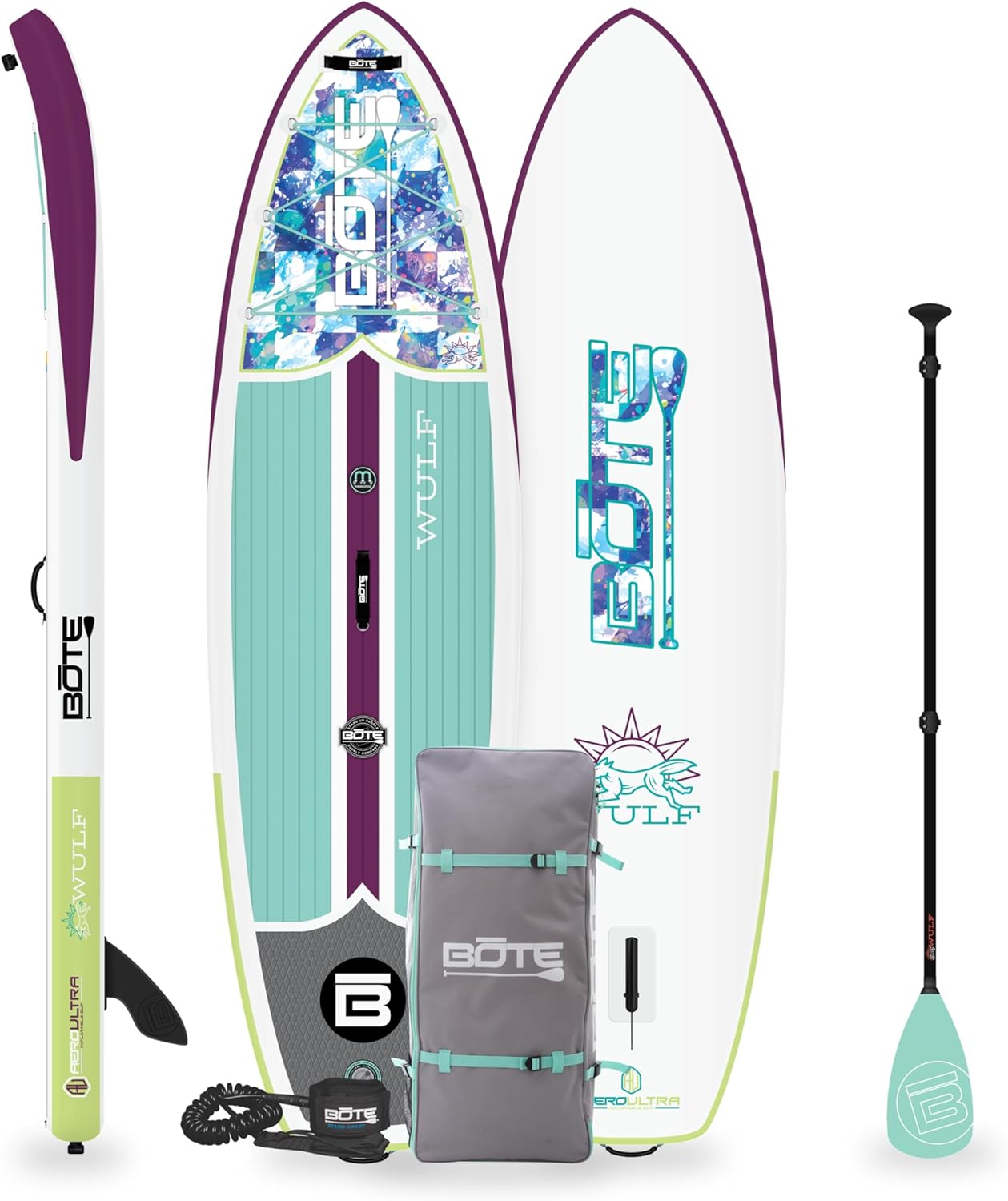 |
BOTE Wulf AeroBest for Gear Lovers |
|
Stable, smart, and endlessly accessorizable. | Check Price on Amazon |
| 5 |  |
FunWater 10’6″ SUPBest Value Bundle |
|
Everything a first-timer needs in a single box. | Check Price on Amazon |
| 6 |  |
SereneLife 10’6″ SUPBest for Casual Paddlers |
|
Relaxed, approachable, and easy to live with. | Check Price on Amazon |
| 7 |  |
Goplus Inflatable SUPBest Starter Kit |
|
A no-stress entry point for weekend paddling. | Check Price on Amazon |
| 8 |  |
AISUNSS 10.6′ x 33″ SUPBest High-Capacity Value |
|
Big-board stability at a starter-friendly price. | Check Price on Amazon |
| 9 |  |
Cetana Wide SUP 138″ x 35″Most Stable Platform |
|
Barely moves underfoot — ideal for nervous beginners. | Check Price on Amazon |
| 10 |  |
FLYPARK 11′ x 35″ SUPBest for Fishing Beginners |
|
Confident underfoot when you are focused on fishing. | Check Price on Amazon |
| 11 |  |
ATPROSS 11’6″ x 35″ SUPBest Two-in-One |
|
Sit-down days when standing feels like too much. | Check Price on Amazon |
| 12 | 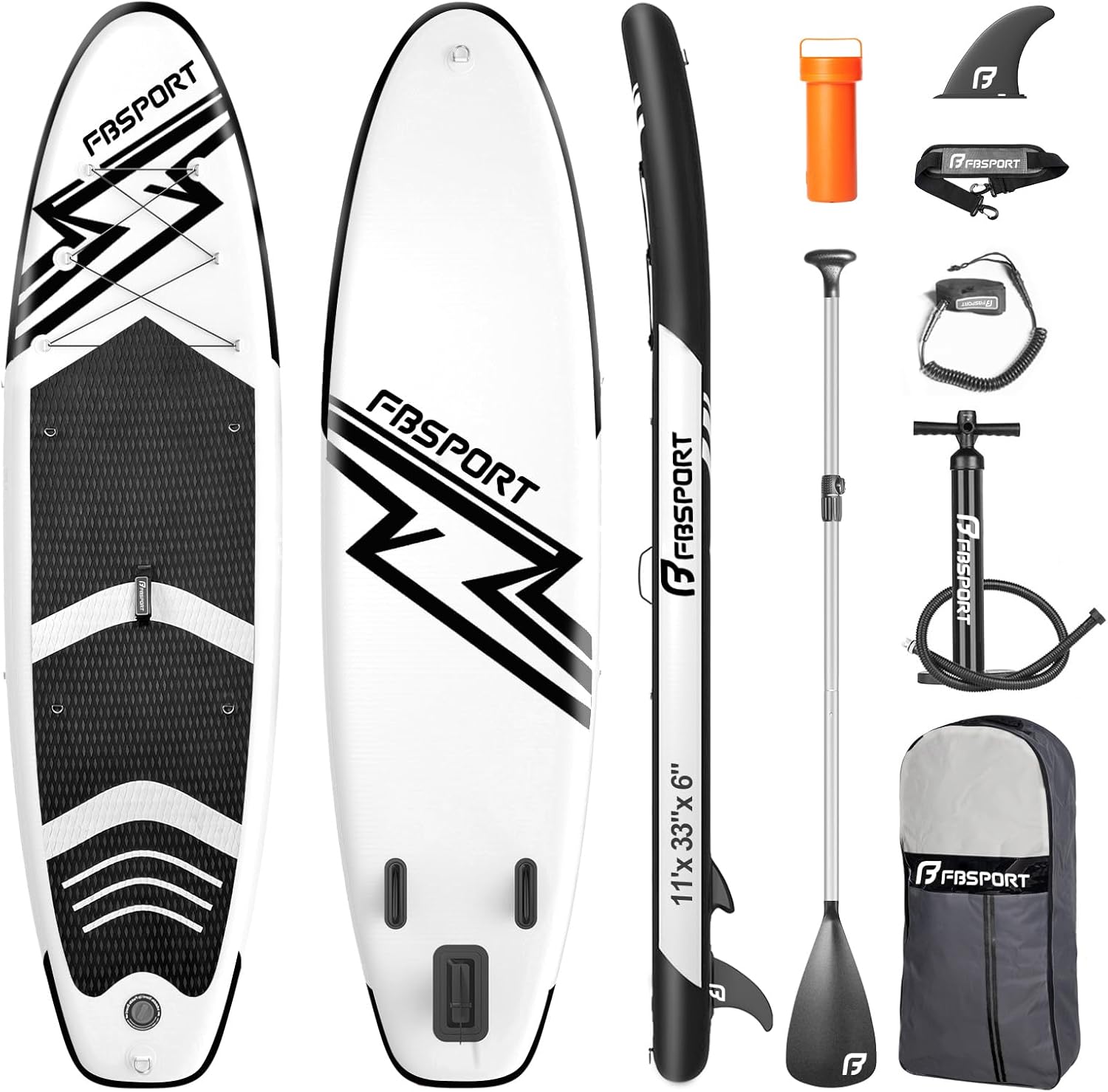 |
FBSPORT 11′ Premium SUPBest for Growing Skills |
|
Beginner now, capable paddler board later. | Check Price on Amazon |
| 13 |  |
Niphean Inflatable SUP 126″ x 33″Best All-Rounder |
|
Does a little of everything without drama. | Check Price on Amazon |
| 14 |  |
Aqua Plus Thick SUP 120″ x 32″Best Stiffness Focus |
|
Feels solid underfoot instead of springy. | Check Price on Amazon |
Section 01
What Actually Makes a Paddle Board Beginner-Friendly?
Beginner-friendly is one of the most abused phrases in the paddle board world. It gets printed on boxes for boards that are, in reality, narrow touring shapes with a nice color scheme. So let’s define it properly, because once you understand the four traits that matter, you can evaluate any board in any shop without needing anyone’s opinion.
Trait one is width. A board’s width is the single biggest predictor of how steady it feels. Wide boards resist the side-to-side rocking that makes a new paddler’s legs tense up. Tensed legs are what actually cause falls, far more than waves do. When you see boards in the 33 to 35 inch range, that is a genuine stability advantage, not a marketing claim.
Trait two is thickness combined with stiffness. Thickness buys volume and buoyancy, but only if the construction holds that shape under load. A board that flexes in the middle feels bouncy and unpredictable, which is exhausting for a beginner. Well-built inflatables use reinforced drop-stitch cores and dense outer layers to stay rigid at standard pressures.
Trait three is deck pad quality. Your feet will be wet within about thirty seconds. A soft, grippy, full-length traction pad gives you the confidence to shift your weight and move around the board. Beginners move around more than they think — to adjust the paddle, reach for water, or step back and turn.
Trait four is forgiveness. All-around shapes with rounded noses and moderate rocker are far more forgiving than pointed, aggressive profiles. They behave predictably in light chop, turn without argument, and are far less likely to submarine when you step too far forward. This is also the reason most beginner paddlers are far better served by an inflatable than by a rigid board, as we explain in our full breakdown of inflatable vs hard paddle boards and our guide to the main types of paddle boards.
Beginner-Friendly at a Glance
- Width first: 33 inches and above feels dramatically steadier for a new paddler.
- Stiffness second: a rigid board is predictable; a flexy board is tiring.
- Grip third: a quality deck pad turns wobbles into corrections instead of falls.
- Shape fourth: rounded, all-around outlines forgive imperfect technique.
Want the Full Beginner Breakdown?
See how inflatables behave for first-time paddlers.
Check Price on AmazonSection 02
How We Chose These Boards
There are hundreds of inflatable paddle boards on the market, and the uncomfortable truth is that a large number of them come out of the same factories with different logos applied afterward. That makes “which brand is best” a much less useful question than “which board is actually right for the way I paddle.” Our selection process is built around that second question.
First we filtered for genuine beginner suitability. That means all-around shapes, generous width, sensible proportions, and a package that gets a new paddler onto the water without a scavenger hunt for missing gear. Boards that were aggressively shaped for speed, racing, or advanced surf were excluded, however well reviewed they might be elsewhere.
Then we looked at construction intent. Inflatable paddle boards are made by inflating a woven drop-stitch core between two layers of fabric and sealing the edges — a genuinely clever process that we unpack in our article on how paddle boards are made. The quality of that core, the density of the outer skin, and the reinforcement at the seams all determine whether a board stays stiff after a season of use. Boards with obviously flimsy edge taping or undersized valves did not make the list.
Next came real-world practicality. Can the board be carried by one person? Does it fit in a car boot? Does it come with the essentials — paddle, pump, leash, fin, and bag — or will you be spending extra before you can even go paddling? Boards that require a long list of add-on purchases before their first outing lost points here.
Finally, we thought about the learning arc. A beginner board should be easy on day one and still feel worthwhile on day thirty. Some boards are wonderful for an hour and frustrating once you want to go further or paddle into light chop. We favored boards that grow with the paddler, which is why you will see a mix of value bundles and premium options in this guide rather than fourteen identical budget kits.
If you want to go deeper on the specific brands and models that repeatedly impress across categories, our reviews of the iRocker paddle board range, the BOTE inflatable paddle board lineup, and the GILI paddle board are good companions to this guide.
Compare Beginner Bundles
See which packages include the gear you actually need.
Check Price on AmazonSection 03
Length, Width, Thickness & Weight Capacity: Decoding the Numbers
Product pages throw four numbers at you and expect you to know what they mean for your body and your balance. Here is the translation, and it is simpler than the industry makes it look.
Length: Tracking and Glide
Longer boards travel further per stroke and hold a straighter line, which is genuinely nice once you are covering distance. Shorter boards turn more easily and feel more playful. For a beginner, the middle ground is ideal, and that is exactly what most boards in this guide occupy. If you plan to paddle with a dog, a child, or a cooler, that extra length also becomes usable deck space rather than wasted nose.
Width: The Beginner’s Best Friend
Width is the stability dial. A board around 32 inches wide is a perfectly reasonable all-rounder. Push to 33 or 34 inches and the platform starts to feel reassuringly planted. At 35 inches you have a genuinely wide board, which is the sweet spot for larger paddlers, anyone carrying gear, and people who simply want to relax rather than concentrate.
There is a practical ceiling, of course. Extra width adds a little drag and makes the board slightly slower to accelerate. For a beginner, that is one of the best trade-offs in the sport. Our detailed look at how much weight a paddle board can hold covers capacity and displacement in more detail.
Thickness and Stiffness
Thickness contributes to volume and buoyancy, and thicker boards generally resist flexing better. But thickness alone is not enough — the internal core and outer skin determine whether the board actually stays flat when you stand in the middle. That is why one board of a given thickness can feel like concrete and another like a waterbed.
Weight Capacity: Read It Correctly
A stated capacity is a maximum rating, not a comfort rating. If you weigh close to a board’s limit, it will sit lower in the water, feel less stable, and respond sluggishly. The comfortable rule is to leave real headroom between your body weight plus gear and the board’s stated maximum. A board rated well above your needs will feel lighter, livelier, and far more confidence-inspiring.
It is also worth clarifying the terminology if you are new, since the terms are used interchangeably in conversation but not always in the same way by manufacturers. Our explainer on SUP board vs paddle board sorts out the language quickly.
The Beginner Rule of Thumb
Prioritize width and stiffness over length and top speed. A wide, rigid board in the 10’6″ to 11’6″ range is the most forgiving starting point for the vast majority of new paddlers.
Find the Right Size for You
Filter beginner SUPs by width, length and capacity.
Check Price on AmazonSection 04 · Reviews
Best Overall Beginner Boards
These four are the boards we would confidently put under a first-time paddler. Each takes a slightly different approach to the same problem: making the first hour feel easy instead of humbling.
| # | Image | Product | Key Specs | Verdict | Check Price |
|---|---|---|---|---|---|
| 1 | |
Roc 10’6″ Inflatable SUPBest Overall |
|
The safest all-round recommendation we can make. | Check Price on Amazon |
| 2 | |
Nixy Newport G4Best Premium |
|
Feels like a finished product, not a starter kit. | Check Price on Amazon |
| 3 | |
BOTE Wulf AeroBest Features |
|
Stability plus genuinely useful design details. | Check Price on Amazon |
| 4 | |
Skatinger 11’6″ Super WideBest for Big & Tall |
|
Massive stability for paddlers who need headroom. | Check Price on Amazon |
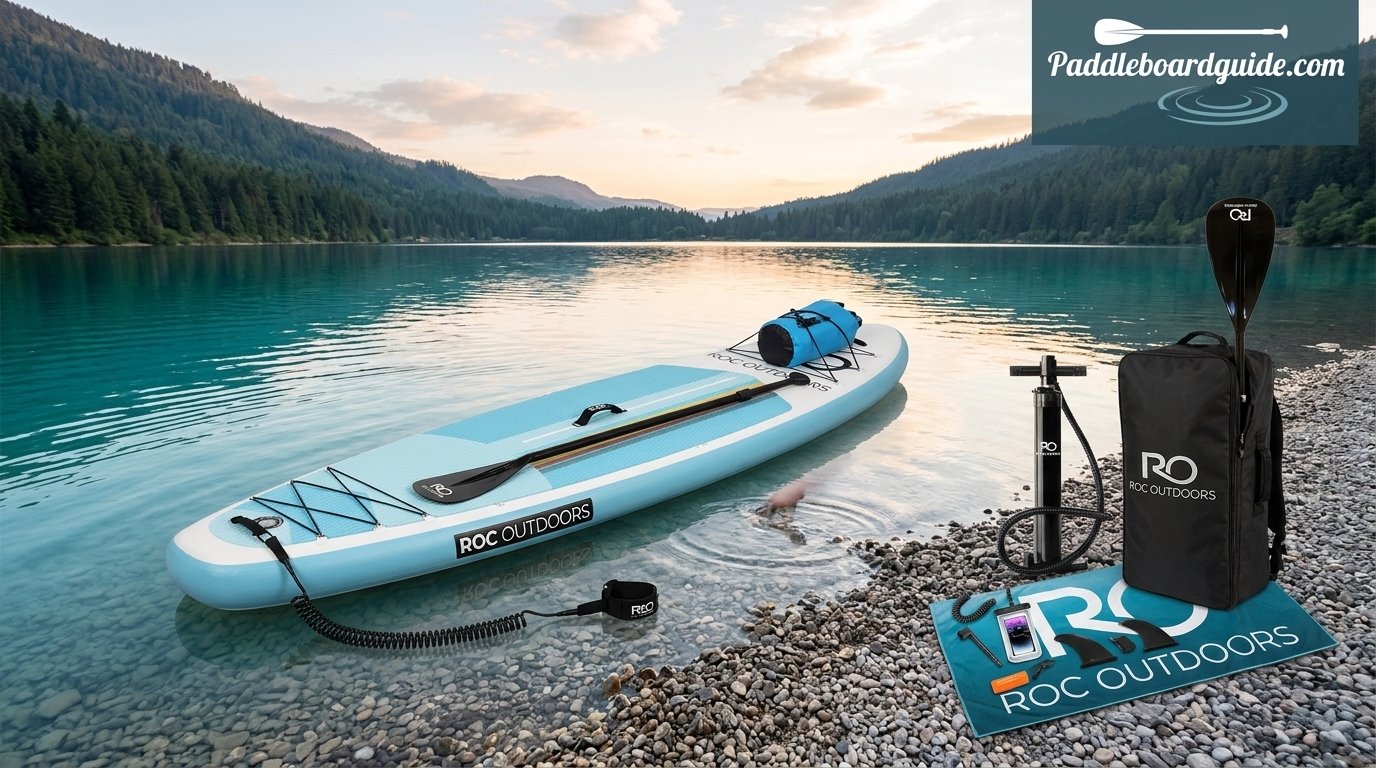
Roc Inflatable Stand Up Paddle Board 10’6″
If you asked us to recommend one board to a friend who has never stood on a paddle board in their life and wanted to be paddling by the weekend, this is the one. The Roc 10’6″ pairs a classic all-around outline with a genuinely reassuring 33-inch width and a generous weight rating, and it does all of that without asking anything complicated from the buyer.
What makes it such a good first board is the way the dimensions work together. The 10’6″ length is the practical middle of the market: long enough to glide nicely across flat water, short enough that turns never feel like a chore. The 33-inch width gives you the lateral stability that beginners need while their feet are still learning what “balanced” feels like. And the 350-pound capacity means that paddlers of a wide range of sizes can stand on this board and still have it floating high and lively rather than sagging underfoot.
That headroom matters more than most people realize. When a board is loaded close to its limit, it sits lower, feels mushy, and responds sluggishly to every paddle stroke. With comfortable capacity to spare, the Roc stays crisp and predictable — which is exactly the kind of feedback loop that builds a beginner’s confidence quickly.
Key Features
- Beginner-friendly proportions: 10’6″ long and 33″ wide for a stable, easy-turning platform.
- Comfortable capacity: rated up to 350 lb, leaving plenty of headroom for body weight plus gear.
- All-around shape: rounded outline that behaves well on lakes, calm bays, and gentle rivers.
- Grippy deck pad: textured standing area that helps wet feet stay where you put them.
- Portable package: deflates and packs down for storage in a closet or car boot.
What We Like
- Genuinely stable width for a first board
- Weight rating leaves real headroom for gear
- Easy to turn and easy to carry
- Forgiving shape for learning the basics
What to Consider
- All-around shape, not built for racing
- Wider boards take a little more effort to accelerate
- Beginners will still want to add a proper PFD
Who it’s best for: First-time paddlers who want a single, sensible board that will not need replacing after one season, and anyone buying as a gift who wants to be certain the recipient will actually enjoy their first session.
Our Top Pick for Beginners
Stable, forgiving, and ready for your first paddle.
Check Price on Amazon
Nixy Newport G4 (10’6″ x 32″)
The Newport G4 is the board you buy when you have done your homework and decided that you would rather own one good thing than replace a cheap thing twice. It is a refined, lightweight, thoughtfully finished inflatable that happens to be an excellent teacher for a beginner.
At 10’6″ by 32 inches it is slightly narrower than some of the boards in this guide, and that is a deliberate design choice rather than a weakness. The narrower platform means less drag and a livelier feel on the water, so the board rewards good technique as you develop it. Beginners who are reasonably athletic, or who expect to progress quickly, tend to prefer this kind of balance. If your priority is maximum stability at any cost, there are wider options below — but if you want a board that stays interesting for years, this is the shape to get.
The details are where premium boards earn their price. Clean seams, sensible hardware placement, a deck pad that feels good under bare feet, and a package that does not feel like an afterthought. It is also rated to a clearly stated 275 pounds, which is honest information you can plan around: choose it if that number comfortably covers you and your gear.
Key Features
- Balanced 10’6″ x 32″ shape: a classic all-round proportion that paddles well in a range of conditions.
- Lightweight construction: easier to carry inflated and easier to haul to the water.
- Stated 275 lb capacity: clear information for matching the board to your body weight.
- Refined finish: clean hardware and a comfortable, high-grip deck pad.
- Grows with you: responsive enough to stay enjoyable as your skills improve.
What We Like
- Noticeably lighter than many rivals
- Lively, responsive glide for an inflatable
- Clean design and comfortable deck pad
- Stays rewarding beyond the beginner phase
What to Consider
- Narrower than extra-wide beginner boards
- Capacity rating suits lighter paddlers best
- Premium positioning means a bigger upfront spend
Who it’s best for: Beginners who expect to paddle regularly and want a board they will still enjoy in a couple of seasons, and lighter paddlers who value a responsive feel over raw stability.
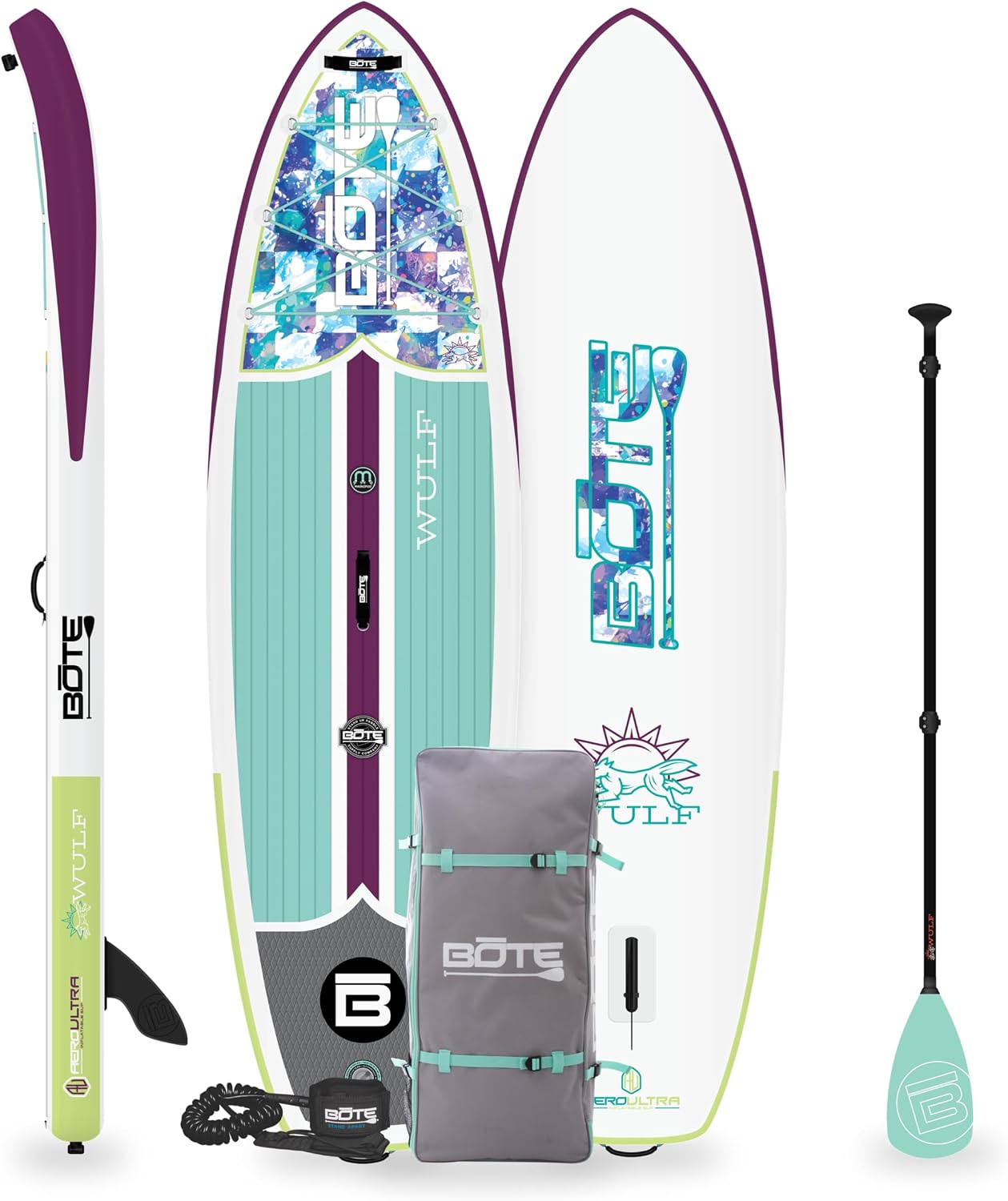
BOTE Wulf Aero Inflatable Paddle Board (34″ Wide, MagnePod Mount)
BOTE has built its reputation on boards that make the sport more fun to live with, and the Wulf Aero is their clearest statement of that idea for newer paddlers. It is wide, it is stable, and it has that clever MagnePod mount that turns a bare deck into a proper little basecamp.
The 34-inch width is the headline here. That is a wide, planted deck by any standard, and it shows the moment you step on. Beginners tend to relax visibly on a board like this, and relaxed paddlers learn faster. Everything else about the shape is similarly easy-going: an all-around outline that turns willingly and stays composed in light chop.
Then there is the mounting system. The MagnePod mount gives you a stable, magnetic spot to attach compatible accessories — a drink holder, a speaker mount, a light — without drilling, strapping, or improvising. For beginners this is quietly brilliant, because the first season of paddle boarding is usually full of small frustrations like “where do I put my water bottle.” Solving those little problems is what keeps people coming back. If you like the design language here, our BOTE inflatable paddle board review covers the wider range.
Key Features
- 34-inch wide deck: a genuinely stable platform that forgives imperfect balance.
- MagnePod magnetic mount: attach compatible accessories cleanly and quickly.
- All-around outline: predictable handling for lakes, bays, and slow-moving water.
- Thoughtful deck layout: practical spacing for gear, water, and a dry bag.
- Inflatable portability: packs down small despite its generous on-water footprint.
What We Like
- Wide, confidence-inspiring deck
- Clever accessory mounting system
- Clean, well-resolved design details
- Great platform for adding gear later
What to Consider
- Accessory system is at its best with matching add-ons
- Wide boards are a touch slower off the mark
- Best value for paddlers who will actually use the extras
Who it’s best for: Beginners who love gadgets and accessories, anyone who paddles with drinks, speakers, or a camera, and paddlers who want a stable board that looks and feels considered.
Build Your Setup Around a Smart Deck
Check the current package for the Wulf Aero.
Check Price on Amazon
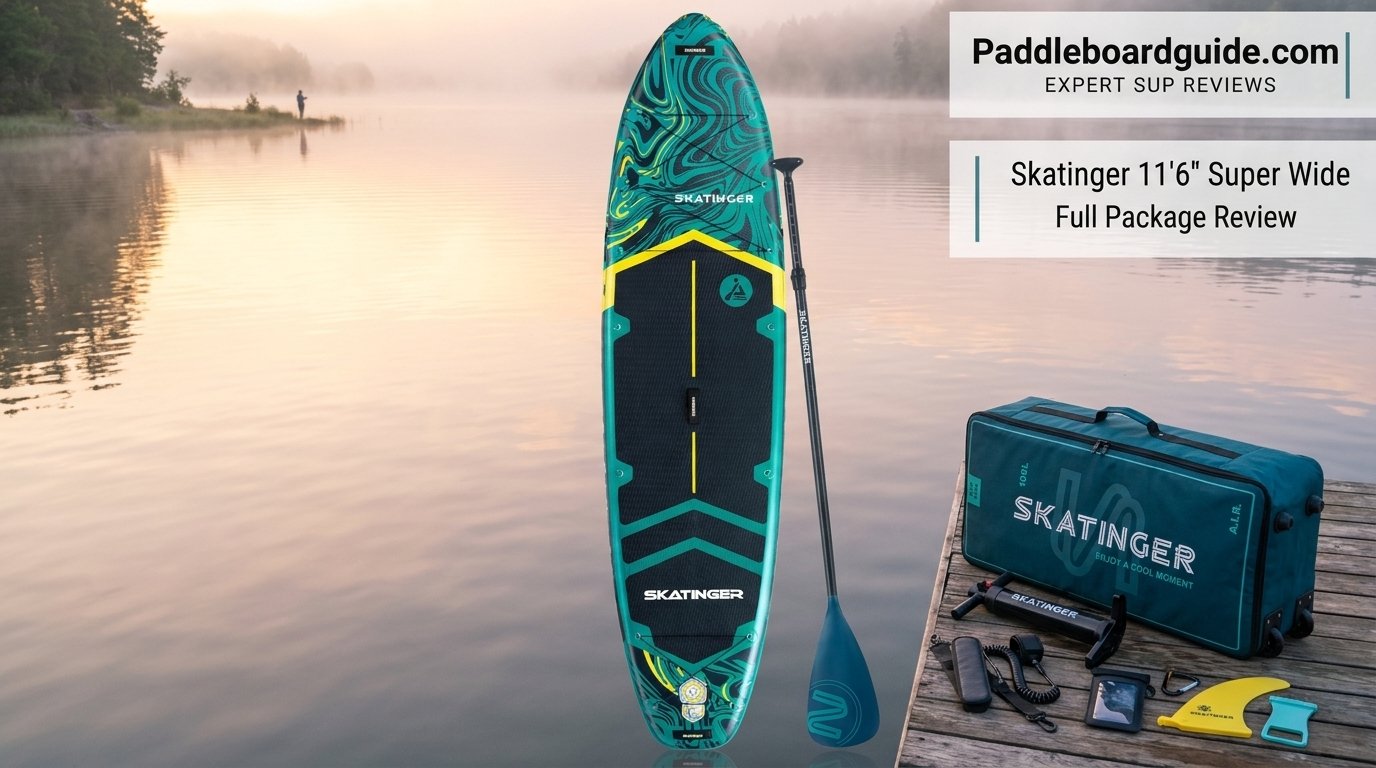
Skatinger 11’6″ Super Wide Inflatable SUP (35″ Wide, 450 lb)
Some boards are beginner-friendly in theory and wobbly in practice. The Skatinger 11’6″ solves that by simply making the platform bigger: 35 inches wide, generously long, and rated to 450 pounds. It is the board that turns “I don’t think I can balance on that” into “this is actually quite easy.”
The advantage of a board like this is most obvious for taller and heavier paddlers, who need more displacement to keep the deck riding high. With 450 pounds of rated capacity, this board can carry a large adult plus a cooler, a dry bag, and a dog without settling into the water. That high ride height is the hidden source of stability — the board responds crisply rather than feeling soggy.
There is also a family argument for this kind of platform. A super-wide board is the one you can bring a child along on, sit down on for a rest, or use as a floating base at the beach. The 35-inch width gives you room to move around without instantly unsettling the board, which makes it a genuinely social piece of kit rather than a solo craft. If you plan to paddle with kids, it is also worth reading our notes on paddle board safety requirements before your first family outing.
Key Features
- Super-wide 35″ deck: exceptional lateral stability for nervous or larger paddlers.
- 450 lb capacity: real headroom for body weight, gear, and a companion.
- 11’6″ length: smooth glide and plenty of usable deck space.
- Roomy platform: ideal for paddling with a child, pet, or cooler.
- Portable inflatable design: deflates for transport and compact storage.
What We Like
- Among the most stable platforms available
- Generous capacity for gear and passengers
- Excellent for larger or taller paddlers
- Doubles as a family and beach platform
What to Consider
- Bigger boards take more effort to inflate and carry
- Not the fastest option on open water
- Overkill for small, light, athletic paddlers
Who it’s best for: Taller or heavier paddlers, families who want to share one board, and anyone who values feeling planted on the water over covering distance quickly.
Maximum Stability, Zero Guesswork
See the super-wide board built for confidence.
Check Price on AmazonSection 05 · Reviews
Best Budget-Friendly Beginner Boards
A lower price should mean fewer extras, not a board you cannot stand on. These four keep the cost sensible while preserving the things that actually matter to a beginner: width, stability, and a package that gets you on the water.
| # | Image | Product | Key Specs | Verdict | Check Price |
|---|---|---|---|---|---|
| 1 | |
FunWater 10’6″ SUPBest Value Bundle |
|
The most complete starter package for the money. | Check Price on Amazon |
| 2 | |
AISUNSS 10.6′ x 33″Best Capacity |
|
Big-board stability without the big-board price. | Check Price on Amazon |
| 3 | |
SereneLife 10’6″ SUPBest for Casual Use |
|
Easy-going and genuinely pleasant to paddle. | Check Price on Amazon |
| 4 | |
Goplus Inflatable SUPBest Starter Kit |
|
Everything in the box, nothing extra to buy. | Check Price on Amazon |
FunWater 10’6″ Inflatable SUP with Beginner Accessories
The best thing about the FunWater package is that it removes the most common beginner mistake: buying a board, then discovering you still need three or four things before you can use it. This arrives as a complete starter system, built around a sensible 10’6″ all-around shape.
As a board, it follows the beginner formula closely. The 10’6″ length is the versatile middle ground, the outline is rounded and forgiving, and the lightweight construction makes it noticeably easier to carry to the water and haul back out again. That last point is underrated. A board that is a chore to move is a board that stays in the garage, and FunWater’s lighter-weight approach makes spontaneous evening paddles much more realistic.
It is not trying to be a premium performance board, and that is fine. It is trying to make sure that someone who has never done this before can inflate it, launch it, and have a good time, and it does that job well. If you are buying for a teenager, a partner, or a holiday house where everyone will take a turn, this is exactly the kind of package that makes sense.
Key Features
- 10’6″ all-around shape: the do-everything length for lakes, bays, and calm rivers.
- Beginner accessories included: the essentials come in the box rather than as add-ons.
- Lightweight construction: easier to carry, load, and store than heavier rivals.
- Grippy standing area: helps new paddlers keep their footing while learning.
- Packs down small: practical for apartments, small cars, and holiday trips.
What We Like
- Complete kit for a first outing
- Light enough to carry comfortably
- Forgiving, easy-handling shape
- Strong value for a shared family board
What to Consider
- Not aimed at high-performance paddling
- Lighter build benefits from careful pressure checks
- Keen paddlers may upgrade accessories over time
Who it’s best for: First-time buyers on a sensible budget, families who want a shared board, and anyone who values a complete package over premium detailing.
Everything You Need in One Box
See the beginner bundle that gets you paddling today.
Check Price on Amazon
SereneLife 10’6″ Inflatable Stand Up Paddle Board
Not every beginner wants to progress to long-distance touring. Some people want a pleasant board for a calm Saturday morning, and that is exactly the lane the SereneLife 10’6″ occupies. It is approachable, unfussy, and easy to enjoy.
The 10’6″ all-around platform is the shape we recommend most often to casual paddlers, and this board wears it well. It is stable enough to learn on, light enough to manage solo, and simple enough that there is nothing to figure out beyond inflating and launching. For someone who has been put off by more technical gear in another sport, that simplicity is a genuine feature.
It is also a forgiving board to learn balance on. The deck feels predictable underfoot, and the outline resists the sudden twitching that unsettles beginners when the wind picks up. Nobody is claiming it will win a race, but it is exactly the kind of board that gets people hooked on the sport, which is the whole point of a beginner purchase. If you find yourself wondering how difficult the sport really is before committing, our guide on how hard paddle boarding is sets realistic expectations.
Key Features
- 10’6″ versatile length: an easy-handling size for everyday paddling.
- All-around profile: predictable behavior in calm and lightly choppy water.
- Complete starter package: ready for a first outing without extra shopping.
- Comfortable deck pad: soft underfoot and reassuring for longer sessions.
- Compact storage: deflates and packs away neatly between trips.
What We Like
- Very easy for a first-timer to enjoy
- Light, simple, and low-fuss
- Good proportions for calm-water paddling
- Straightforward to inflate and store
What to Consider
- Better for casual use than ambitious distance
- Not the stiffest board in its class
- Less suited to choppy open water
Who it’s best for: Casual paddlers, holiday-house buyers, and beginners who want a relaxed, easy-going board rather than a technical one.
Goplus Inflatable Stand Up Paddle Board
The Goplus is a straightforward, no-drama starter kit. It covers the essentials properly, keeps the price grounded, and includes the kind of accessory set that means you can go from opening the box to being on the water in one afternoon.
What we like about this board for beginners is the clarity of its intent. It is an all-around inflatable built for learning, and it does not pretend otherwise. The shape is rounded and forgiving, the proportions are sensible for a first board, and the included kit removes the guesswork around paddles, pumps, and storage.
Practicality is a big part of why starter kits like this make sense. Everything stows in the backpack, which means the board can live in a cupboard rather than taking over a garage. That matters more than people expect — the easier a board is to own, the more often it gets used. If storage space is genuinely tight at home, our inflatable paddle board storage ideas are worth a look before your board arrives.
Key Features
- All-around beginner shape: stable and predictable for first sessions.
- Full accessory kit: the essentials come as standard rather than as extras.
- Backpack storage: compact, tidy, and easy to keep at home or in a car.
- Simple inflation and setup: designed for people who have never done this before.
- Weekend-ready: everything you need for a lake or calm-water outing.
What We Like
- Genuinely complete starter package
- Easy to store in a small space
- Simple setup for absolute beginners
- Good price-to-completeness ratio
What to Consider
- Entry-level positioning throughout
- Not designed for rough conditions
- Accessory quality reflects the price point
Who it’s best for: Absolute beginners who want a single purchase that covers everything, and paddlers who need a board that stores away neatly in a small home.
AISUNSS 10.6′ x 33″ Inflatable Paddle Board (450 lb)
Here is a board that gives you the numbers usually associated with much pricier platforms: a comfortable 33-inch width and a 450-pound capacity rating, in a package that stays friendly to a beginner’s budget.
The width and the capacity work together here in a way that directly benefits a new paddler. A 450-pound rating means the board rides high and lively with a typical adult on board, and high riding is what makes a board feel crisp rather than draggy. Combined with a 33-inch stance, you get a platform that feels planted without being ponderous.
That combination makes this a genuinely sensible option for heavier paddlers who are tired of reading “beginner board” descriptions that clearly assume a lighter rider. It also leaves room for a dry bag, a pet, or a spare paddle without pushing the board anywhere near its limits. And since it is a standard inflatable at heart, it travels in a car and stores in a closet just like the rest of this list.
Key Features
- 33-inch wide deck: a stable stance for learning balance and paddle technique.
- 450 lb capacity: generous headroom for paddlers of different sizes and extra gear.
- 10.6′ length: a practical all-round size that handles well and glides nicely.
- Confident platform: rides high and responsive rather than low and soggy.
- Packable design: deflates for easy transport and compact storage.
What We Like
- Strong capacity at a friendly price
- Stable 33-inch width for learning
- Room for gear without overloading
- Good option for larger paddlers
What to Consider
- Less brand cachet than premium rivals
- Basic accessory set compared to premium bundles
- Best for calm to moderate conditions
Who it’s best for: Beginners who want big-board stability and generous capacity without paying premium-brand prices.
Stability Without the Premium Price
Check the current price and available bundles.
Check Price on AmazonSection 06 · Reviews
Best Wide & Stable Boards for Cautious Beginners
Some new paddlers want speed. Most want to not fall in. These boards are built for the second group — extra width, generous capacity, and platforms that behave more like floating decks than balance beams.
| # | Image | Product | Key Specs | Verdict | Check Price |
|---|---|---|---|---|---|
| 1 | |
Cetana Wide SUP 138″ x 35″Most Stable |
|
As close to un-tippy as a paddle board gets. | Check Price on Amazon |
| 2 | |
ATPROSS 11’6″ x 35″Most Versatile |
|
Sit down whenever standing feels like hard work. | Check Price on Amazon |
| 3 | |
FLYPARK 11′ x 35″Best for Fishing |
|
A steady platform for standing and casting. | Check Price on Amazon |
Cetana Wide Inflatable Paddle Board (138″ x 35″)
This is the board for people who have looked at paddle boarding and thought, “I’d love to try that, but I know I’d fall off.” At 138 inches long and 35 inches wide, the Cetana is closer to a floating platform than a balance challenge, and that is exactly what makes it brilliant for beginners.
The sheer size of the deck changes the experience entirely. You are not perched on a narrow strip of material trying to stay centered — you have room to stand, adjust, kneel, sit, and move around without the board immediately reacting. That freedom is what makes the first session enjoyable instead of exhausting, and enjoyment is what turns a curious beginner into a paddler.
The extra length also earns its keep when you want company. There is genuine room for a second paddler, a child, or a well-behaved dog, which makes this a natural choice for families and for people who like to bring gear along. If you are planning to share the board with others, pairing it with properly fitted flotation is essential — see our picks for the best paddle board life jackets before you head out.
Key Features
- 138-inch deck length: extensive platform with room to move and share.
- 35-inch width: exceptionally stable underfoot for nervous beginners.
- Two-paddler capacity: comfortable space for a companion or a child.
- Forgiving behavior: stays composed as you shift your weight around.
- Inflatable convenience: packs down despite its large on-water footprint.
What We Like
- Remarkable stability for first-timers
- Room for a second paddler or extra gear
- Great confidence builder
- Doubles as a family and beach board
What to Consider
- Large boards need more storage space
- Heavier to carry when inflated
- Slower than narrower all-round shapes
Who it’s best for: Nervous beginners, families sharing one board, and paddlers who want maximum stability and deck space above all else.
FLYPARK 11′ x 35″ Inflatable Paddle Board (430 lb)
If your first paddle board is really a fishing platform in disguise, this is the shape to look at. The FLYPARK pairs an 11-foot hull with a very wide 35-inch deck and a 430-pound capacity, creating a stable base for standing, casting, and managing gear.
Fishing from a paddle board puts unusual demands on stability. You are not just standing still — you are twisting, reaching, leaning over the side, and concentrating on something other than your balance. A wide, high-capacity board absorbs those shifts without complaint, which is why so many first-time SUP anglers end up on platforms exactly like this one.
There is plenty of room for tackle and gear, and the board’s generous capacity means you can load up without worrying about riding low in the water. It is equally happy as a general-purpose board for bigger paddlers who simply want a planted feel. If you want to explore the wider world of angling setups, our guide to the best paddle boards for fishing covers specialized options in depth.
Key Features
- 11′ x 35″ platform: wide and long enough for standing casts and gear management.
- 430 lb capacity: generous headroom for angling equipment and supplies.
- Steady under movement: handles leaning and reaching without twitchy reactions.
- Ample deck space: room for tackle, a cooler, and safety equipment.
- Inflatable practicality: transportable without a roof rack.
What We Like
- Excellent stability for casting and reaching
- High capacity for gear-heavy outings
- Versatile beyond fishing use
- Easy to transport and store
What to Consider
- Wide and heavy when fully loaded
- More board than a casual solo paddler needs
- Fishing accessories bought separately
Who it’s best for: Beginners who want to fish from their board, larger paddlers who want maximum stability, and anyone carrying a lot of gear.
Turn Your Board Into a Fishing Platform
Check the current package and configurations.
Check Price on Amazon
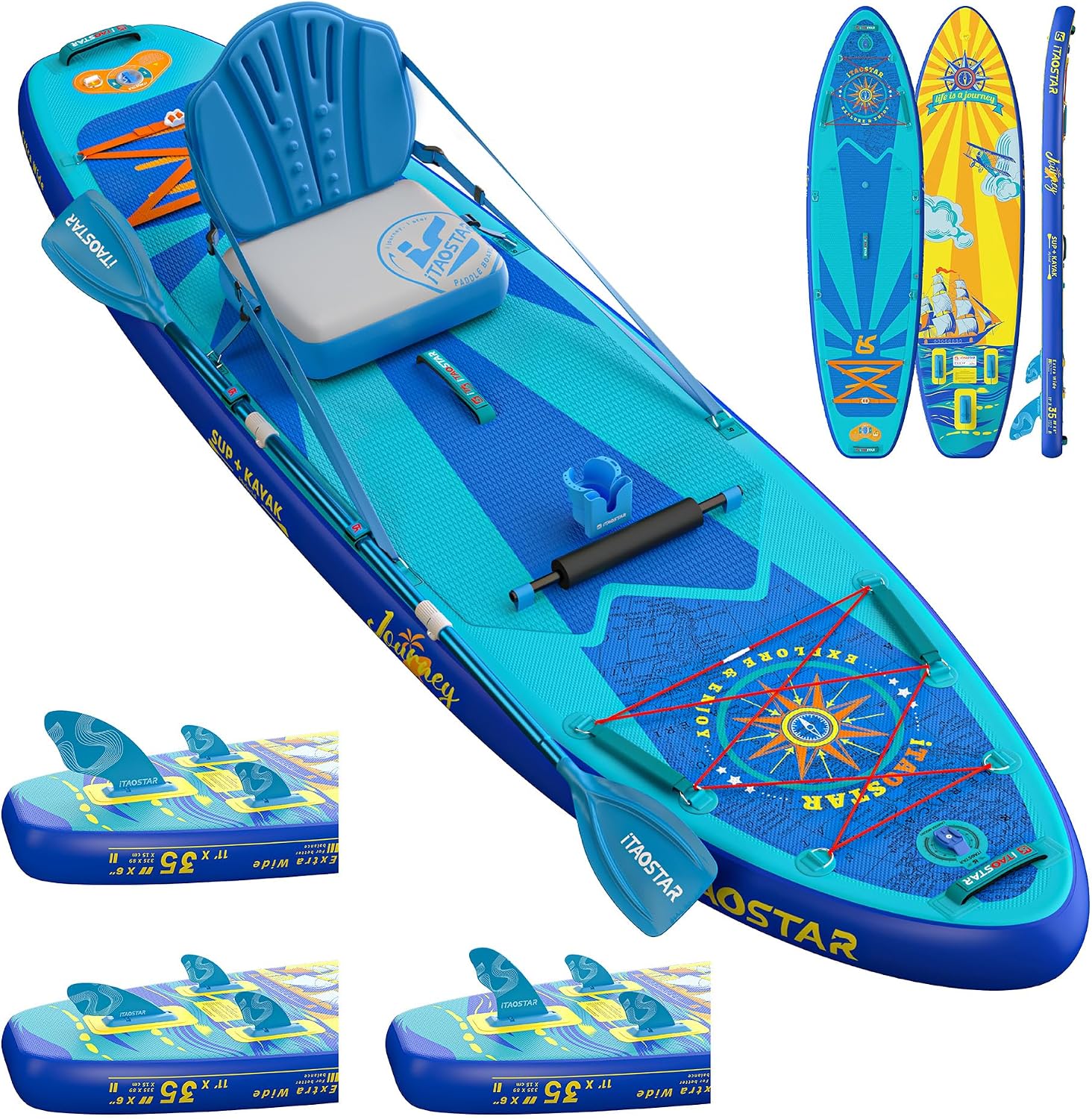
ATPROSS 11’6″ x 35″ Inflatable Paddle Board (450 lb, Kayak Mode)
Beginners have good days and bad days. Some sessions you feel balanced and unstoppable; others your legs decide otherwise. The ATPROSS handles both by offering a kayak mode alongside its standing setup, so you can sit down and keep paddling instead of heading home.
The underlying board is already well suited to learners: 11’6″ long, 35 inches wide, and rated to 450 pounds. That is a big, stable platform that behaves calmly in light chop and carries plenty of gear. Add the ability to convert to a seated configuration and you have a board that is genuinely useful across a range of days, moods, and abilities.
That flexibility is a real asset for couples and families where different people want different things from the water. One paddler can stand while another sits, and nobody has to compromise. It also makes longer outings far more comfortable, because you can rest without interrupting the day. If you like the idea of a hybrid setup, our comparison of paddle boards vs kayaks is a useful read.
Key Features
- 11’6″ x 35″ deck: generous, stable proportions for confident learning.
- 450 lb capacity: plenty of headroom for paddlers and equipment.
- Kayak mode: convert to a seated setup for rest and longer trips.
- Multi-person friendly: suitable for couples and families sharing gear.
- Packable design: deflates down for transport and storage.
What We Like
- Two paddling styles in one board
- Very stable, high-capacity platform
- Comfortable for longer outings
- Great for mixed-ability groups
What to Consider
- Larger footprint to store and carry
- Hybrid setups add a little complexity
- Sit-down paddling needs a suitable paddle setup
Who it’s best for: Beginners who want the option to sit, couples and families sharing a board, and paddlers planning longer, more relaxed outings.
Section 07 · Reviews
Best Value All-Arounders for Growing Skills
These three sit in the sweet spot between pure starter boards and premium options. They are easy to learn on and still interesting to paddle once the basics click.
| # | Image | Product | Key Specs | Verdict | Check Price |
|---|---|---|---|---|---|
| 1 | |
FBSPORT 11′ PremiumBest for Progression |
|
Beginner now, confident paddler later. | Check Price on Amazon |
| 2 | |
Niphean 126″ x 33″Best All-Rounder |
|
Does everything well and nothing badly. | Check Price on Amazon |
| 3 | |
Aqua Plus Thick 120″ x 32″Best Stiffness |
|
Solid underfoot, not springy or vague. | Check Price on Amazon |
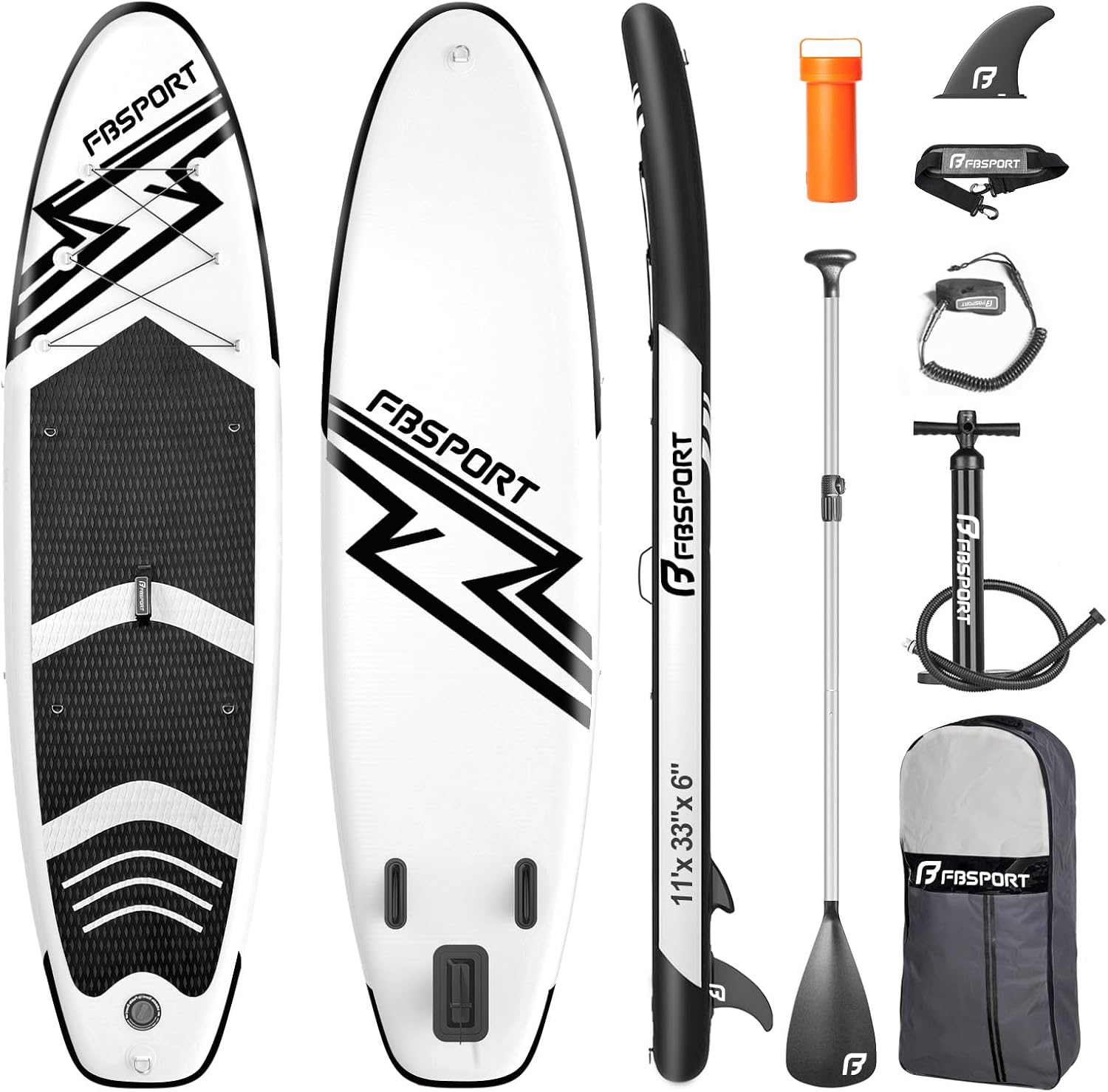
FBSPORT 11′ Premium Stand Up Paddle Board
The FBSPORT 11′ is aimed at people who want to start at the beginning but not stay there. It is a well-proportioned all-around board with a slightly more refined feel than a typical entry-level package, which makes it a great companion for a beginner’s first season and beyond.
At 11 feet, it sits just above the common starter length, and that extra foot shows up as smoother glide and better tracking between strokes. For a beginner that means less correction and a calmer, straighter ride. At the same time, the all-around outline keeps the board easy to turn and forgiving of the small mistakes that everyone makes early on.
The premium positioning is most noticeable in the details: clean finishing, a deck that feels considered rather than functional-only, and an overall impression that this is a board meant to be used regularly. That matters for motivation. A board you are proud of is a board you take out more often, and frequency is the single biggest factor in how fast anyone improves at this sport.
Key Features
- 11-foot all-around shape: smooth glide with easy, predictable handling.
- Good tracking: holds a line between strokes for calmer, straighter paddling.
- Premium detailing: a refined finish that rewards regular use.
- Beginner-friendly balance: stable enough to learn on without feeling dull later.
- Portable inflatable design: packs down for storage and travel.
What We Like
- Grows with your ability
- Better glide than most starter boards
- Refined look and feel
- Sensible, versatile proportions
What to Consider
- Slightly less stable than extra-wide boards
- Longer boards need more room to store
- Not aimed at speed or racing
Who it’s best for: Beginners who plan to paddle often and want a board that stays enjoyable as their skills develop.
A Board You Won’t Outgrow Quickly
Check the current package for the FBSPORT 11′.
Check Price on Amazon
Niphean Inflatable Paddle Board (126″ x 33″)
The Niphean is the definition of a sensible all-rounder. At 126 inches long and 33 inches wide, it lands squarely in the middle of the beginner-friendly range, and it comes with the kind of complete accessory package that makes a first purchase painless.
What we appreciate about this board is its balance of traits. It is wide enough to feel steady under a new paddler but not so wide that it becomes a barge. It is long enough to glide nicely but short enough to turn without a fight. And the 33-inch width gives you that crucial stability margin while your feet are still calibrating.
The complete package is the practical cherry on top. Beginners consistently underestimate how much little stuff surrounds the sport — fins, leashes, pumps, bags — and buying them one at a time is both expensive and annoying. Having it all arrive together means your first session is spent paddling rather than shopping. If you want to know which extras are genuinely worth upgrading later, see our guide to the best paddle board paddles.
Key Features
- 126″ x 33″ proportions: the classic beginner-friendly all-round size.
- Balanced handling: steady in a straight line and easy to turn.
- Complete accessory package: ready for a first outing without extra purchases.
- Comfortable deck pad: supportive underfoot for longer sessions.
- Easy to own: deflates, packs away, and stores in a small space.
What We Like
- Well-judged all-round dimensions
- Complete package out of the box
- Easy to learn on and live with
- Good balance of stability and glide
What to Consider
- Jack of all trades rather than a specialist
- Accessories may be upgraded by keen paddlers
- Best suited to calm and moderate conditions
Who it’s best for: Beginners who want one dependable board for a bit of everything — flat water, gentle chop, family outings, and fitness paddling.
Aqua Plus Thick Inflatable SUP (120″ x 32″)
Stiffness is the quality that separates a board that feels like a board from one that feels like a lilo. The Aqua Plus leans into that with a thicker, more rigid construction, and beginners notice the difference immediately.
A stiff board communicates clearly. When you shift your weight, it responds directly instead of flexing and then recovering a half-second later. That direct feedback makes learning balance faster and less tiring, because you are not constantly compensating for a springy deck. For anyone who has tried a cheap inflatable and found it vaguely bouncy, this is the antidote.
The 120-inch by 32-inch proportions are a sensible all-round choice: easy to handle, reasonably quick on the water, and stable enough for a learner. It is not trying to be the widest or the longest board here. It is trying to be the one that feels solid and trustworthy every time you step on, and that is a very good thing to prioritize.
Key Features
- Extra-thick construction: resists flexing for a solid, board-like feel.
- 120″ x 32″ proportions: a versatile size for learning and everyday paddling.
- Supportive platform: clear, direct response when you shift your weight.
- Comfortable deck pad: grippy and supportive for longer sessions.
- Inflatable convenience: deflates for easy transport and storage.
What We Like
- Noticeably rigid and supportive
- Direct, predictable response
- Comfortable proportions for learners
- Less tiring to paddle than springy boards
What to Consider
- Thicker boards can feel slightly heavier
- Not the widest platform in this guide
- Rigidity is best when properly inflated
Who it’s best for: Beginners who have tried a soft or bouncy inflatable before and want a properly rigid feel underfoot.
Feel the Difference a Rigid Board Makes
Check the current price and package details.
Check Price on AmazonSection 08
Accessories That Matter: Pumps, Paddles, Leashes & PFDs
Most beginner boards ship with a bundle of accessories, and the quality of that bundle shapes your experience more than you would expect. A poor pump turns setup into a workout. A badly sized paddle turns a pleasant outing into sore shoulders. Here is what genuinely matters and where it is worth paying attention.
The Pump Is Not a Throwaway Item
Inflating a board to the correct pressure is the difference between a stiff, responsive platform and a soft, saggy one. A good double-action or electric pump gets you to pressure quickly and lets you check where you are. If the pump in your kit feels flimsy, upgrading is one of the highest-value improvements you can make. Our roundup of the best paddle board pumps covers both manual and electric options.
The Paddle Determines How You Feel at Hour Two
A paddle that is the wrong length or too heavy will make itself known very quickly. Adjustable paddles included with most beginner kits are fine to start with, and they let you experiment with length as you learn. As your technique develops, a lighter, better-balanced paddle becomes one of the most noticeable upgrades you can make — more than almost anything else on the board.
One small but useful piece of reassurance for beginners: in most designs, the paddle floats. Our article on whether paddle board paddles float explains the details, and our guide to the best paddle board paddles covers what to look for when you upgrade.
Leash and PFD: Non-Negotiables
A leash keeps the board with you when you fall in, which matters because a board in light wind travels faster than a tired swimmer. A properly fitted personal flotation device is equally important, and it is required in many places. Fit matters more than brand here — a PFD that rides up or chafes will not get worn. Our recommendations for the best paddle board life jackets focus on comfort and fit for paddling specifically.
Storage, Seats and Bags
A dry bag, a decent carry bag, and a comfortable seat (if your board supports kayak-style paddling) round out a practical kit. If you plan to paddle seated or want a hybrid setup, have a look at the best paddle board seats. And if you are buying for a family or expect to travel with your board, a quality carry bag matters more than people expect — see our guide to the best paddle board bags.
Section 09
Your First Days on the Water: Skills, Wobbles & Progression
Buying the right board solves the equipment half of the beginner problem. The other half is technique, and the good news is that the basics come together quickly. Most people go from nervous to comfortable within a couple of sessions.
Session One: Just Stand Up
Start in shallow, calm water. Kneel first, find your balance, and get used to how the board responds when you shift your weight. Then stand up slowly, one foot at a time, with your feet roughly shoulder-width apart and your knees softly bent. Look at the horizon rather than your feet — this single adjustment fixes most beginners’ balance immediately.
Expect to fall in at least once. Everyone does. It is part of the process, and falling into warm water is far less dramatic than it looks from the shore. If you want a complete walkthrough of stance and stroke, our guide on how to paddle board covers the fundamentals step by step, and our honest look at whether paddle boards are hard to use sets realistic expectations for the learning curve.
Session Two: The Stroke
Most beginners paddle with their arms alone, which works and then exhausts them. Rotate from your core instead, reaching forward with the blade fully submerged, and pull the paddle back alongside the board. Short, frequent strokes keep the board straighter than a few long ones. Speed comes later; rhythm matters first.
Session Three: Turning and Stopping
To turn, take longer strokes on the opposite side of the direction you want to go. To stop, drag the paddle vertically in the water alongside the board. Once those two feel natural, you have everything you need for a relaxed paddle on flat water.
A Note on Confidence
The single biggest predictor of how quickly someone improves is time on the water, not talent or equipment. A stable board simply gets you past the awkward early stage faster, which is exactly why this guide emphasizes width and forgiveness over speed.
As you progress, you will naturally start caring about the finer points: paddle length, cadence, and how to handle small waves or boat wash. When you reach that stage, our guide to the best time to paddle board helps you plan outings around conditions, and if you are working out how to get your board to the water in the first place, our how to transport a paddle board guide covers every method from car boots to roof racks.
Section 10
Safety, Weight Limits & Paddling With Kids or Pets
Paddle boarding is a low-risk sport when you follow a few basic rules, and those rules are easy to learn. None of this should discourage you — it is simply the checklist that makes every outing a good one.
Wear a Leash and a PFD
The leash keeps your board — which is your primary flotation device — within reach. The PFD keeps you afloat if you are separated from it or exhausted. Both are essential, and in many locations both are legally required. Our full breakdown of paddle board safety requirements covers what applies where, and our PFD guide linked above helps you choose something comfortable enough to actually wear.
Understand Your Board’s Capacity Honestly
Weight capacity is a maximum, not a target. If you are paddling near the limit, the board sits lower, feels less stable, and handles poorly in chop. Always account for gear, water, a pet, or a child on top of your own body weight. Our detailed explanation of how much weight a paddle board can hold shows how to do that calculation properly.
Start in the Right Conditions
Calm, sheltered water on a mild day is the ideal learning environment. Wind is the beginner’s real enemy, because it pushes both you and the board downwind faster than you can paddle back. Check the forecast, stay close to shore, and give yourself an easy route home. Our guide to the best time to paddle board covers conditions and timing in detail.
Paddling With Children and Pets
A wide, high-capacity board is the right platform for bringing others along. Children should always wear a properly fitted PFD, and pets benefit from a non-slip mat so they feel secure. Keep early outings short, calm, and close to shore. Boards like the Cetana and Skatinger above are natural choices for shared paddling because of their generous deck space.
Beginner Safety Essentials
- Always wear a leash so your board stays within reach.
- Wear a properly fitted PFD — comfort determines whether it stays on.
- Stay well within the board’s weight capacity, including gear.
- Choose calm, sheltered water and check the wind forecast first.
- Tell someone where you are going and when you expect to be back.
Section 11
Care, Storage, Transport & Longevity
Inflatable paddle boards are remarkably durable, and a little care extends their life considerably. The habits below take a few minutes and protect the single biggest purchase in your new hobby.
Rinse, Dry, Store
After every outing, rinse your board with fresh water — especially if you have been in salt water — and let it dry completely before packing it away. Storing a damp board in a sealed bag is the fastest route to mildew and unpleasant smells. Roll it loosely rather than compressing it tightly, and keep it out of direct sunlight and away from sharp objects.
For clever ways to keep a board tidy at home, our inflatable paddle board storage ideas range from simple hooks to dedicated racks. And if you want to know what a realistic lifespan looks like, our article on how long inflatable paddle boards last covers the factors that matter most.
Transport Without the Hassle
One of the great advantages of an inflatable is that it fits in a normal car. A good carry bag protects the board in transit and makes the walk from the car park to the launch point far easier. For those who prefer to transport their board inflated, or who also own a hard board, our guide to the best paddle board roof racks covers the options, and our how to transport a paddle board article covers everything from boots to trailers.
Fix Small Problems Early
Nicks, scratches, and small punctures are part of owning any watercraft. The good news is that inflatable boards are straightforward to repair at home with a standard patch kit, and a well-executed repair is invisible in practice. If you do get unlucky, our step-by-step guide on how to patch a paddle board walks through the process.
Pressure and Valve Care
Inflate to the manufacturer’s recommended pressure before every session, and check it as the day warms up, since air expands in heat. Never leave a fully inflated board in direct sun on a hot day — this is the most common cause of damage we hear about, and it is entirely avoidable. When you finish, release the pressure fully before rolling the board up.
Section 12
Fitness, Use Cases & How SUP Compares to the Alternatives
People tend to discover paddle boarding for the scenery and stay for the fitness. It is one of those rare activities that does not feel like exercise while quietly working your entire body, and it is easy to scale from a gentle drift to a genuine workout.
The Fitness Case for Stand Up Paddle Boarding
Standing on an unstable surface engages your core, legs, and stabilizing muscles constantly, while the paddling motion works your back, shoulders, and arms. It is low-impact, it is outdoors, and it is infinitely adjustable in intensity. If you are curious about the specifics, our guide on whether paddle boarding is good exercise and our breakdown of how many calories paddle boarding burns go into the details.
Yoga, Fishing and Hybrid Uses
A wide, stable board is also a floating yoga mat, which is why yoga-specific paddling has exploded in popularity. Boards in the 33 to 35-inch range from this guide make excellent platforms for poses, and our picks for the best paddle boards for yoga cover purpose-built options. Fishing is the other hugely popular use case, and the FLYPARK above is a good starting point, with more options in our fishing paddle board guide.
How Does Paddle Boarding Compare?
The most common comparison is with kayaking. Both are excellent, and they suit different temperaments. Kayaking is faster, more stable for beginners, and easier in wind; paddle boarding gives you a higher viewpoint, a full-body workout, and more freedom to move around the board. Our comparison of paddle boards vs kayaks lays out the trade-offs clearly, and our explainer on SUP board vs paddle board terminology is useful if you are new to the vocabulary.
Hard boards and inflatables are the other big decision, and for beginners the answer is nearly always inflatable. Our inflatable vs hard paddle board comparison covers the full picture if you want to think it through yourself.
Find the Right Board for Your Goals
Compare beginner SUPs for fitness, yoga and fishing.
Check Price on AmazonFAQ
Beginner Paddle Board FAQs
What size paddle board should a beginner buy?
For most new paddlers, a board between 10’6″ and 11’6″ long and at least 32 to 33 inches wide is ideal. This combination gives you enough stability to learn on while remaining easy to handle and turn. If you are taller, heavier, or planning to carry gear or a passenger, moving up to a 35-inch wide board makes a noticeable difference.
Are inflatable paddle boards good for beginners?
They are arguably the best option for beginners. Modern inflatables inflate to a very firm pressure, are forgiving of knocks against rocks and docks, and pack down small enough to store in an apartment or transport in a regular car. The convenience factor means you will actually use the board, which is the single most important thing when you are learning.
How much weight can a beginner paddle board hold?
It varies widely by board. The boards in this guide range from a stated 275 pounds up to 450 pounds. Treat any stated capacity as a maximum rather than a target — you want to stay comfortably below it so the board rides high and feels stable. Always include gear, water, and any passengers in your calculation.
Is paddle boarding hard to learn?
Most people are standing and paddling comfortably within their first session. The balance element looks intimidating but comes quickly, especially on a wide, stable board. Technique improves steadily with practice, and the learning curve is far gentler than most people expect before they try it.
What is the most stable paddle board for a beginner?
Wide, long boards with generous weight capacity are the most stable. In this guide, the Cetana 138″ x 35″ and the Skatinger 11’6″ super-wide both offer exceptional stability, as does the ATPROSS with its 35-inch width. Stability is primarily a function of width, so look there first when comparing.
Should a beginner get a hard board or an inflatable?
For almost all beginners, inflatable. Hard boards are faster and more responsive, but they are harder to transport, harder to store, and more easily damaged. Inflatables handle the realities of everyday life far better, and modern construction means the performance gap is much smaller than it used to be.
What accessories do I need to start paddle boarding?
At minimum: a pump, a paddle, a leash, and a personal flotation device. Most beginner boards come as packages with these included, which is why the bundles in this guide are such good starting points. A dry bag and a good carry bag are worthwhile early additions, and a better pump or paddle makes a noticeable difference once you are paddling regularly.
How long does it take to inflate a paddle board?
With a decent manual pump, most boards take somewhere between five and ten minutes of effort. Electric pumps handle it for you, which is a nice luxury if you paddle often. Always inflate to the manufacturer’s recommended pressure — a properly firm board is dramatically more stable than a soft one.
Can beginners paddle board with a dog or child?
Yes, but choose a wide, high-capacity board and keep early outings short and in calm water. Children should always wear a well-fitted PFD, and dogs usually do better with a non-slip mat so they feel secure underfoot. Boards like the Cetana and Skatinger are natural choices for shared paddling.
How do I store an inflatable paddle board?
Rinse it with fresh water, dry it completely, deflate it, and roll it loosely. Store it somewhere cool and out of direct sunlight, away from sharp objects and heavy items that might press on it. Avoid storing it damp in a sealed bag, which can lead to mildew.
Do paddle board paddles float?
Most do, though not all — it depends on the materials and construction. It is worth testing yours in shallow water before you rely on it, and a leash for the paddle is a sensible precaution for beginners. Our article on whether paddle board paddles float covers the details.
What should I wear for my first paddle board session?
Comfortable, quick-drying clothing appropriate for the water temperature, plus a well-fitted PFD and secure footwear if the entry point is rocky. Sun protection matters more than people expect, since you are on open water with reflection from the surface. Dress for the water temperature rather than the air temperature, especially early in the season.
Conclusion: Which Beginner Paddle Board Should You Buy?
After working through fourteen boards, the pattern is clear. The boards that make beginners happy are the ones that prioritize stability, forgiveness, and ease of ownership over headline speed. Width matters more than anything else. Stiffness comes second. Everything else is refinement.
If you want the safest possible recommendation, the Roc Inflatable Stand Up Paddle Board 10’6″ does everything a first board should. Its 33-inch width and 350-pound capacity give it a genuinely welcoming platform, and its all-around shape behaves predictably in the calm conditions where beginners learn fastest. For paddlers who want more headroom and a bigger deck, the Skatinger 11’6″ Super Wide is exceptionally stable and easy to share with family. And for those who want a board that stays rewarding as skills develop, the Nixy Newport G4 is a refined, lightweight option that grows with you.
Whatever you choose, the important part is getting on the water. Paddle boarding is one of those rare sports where the first session is genuinely fun, and where improvement happens fast enough to be addictive. Pick a board that fits your body and your ambitions, follow the safety basics, and give yourself permission to fall in a few times. Everyone does, and everyone comes back for more.
Ready to Start Paddle Boarding?
Our top pick is stable, forgiving, and beginner-ready.
Check Price on AmazonKeep Reading
You May Also Like
If you found this guide useful, these related articles cover the next questions most beginners ask.
iRocker Nautical Review
An honest look at one of the most popular entry-level inflatable paddle boards.
Read the review → ReviewiRocker Paddle Board Review
What the full iRocker range offers, from beginner shapes to performance models.
Read the review → ReviewRetrospec Weekender Review
A budget-friendly inflatable that punches above its price for casual paddling.
Read the review → ReviewISLE Paddle Board Review
How ISLE’s inflatable lineup stacks up for comfort, build, and everyday usability.
Read the review → ReviewTower Paddle Board Review
A look at the brand known for durable, straightforward inflatable paddle boards.
Read the review → ReviewGILI Paddle Board Review
Stylish, well-rounded inflatables that suit beginners and progressing paddlers.
Read the review → ReviewBOTE Inflatable Paddle Board Review
Design-led boards with clever features for gear, drinks, and accessories.
Read the review → ComparisoniRocker vs BOTE
Two leading inflatable brands, compared across stability, features and value.
Read the comparison → ComparisonISLE vs iRocker
Which brand better suits beginners, families, and everyday flat-water paddling.
Read the comparison → ComparisonAtoll vs iRocker
A side-by-side look at build, handling and long-term value in both lineups.
Read the comparison → Buying GuideBest Paddle Board Seats
Turn your SUP into a comfortable hybrid setup with a supportive seat.
Read the guide → Beginner GuideAre Paddle Boards Hard to Use?
A realistic look at the learning curve, and why most people pick it up fast.
Read the guide →Explore the Full Range
See every beginner inflatable paddle board in one place.
Check Price on Amazon