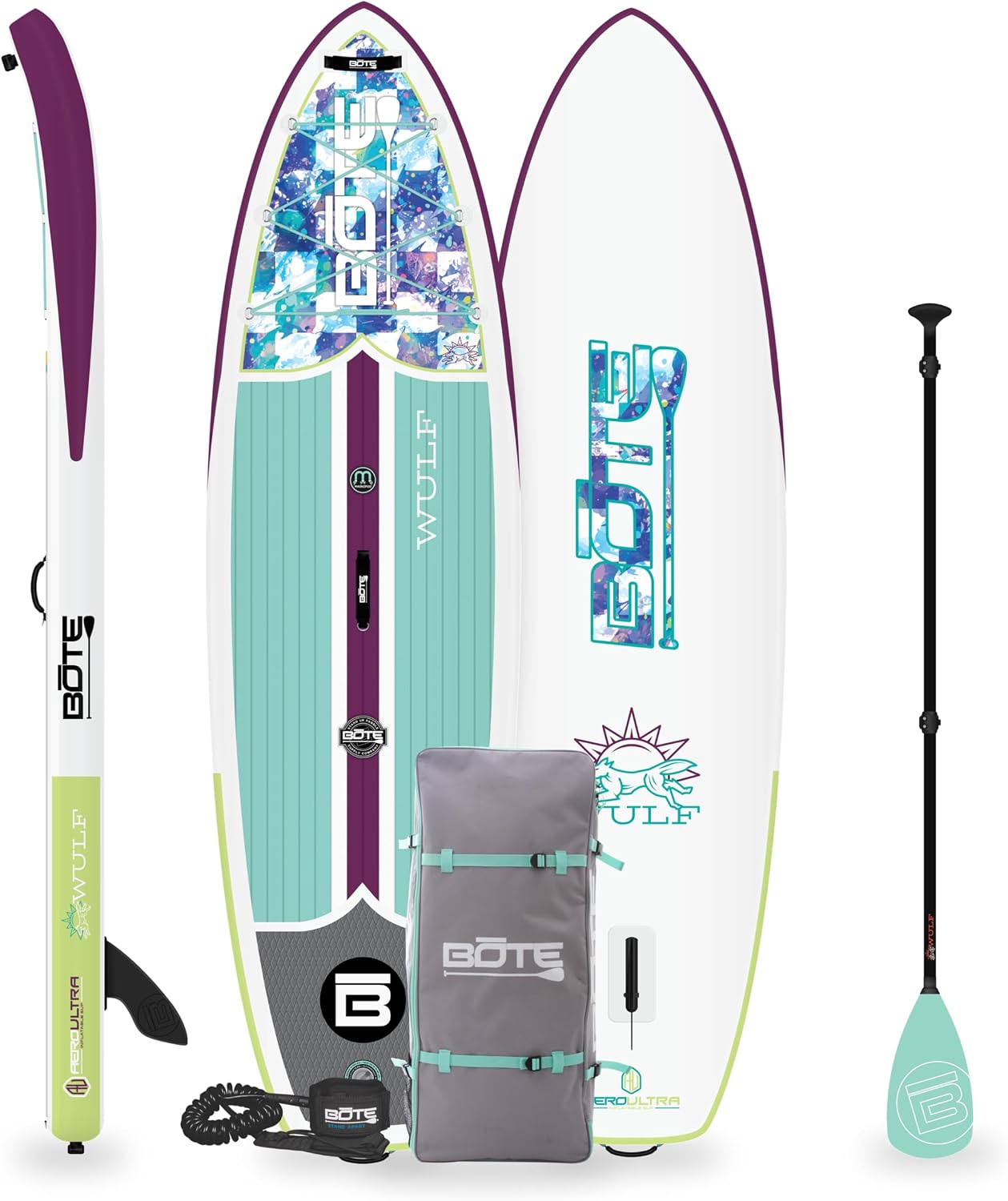
Why This Comparison Matters More Than a Spec Sheet
If you have spent any time shopping for an inflatable stand up paddle board, two brand names keep rising to the top of the conversation: iRocker and Bote. Both build inflatable boards that real people paddle on real water every weekend. Both ship complete packages. And both will happily take your money. The difference is in what they decide to optimize for.
Choosing between them is not really about which brand is “better” in some abstract sense. It is about which brand’s priorities match yours. Maybe you are a heavier rider who wants as much stability and carrying capacity as possible. Maybe you travel constantly and need something that packs down smaller than a standard inflatable. Maybe you fish from your board, or you do yoga, or you paddle with a dog and a dry bag full of snacks. Each of those scenarios points toward a different answer.
That is exactly how this article is organized. Rather than throwing all six boards into one giant spreadsheet, we matched them up the way you would actually shop: a stable, do-everything all-around in the popular 10’6″ class; a compact all-around for people who value packability and easy handling; and a heavy-duty option built for larger riders and gear-heavy days. Within each matchup, we look at what each board does well, where it gives something up, and who should honestly buy it.
A quick note on how we write these guides: we do not invent prices, star ratings, review counts, or laboratory test results. Where a specification is not something we can state with confidence, we describe the real-world effect instead of dressing it up with numbers. The numbers you see in this article are the ones attached to the boards themselves — dimensions and capacities as listed — so you can compare like for like without wondering where a figure came from.
If you are completely new to the sport and still figuring out what a stand up paddle board even is, our beginner’s guide to paddle boards is the right place to start before you read another word of a comparison. If you already know your paddling style and just want the verdict, jump straight to the quick comparison table below.
What you will get from this guide
Six full product breakdowns, three head-to-head matchups, a master comparison table, a plain-English buying guide, and a set of frequently asked questions covering the things people actually ask before clicking “buy.” By the end, you should be able to name the exact board you want and explain why.
Ready to Start Shopping?
Compare current inflatable paddle board listings and see which packages are available right now.
Browse Inflatable Paddle Boards on AmazonQuick Comparison: Our Top Picks
Every board in this guide is listed here in one place. Scan the “Best For” label to find the category that matches your paddling, then use the button to check the current listing. Detailed reviews for each board follow in the sections below.
| # | Image | Product | Key Specs | Verdict | Check Price |
|---|---|---|---|---|---|
| 1 | |
iROCKER Cruiser 10’6″ Inflatable Paddle Board Top Pick Best Overall All-Around |
|
Huge capacity and easy stability for almost everyone. | Check Price on Amazon |
| 2 | 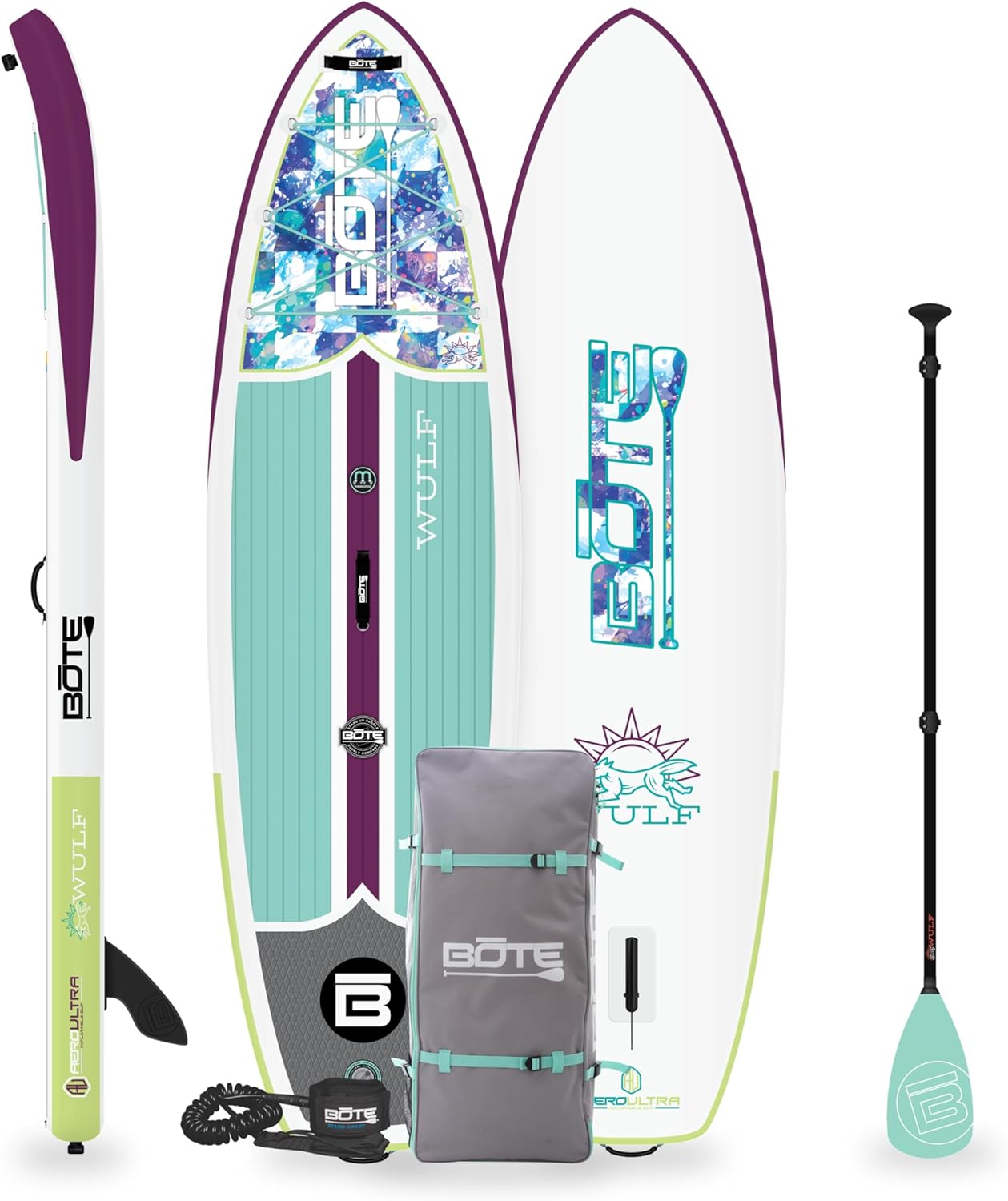 |
BOTE Wulf Aero Inflatable Paddle Board Best for Stability-First Paddlers |
|
Extra width plus a mount system that grows with you. | Check Price on Amazon |
| 3 |  |
iROCKER Blackfin Model XL Inflatable Paddle Board Best for Heavier Riders & Gear |
|
The board you buy when “enough room” really matters. | Check Price on Amazon |
| 4 |  |
BOTE HD Aero 11’6″ x 34″ Inflatable Paddle Board Best for Versatile Big-Day Trips |
|
Long, wide, and happy to carry a full day of gear. | Check Price on Amazon |
| 5 |  |
iROCKER Cruiser Ultra 10’6″ x 33″ x 6″ Inflatable Paddle Board Best Compact Travel All-Around |
|
Full-size comfort in a travel-friendlier package. | Check Price on Amazon |
| 6 | 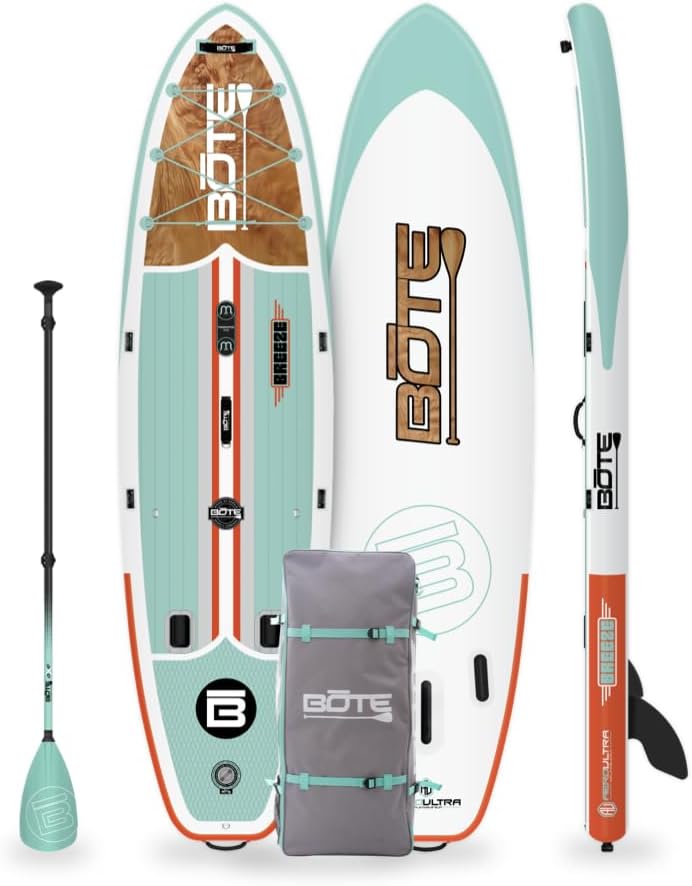 |
BOTE Breeze Aero 10’8″ x 33″ x 6″ Inflatable Paddle Board Best for Carefree Cruising |
|
A relaxed, forgiving cruiser for calm water days. | Check Price on Amazon |
Quick read: if you want the single most confidence-inspiring all-around in this group, start with the iROCKER Cruiser. If you want a wider platform and a built-in accessory mount, start with the BOTE Wulf Aero. Larger riders should jump to the third and fourth rows.
See the Full Listing for Our Top Pick
Check what is included in the current Cruiser package before you decide.
Check Price on AmazonBrand DNA: What iRocker and Bote Each Stand For
Before comparing individual boards, it helps to understand the two design philosophies behind them, because those philosophies show up in every decision from hull shape to deck pad texture.
iRocker: capacity, stability, and honest value
iRocker has built its reputation on boards that feel planted and forgiving from the first stroke. The lineup reads like a deliberate ladder: entry-friendly options such as the iRocker Nautical, all-around workhorses like the Cruiser, compact travel boards in the Ultra range, and the heavier-duty Blackfin line for riders who need more board underfoot. That structure makes it unusually easy to find your place in the range.
The recurring theme across iRocker boards is generous usable space. Look at the Cruiser: 33 inches wide and rated to carry up to 435 pounds. That is a board designed around the assumption that you will bring things with you — a kid, a cooler, a dog, a camera bag — and that you would rather have stability you do not need than stability you wish you had. For a full breakdown of the brand’s approach, our iRocker paddle board review goes deeper into the lineup as a whole.
Bote: design, lifestyle, and an accessory ecosystem
Bote tends to lead with design and experience. Boards in the Aero family are built to look considered on the water and to integrate with a wider world of accessories, the clearest example being the MagnePod mount system on boards like the Wulf Aero. If you like the idea of a board that can accept add-ons without glue-on improvisation, that ecosystem is genuinely useful.
Bote also spreads its range across a wide set of shapes, from relaxed cruisers like the Breeze Aero to longer, wider platforms like the HD Aero. The unifying idea is a board that feels like part of a day out rather than a piece of sporting equipment you simply tolerate. You can read more about the brand’s inflatable lineup in our Bote inflatable paddle board review.
Where the philosophies collide
The practical tension between the two brands comes down to three questions:
- How much board do you want under you? iRocker tends to give you more platform and more rated capacity in the same size class.
- How much do you care about add-ons? Bote’s mount-friendly design makes accessory expansion simpler.
- How far will the board travel? Compact-oriented designs like the Cruiser Ultra change the packing math significantly.
Neither answer is universally correct, which is why the rest of this guide is organized by use case rather than by brand loyalty. And if you want the wider market context, our roundup of the best inflatable paddle boards shows how both brands stack up against everything else out there.
A note on comparisons
Brand matchups are useful, but they are not the only ones worth reading. If you are cross-shopping aggressively, our Isle vs iRocker and Atoll vs iRocker comparisons cover two of the most common alternative shortlists.
Explore the Wider Paddle Board Market
See current inflatable paddle board packages across every major style.
Check Inflatable Paddle Boards on AmazonAll-Around 10’6″ Class: iROCKER Cruiser vs BOTE Wulf Aero
This is the matchup most shoppers will actually face. The 10’6″ all-around is the hatchback of the paddle board world: not the fastest, not the most specialized, but the shape that does the widest range of jobs credibly. Both boards here fit that brief, and both prioritize stability. The difference is how they get there.
| Attribute | iROCKER Cruiser 10’6″ | BOTE Wulf Aero |
|---|---|---|
| Width | 33 inches — wide and reassuring | 34 inches — one of the widest in class |
| Rated capacity | Up to 435 lb | Roomy platform for rider plus gear |
| Board weight | 25 lb | Manageable to carry with the included bag setup |
| Accessory story | Traditional deck rigging and D-ring layout | MagnePod mount for quick-attach accessories |
| Best for | Riders who want maximum usable capacity | Riders who want the widest possible stance |
iROCKER Cruiser 10’6″ Inflatable Paddle Board
The Cruiser is the board most people should look at first. It is a 10’6″ all-around with a 33-inch-wide deck, a listed board weight of 25 pounds, and a rated carrying capacity of up to 435 pounds. Those numbers describe a board that is forgiving when you are learning, stable when you are loaded, and comfortable to stand on for hours.
What makes it our overall top pick is not any single dramatic feature. It is the combination: enough width to feel steady, enough length to glide decently between strokes, and enough rated capacity that you can realistically paddle with a child, a pet, or a pile of gear without the board feeling overwhelmed.
Key Features
- 10’6″ all-around outline that balances straight-line glide with easy turning.
- 33-inch-wide deck for a planted, confidence-building stance.
- Rated capacity up to 435 lb, making it one of the most gear-friendly boards in this comparison.
- 25 lb board weight — substantial enough to feel solid, still manageable to carry.
- Full-traction deck pad for comfortable standing, kneeling, and moving around on the board.
What We Like
- Exceptionally generous rated capacity for the size class
- Stable enough for absolute beginners and nervous standers
- Works for solo paddling, tandem cruising, and gear-heavy days
- Dimensions that suit a wide range of rider heights
Keep in Mind
- 25 lb is not the lightest carry on a long walk to the water
- All-around shape will not match a dedicated touring board for speed
- Wide platform asks for a slightly wider paddle stroke
Best for: First-time buyers, families, dog owners, and anyone who would rather have too much stability than too little.
Check the iROCKER Cruiser
See the current package and what ships with the board.
Check Price on Amazon
BOTE Wulf Aero Inflatable Paddle Board
The Wulf Aero is Bote’s answer to the stability question, and it answers it by going wide. At 34 inches across, it gives you a platform that feels reassuringly large underfoot, which is exactly what nervous beginners and heavier paddlers tend to want in their first season.
The feature that separates it from the crowd is the MagnePod mount. Instead of treating accessories as an afterthought, the board gives you a dedicated, quick-attach point that works with Bote’s wider ecosystem. If you like the idea of a drink holder, a mount for your phone, or other add-ons that click into place rather than strap on awkwardly, this is a genuinely meaningful design choice.
Key Features
- 34-inch-wide deck for a very stable, beginner-friendly platform.
- MagnePod magnetic mount system for fast, clean accessory attachment.
- Aero inflatable construction shared across Bote’s inflatable range.
- Wide all-around outline that turns willingly without feeling twitchy.
- Clean, lifestyle-focused deck design with practical on-deck storage options.
What We Like
- One of the widest platforms in this comparison
- MagnePod makes accessory use genuinely convenient
- Confidence-inspiring for first sessions on the water
- Roomy deck suits relaxed, gear-laden paddling
Keep in Mind
- Extra width trades away a little speed and glide
- Best experience comes from staying within the brand’s accessory ecosystem
- Wide boards need slightly more paddle reach on each stroke
Best for: Stability-first paddlers, accessory lovers, and anyone who wants their first board to feel as safe as possible.
Check the BOTE Wulf Aero
See the current listing and available accessory options.
Check Price on AmazonWhich one wins this matchup?
It comes down to what you are optimizing for. The Cruiser’s rated capacity of 435 pounds is the headline number here; if your plan involves bringing other people, pets, or a lot of gear, that headroom is genuinely valuable and it is the main reason the Cruiser takes our overall top spot. The Wulf Aero, meanwhile, gives you an extra inch of width and a cleaner path to accessories through the MagnePod system.
If you are an average-weight solo paddler who mostly wants a comfortable cruiser and occasionally adds a few accessories, the Wulf Aero is a satisfying choice. If you want the broadest possible range of uses from a single board, the Cruiser edges it. For more background on board shapes and what they mean in practice, see our guide to the different types of paddle boards.
Our Pick in This Matchup
For capacity and all-around versatility, the Cruiser is the one to check first.
Check Price on AmazonCompact All-Arounds: iROCKER Cruiser Ultra vs BOTE Breeze Aero
Not everyone shops for the biggest board they can find. Plenty of paddlers live in apartments, drive small cars, take boards on planes, or simply do not want to wrestle a full-size bag up and down stairs every weekend. That is where compact all-around boards earn their keep, and it is exactly the territory this second matchup covers.
Both boards here keep the familiar all-around proportions that make a board easy to learn on, but they package that experience differently. The Cruiser Ultra keeps the Cruiser’s stable 10’6″ by 33-inch footprint while aiming for a smaller, more manageable packed profile. The Breeze Aero stretches out slightly to 10’8″ by 33 inches by 6 inches, giving a touch more length for relaxed cruising on calm water.
| Attribute | iROCKER Cruiser Ultra | BOTE Breeze Aero |
|---|---|---|
| Dimensions | 10’6″ x 33″ x 6″ | 10’8″ x 33″ x 6″ |
| Design priority | Compact packed size without losing a stable deck | Easy, relaxed all-around cruising |
| Water type | Lakes, bays, calm rivers, light chop | Lakes, bays, calm coastal water |
| Best for | Travelers and small-space owners | Casual paddlers who value comfort |
iROCKER Cruiser Ultra 10’6″ x 33″ x 6″ Inflatable Paddle Board
The Cruiser Ultra exists to solve a specific annoyance: you want the stability of a wide all-around, but you do not want the packing and storage burden that usually comes with one. By keeping the proven 10’6″ by 33-inch by 6-inch footprint and focusing on a more compact packed profile, it targets people who need their board to fit into real life as well as onto the water.
The dimensions matter here. Thirty-three inches wide and six inches thick is the sweet spot for a board that stays composed when you shift your weight, stands up well to light chop, and still feels predictable when you hand it to a nervous friend.
Key Features
- 10’6″ x 33″ x 6″ proportions — stable, familiar, and easy to learn on.
- Compact-oriented packing design aimed at easier storage and transport.
- Six-inch thickness for solid rigidity and clearance over surface chop.
- Cruiser-family stability in a more travel-friendly format.
- Versatile all-around outline suited to flatwater and light coastal use.
What We Like
- Full-size stability with a friendlier packed profile
- Six-inch thickness keeps the deck firm underfoot
- Ideal for apartment dwellers and frequent travelers
- Dimensions work well for a broad range of riders
Keep in Mind
- Compact designs often mean a more deliberate setup routine
- Not the right choice if you want maximum cargo capacity
- Best suited to paddlers who value portability over raw size
Best for: Travelers, small-space owners, and anyone who wants a stable board that is easier to live with between sessions.
Check the iROCKER Cruiser Ultra
See the current listing and what is included in the package.
Check Price on Amazon
BOTE Breeze Aero 10’8″ x 33″ x 6″ Inflatable Paddle Board
The Breeze Aero is the board you buy when you want paddling to feel easy. Its 10’8″ by 33-inch by 6-inch outline is slightly longer than the classic all-around, which tends to help the board track a little straighter between strokes while keeping the wide, stable platform that makes a board pleasant to stand on all afternoon.
This is not a board built around technical ambitions. It is built around the simple pleasure of getting out on the water without thinking too hard about it — which, for a large number of paddlers, is the entire point.
Key Features
- 10’8″ x 33″ x 6″ outline for a balanced blend of stability and glide.
- Aero inflatable construction for a stiff, confident feel on the water.
- Wide, comfortable deck suited to relaxed cruising and casual fitness.
- Six-inch thickness that helps the board stay composed in light chop.
- Clean deck layout with practical storage for day-trip essentials.
What We Like
- Very approachable handling for new paddlers
- Slight extra length helps with straight-line tracking
- Comfortable platform for long, slow sessions
- Pairs well with Bote’s accessory ecosystem
Keep in Mind
- Relaxed shape is not aimed at speed or racing
- Extra length means a slightly bigger board to store
- Best experienced on calm to moderate water
Best for: Casual paddlers, couples, and anyone who wants a low-stress cruiser for calm-water days.
Which compact board suits you?
The honest answer is that these two boards appeal to slightly different people. The Cruiser Ultra is aimed at anyone whose real constraint is space and transport — the paddler who needs the board to disappear into a closet or a car trunk and come back out ready to paddle. The Breeze Aero is aimed at anyone whose real constraint is effort: you want a board that feels natural and comfortable the moment you step on it.
Both share the same six-inch thickness and 33-inch width, so neither will feel twitchy or unstable. If your home is small and your travel plans are ambitious, lean Cruiser Ultra. If you are buying a board for leisurely weekends and want it to feel effortless, lean Breeze Aero. And if you are still deciding what “compact” even means for your lifestyle, our guide to inflatable paddle board storage ideas is worth reading before you commit to a size.
Shop Compact All-Around Boards
Compare current listings in the compact inflatable category.
Check Prices on AmazonHeavier Riders & Versatility: iROCKER Blackfin Model XL vs BOTE HD Aero
Here is where the conversation changes tone. Standard all-around boards work beautifully for lighter paddlers on calm water, but once you add body weight, gear, a cooler, a fishing crate, or a second passenger, the demands on a board rise quickly. That is why both brands build a heavier-duty option, and both of these boards are designed to carry more and do more.
The Blackfin Model XL is iRocker’s answer for riders who need room and capability. The HD Aero is Bote’s longer, wider inflatable platform, listed with a 315-pound weight capacity and an 11’6″ by 34-inch outline that makes it one of the more substantial boards in this comparison. Both are legitimate choices; they simply emphasize different things.
| Attribute | iROCKER Blackfin Model XL | BOTE HD Aero |
|---|---|---|
| Board class | Heavy-duty, gear-friendly all-around | Long, wide inflatable platform |
| Key dimensions | Extended outline with generous deck area | 11’6″ long x 34″ wide |
| Rated capacity | Built for heavier riders and loaded decks | 315 lb |
| Best for | Heavier paddlers, fishing, family days | Versatile big-day trips with gear |
iROCKER Blackfin Model XL Inflatable Paddle Board
The Blackfin Model XL is the board you step up to when a standard all-around stops feeling like enough. It is built around the idea that bigger riders and gear-loaded days deserve a platform that does not feel like it is working hard just to keep you out of the water.
The extra deck area changes what is possible. There is room to stand, room to stow, and room to shift your weight around without the board reacting dramatically. That matters enormously if you fish from your board, paddle with children, or simply prefer a platform that never feels cramped.
Key Features
- Extended all-around outline designed around heavier riders and loaded paddling.
- Generous deck area for cargo, crates, coolers, and extra passengers.
- Stability-first platform that stays composed as weight is added.
- Practical deck rigging for securing gear on longer outings.
- Versatile usage profile spanning cruising, fishing, and family days.
What We Like
- Genuinely roomy platform for larger paddlers
- Handles gear-heavy outings without feeling overloaded
- Stable enough for fishing and photography
- Grows with you as your paddling ambitions expand
Keep in Mind
- Bigger boards mean more to carry and more to store
- Not the choice for paddlers who value lightweight simplicity
- Overkill if you only ever paddle solo on calm water
Best for: Heavier riders, anglers, families, and anyone who consistently paddles with a lot of gear.
Check the iROCKER Blackfin Model XL
See the current listing and package inclusions.
Check Price on Amazon
BOTE HD Aero 11’6″ x 34″ Inflatable Paddle Board
The HD Aero is the big-platform option in this comparison: 11’6″ long, 34 inches wide, and listed with a 315-pound weight capacity. That combination tells you a lot about its character. The length helps it carry momentum between strokes, the width keeps it steady, and the rated capacity gives real headroom for a paddler plus a full day of equipment.
It is a board that rewards people who like to bring things along. Fishing tackle, dry bags, a camera, a picnic, a four-legged companion — the HD Aero is set up to handle the kind of day where the paddle is only part of the plan.
Key Features
- 11’6″ length for improved glide and straight-line tracking.
- 34-inch-wide deck delivering a stable, roomy standing platform.
- 315 lb rated weight capacity for paddler plus gear.
- Aero inflatable construction for a firm, dependable feel.
- Versatile deck layout suited to touring, fishing, and all-day outings.
What We Like
- Long and wide enough for confident loaded paddling
- Tracks well for a board of its width
- Rated capacity with real-world headroom for gear
- Excellent platform for fishing and day touring
Keep in Mind
- Large board means a bigger bag and more setup space
- Length makes tight, twisty water more work
- Rated capacity is lower than the Cruiser’s headline figure
Best for: Larger paddlers, day-touring enthusiasts, and anglers who want one board for a wide range of trips.
The capacity question, answered honestly
The number that jumps out of this comparison is the Cruiser’s rated 435-pound capacity, which sits well above the HD Aero’s listed 315 pounds. But rated capacity is only one part of the story. A longer board like the HD Aero can feel smoother and more efficient on the water even with a lower rated limit, because length and outline shape determine how the board carries weight once it is moving.
As a practical rule: match the board to the total load you actually plan to carry, then add a margin for comfort. If you want to understand how capacity figures relate to real paddling, our explainer on how much weight a paddle board can hold breaks down the variables that matter, and our guide to the best paddle boards for fishing covers what anglers specifically should look for.
Shop Heavy-Duty Paddle Boards
Compare larger, higher-capacity inflatable boards built for gear.
Check Prices on AmazonConstruction & Build Quality: What You Are Actually Standing On
Every inflatable paddle board in this comparison is built on the same fundamental idea: two layers of material joined by thousands of fine internal threads, then inflated until the whole structure becomes rigid. That is drop-stitch construction, and it is the reason an inflatable board can feel genuinely firm underfoot rather than like a pool toy that happens to be shaped like a surfboard.
The differences between brands show up in how they finish that basic structure — the outer skin, the rails (the edges of the board), the deck pad, the attachment hardware, and the overall attention to detail. These are the things that determine whether a board feels solid and well-made after a season of use, or whether it starts to feel tired.
What to look for in an inflatable board’s build
- Rail construction. The rails are where a lot of a board’s stiffness and durability live. Well-finished rails feel clean to the touch and resist scuffing.
- Deck pad quality. You stand on this for hours. A textured, comfortable pad with good coverage makes a noticeable difference to foot fatigue and grip.
- Hardware integration. D-rings, mounts, and bungee attachment points should feel recessed and secure, not stuck on as an afterthought.
- Seam and finish quality. Clean seams and consistent material finishing are the quiet signals of careful manufacturing.
Both iRocker and Bote build boards that feel substantial when inflated properly. iRocker’s boards in this comparison tend to emphasize usable deck area and carrying capacity, while Bote’s designs emphasize integrated features such as the MagnePod mount on the Wulf Aero. Neither approach is wrong; they simply reflect different priorities.
If you want to understand how these boards come together in the factory — what drop-stitch actually does, why thickness matters, and where costs go — our guide on how paddle boards are made is a genuinely useful read. And if you are still weighing inflatable against a traditional hard board, the inflatable vs hard paddle board comparison lays out the trade-offs clearly.
The honest truth about “military-grade” claims
Almost every inflatable board on the market uses similar families of drop-stitch and PVC. Marketing language varies wildly; the underlying technology does not vary nearly as much. Judge boards by how they paddle, how well they hold air over time, and how thoughtfully the details are finished — not by the adjectives on the listing.
Compare Inflatable Build Quality
Browse current inflatable paddle boards and read listing details carefully.
Check Prices on AmazonStability, Width & Weight Capacity: The Numbers That Change Your Session
If there is one thing that decides whether a beginner falls in love with paddle boarding or gives up after two sessions, it is stability. And the good news is that stability is largely predictable from a board’s dimensions. Wider is steadier. Longer carries momentum. Thickness adds rigidity. Capacity tells you how much the board can realistically carry before it starts to sit low and feel sluggish.
Here is how the six boards in this comparison line up on the headline figures we can state with confidence.
| Board | Length | Width | Rated Capacity | Stability Feel |
|---|---|---|---|---|
| iROCKER Cruiser | 10’6″ | 33″ | Up to 435 lb | Very planted |
| BOTE Wulf Aero | All-around class | 34″ | Roomy platform | Extremely planted |
| iROCKER Cruiser Ultra | 10’6″ | 33″ | All-around range | Very planted |
| BOTE Breeze Aero | 10’8″ | 33″ | All-around range | Stable and relaxed |
| iROCKER Blackfin Model XL | Extended outline | Wide platform | Heavy-duty range | Maximum planted |
| BOTE HD Aero | 11’6″ | 34″ | 315 lb | Stable and composed |
Width: the single most important stability number
Thirty-three inches is already a generous width for an all-around board, and both the Cruiser and the Cruiser Ultra sit right there. Push to 34 inches — as the Wulf Aero and HD Aero do — and you get an even more reassuring platform, particularly for taller or heavier paddlers or anyone whose balance is still developing. The trade-off is that wider boards ask for a slightly longer reach on each paddle stroke and give up a little speed.
Capacity: headroom matters more than the headline
Rated capacity is a useful guide, but what you actually feel is how the board behaves at your real load. A board rated well above your body weight plus gear will sit higher in the water, respond more crisply to your strokes, and feel livelier. That is why the Cruiser’s 435-pound figure is meaningful even for a lighter paddler — it means enormous headroom for gear, a passenger, or a dog. For a deeper dive into how these figures work in practice, read how much weight can a paddle board hold.
Matching the board to your body
As a general approach: if you are a lighter paddler on calm water, any of these boards will feel stable. If you are taller or heavier, prioritize width and capacity first, and consider stepping up to the Blackfin Model XL or HD Aero. If you are buying a board to share with family members of different sizes, buy for the largest person who will use it — everyone else will find it easier, not harder. Our guide to the best paddle boards for beginners covers this matching process in more detail.
Find a Board That Fits Your Build
Shop high-stability inflatable paddle boards with generous capacity.
Check Prices on AmazonPortability, Storage & Travel: Living With Your Board Between Sessions
Here is a truth that product listings rarely emphasize: the vast majority of a paddle board’s life is spent out of the water. It lives in a closet, in a car trunk, in a garage corner, or in the overhead bin of an aircraft. How easily a board fits into that life is a huge part of whether you will actually use it.
This is where the distinction between a standard inflatable and a compact-oriented design becomes real. The iROCKER Cruiser Ultra is explicitly built for people whose constraint is space. A board that packs down smaller changes the entire ownership equation: you can store it in an apartment, carry it further to the water, and take it places a traditional inflatable simply would not go.
The carry question
The Cruiser lists a board weight of 25 pounds, which is a useful reference point. Add a pump, paddle, and personal gear, and a full kit becomes something you carry in a backpack-style bag rather than under one arm. That is completely normal for inflatable paddle boards, and it is exactly why quality bags matter. Our guide to the best paddle board bags covers what to look for in terms of padding, straps, and packing space.
Getting the board to the water
One of the great advantages of an inflatable is that you do not need a roof rack. A folded board fits in a trunk, a back seat, or a closet, which removes the single biggest barrier to spontaneous paddling. That said, plenty of paddlers own both inflatable and hard boards, or eventually upgrade — and if you are in that camp, our guide to the best paddle board roof racks will save you a lot of guesswork.
For the full picture of moving boards of every kind around, see how to transport a paddle board. And if storage space is genuinely tight, inflatable paddle board storage ideas has practical setups for apartments, garages, and small cars.
Travel tips worth knowing before you fly
- Weight is the constraint, not size. Airlines care about total bag weight, so a lighter board and a minimal accessory kit make travel far easier.
- Pack the pump and fins carefully. Hard accessories are what tend to get damaged in transit.
- Allow drying time before packing. Storing a damp board is the fastest route to a musty smell.
- Think about the paddle. A breakdown or adjustable paddle travels far better than a fixed-length one. See our guide to the best paddle board paddles for options.
Where the brands differ here
The compact-focused Cruiser Ultra is the strongest choice in this comparison when travel and storage are the priority. The larger boards — the Blackfin Model XL and the HD Aero — give up some packability in exchange for on-water capability, which is a perfectly reasonable trade if you drive to your launch site.
Shop Paddle Board Bags & Travel Gear
Find backpacks and bags sized for inflatable paddle boards.
Check Prices on AmazonAccessories, Fins & Mounts: The Extras That Shape Your Experience
A paddle board is really a system: board, paddle, pump, fins, leash, personal flotation, and whatever you bolt, strap, or click onto the deck. Both brands know this, and both ship their boards as packages. The interesting differences are in the philosophy behind the extras.
Bote’s MagnePod advantage
The clearest accessory differentiator in this comparison is the MagnePod mount on the BOTE Wulf Aero. A dedicated, quick-attach mount point removes the friction from using accessories. Instead of strapping a cup holder on and off every session, you click it into place and forget about it. If you know you will use add-ons regularly — a phone mount for photos, a drink holder for long flatwater sessions — that convenience compounds every single time you paddle.
The essentials every board needs
- A pump that matches the board. A good pump turns setup from a chore into a two-minute job. See our guide to the best paddle board pumps.
- A paddle sized for you. Height, blade shape, and shaft material all affect comfort and efficiency. Our paddle buyer’s guide covers the trade-offs.
- A leash and a flotation device. Non-negotiable safety items, covered properly in paddle board safety requirements and our list of the best paddle board life jackets.
- A seat, if you want to sit. Several boards in this class accept a kayak-style seat, which turns a paddle board into a genuinely versatile hybrid. See the best paddle board seats.
A small question with a surprisingly big impact
Beginners often ask whether a paddle floats. The answer depends entirely on the paddle, and it matters more than it sounds — dropping a paddle in deep water is one of the most common ways a pleasant session turns stressful. Our explainer on do paddle board paddles float covers what to look for and what to do if yours does not.
Fins and tracking hardware
Fin setup affects how straight a board tracks and how easily it turns. Most all-around boards use a configuration that favors predictable, straight-line tracking with easy release when you want to turn. If you are comparing fin systems across brands, pay attention to how easily fins can be installed and removed without tools, because you will do this every session.
Complete Your Paddle Board Setup
Shop pumps, paddles, seats, and mount accessories for your board.
Check Prices on AmazonOn-Water Performance: How These Boards Actually Feel to Paddle
Specs describe a board. Paddling reveals it. This section covers the qualities you will notice in the first ten minutes on the water and the qualities that matter after fifty sessions.
Tracking and glide
Longer boards generally carry momentum better between strokes, which is why the 11’6″ HD Aero tends to feel smoother on open water than a shorter all-around. Wider boards give up a small amount of efficiency in exchange for stability. In practice, the difference shows up as how many strokes you take to cross a bay — not as a dramatic change in experience.
Turning and maneuverability
Shorter, wider boards turn more willingly. If your paddling happens on twisty rivers, in and out of docks, or around swimmers and other traffic, a compact all-around like the Cruiser Ultra or Breeze Aero will feel more responsive. If you mostly paddle straight lines on open water, the longer boards will reward you.
Chop, wind, and less-than-perfect water
Six-inch thickness helps here. Both the Cruiser Ultra and Breeze Aero are listed at six inches thick, which gives them solid rigidity and enough clearance to bridge small chop rather than slapping through it. Larger boards handle wind better simply because they have more waterline and more mass. For timing your outings around conditions, our guide to the best time to paddle board is genuinely practical.
Specialized uses
Stable, wide boards are excellent platforms for activities beyond simple cruising:
- Yoga and fitness. A wide, flat deck with good grip is ideal. See the best paddle boards for yoga.
- Fishing. Stability and deck room matter most. See the best paddle boards for fishing.
- Paddling with kids or pets. Capacity and stability matter most here, which is where the Cruiser’s 435-pound rating shines.
- Casual touring. The HD Aero’s length makes it the natural fit in this group.
One question we get constantly is whether a stand up paddle board and a “paddle board” are the same thing, and how all of this relates to kayaks. Our comparisons of SUP board vs paddle board and paddle board vs kayak clear that up quickly.
Shop Boards Built for Performance
Compare touring, all-around, and specialized inflatable paddle boards.
Check Prices on AmazonDurability, Care & Longevity: Protecting Your Investment
Inflatable paddle boards have a reputation for toughness, and it is largely deserved. A well-made inflatable handles bumps, scrapes, and rough launches far better than many people expect. But “tough” does not mean “indestructible,” and a handful of habits will determine whether your board lasts a few seasons or many.
The habits that extend a board’s life
- Do not store it fully inflated in direct sun. Heat and sustained pressure are hard on any inflatable material.
- Do not store it soaking wet. Dry it thoroughly before rolling it up. This single habit prevents most long-term problems.
- Rinse after saltwater use. Salt is abrasive and corrosive to hardware.
- Avoid dragging it over rough surfaces. Lift and carry where possible, especially across concrete and shell beds.
- Check your pressure regularly. A board that is too soft flexes more than it should and works the seams harder.
When things go wrong
Most inflatable board damage is minor: a slow leak from a puncture, a scuffed rail, or a fin box that takes a hit on a rocky launch. The overwhelming majority of these are repairable at home with a standard patch kit and a little patience. Our walkthrough on how to patch a paddle board covers the process step by step, and it is worth reading before you ever need it.
How long should you expect a board to last?
That depends on how often you paddle, how you store the board, and how well you look after it. Paddlers who dry their boards before storage and keep them out of prolonged direct sun consistently report many seasons of use. For a fuller answer covering materials, storage, and wear patterns, see how long do inflatable paddle boards last.
Both brands age well — if you let them
Nothing in this comparison suggests either iRocker or Bote boards are fragile. The differentiator in longevity is almost always owner habits, not factory quality. Treat your board like a piece of outdoor equipment rather than a toy, and it will reward you for years.
Shop Paddle Board Repair Essentials
Keep a patch kit and maintenance supplies on hand before you need them.
Check Prices on AmazonBuying Guide: Which of These Boards Should You Actually Buy?
Everything up to this point has been analysis. This section is decision-making. Read the profile that sounds most like you, and you will almost certainly land on the right board.
Buy the iROCKER Cruiser if…
You want one board that does almost everything well. The 10’6″ by 33-inch platform is easy to learn on, and the rated 435-pound capacity gives you room to bring gear, kids, or pets without the board feeling taxed. This is our overall recommendation for the broadest range of paddlers.
Buy the BOTE Wulf Aero if…
Stability is your top priority and you love the idea of accessories that attach cleanly. At 34 inches wide with the MagnePod mount, it is a confidence-building board with a clear upgrade path as your accessory collection grows.
Buy the iROCKER Cruiser Ultra if…
Space and travel are your constraints. You want the stability of a 10’6″ by 33-inch by 6-inch all-around, but you need it to fit into a smaller footprint between sessions. This is the apartment-dweller’s board.
Buy the BOTE Breeze Aero if…
You want paddling to be easy. The 10’8″ by 33-inch by 6-inch outline is relaxed, comfortable, and forgiving — a board for people who measure a good session in hours of calm water rather than miles covered.
Buy the iROCKER Blackfin Model XL if…
You are a heavier rider, an angler, or a family paddler who consistently needs more room and more capability than a standard all-around offers. This is the board you grow into rather than out of.
Buy the BOTE HD Aero if…
You want a long, wide, versatile platform for full-day trips with gear. With an 11’6″ by 34-inch outline and a 315-pound rated capacity, it is a natural fit for touring, fishing, and big-water adventures.
| If You Are… | Your Best Match | Why |
|---|---|---|
| A first-time buyer | iROCKER Cruiser | Maximum stability and capacity headroom |
| Nervous about balance | BOTE Wulf Aero | Widest platform in the group |
| Short on storage space | iROCKER Cruiser Ultra | Compact-oriented packing design |
| A casual, relaxed paddler | BOTE Breeze Aero | Comfortable, easy-going cruising shape |
| Heavier or gear-heavy | iROCKER Blackfin Model XL | Roomy, heavy-duty platform |
| A day-touring enthusiast | BOTE HD Aero | Longer outline with generous capacity |
Questions to ask before you click buy
- Where will I actually paddle? Calm lakes and bays reward different boards than windy coastal water.
- Who else will use this board? Buy for the largest or least experienced person.
- Where will I store it? Be honest about your closet and your car.
- What will I carry? Coolers, dogs, and fishing gear all eat into capacity.
- Will I want accessories later? Mount systems matter more than people expect.
If you are brand-new and still uncertain, our overview of whether inflatable paddle boards are good for beginners answers the most common doubts, and the beginner board roundup narrows the field further. We also keep full brand reviews for Isle, Tower, and Gili if you want to widen your shortlist beyond these two brands.
Ready to Decide?
Compare current inflatable paddle board packages across every size class.
Check Prices on AmazonSafety, Learning Curve & Fitness: Getting the Most From Your Board
Buying the right board is half the equation. The other half is using it safely, learning efficiently, and building the habit that turns a purchase into a lifestyle. This final deep-dive section covers all three.
Safety basics that are not optional
Paddle boarding looks serene, and on calm water it usually is. But water is unforgiving of complacency. Before your first session, make sure you have a properly fitted personal flotation device, a leash appropriate for your water type, and a clear understanding of the conditions. Our complete guide to paddle board safety requirements covers the essentials, and our review of the best paddle board life jackets helps you choose one you will actually wear.
- Always wear a leash. It keeps you connected to your board, which is your largest flotation device.
- Check conditions before you launch. Wind is the single most underestimated factor in paddle boarding.
- Tell someone your plan. A simple “I am paddling here until this time” is enough.
- Start calm, build gradually. Flatwater first, then light chop, then open water.
- Respect other water users. Keep distance from swimmers, boats, and wildlife.
The learning curve, honestly described
Most people stand up on a paddle board within their first session, especially on a wide, stable board like any of these. The first hour is mostly about balance and trust; the first season is about efficient stroke technique and reading the water. If you want a structured introduction, our guide on how to paddle board walks through stance, stroke, and turning.
For the honest answer on difficulty, see how hard is paddle boarding and are paddle boards hard to use. The short version: easier than almost everyone expects on calm water, and meaningfully harder in wind and current.
Fitness benefits you will actually notice
Paddle boarding is one of those rare activities that feels like leisure and works like training. Standing balance engages your core constantly, the stroke works your back, shoulders, and hips, and the gentle instability of the water means your stabilizer muscles never fully switch off. It is low-impact, scalable, and quietly demanding.
Our guides on whether paddle boarding is good exercise and how many calories paddle boarding burns cover the physiology in detail. If fitness is a major reason you are buying a board, pair it with a paddle sized correctly — our paddle guide explains why this matters more than most people think.
Getting kids and beginners started
Wide, stable boards are the right tool here, which is why the Cruiser and Wulf Aero both work so well for teaching. Give a beginner the most stable board in your collection, start on flat water, and let them kneel first. Most people find their feet within minutes. If you are building a beginner-friendly quiver, our roundup of the best paddle boards for beginners is the natural next read.
Shop Safety Gear & Paddling Essentials
Find life jackets, leashes, and accessories for safe sessions on the water.
Check Prices on AmazonFrequently Asked Questions: iRocker vs Bote
Which brand is better overall, iRocker or Bote?
Neither brand is universally better; they optimize for different things. iRocker tends to emphasize usable deck space, generous capacity, and straightforward value, while Bote emphasizes design, lifestyle features, and an integrated accessory ecosystem. For most paddlers wanting maximum versatility, the iROCKER Cruiser’s combination of a stable 10’6″ by 33-inch platform and a 435-pound rated capacity makes it the stronger all-around recommendation. If you value accessory integration and a slightly wider platform, the BOTE Wulf Aero is the better fit.
Is the iROCKER Cruiser a good board for beginners?
Yes, it is one of the more beginner-friendly boards in this comparison. A 33-inch-wide deck feels planted underfoot, and the 435-pound rated capacity means a beginner can paddle with extra gear or a passenger without the board sitting low in the water. Beginners benefit enormously from stability, because it lets them focus on stroke technique rather than staying upright. For more options aimed squarely at first-timers, see our guide to the best paddle boards for beginners.
What is the MagnePod mount on the BOTE Wulf Aero?
MagnePod is Bote’s quick-attach accessory mount system. Rather than strapping or clamping accessories onto the deck, compatible add-ons click into a dedicated mount point on the board. It is a convenience feature that matters most to paddlers who regularly use drink holders, phone mounts, or similar accessories. If you paddle bare-board with nothing attached, it is a nice-to-have. If you like having your gear within reach, it becomes one of the most-used features on the board.
How much weight can these paddle boards hold?
Two boards in this comparison have published figures: the iROCKER Cruiser is rated up to 435 pounds, and the BOTE HD Aero is listed with a 315-pound capacity. For the other boards, capacity is best understood as a function of their size class. As a practical rule, keep your total load — body weight plus gear plus any passengers — comfortably below the rated limit so the board rides high and responds well. Our full explainer on how much weight a paddle board can hold covers the details.
Are inflatable paddle boards as good as hard boards?
For the vast majority of recreational paddlers, yes. Modern inflatable boards are rigid when properly inflated, they are far easier to store and transport, and they handle bumps and rough launches better than most people expect. Hard boards still hold an edge in absolute speed and refined carving, which matters mainly to experienced surf and race paddlers. The trade-offs are laid out clearly in our inflatable vs hard paddle board comparison.
Which board is best for heavier riders?
Two boards stand out: the iROCKER Blackfin Model XL, which is built around heavier riders and gear-loaded paddling, and the BOTE HD Aero, with its 11’6″ by 34-inch outline and 315-pound rated capacity. The Wulf Aero’s 34-inch width also makes it a very stable choice. Generally, heavier riders should prioritize width, thickness, and rated capacity over length, then choose the largest board their storage situation allows.
What size paddle board should a beginner buy?
For most adults starting out, a board around 10’6″ long and 33 inches wide is close to ideal — which is exactly the size of the iROCKER Cruiser and the iROCKER Cruiser Ultra. That combination is long enough to glide reasonably well and wide enough to feel safe while you learn. Taller or heavier beginners should look at the 34-inch-wide options. Our guide to the different types of paddle boards explains how shape affects handling.
How long do inflatable paddle boards last?
With reasonable care, inflatable paddle boards routinely deliver many seasons of use. The two biggest factors are storage and moisture: dry your board thoroughly before rolling it up, and keep it out of prolonged direct sunlight and extreme heat. Paddlers who follow those two habits consistently report the best longevity. For a full answer covering materials and wear patterns, see how long do inflatable paddle boards last.
Can you do yoga or fish from these boards?
Yes, particularly the wider models. Yoga benefits from a flat, stable deck with good grip — the Wulf Aero and the Blackfin Model XL are strong candidates — while fishing rewards stability and deck room for tackle and crates. We cover both activities in depth in our guides to the best paddle boards for yoga and the best paddle boards for fishing.
Do I need a special pump for these boards?
You need a pump designed for high-pressure inflatable paddle boards, which is standard in most board packages. A quality pump makes setup dramatically faster and less tiring, and many paddlers upgrade after their first season. Electric pumps are a popular option for people who paddle frequently. Our guide to the best paddle board pumps covers manual and electric options.
Is paddle boarding good exercise?
It is excellent exercise disguised as a leisure activity. Standing on an unstable surface engages your core throughout the session, the paddling stroke works your back, shoulders, and hips, and the effort scales naturally with speed and conditions. It is also low-impact, which makes it accessible to a wide range of fitness levels. See is paddle boarding good exercise and does paddle boarding burn calories for the details.
How do I transport and store an inflatable paddle board?
That is one of the biggest advantages of inflatable boards: they fold down and fit in a trunk, a closet, or a backpack-style bag. No roof rack is required, though many paddlers eventually add one if they also own hard boards. Dry your board completely before storage, roll it loosely, and keep it away from heat sources. Our guides to how to transport a paddle board and inflatable paddle board storage ideas cover both topics thoroughly.
Final Verdict: iRocker or Bote?
After working through six boards across three matchups, the pattern is clear. iRocker builds boards around capability and confidence: more usable deck, more rated capacity, and a lineup that makes it easy to find exactly the right step up. Bote builds boards around experience and ecosystem: wider stability, thoughtful design, and an accessory system that makes small conveniences effortless.
For the widest range of paddlers, our overall recommendation is the iROCKER Cruiser 10’6″. A 33-inch-wide platform, 25-pound board weight, and a rated capacity of up to 435 pounds combine into a board that will work for a first season and a tenth season alike. It is stable enough for nervous beginners, big enough for gear-heavy days, and versatile enough to cover almost every recreational use case.
If you want the widest possible platform and a clean path into accessories, the BOTE Wulf Aero is the pick. If storage and travel are your constraints, the iROCKER Cruiser Ultra solves that problem elegantly. If you want effortless comfort on calm water, the BOTE Breeze Aero delivers it. And if you need heavy-duty capability, the iROCKER Blackfin Model XL and the BOTE HD Aero are both excellent, with the Blackfin leaning toward maximum deck room and the HD Aero leaning toward long-distance composure.
Whichever direction you go, buy the board that matches how you will actually paddle this year — not the one that matches how you imagine paddling in some ideal future. The best paddle board is the one you use most.
Get Our Overall Top Pick
Check the iROCKER Cruiser listing and see what comes in the package.
Check Price on AmazonOne last tip: whichever board you choose, pair it with a paddle sized for your height and a properly fitted life jacket. Those two decisions improve every single session more than any board upgrade will.
You May Also Like
More brand comparisons, beginner guides, and gear roundups to help you build the perfect setup.
Retrospec Weekender Paddle Board Review
A closer look at a popular budget-friendly all-around inflatable and how it handles real-world paddling.
Brand ReviewIsle Paddle Board Review
How Isle’s inflatable lineup compares on stability, design, and everyday usability.
Brand ReviewTower Paddle Board Review
An honest breakdown of Tower’s boards, build philosophy, and who they suit best.
Brand ReviewGILI Paddle Board Review
What GILI brings to the inflatable market and where its boards stand out from the pack.
ComparisonAtoll vs iRocker
Another heavyweight brand matchup, covering capacity, handling, and long-term value.
Buyer’s GuideBest Inflatable Paddle Boards
Our complete roundup of the top inflatable boards across every category and budget level.